GPS and multisport
The best running watches, ranked by what their data is worth
Six watches, one published rubric, and the arithmetic shown. The most expensive one is cheaper than you think, and the cheapest one has the best battery on the site.
We earn a commission when you buy through our Amazon links, at no extra cost to you. It never decides a ranking — the rubric that does is published in full, so you can check us rather than take our word for it. How this works.
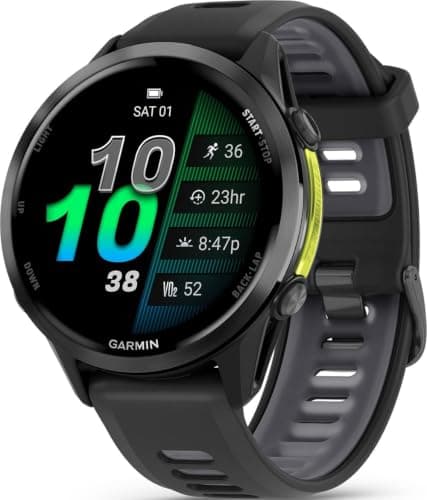
Top pick
Long-course athletes who want mapsGarmin Forerunner 970
The most complete running watch Garmin sells, and — counter-intuitively — the cheapest of the pair per hour of GPS you get.
Price as of October 22, 2026. Prices move; Amazon's is the one that counts.
#ad · we may earn a commission from this link to Garmin Forerunner 970
The short answer
The Garmin Forerunner 970 ranks first on our rubric: multi-band positioning, the widest metric coverage, and — because it states 26 GPS hours against the 570's 18 — the better cost per GPS hour of the two. If you want endurance for the money instead, the COROS PACE 4 states 41 GPS hours at roughly a third of the price.
Ranked
Quick picks
| # | Device | Best for | Evidence | Score | Price |
|---|---|---|---|---|---|
| 01 | Garmin Forerunner 970 The most complete running watch Garmin sells, and — counter-intuitively — the cheapest of the pair per hour of GPS you get. | Long-course athletes who want maps | Manufacturer specification | 7.7/10 | $749.99Amazon |
| 02 | 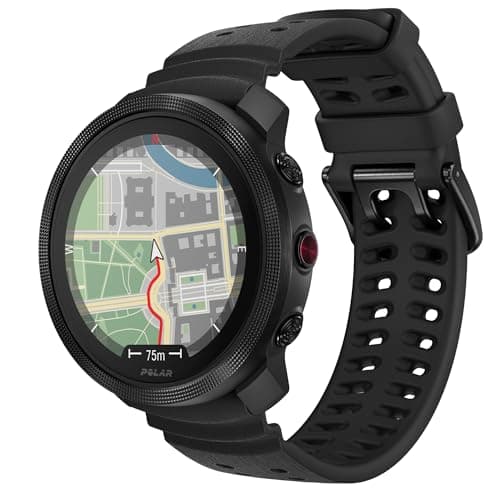 Polar Vantage M3 The pick when positioning accuracy is the thing you actually care about — Polar was the one brand under 5% error in the eight-watch validation study. | Runners who want the best-validated GPS | Peer-reviewed validation | 7.5/10 | $449.18Amazon |
| 03 | 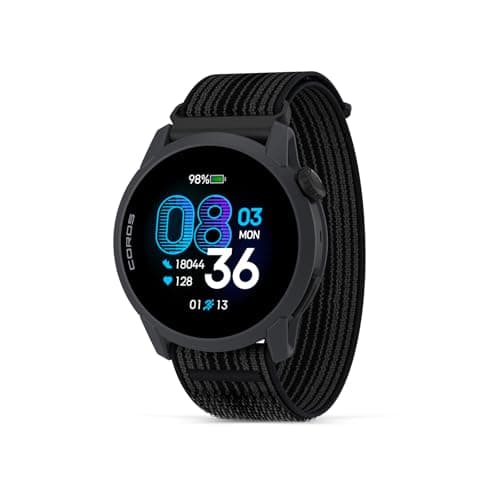 COROS PACE 4 41 stated GPS hours in a 32-gram watch, for a third of the Forerunner 970's money. The endurance-per-dollar winner by a distance. | Long days on a budget | Independent measured test | 7.5/10 | $249.00Amazon |
| 04 | 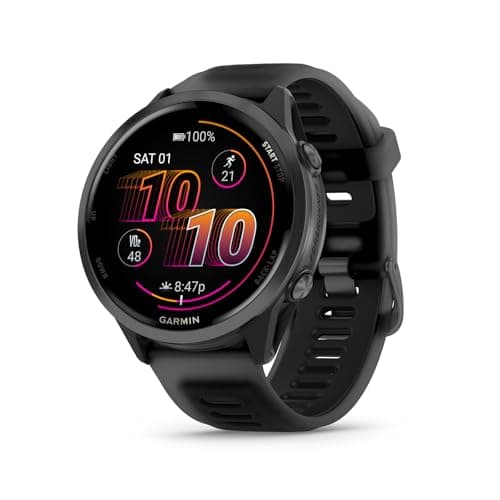 Garmin Forerunner 570 Same sensor family as the 970, $200 less, and no maps. For most runners that is the correct trade. | Most runners, most of the time | Manufacturer specification | 7.3/10 | $546.00Amazon |
| 05 | 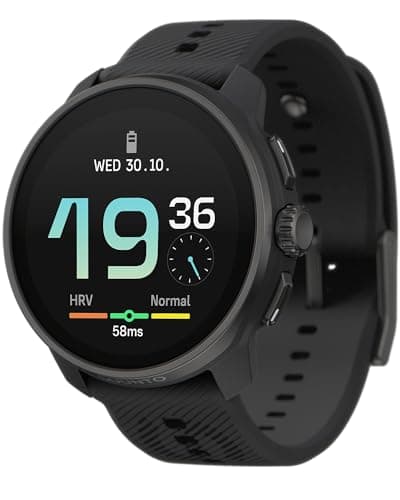 Suunto Race S A big AMOLED and dual-frequency positioning at a price that undercuts the mid-range Garmins. | Value AMOLED multi-sport | No validation study exists | 6.5/10 | $299.00Amazon |
| 06 | 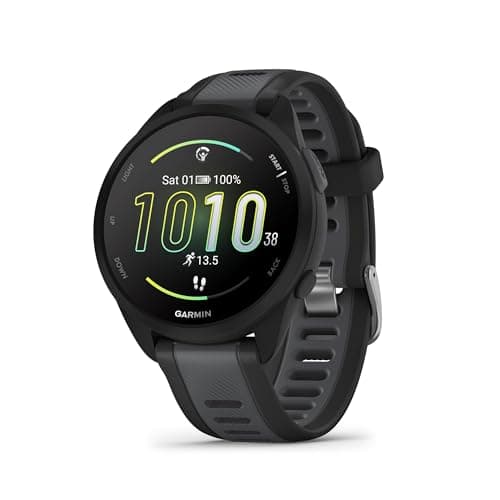 Garmin Forerunner 165 The cheapest way into a genuinely good AMOLED Garmin, provided you accept single-band positioning. | First real running watch | Manufacturer specification | 6.4/10 | $196.29Amazon |
#ad· Live prices from the Amazon Product API, as of October 22, 2026. Where we have no verified live price we show none. Scores come from the published rubric at How we rank — the Evidence column shows what each ranking actually rests on, including where the answer is nothing.
How this ranking was built
Five weighted factors, applied identically to every device on this site: evidence (30%), hardware (20%), metric coverage (20%), endurance (15%) and cost per capability (15%). The weights and the reasoning are published at How we rank, and every pick below has an expandable breakdown showing exactly which sub-score produced its number.
We have not worn any of these watches. There is no test lab here and no drawer of review units. What follows comes from published validation research, the manufacturers' own specification pages, and arithmetic you can repeat.
The finding that reorders this list
The intuitive ranking of these six watches is by price, and the intuitive read is that the Forerunner 570 is the sensible-value choice against its more expensive sibling. Divide price by manufacturer-stated GPS endurance and that flips.
Garmin states 26 hours of GPS mode for the 970 and 18 hours for the 47 mm 570. At today's live prices that works out at $28.85 per GPS hour for the 970 against $30.33 for the 570. The more expensive watch is the cheaper one, per hour of the thing you actually bought it to do.
That does not automatically make it the right purchase. If your longest run is ninety minutes, hours 19 through 26 are worth precisely nothing to you and the 570 is the better buy. But it reframes the question from "is the 970 worth $200 more?" to "do I need maps, and do I need the battery?" — which is something you can actually answer about yourself.
And then the COROS PACE 4 walks in and states 41 GPS hoursin All-Systems mode, in a 32-gram case, for about a third of the 970's money. On cost per GPS hour it is not close — it scores a perfect 10 on both endurance and cost, the only device on the site to do so.
It still only places third, and the reason is worth understanding because it is the rubric working as intended. Endurance and cost carry 30% of the score between them; evidence carries 30% on its own. The PACE 4 wins the first pair outright and has the weakest evidence position in the top four, so the Polar Vantage M3 — with a genuinely favorable (if dated) peer-reviewed positioning result behind it — edges past it into second on the weighted total. Different weights would give a different order, which is exactly why ours are published rather than asserted.
Why the top pick is not the one with the best evidence
Here is something worth being blunt about: none of these watches has an independent validation of its optical heart rate.Not one. We searched, and the only measured test of any current-generation running watch sensor we found was the5krunner's comparison of the COROS PACE 3 — a previous model, with a dataset the author himself flags as limited, and an unfavorable result.
So the evidence sub-scores across this roundup are low and closely bunched, and they are low for an honest reason rather than a punitive one. The two Polars score highest on evidence because Polar is the one brand with a favorable peer-reviewed positioning result — and even that is a 2020 study of the Vantage M, Vantage V and V800, which are not the watches sold today. It is brand engineering history, not a measurement of the M3, and we score it accordingly.
The Suunto Race S is the clearest illustration of the rubric doing its job. Excellent hardware, the cheapest dual-frequency AMOLED here, and no published validation of any kind that we could find. It ranks fifth. If you think that is unfair to a good watch, you may well be right — but you can see exactly which number did it, which is more than any other ranking in this category will give you.
If you only remember one thing
If you came here because your heart rate readings are wrong, do not buy any of these watches. The problem is that an optical sensor is reading through a moving wrist joint, and it is not brand-specific: in the 2025 Sensors placement study, a wrist device showed a bias of roughly 33 bpm during explosive work while the same sensor moved up the arm performed far better. A $105 chest strap fixes that with the watch you already own. We would rather tell you that than sell you a watch that will not help — the full argument is on the heart-rate upgrade path.
One caveat on how to read this ranking: it is organized around what a watch measures, not around a distance. If you are building toward a specific race, the same field re-sorted for a sixteen-week block — and the one published measurement of a watch threshold estimate — is at best running watches for marathon training.
There is a prior question worth asking before any of these, and the answer is not always yes: do you need a running watch? sets a phone plus a chest strap against an entry-level watch.
In full
Every pick, and why
Garmin Forerunner 970
The most complete running watch Garmin sells, and — counter-intuitively — the cheapest of the pair per hour of GPS you get.
- Case
- 47mm, titanium bezel, AMOLED
- Satellite
- Multi-band GNSS with SatIQ
- Battery (stated)
- 15 days smartwatch / 26 h GPS
- Maps
- Built-in, full color
- Extras
- ECG app, speaker and microphone
What's good
- Multi-band GNSS with SatIQ — the current top tier of consumer positioning hardware
- 26 stated GPS hours is enough for an ironman-distance day with a wide margin
- Built-in maps, which the 570 does not have at any price
What isn't
- The wrist optical sensor is the same class of hardware as the 570's — the premium buys features, not a better heart-rate signal
- 47mm only; there is no smaller case in this model
Skip this if
Skip this if you never race longer than a marathon and never navigate. Maps and titanium are the entire difference, and neither changes a single number the watch records.
What the evidence says
Manufacturer specificationNo independent validation study of the Forerunner 970's optical heart rate has been published that we could find. The specification figures are Garmin's own.
Show how this 7.7 was calculated
| Factor | Weight | Score |
|---|---|---|
| EvidenceSpecs are published and detailed, but no peer-reviewed or independent measured validation of this specific model exists yet. | 30% | 5.5 |
| HardwareMulti-band GNSS with SatIQ and Garmin's current-generation optical sensor — the top hardware tier available. | 20% | 9.5 |
| Metric coverageRunning dynamics, ECG, training load, maps, and a documented export path off the watch. | 20% | 9.5 |
| EnduranceGarmin states 26 hours in GPS mode, 15 days smartwatch. | 15% | 7.5 |
| Cost per capabilityHighest sticker in the range, but the strongest dollars-per-GPS-hour of the two Forerunners — see the arithmetic on the comparison page. | 15% | 7.5 |
Price as of October 22, 2026. Prices move; Amazon's is the one that counts.
#ad · we may earn a commission from this link to Garmin Forerunner 970
Polar Vantage M3
The pick when positioning accuracy is the thing you actually care about — Polar was the one brand under 5% error in the eight-watch validation study.
- Display
- AMOLED
- Satellite
- Dual-frequency GNSS
- Extras
- Turn-by-turn navigation, offline maps
What's good
- Polar is the only brand that came in under 5% distance error across all conditions in the JMIR eight-watch study
- Dual-frequency positioning plus offline maps at a mid-range price
What isn't
- The validation that flatters Polar is from 2020 and tested older models — it is evidence about the brand's GNSS engineering, not a measurement of this watch
- Smaller ecosystem than Garmin
Skip this if
Skip this if you are deep in Garmin's ecosystem already. Nothing here is enough better to justify rebuilding your training history somewhere else.
What the evidence says
Peer-reviewed validationThe peer-reviewed evidence is brand-level and dated: Gilgen-Ammann et al. (2020) measured eight watches against a trundle wheel and found only Polar's receivers stayed under 5% error. That study tested the Vantage M, Vantage V and V800 — not the M3.
Show how this 7.5 was calculated
| Factor | Weight | Score |
|---|---|---|
| EvidenceThe only brand in this roundup with a favorable peer-reviewed positioning result — but the study is from 2020 and tested earlier models, so it is dated brand evidence, not a measurement of this watch. | 30% | 7.0 |
| HardwareDual-frequency GNSS with offline maps. | 20% | 8.5 |
| Metric coverageStrong training-load and recovery platform; good sensor support. | 20% | 8.0 |
| EnduranceCompetitive for an AMOLED multi-sport watch, per Polar's stated figures. | 15% | 7.0 |
| Cost per capabilityMid-range pricing for dual-frequency plus maps. | 15% | 7.0 |
$499.9910% off
Price as of October 22, 2026. Prices move; Amazon's is the one that counts.
#ad · we may earn a commission from this link to Polar Vantage M3
COROS PACE 4
41 stated GPS hours in a 32-gram watch, for a third of the Forerunner 970's money. The endurance-per-dollar winner by a distance.
- Display
- 1.2" AMOLED touchscreen
- Weight
- 32 g with nylon band, 40 g with silicone
- Satellite
- All-Systems and Dual-Frequency modes
- Battery (stated)
- 19 days daily use / 41 h GPS (All-Systems)
- Thickness
- 11.8 mm
What's good
- 41 manufacturer-stated GPS hours — more than the Forerunner 970 and the 570 combined
- 32 g is light enough that you stop noticing it, which matters more over 100 miles than any feature
- Dual-frequency positioning at an entry-level price
What isn't
- COROS wrist heart rate is the one area where an independent test has published a specific problem — see the evidence note
- Smaller third-party app ecosystem than Garmin's
Skip this if
Skip this if you train by heart rate off the wrist and will not wear a strap. The one independent test we found flagged COROS wrist HR during exactly the intervals you would be buying it for.
What the evidence says
Independent measured testThe5krunner's measured comparison found the previous-generation PACE 3's wrist heart rate diverged during and after rapid intensity changes. That test was of the PACE 3, not the PACE 4, and the author cautions the dataset was limited. COROS states the PACE 4 has a redesigned sensor; no independent test of the new sensor has been published that we could find.
Show how this 7.5 was calculated
| Factor | Weight | Score |
|---|---|---|
| EvidenceThe only independent measured evidence in the range is a limited-dataset test of the PREVIOUS model, and it was unfavorable. The redesigned sensor is unvalidated. | 30% | 4.5 |
| HardwareDual-frequency GNSS and a redesigned optical sensor, per the COROS spec page. | 20% | 8.0 |
| Metric coverageStrong training metrics; a narrower ecosystem than Garmin for third-party integrations. | 20% | 7.5 |
| Endurance41 stated GPS hours in All-Systems mode is the best in this roundup by a wide margin. | 15% | 10.0 |
| Cost per capabilityComfortably the strongest dollars-per-GPS-hour figure on the site. | 15% | 10.0 |
Price as of October 22, 2026. Prices move; Amazon's is the one that counts.
#ad · we may earn a commission from this link to COROS PACE 4
Garmin Forerunner 570
Same sensor family as the 970, $200 less, and no maps. For most runners that is the correct trade.
- Case
- 42mm or 47mm, AMOLED
- Satellite
- Multi-band GNSS
- Battery (stated)
- 11 days smartwatch / 18 h GPS (47mm)
- Maps
- None
- Extras
- Speaker and microphone, on-watch music
What's good
- Records the same core metrics as the 970 — the data you get back is not a cut-down version
- Two case sizes, which the 970 does not offer
- Multi-band GNSS at a mid-range price
What isn't
- 18 stated GPS hours is thin for ultra distances
- No maps, so navigation is breadcrumb-only
Skip this if
Skip this if you race beyond about 12 hours or navigate unfamiliar trails. The battery and the missing maps are both real limits, and neither is fixable in software.
What the evidence says
Manufacturer specificationAs with the 970, no independent validation of this model's optical heart rate has been published that we could find.
Show how this 7.3 was calculated
| Factor | Weight | Score |
|---|---|---|
| EvidenceDetailed published specs, no independent measured validation of this model. | 30% | 5.5 |
| HardwareMulti-band GNSS and the same current-generation optical sensor family as the 970. | 20% | 9.0 |
| Metric coverageEverything the 970 records except maps and the ECG app. | 20% | 8.5 |
| EnduranceGarmin states 18 hours GPS, 11 days smartwatch, on the 47mm case. | 15% | 6.0 |
| Cost per capabilityMaterially cheaper than the 970 for the same recorded data. | 15% | 8.0 |
Price as of October 22, 2026. Prices move; Amazon's is the one that counts.
#ad · we may earn a commission from this link to Garmin Forerunner 570
Suunto Race S
A big AMOLED and dual-frequency positioning at a price that undercuts the mid-range Garmins.
- Display
- 1.32" AMOLED
- Sport modes
- 95+
- Satellite
- Dual-frequency GNSS
What's good
- Dual-frequency positioning well below the price the same feature costs at Garmin
- Large, bright AMOLED for the money
What isn't
- No independent validation of its heart rate or positioning that we could find
- Smallest third-party ecosystem of the brands here
Skip this if
Skip this if you want structured workouts pushed from a coaching platform. Suunto's integrations are the thinnest in this group.
What the evidence says
No validation study existsNo independent validation study exists for this device that we could find as of July 2026. It is ranked on published hardware specification and price alone, and that is why it does not place higher.
Show how this 6.5 was calculated
| Factor | Weight | Score |
|---|---|---|
| EvidenceNo validation of any kind that we could find. Under our evidence hierarchy this caps how high it can rank, regardless of its hardware. | 30% | 3.0 |
| HardwareDual-frequency GNSS and a large AMOLED, per Suunto's spec page. | 20% | 8.0 |
| Metric coverage95+ sport modes; a lighter analytics platform than Garmin or Polar. | 20% | 7.5 |
| EnduranceStrong stated battery for an AMOLED watch at this size. | 15% | 7.5 |
| Cost per capabilityThe cheapest dual-frequency AMOLED watch in this roundup. | 15% | 9.0 |
$349.0014% off
Price as of October 22, 2026. Prices move; Amazon's is the one that counts.
#ad · we may earn a commission from this link to Suunto Race S
Garmin Forerunner 165
The cheapest way into a genuinely good AMOLED Garmin, provided you accept single-band positioning.
- Display
- AMOLED
- Satellite
- Single-band GNSS
- Extras
- Training metrics, sleep tracking, music on the Music edition
What's good
- AMOLED and Garmin's training platform at the bottom of the range
- Light, simple, and hard to get wrong as a first watch
What isn't
- Single-band positioning, which is the specification that actually degrades in cities and under tree cover
- No multi-band means it is the wrong upgrade if GPS drift is your complaint
Skip this if
Skip this if you are here because your GPS track wanders between buildings. Single-band is the hardware that causes that, and this watch has it.
What the evidence says
Manufacturer specificationPublished specifications only; no independent validation of this model that we could find.
Show how this 6.4 was calculated
| Factor | Weight | Score |
|---|---|---|
| EvidencePublished specs, no independent measured validation. | 30% | 5.0 |
| HardwareSingle-band GNSS — a genuine step down from the multi-band models above it. | 20% | 6.0 |
| Metric coverageFull Garmin training platform; fewer advanced running-dynamics metrics. | 20% | 7.0 |
| EnduranceSolid for the class, per Garmin's stated figures. | 15% | 7.0 |
| Cost per capabilityLowest entry price to the Garmin ecosystem with an AMOLED screen. | 15% | 8.5 |
$249.9921% off
Price as of October 22, 2026. Prices move; Amazon's is the one that counts.
#ad · we may earn a commission from this link to Garmin Forerunner 165
What to actually check before you buy
Multi-band, or single-band
This is the one specification that genuinely changes what the watch records. A single-band receiver listens on one frequency and cannot easily distinguish a signal that arrived directly from one that bounced off a building. A dual-frequency receiver hears both L1 and L5, and the disagreement between them is the clue that lets it discard the reflection. If your tracks wander in cities or under tree cover, this is the fix. If they do not, it is a specification you are paying for and will not notice.
Which battery number you are reading
Manufacturers publish several endurance figures per watch, and they differ by up to a factor of two. "GPS-only" is the flattering one. "All-systems multi-band" — everything switched on, which is how you would run it if accuracy is why you bought it — is considerably shorter. Every battery figure on this site is labeled with the mode it refers to. Not every spec sheet you read elsewhere will be.
Maps, which are the real difference in the Garmin range
The gap between the 570 and the 970 is maps, titanium and battery. It is not sensors and it is not the data. Both record the same core metrics from the same generation of sensor hardware. If you run known routes, the map is a beautiful feature you will use twice.
Weight, which matters more the longer you go
The PACE 4 is 32 grams with the nylon band; a flagship multisport watch is roughly double that. Over an hour it is irrelevant. Over a hundred miles it is the difference between forgetting you are wearing it and being aware of it every single step. This is one of the few things a spec sheet tells you honestly and directly.
Accessories
The two accessories every watch here needs
Neither of these changes which watch you should buy. Both change whether the watch you own is recording at all, and how well it reads while it does.
These are not ranked and they are not scored on the rubric — none of them has a validation study and none ever will. They are here because a manufacturer's own instructions say they change what your sensor records, and each one links the page that says it. How the actual ranking works.
Spare watch charging cable
The nights and long runs that never got recorded at all.
Endurance carries 15% of the rubric on this site because a measurement you did not take is the worst data quality there is. Every watch here uses a proprietary cable, and the failure mode is always the same one: the cable lives at home, so the watch charges instead of recording your sleep, or dies at mile 18.
Cables are brand-specific and sometimes model-specific, so this opens a search rather than one listing. Match it to your own watch before you buy.
Find the one that fits →Opens an Amazon search, because the right item depends on your watch. We are not quoting a price for something we have not picked.
#ad · we may earn a commission
Quick-release watch band
Wrist heart rate that drifts because the watch is moving on your arm.
If you are staying on the wrist, fit is the one variable that costs nothing to get right. Garmin's own instruction is to "wear the device above your wrist bone" and that it "should be snug but comfortable", adding that "for more accurate heart rate readings, the device should not move while running or exercising". A stretched or slippery band makes that impossible. Garmin manual: wearing the device.
Lug width varies by watch — commonly 20mm, 22mm or 26mm. Check yours; the wrong width will not fit at all.
Find the one that fits →Opens an Amazon search, because the right item depends on your watch. We are not quoting a price for something we have not picked.
#ad · we may earn a commission
How this ranking was built
Every score on this page comes from one published rubric, applied identically to every device on the site, with the weights written down and the inputs shown. We have not worn any of these devices and we never say we have. Read the method and check us.
Questions
Frequently asked
Is the Forerunner 970 worth $200 more than the 570?
It buys maps, a titanium bezel, an ECG app and roughly eight extra hours of stated GPS endurance. It does not buy better heart-rate data or better positioning hardware — both watches have multi-band GNSS and the same sensor generation. Per GPS hour the 970 is actually the cheaper of the two. So the answer depends entirely on whether you navigate and whether you race long.
Which running watch has the most accurate GPS?
Nobody can answer that honestly for current models, because no independent validation of current-generation watches has been published that we could find. The best peer-reviewed evidence is a 2020 eight-watch study which found only Polar under 5% error — but it tested hardware two generations old. What you can rely on is the specification: multi-band reception measurably reduces the reflected-signal errors that cause drift in cities and forests, and it is checkable before you buy.
Do I need a chest strap if I buy an expensive watch?
If you train by heart rate and do intervals, yes — and the price of the watch does not change that. The published evidence is that wrist optical sensing struggles during rapid intensity changes regardless of brand, and that moving the same sensor up the arm improves it markedly. The strap works with whatever watch you own, which is why we treat it as the cheaper and better first purchase.
Why does the COROS PACE 4 rank above the Forerunner 570?
Endurance and cost, which carry 30% of the score between them. The PACE 4 states 41 GPS hours to the 570's 18, at roughly half the price. It scores lower on evidence — the only independent COROS heart-rate test we found was unfavorable and tested the previous model — and lower on ecosystem breadth. The weighted total still comes out ahead.
Have you tested these watches?
No, and we will never say we have. We own none of them and run no lab. Every figure on this page comes from a published validation study, a manufacturer specification page, or arithmetic on a live price — each one linked so you can check it. Devices we claim to have tested: zero.
Show your working
Sources
Every one of these was read in full before it was cited. Where we could not access a paper, we do not quote its numbers.
- [1]Manufacturer specification2026Garmin — Forerunner 970 published specifications
Manufacturer-stated battery: up to 15 days smartwatch mode, up to 26 hours GPS mode.
- [2]Manufacturer specification2026Garmin — Forerunner 570 (47 mm) published specifications
Manufacturer-stated battery: up to 11 days smartwatch mode, up to 18 hours GPS mode.
- [3]Manufacturer specification2026COROS — PACE 4 published specifications
Manufacturer-stated: 1.2" AMOLED, 32 g with nylon band, 11.8 mm thick, All-Systems and Dual-Frequency satellite modes, 41 GPS hours, 19 days of daily training and sleep.
- [4]Peer-reviewed validation2020Gilgen-Ammann, Schweizer & Wyss, “Accuracy of Distance Recordings in Eight Positioning-Enabled Sport Watches: Instrument Validation Study”, JMIR mHealth and uHealth
DOI 10.2196/17118. Eight watches (Apple Watch Series 4, Coros Apex 46mm, Garmin Fenix 5X Plus, Garmin Forerunner 935, Polar Vantage M, Polar Vantage V, Polar V800, Suunto 9 Baro) measured against a trundle wheel accurate to 1 cm, across urban, forest and 400 m track conditions. IMPORTANT: this predates the dual-frequency receivers now standard, so it describes brand engineering history, not any watch currently sold.
- [5]Peer-reviewed validation2025“Impact of Anatomical Placement on the Accuracy of Wearable Heart Rate Monitors During Rest and Various Exercise Intensities”, Sensors (Basel)
n = 28 (14 male, 14 female). Polar H10 chest strap as the reference. Compared Polar Verity Sense (forearm), Garmin Forerunner 55 (wrist) and three simultaneous Whoop 4.0 units at wrist, forearm and upper arm, across rest, cycling warm-up, burpees and a modified Bruce treadmill protocol.
- [6]Independent measured test2023the5krunner, measured heart-rate comparison of the COROS PACE 3
An independent measured test, not a peer-reviewed study, and the author explicitly cautions the dataset was limited. Compared against Garmin HRM-Pro Plus and Polar Verity Sense across easy runs, intervals and cycling. Found divergence during and after rapid intensity change. Tests the PACE 3, not the PACE 4.
Read next
Related
- Do you need a running watch?
The honest prior question, including the cheaper setup that measures better.
- Best marathon training watches
The same field re-ranked for a sixteen-week build and a race.
- Forerunner 570 vs 970
The full spec table and the cost-per-hour arithmetic that decides it.
- Best multisport watches
If you swim and ride as well as run, the ranking changes.
- Most accurate fitness trackers
How we know these numbers — the consolidated evidence scoreboard.
- Fix GPS drift
If your tracks wander, this is the one case where a new watch really is the answer.
- Polar Vantage M3
Dual-frequency and maps from the one brand with a peer-reviewed GPS result.
- Garmin Forerunner 165
The cheapest good AMOLED Garmin, and the one specification that decides it.
- Best gifts for runners
This ranking, explained for someone buying for a runner.
- Black Friday & Cyber Monday deals hub
What actually discounted in this category the last two Novembers, and when to buy.
- The best Garmin watches, ranked
If you have already decided on the brand, this is the same rubric inside it.