Fix what's failing
Your GPS track wanders. This is one of the few times a new watch is the answer.
Reflected satellite signals are the cause, multi-band reception is the fix, and it is checkable on a spec sheet before you spend anything.
We earn a commission when you buy through our Amazon links, at no extra cost to you. It never decides a ranking — the rubric that does is published in full, so you can check us rather than take our word for it. How this works.
Top pick
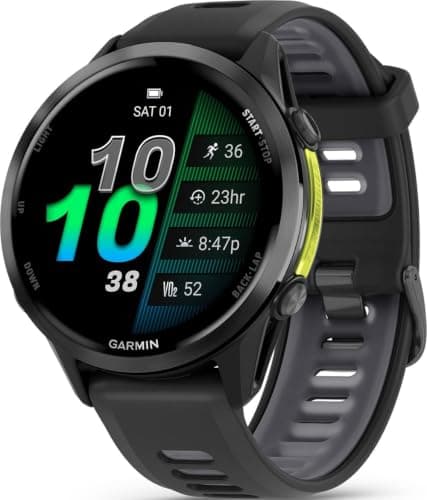
Long-course athletes who want mapsGarmin Forerunner 970
The most complete running watch Garmin sells, and — counter-intuitively — the cheapest of the pair per hour of GPS you get.
Price as of October 22, 2026. Prices move; Amazon's is the one that counts.
#ad · we may earn a commission from this link to Garmin Forerunner 970
The short answer
GPS tracks wander because a single-frequency receiver cannot distinguish a satellite signal that arrived directly from one that bounced off a building or tree canopy. A multi-band (dual-frequency) receiver hears the same satellite on two frequencies and uses the disagreement between them to discard reflections. It is the one specification worth paying for here.
Ranked
Quick picks
| # | Device | Best for | Evidence | Score | Price |
|---|---|---|---|---|---|
| 01 | Garmin Forerunner 970 The most complete running watch Garmin sells, and — counter-intuitively — the cheapest of the pair per hour of GPS you get. | Long-course athletes who want maps | Manufacturer specification | 7.7/10 | $749.99Amazon |
| 02 | 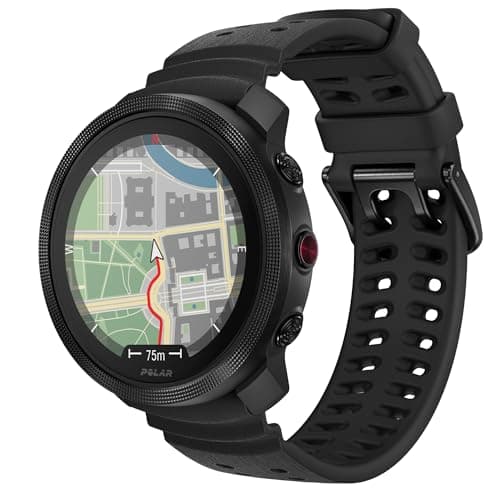 Polar Vantage M3 The pick when positioning accuracy is the thing you actually care about — Polar was the one brand under 5% error in the eight-watch validation study. | Runners who want the best-validated GPS | Peer-reviewed validation | 7.5/10 | $449.18Amazon |
| 03 | 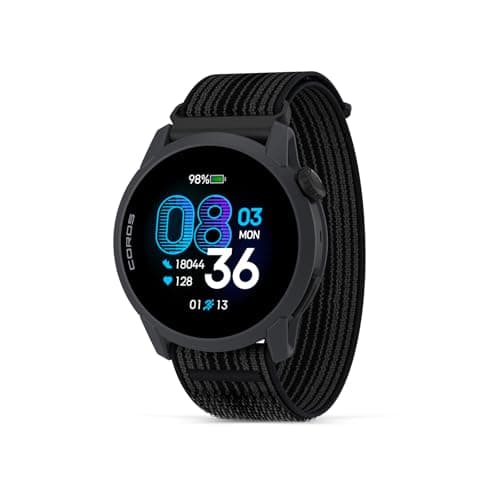 COROS PACE 4 41 stated GPS hours in a 32-gram watch, for a third of the Forerunner 970's money. The endurance-per-dollar winner by a distance. | Long days on a budget | Independent measured test | 7.5/10 | $249.00Amazon |
#ad· Live prices from the Amazon Product API, as of October 22, 2026. Where we have no verified live price we show none. Scores come from the published rubric at How we rank — the Evidence column shows what each ranking actually rests on, including where the answer is nothing.
The symptom
- Your track crosses to the wrong side of the road, or through buildings
- Switchback corners get cut off, so a climb records short
- A route you know is 5.0 miles records as 5.2 — or 4.8
- It is fine on open roads and bad in city centers and under tree cover
That last line is the diagnostic. If the error is environment-dependent, it is reflected signals, and there is a hardware answer.
The sensor-level reason
A satellite transmits on more than one frequency. A single-band receiver listens to one only. When a signal bounces off a building or wet canopy before reaching you, it arrives slightly late — and to a single-band receiver, late is indistinguishable from further away. It folds the reflection into its position fix, and the fix drifts.
A dual-frequency receiver hears the same satellite on L1 and L5. Those frequencies are delayed differently by the atmosphere and by reflections, so the disagreement between them is a signature the receiver can use to identify and discard the corrupted signal.
This is physics, not marketing, and it is why multi-band is the one hardware upgrade in this category we recommend without hedging — when the symptom matches.
The evidence, and its age
The best peer-reviewed measurement is Gilgen-Ammann et al. (2020): eight watches against a trundle wheel accurate to 1 cm, across urban, forest and track conditions.
- Overall error 3.2% to 6.1%
- Track only: 0.9% to 4.1%
- Only Polar stayed under 5% overall
- Urban and forest conditions were substantially worse than open track
The environment gradient in that data is precisely the reflected-signal problem, measured.
The critical caveat: every watch in that study was single-frequency. Multi-band consumer receivers arrived afterwards. So the study proves the problem exists and is environment-driven; it cannot tell you how much a modern multi-band watch improves it, because nobody has published that comparison. We would rather say so than imply the 2020 numbers describe a 2026 watch.
Test your current watch first, for free
Before you spend anything. Find a 400 m running track and run exactly four laps in lane one — 1,600 m, one of the few precisely measured distances most people can access.
- Under 1% off: your watch is working properly.
- 1-3% off: normal, consistent with the published literature.
- Over 3% off on a track: something is wrong. Check your satellite mode is not set to power-saving, and wait for a full lock before starting.
Then run your usual problem route. If the track is accurate and the trail is not, you have confirmed the diagnosis and multi-band is the upgrade that addresses it. If the track is also bad, the problem is settings or a fault, and a new watch will not help.
What actually fixes it
Any of the three below has a multi-band or dual-frequency receiver. They differ on everything else — price, battery, ecosystem — but on this specific problem they are addressing the same cause with the same hardware approach.
The Polar Vantage M3 is the only one whose brand has a favorable peer-reviewed positioning result, dated as it is. The COROS PACE 4 is by far the cheapest route to dual-frequency. The Forerunner 970 adds SatIQ mode-switching and maps.
This won't fix it if…
Your watch is already multi-band. Check the specification before buying. If it is, you have hit the current limit of consumer positioning hardware and a different multi-band watch will not measurably help.
Your complaint is that race distances do not match. Courses are measured along the shortest legal line, which nobody runs. Going wide on corners is real extra distance your watch correctly records — that is not an error.
The error is on an open track too. That is settings or a fault, not reflected signals.
You run indoors. Treadmill distance comes from the accelerometer, not GPS. Calibrate it against a known outdoor distance instead.
One clarification worth having before you spend anything: multi-band, dual-band and dual-frequency are four brands' words for the same receiver specification, and it costs roughly a third of your recording time. What it does, which watches publish it, and the measurement nobody has made are at what dual-band GPS actually is.
In full
Every pick, and why
Garmin Forerunner 970
The most complete running watch Garmin sells, and — counter-intuitively — the cheapest of the pair per hour of GPS you get.
- Case
- 47mm, titanium bezel, AMOLED
- Satellite
- Multi-band GNSS with SatIQ
- Battery (stated)
- 15 days smartwatch / 26 h GPS
- Maps
- Built-in, full color
- Extras
- ECG app, speaker and microphone
What's good
- Multi-band GNSS with SatIQ — the current top tier of consumer positioning hardware
- 26 stated GPS hours is enough for an ironman-distance day with a wide margin
- Built-in maps, which the 570 does not have at any price
What isn't
- The wrist optical sensor is the same class of hardware as the 570's — the premium buys features, not a better heart-rate signal
- 47mm only; there is no smaller case in this model
Skip this if
Skip this if you never race longer than a marathon and never navigate. Maps and titanium are the entire difference, and neither changes a single number the watch records.
What the evidence says
Manufacturer specificationNo independent validation study of the Forerunner 970's optical heart rate has been published that we could find. The specification figures are Garmin's own.
Show how this 7.7 was calculated
| Factor | Weight | Score |
|---|---|---|
| EvidenceSpecs are published and detailed, but no peer-reviewed or independent measured validation of this specific model exists yet. | 30% | 5.5 |
| HardwareMulti-band GNSS with SatIQ and Garmin's current-generation optical sensor — the top hardware tier available. | 20% | 9.5 |
| Metric coverageRunning dynamics, ECG, training load, maps, and a documented export path off the watch. | 20% | 9.5 |
| EnduranceGarmin states 26 hours in GPS mode, 15 days smartwatch. | 15% | 7.5 |
| Cost per capabilityHighest sticker in the range, but the strongest dollars-per-GPS-hour of the two Forerunners — see the arithmetic on the comparison page. | 15% | 7.5 |
Price as of October 22, 2026. Prices move; Amazon's is the one that counts.
#ad · we may earn a commission from this link to Garmin Forerunner 970
Polar Vantage M3
The pick when positioning accuracy is the thing you actually care about — Polar was the one brand under 5% error in the eight-watch validation study.
- Display
- AMOLED
- Satellite
- Dual-frequency GNSS
- Extras
- Turn-by-turn navigation, offline maps
What's good
- Polar is the only brand that came in under 5% distance error across all conditions in the JMIR eight-watch study
- Dual-frequency positioning plus offline maps at a mid-range price
What isn't
- The validation that flatters Polar is from 2020 and tested older models — it is evidence about the brand's GNSS engineering, not a measurement of this watch
- Smaller ecosystem than Garmin
Skip this if
Skip this if you are deep in Garmin's ecosystem already. Nothing here is enough better to justify rebuilding your training history somewhere else.
What the evidence says
Peer-reviewed validationThe peer-reviewed evidence is brand-level and dated: Gilgen-Ammann et al. (2020) measured eight watches against a trundle wheel and found only Polar's receivers stayed under 5% error. That study tested the Vantage M, Vantage V and V800 — not the M3.
Show how this 7.5 was calculated
| Factor | Weight | Score |
|---|---|---|
| EvidenceThe only brand in this roundup with a favorable peer-reviewed positioning result — but the study is from 2020 and tested earlier models, so it is dated brand evidence, not a measurement of this watch. | 30% | 7.0 |
| HardwareDual-frequency GNSS with offline maps. | 20% | 8.5 |
| Metric coverageStrong training-load and recovery platform; good sensor support. | 20% | 8.0 |
| EnduranceCompetitive for an AMOLED multi-sport watch, per Polar's stated figures. | 15% | 7.0 |
| Cost per capabilityMid-range pricing for dual-frequency plus maps. | 15% | 7.0 |
$499.9910% off
Price as of October 22, 2026. Prices move; Amazon's is the one that counts.
#ad · we may earn a commission from this link to Polar Vantage M3
COROS PACE 4
41 stated GPS hours in a 32-gram watch, for a third of the Forerunner 970's money. The endurance-per-dollar winner by a distance.
- Display
- 1.2" AMOLED touchscreen
- Weight
- 32 g with nylon band, 40 g with silicone
- Satellite
- All-Systems and Dual-Frequency modes
- Battery (stated)
- 19 days daily use / 41 h GPS (All-Systems)
- Thickness
- 11.8 mm
What's good
- 41 manufacturer-stated GPS hours — more than the Forerunner 970 and the 570 combined
- 32 g is light enough that you stop noticing it, which matters more over 100 miles than any feature
- Dual-frequency positioning at an entry-level price
What isn't
- COROS wrist heart rate is the one area where an independent test has published a specific problem — see the evidence note
- Smaller third-party app ecosystem than Garmin's
Skip this if
Skip this if you train by heart rate off the wrist and will not wear a strap. The one independent test we found flagged COROS wrist HR during exactly the intervals you would be buying it for.
What the evidence says
Independent measured testThe5krunner's measured comparison found the previous-generation PACE 3's wrist heart rate diverged during and after rapid intensity changes. That test was of the PACE 3, not the PACE 4, and the author cautions the dataset was limited. COROS states the PACE 4 has a redesigned sensor; no independent test of the new sensor has been published that we could find.
Show how this 7.5 was calculated
| Factor | Weight | Score |
|---|---|---|
| EvidenceThe only independent measured evidence in the range is a limited-dataset test of the PREVIOUS model, and it was unfavorable. The redesigned sensor is unvalidated. | 30% | 4.5 |
| HardwareDual-frequency GNSS and a redesigned optical sensor, per the COROS spec page. | 20% | 8.0 |
| Metric coverageStrong training metrics; a narrower ecosystem than Garmin for third-party integrations. | 20% | 7.5 |
| Endurance41 stated GPS hours in All-Systems mode is the best in this roundup by a wide margin. | 15% | 10.0 |
| Cost per capabilityComfortably the strongest dollars-per-GPS-hour figure on the site. | 15% | 10.0 |
Price as of October 22, 2026. Prices move; Amazon's is the one that counts.
#ad · we may earn a commission from this link to COROS PACE 4
How this ranking was built
Every score on this page comes from one published rubric, applied identically to every device on the site, with the weights written down and the inputs shown. We have not worn any of these devices and we never say we have. Read the method and check us.
Questions
Frequently asked
What is multi-band GPS and do I need it?
Multi-band (dual-frequency) receivers listen to satellites on two frequencies, which lets them identify and discard signals that have bounced off buildings or tree cover. You need it if your tracks drift in cities or forests. If you run on open roads, single-band is already performing near its best.
Why is my GPS worse in the forest?
Wet foliage and canopy both reflect and attenuate satellite signals, so more of what reaches your watch has taken an indirect path. The 2020 eight-watch study measured exactly this: forest and urban errors were substantially worse than open track.
How accurate should my running watch be?
On a 400 m track, within about 1% is good and 1-3% is normal. In cities and under tree cover, published errors ran 3.2-6.1% on single-band hardware. If a track measures more than 3% off, check your satellite mode before blaming the watch.
Which brand has the most accurate GPS?
On the only peer-reviewed multi-watch evidence, Polar — the sole brand under 5% error overall. But that was 2020 on single-band hardware, so read it as evidence about Polar's receiver engineering rather than a verdict on any current model.
Show your working
Sources
Every one of these was read in full before it was cited. Where we could not access a paper, we do not quote its numbers.
- [1]Peer-reviewed validation2020Gilgen-Ammann, Schweizer & Wyss, “Accuracy of Distance Recordings in Eight Positioning-Enabled Sport Watches: Instrument Validation Study”, JMIR mHealth and uHealth
DOI 10.2196/17118. Eight watches (Apple Watch Series 4, Coros Apex 46mm, Garmin Fenix 5X Plus, Garmin Forerunner 935, Polar Vantage M, Polar Vantage V, Polar V800, Suunto 9 Baro) measured against a trundle wheel accurate to 1 cm, across urban, forest and 400 m track conditions. IMPORTANT: this predates the dual-frequency receivers now standard, so it describes brand engineering history, not any watch currently sold.
Read next
Related
- What is dual-band GPS?
What the setting does, and what it costs in recording hours.
- GPS accuracy by device
Every published distance-error figure, and every blank.
- Best trail GPS watches
Where reflected-signal error does the most damage.
- GPS accuracy compared
The study in full, and what it does not tell you.
- Best running watches
Which models actually carry multi-band receivers.
- Fix heart rate instead
The more common complaint, with a much cheaper fix.
- Polar Vantage M3
The full review of the one brand with a peer-reviewed positioning result.
- Fix your battery life
The upgrade that trades directly against this one.