GPS and multisport
Polar Vantage M3
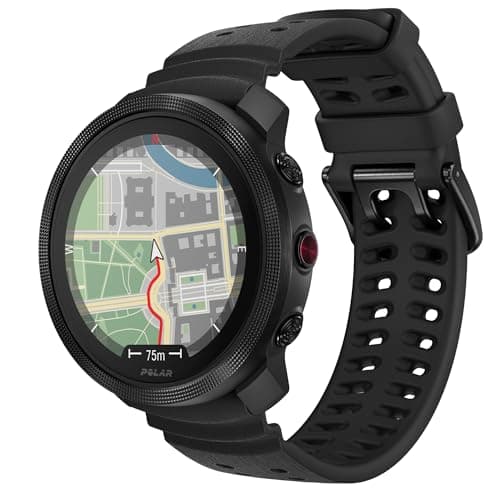
Dual-frequency positioning and offline maps at mid-range money, from the one brand with a favorable peer-reviewed GPS result behind it. The result is six years old and about other watches.
We earn a commission when you buy through our Amazon links, at no extra cost to you. It never decides a ranking — the rubric that does is published in full, so you can check us rather than take our word for it. How this works.
Top pick
Runners who want the best-validated GPSPolar Vantage M3
The pick when positioning accuracy is the thing you actually care about — Polar was the one brand under 5% error in the eight-watch validation study.
$499.9910% off
Price as of October 22, 2026. Prices move; Amazon's is the one that counts.
#ad · we may earn a commission from this link to Polar Vantage M3
The short answer
The Vantage M3 pairs dual-frequency reception with offline maps in the mid-range. Polar is the only brand with a favorable peer-reviewed positioning result — the sole maker under 5% distance error across eight watches — but that study is from 2020 and tested the Vantage M, Vantage V and V800, not this watch.
Ranked
Quick picks
| # | Device | Best for | Evidence | Score | Price |
|---|---|---|---|---|---|
| 01 | Polar Vantage M3 The pick when positioning accuracy is the thing you actually care about — Polar was the one brand under 5% error in the eight-watch validation study. | Runners who want the best-validated GPS | Peer-reviewed validation | 7.5/10 | $449.18Amazon |
#ad· Live prices from the Amazon Product API, as of October 22, 2026. Where we have no verified live price we show none. Scores come from the published rubric at How we rank — the Evidence column shows what each ranking actually rests on, including where the answer is nothing.
The evidence, and exactly what it covers
Gilgen-Ammann, Schweizer and Wyss (2020) measured eight positioning-enabled sport watches against a trundle wheel accurate to one centimeter, across urban streets, forest and a 400 m track. It remains the best peer-reviewed distance validation in this category.
- Overall error across all watches and conditions: 3.2% to 6.1%
- On the track alone: 0.9% to 4.1%
- Only Polar stayed under 5% overall — the Vantage M, Vantage V and V800 were the models tested
- Urban and forest conditions were substantially worse than open track for everything
Three caveats travel with that finding and we attach all of them every time we cite it. The study is from 2020. Every watch in it was single-frequency, because consumer multi-band receivers arrived afterwards. And it tested three earlier Polar models, not the M3.
So what does it actually support? A claim about Polar's receiver engineering as a brand-level property, measured once, six years ago, on different hardware. That is real evidence and it is more than any other brand on this site can offer for positioning. It is not a measurement of this watch, and we score it accordingly: the M3 takes the peer-reviewed tier on our hierarchy but not a top evidence score, because the paper does not describe the device you would be buying.
Anybody telling you the Vantage M3 has the most accurate GPS on the market is extrapolating from that study far past what it measured.
What dual-frequency reception does
A satellite broadcasts on more than one frequency. A single-band receiver listens to one. A signal that bounces off a building or wet canopy arrives fractionally late, and to a single-band receiver, late is indistinguishable from further away — so the reflection is folded into the position fix and the track drifts.
A dual-frequency receiver hears the same satellite on two frequencies that are delayed differently by the atmosphere and by reflection. The disagreement between them is a signature the receiver can use to identify and discard the corrupted signal. This is physics rather than marketing, and it is the one hardware upgrade in this category we recommend without hedging — when the symptom matches.
What nobody has published is how much difference it makes in numbers, because the only multi-watch validation predates the technology. We would rather say that than imply the 2020 figures describe a 2026 receiver.
Where it sits against the alternatives
The M3's specific position is dual-frequency plus turn-by-turn navigation and offline maps at a mid-range price. Garmin charges materially more for a mapping watch; the COROS PACE 4 is cheaper and has dual-frequency but no maps and far more stated battery.
Against Polar's own Vantage V3, the M3 is the value proposition: the V3 adds a wrist ECG, skin temperature and a denser sensor set, and neither watch has model-specific validation of anything. If you will not use the extra sensors, more measurements you ignore is not more value, and the M3 is the better buy on our rubric.
The honest argument against all of it is ecosystem. Garmin Connect has the deepest third-party integration in the category, and if your training history and your coaching platform already live there, nothing about the M3 is enough better to justify rebuilding that somewhere else.
The other Polar result, which is unflattering
We publish both directions. Polar's brand carries the best positioning result in this category and the worst nocturnal HRV result.
Dial et al. (2025) measured five wearables simultaneously against a single-lead ECG across 536 nights. The Polar Grit X Pro finished last of the five on HRV agreement, at a concordance of 0.82 and a mean absolute percentage error of 16.32 ± 24.39%. That is a different watch in a different Polar line, and it is not a measurement of the M3 — but it is the only published nocturnal HRV figure any Polar watch has, and a spread of ±24% means the measurement noise is comparable to the physiological signal.
Practical translation: buy this watch for positioning if positioning is your problem. Do not buy it for the recovery score. The HRV upgrade path is here, and the device at the top of it is a chest strap made by the same company.
What we could not verify
- Any accuracy figure for this specific watch. Positioning, heart rate, sleep — nothing about the M3 itself has been published that we could find.
- Battery figures.Polar's own, under Polar's conditions.
- Whether dual-frequency reception improves on the 2020 numbers. Nobody has measured it, at any brand.
- Map coverage detail. We have not loaded maps onto one.
Who should not buy it
Anyone already invested in Garmin. The ecosystem gap is real and the accuracy gap is unmeasured. Moving is a lot of friction for a benefit nobody has quantified.
Anyone whose complaint is the recovery score. See above. The published Polar HRV result is the weakest in the field.
Anyone who runs only on open roads. Single-band error on an open track ran under 1% in the study. If your tracks are already accurate, dual-frequency solves a problem you do not have.
In full
Every pick, and why
Polar Vantage M3
The pick when positioning accuracy is the thing you actually care about — Polar was the one brand under 5% error in the eight-watch validation study.
- Display
- AMOLED
- Satellite
- Dual-frequency GNSS
- Extras
- Turn-by-turn navigation, offline maps
What's good
- Polar is the only brand that came in under 5% distance error across all conditions in the JMIR eight-watch study
- Dual-frequency positioning plus offline maps at a mid-range price
What isn't
- The validation that flatters Polar is from 2020 and tested older models — it is evidence about the brand's GNSS engineering, not a measurement of this watch
- Smaller ecosystem than Garmin
Skip this if
Skip this if you are deep in Garmin's ecosystem already. Nothing here is enough better to justify rebuilding your training history somewhere else.
What the evidence says
Peer-reviewed validationThe peer-reviewed evidence is brand-level and dated: Gilgen-Ammann et al. (2020) measured eight watches against a trundle wheel and found only Polar's receivers stayed under 5% error. That study tested the Vantage M, Vantage V and V800 — not the M3.
Show how this 7.5 was calculated
| Factor | Weight | Score |
|---|---|---|
| EvidenceThe only brand in this roundup with a favorable peer-reviewed positioning result — but the study is from 2020 and tested earlier models, so it is dated brand evidence, not a measurement of this watch. | 30% | 7.0 |
| HardwareDual-frequency GNSS with offline maps. | 20% | 8.5 |
| Metric coverageStrong training-load and recovery platform; good sensor support. | 20% | 8.0 |
| EnduranceCompetitive for an AMOLED multi-sport watch, per Polar's stated figures. | 15% | 7.0 |
| Cost per capabilityMid-range pricing for dual-frequency plus maps. | 15% | 7.0 |
$499.9910% off
Price as of October 22, 2026. Prices move; Amazon's is the one that counts.
#ad · we may earn a commission from this link to Polar Vantage M3
Questions
Frequently asked
Does Polar really have the most accurate GPS?
Polar was the only brand under 5% distance error in the peer-reviewed eight-watch study, which is the strongest positioning evidence any brand here has. But that was 2020, on single-frequency hardware, testing the Vantage M, Vantage V and V800. It supports a claim about Polar's receiver engineering, not a verdict on any watch currently sold.
Is the Polar Vantage M3 worth it over the Vantage V3?
For most runners, yes. The V3 adds a wrist ECG, skin temperature and a wider sensor set, and neither watch has any model-specific validation. If you will not act on the extra measurements, the M3 gives you the same dual-frequency reception and offline maps for less.
Does the Vantage M3 have offline maps?
Polar publishes turn-by-turn navigation and offline maps for it, which at this price point is unusual — Garmin's mapping models sit in a higher tier. We have not loaded maps onto one ourselves, so we are reporting the published specification.
Should I buy this for HRV or recovery tracking?
No. The only published nocturnal HRV measurement of a Polar watch is of the Grit X Pro, which finished last of five devices against an ECG reference at 16.32% error with a ±24.39% spread. That is a different model, but it is the only Polar evidence there is, and it does not support buying a Polar watch for recovery data.
Is dual-frequency GPS worth paying for?
If your tracks drift between buildings or under tree cover, yes — that is exactly the reflected-signal problem the second frequency exists to reject. If you run on open roads, single-band error was already under 1% on a track in the published study, and you would be paying to fix something that is not broken.
Show your working
Sources
Every one of these was read in full before it was cited. Where we could not access a paper, we do not quote its numbers.
- [1]Peer-reviewed validation2020Gilgen-Ammann, Schweizer & Wyss, “Accuracy of Distance Recordings in Eight Positioning-Enabled Sport Watches: Instrument Validation Study”, JMIR mHealth and uHealth
DOI 10.2196/17118. Eight watches (Apple Watch Series 4, Coros Apex 46mm, Garmin Fenix 5X Plus, Garmin Forerunner 935, Polar Vantage M, Polar Vantage V, Polar V800, Suunto 9 Baro) measured against a trundle wheel accurate to 1 cm, across urban, forest and 400 m track conditions. IMPORTANT: this predates the dual-frequency receivers now standard, so it describes brand engineering history, not any watch currently sold.
- [2]Peer-reviewed validation2025Dial, Hollander, Vatne, Emerson, Edwards & Hagen, “Validation of nocturnal resting heart rate and heart rate variability in consumer wearables”, Physiological Reports 13(16):e70527
DOI 10.14814/phy2.70527. n = 13 healthy adults (7 male, 6 female, 33.2 ± 8.6 years) across 536 nights, each wearing an Oura Gen 3, Oura Gen 4, Polar Grit X Pro, Garmin fēnix 6 and Whoop 4.0 simultaneously against a Polar H10 single-lead ECG reference sampled at 1000 Hz. Authors’ stated limits: healthy adults only, no atrial-fibrillation population, proprietary and periodically-updated algorithms, and unequal night counts per device. The Garmin was dropped from the resting-heart-rate comparison because the 30-minute window it uses is not timestamped.
- [3]Manufacturer specification2026Polar — H10 heart rate sensor published specifications
Manufacturer-stated: electrical (ECG) measurement, Bluetooth LE + ANT+, internal memory for one session up to 30 hours, up to 400 h on a CR2025 coin cell, WR30.
Read next
Related
- Best running watches with maps
The cheapest offline mapping we cover, in context.
- Fix your GPS accuracy
The upgrade path this watch sits on, including the free test to run first.
- Polar vs Garmin
The brand comparison, evidence by evidence.
- Polar Vantage V3
What Polar's flagship adds, and whether you will use it.
- GPS accuracy by device
The eight-watch study in full, model by model.
- Best running watches
Where the M3 places against the rest of the field.