GPS and multisport
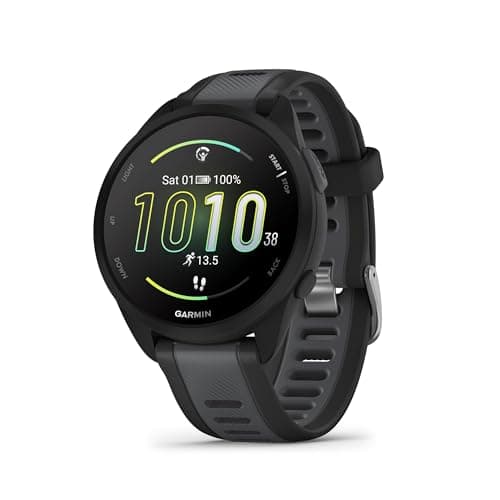
Garmin Forerunner 165
The cheapest way into a genuinely good AMOLED Garmin, and the wrong watch if the reason you are shopping is a GPS track that wanders.
We earn a commission when you buy through our Amazon links, at no extra cost to you. It never decides a ranking — the rubric that does is published in full, so you can check us rather than take our word for it. How this works.
Top pick
First real running watchGarmin Forerunner 165
The cheapest way into a genuinely good AMOLED Garmin, provided you accept single-band positioning.
$249.9921% off
Price as of October 22, 2026. Prices move; Amazon's is the one that counts.
#ad · we may earn a commission from this link to Garmin Forerunner 165
The short answer
The Forerunner 165 puts an AMOLED screen and Garmin's full training platform at the bottom of the range. It uses single-band positioning — the receiver type that cannot reject signals reflected off buildings or canopy — so it is the wrong upgrade if GPS drift is your complaint.
Ranked
Quick picks
| # | Device | Best for | Evidence | Score | Price |
|---|---|---|---|---|---|
| 01 | Garmin Forerunner 165 The cheapest way into a genuinely good AMOLED Garmin, provided you accept single-band positioning. | First real running watch | Manufacturer specification | 6.4/10 | $196.29Amazon |
#ad· Live prices from the Amazon Product API, as of October 22, 2026. Where we have no verified live price we show none. Scores come from the published rubric at How we rank — the Evidence column shows what each ranking actually rests on, including where the answer is nothing.
What you get, and it is more than the price suggests
The 165 is the cheapest Garmin on this site with an AMOLED display, and it runs the same Garmin Connect platform as the flagships. That platform is the strongest argument for buying any Garmin: the deepest third-party integration in the category, structured workout support, and a training history that transfers if you later upgrade within the brand.
For a first real running watch — someone moving off a phone app or a generic fitness band — it is hard to get wrong. It is light, simple enough that a new runner will actually use all of it, and it does not present a wall of metrics nobody has explained.
The one specification that decides this purchase
The 165 is single-band. That is the entire argument against it, and it is worth understanding rather than glossing.
A satellite broadcasts on more than one frequency. A single-band receiver listens to one. A signal that bounces off a building or wet foliage before reaching you arrives fractionally late — and to a single-band receiver, late is indistinguishable from further away. The reflection gets folded into the position fix, and your track drifts across the road, through buildings, or cuts the corner off a switchback.
A dual-frequency receiver hears the same satellite twice on different frequencies, which are delayed differently by the atmosphere and by reflections. The disagreement between them is a signature it can use to discard the corrupted signal.
The peer-reviewed evidence for how much this matters is the 2020 eight-watch study, which measured 3.2-6.1% overall distance error but only 0.9-4.1% on an open track, with urban and forest conditions substantially worse. Every watch in that study was single-frequency. So the study describes what a receiver like this one does, and cannot tell you how much a modern multi-band watch improves on it, because nobody has published that comparison.
Practical translation. If you run on open roads, tracks and parks, single-band positioning is already performing near its ceiling and the 165 costs you nothing. If your complaint is a track that wanders between buildings or under tree cover, this is the specification that causes it, and this watch is the wrong fix.
Test before you upgrade, for free
Before assuming you need multi-band, find a 400 m running track and run exactly four laps in lane one — 1,600 m, one of the few precisely measured distances most people can reach.
- Under 1% off: your receiver is working properly.
- 1-3% off: normal, and consistent with the published literature.
- Over 3% off on a track: check your satellite mode is not set to power saving and that you waited for a full lock. A watch upgrade will not fix a settings problem.
Then run your usual problem route. If the track is accurate and the trail is not, you have confirmed the diagnosis and the 165 is not the watch. If both are bad, buying any new watch is premature.
The evidence position
No independent validation of this model exists that we could find — not of its optical heart rate, not of its positioning. It sits at manufacturer specification on our hierarchy, the same tier as most of the range.
There is one Garmin measurement worth carrying, because it is unusual for any consumer watch to have been measured at all. The 2025 Sensors placement study tested a wrist-worn Forerunner 55 against a Polar H10 reference and recorded a bias of roughly 33 bpm during burpees, the largest error in the paper. Wrist devices in the same study showed limits of agreement of about ±10-19 bpm during a cycling warm-up.
That is a different, older watch, so it is not evidence about the 165. What it is evidence about is wrist optical sensing during rapid intensity change, which applies to every watch on this site including the ones costing five times as much. If interval heart rate is why you are shopping, the fix is a strap, and it costs less than the difference between watch tiers.
Where it sits against the alternatives
Against the COROS PACE 4: the PACE 4 has dual-frequency reception and 41 stated GPS hours at a comparable price, which on specification is simply more watch. What Garmin has that COROS does not is the ecosystem, and for a lot of runners that is the deciding factor rather than a footnote.
Against the Forerunner 55: the 55 is cheaper, and Garmin states 14 smartwatch days and 20 GPS hours for it. It is also the specific device caught at roughly 33 bpm of error during burpees in the placement study. The 165 buys you an AMOLED screen and a more current platform.
Against the Forerunner 570: the 570 adds multi-band reception and a wider metric set for meaningfully more money. If the track test above showed a problem, that gap is what closes it.
What we could not verify
- Optical heart-rate accuracy. No published measurement of this model.
- Positioning accuracy. No published measurement of this model.
- Battery figures.Garmin's, under Garmin's conditions, and published less granularly for this model than for the Instinct 3.
- Sleep staging.Garmin's sleep algorithms have no independent polysomnography validation we could find, at any price point.
Who should not buy it
Anyone whose GPS track wanders.Single-band is the hardware that causes that. This is the clearest don't-buy case on the page.
Anyone racing very long. This is the entry tier, and battery is a hardware problem — check the stated figure for the mode you will actually run before committing to an ultra with it.
Anyone buying it to fix heart-rate data. Same wrist optical class as everything else. Buy a strap instead.
The watch directly above it is the obvious alternative, and the comparison turns on one missing row in Garmin's own battery table: Forerunner 165 vs 265.
In full
Every pick, and why
Garmin Forerunner 165
The cheapest way into a genuinely good AMOLED Garmin, provided you accept single-band positioning.
- Display
- AMOLED
- Satellite
- Single-band GNSS
- Extras
- Training metrics, sleep tracking, music on the Music edition
What's good
- AMOLED and Garmin's training platform at the bottom of the range
- Light, simple, and hard to get wrong as a first watch
What isn't
- Single-band positioning, which is the specification that actually degrades in cities and under tree cover
- No multi-band means it is the wrong upgrade if GPS drift is your complaint
Skip this if
Skip this if you are here because your GPS track wanders between buildings. Single-band is the hardware that causes that, and this watch has it.
What the evidence says
Manufacturer specificationPublished specifications only; no independent validation of this model that we could find.
Show how this 6.4 was calculated
| Factor | Weight | Score |
|---|---|---|
| EvidencePublished specs, no independent measured validation. | 30% | 5.0 |
| HardwareSingle-band GNSS — a genuine step down from the multi-band models above it. | 20% | 6.0 |
| Metric coverageFull Garmin training platform; fewer advanced running-dynamics metrics. | 20% | 7.0 |
| EnduranceSolid for the class, per Garmin's stated figures. | 15% | 7.0 |
| Cost per capabilityLowest entry price to the Garmin ecosystem with an AMOLED screen. | 15% | 8.5 |
$249.9921% off
Price as of October 22, 2026. Prices move; Amazon's is the one that counts.
#ad · we may earn a commission from this link to Garmin Forerunner 165
Questions
Frequently asked
Does the Garmin Forerunner 165 have multi-band GPS?
No. It is single-band, which is the receiver type that cannot distinguish a direct satellite signal from one that has bounced off a building or tree canopy. On open roads that costs you very little. In cities and under forest it is the specification behind track drift.
Is the Forerunner 165 good for beginners?
It is one of the easiest recommendations in the range for a first real running watch — AMOLED, light, simple, and running the same Garmin Connect platform as the flagships, so your history transfers if you upgrade later. The caveat is single-band positioning, which matters more in cities than on open roads.
Forerunner 165 or COROS PACE 4?
On specification the PACE 4 wins clearly: dual-frequency reception and 41 stated GPS hours at a similar price. On platform the Garmin wins, and Garmin Connect's third-party depth is a genuine daily benefit. Neither has any independent sensor validation.
How accurate is the Forerunner 165?
Unmeasured — no published validation of this model exists that we could find. The closest relevant peer-reviewed data is the 2020 eight-watch study, which found 3.2-6.1% distance error across single-frequency watches, with urban and forest conditions substantially worse than open track.
Show your working
Sources
Every one of these was read in full before it was cited. Where we could not access a paper, we do not quote its numbers.
- [1]Peer-reviewed validation2020Gilgen-Ammann, Schweizer & Wyss, “Accuracy of Distance Recordings in Eight Positioning-Enabled Sport Watches: Instrument Validation Study”, JMIR mHealth and uHealth
DOI 10.2196/17118. Eight watches (Apple Watch Series 4, Coros Apex 46mm, Garmin Fenix 5X Plus, Garmin Forerunner 935, Polar Vantage M, Polar Vantage V, Polar V800, Suunto 9 Baro) measured against a trundle wheel accurate to 1 cm, across urban, forest and 400 m track conditions. IMPORTANT: this predates the dual-frequency receivers now standard, so it describes brand engineering history, not any watch currently sold.
- [2]Peer-reviewed validation2025“Impact of Anatomical Placement on the Accuracy of Wearable Heart Rate Monitors During Rest and Various Exercise Intensities”, Sensors (Basel)
n = 28 (14 male, 14 female). Polar H10 chest strap as the reference. Compared Polar Verity Sense (forearm), Garmin Forerunner 55 (wrist) and three simultaneous Whoop 4.0 units at wrist, forearm and upper arm, across rest, cycling warm-up, burpees and a modified Bruce treadmill protocol.
- [3]Manufacturer specification2026Garmin — Forerunner 55 owner’s manual, specifications
Manufacturer-stated: up to 14 days in smartwatch mode with notifications and wrist heart rate, up to 20 hours in GPS mode, 5 ATM (swim), operating range -20 °C to 60 °C. The table lists ONE GPS-mode figure — there is no separate all-systems multi-band row of the kind Garmin publishes for its multi-band watches.
Read next
Related
- Forerunner 165 vs 265
The receiver difference, with both battery tables side by side.
- Best budget running watches
The full ranking this watch competes in, with live prices.
- Fix your GPS accuracy
The free track test to run before you spend anything.
- Garmin Forerunner 570
What the multi-band upgrade costs inside the same brand.
- COROS PACE 4
More specification for the money, less ecosystem.
- GPS accuracy by device
Every published positioning figure, single-band and otherwise.