GPS and multisport
Best running watches for marathon training
Battery is not the constraint at this distance, whatever the marketing says. The constraint is whether the numbers your sixteen-week plan rests on mean anything.
We earn a commission when you buy through our Amazon links, at no extra cost to you. It never decides a ranking — the rubric that does is published in full, so you can check us rather than take our word for it. How this works.
The short answer
Every watch on this page records a five-hour marathon several times over in its most accurate published mode, so battery should not decide your purchase. What should: only one of these five has ever appeared in a published threshold validation, and in that study its threshold pace was out by 25.78% on average. Plan accordingly.
Ranked
Quick picks
| # | Device | Best for | Evidence | Score | Price |
|---|---|---|---|---|---|
| 01 | 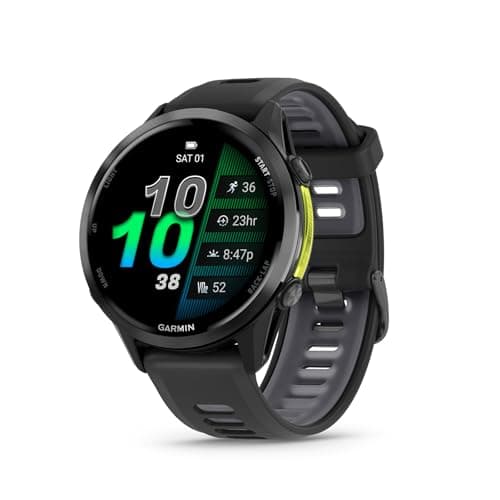 Garmin Forerunner 970 The most complete running watch Garmin sells, and — counter-intuitively — the cheapest of the pair per hour of GPS you get. | Long-course athletes who want maps | Manufacturer specification | 7.7/10 | $742.95Amazon |
| 02 | 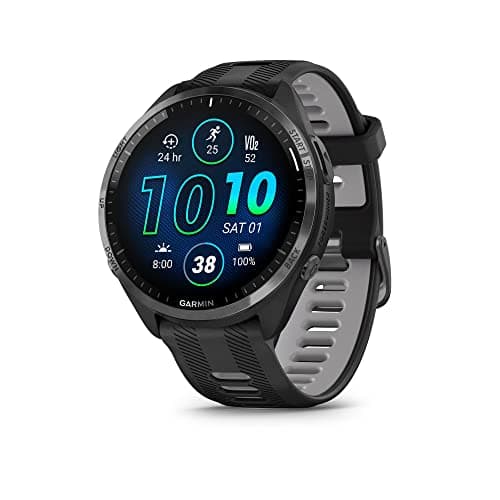 Garmin Forerunner 965 The previous flagship Forerunner, still on sale: maps, 32 GB of music storage and 31 stated GPS hours, usually for less than the 970. | Maps and music without the current-flagship price | Manufacturer specification | 7.5/10 | $599.99Amazon |
| 03 | 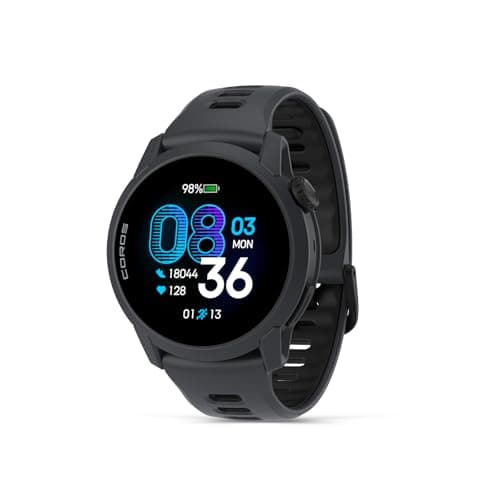 COROS PACE 4 41 stated GPS hours in a 32-gram watch, for a third of the Forerunner 970's money. The endurance-per-dollar winner by a distance. | Long days on a budget | Independent measured test | 7.5/10 | $249.00Amazon |
| 04 | 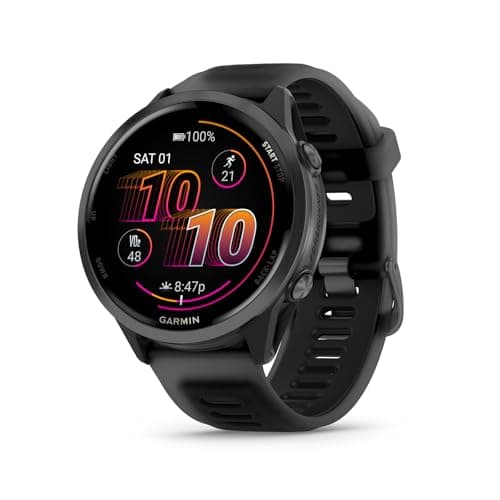 Garmin Forerunner 570 Same sensor family as the 970, $200 less, and no maps. For most runners that is the correct trade. | Most runners, most of the time | Manufacturer specification | 7.3/10 | $546.00Amazon |
| 05 | 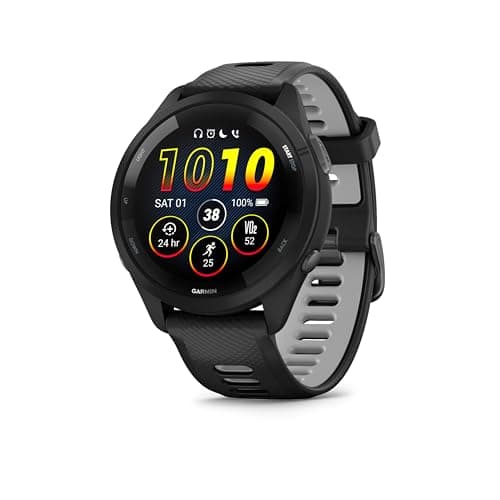 Garmin Forerunner 265 One of the very few watches on this site whose training estimates have actually been measured against a laboratory — and the measurement was not kind. | Runners who want a measured device, flaws included | Peer-reviewed validation | 7.2/10 | $439.85Amazon |
#ad· Live prices from the Amazon Product API, as of Sep 17, 2026. Where we have no verified live price we show none. Scores come from the published rubric at How we rank — the Evidence column shows what each ranking actually rests on, including where the answer is nothing.
Race day is the part that is already solved
Marathon watch roundups almost always open with battery life, and for a road marathon that is the wrong lead. Below is every watch on this page with the endurance figure its own maker publishes, the satellite mode that figure refers to, and how many times over it covers a five-hour marathon.
| Watch | Stated hours | Mode the figure refers to | Five-hour marathons |
|---|---|---|---|
| COROS PACE 4 | 41 h | All-Systems satellite mode | Eight |
| Garmin Forerunner 970 | 26 h | GPS mode | Five |
| Garmin Forerunner 965 | 19 h | All + Multi-Band GPS | Three |
| Garmin Forerunner 570 (47 mm) | 18 h | GPS mode | Three |
| Garmin Forerunner 265 (46 mm) | 14 h | All + Multi-Band GPS | Two |
Two honest caveats about that table. These figures are not like-for-like: Garmin publishes a separate multi-band number for the 965 and the 265 and we quote it, while the headline figures we carry for the 970 and the 570 are GPS-mode numbers, and COROS publishes no dual-frequency figure for the PACE 4 at all. Comparing across rows compares different satellite modes, which is exactly the trick that makes spec sheets misleading without lying.
And second: none of it matters much for 26.2 miles. The tightest watch here still finishes two marathons on one charge. Battery is a real argument for an ultra, and we make it on the ultrarunning page. It is not an argument for a marathon.
What actually decides a marathon block
A sixteen-week build is roughly sixty sessions, and the ones that matter most are the threshold and marathon-pace runs. Every modern watch will hand you a threshold pace and a threshold heart rate, and modern training plans are written around exactly those numbers. So the question worth asking is not how long the battery lasts. It is whether the number is right.
There is exactly one published answer, and one of the watches on this page is in it.
The only watch here that has been measured
A 2025 study in Frontiers in Physiologyput 100 recreational runners through a treadmill graded exercise test with fingertip blood lactate sampling, then had them run each device's own on-device threshold protocol. The Garmin Forerunner 265 was one of three devices tested, on 23 participants.
- It produced an estimate 65.2% of the time. Fifteen successful estimates out of 23 attempts, with the protocol followed correctly. A third of the tests simply did not yield a number.
- Threshold heart rate was out by 11.44 bpm on average — a 7.15% mean absolute percentage error, correlating with the laboratory value at r = 0.67.
- Threshold pace was out by 2.17 km/h on average, a 25.78% error, and significantly overestimated (p < 0.01).
Overestimated is the word that should change your training. If you take the watch's threshold pace at face value and run your tempo sessions at it, the published evidence says you are more likely to be running them too fast than too slow — which is the single most common way a marathon build goes wrong.
The authors also ran equivalence testing, the stricter question of whether watch and laboratory can be treated as interchangeable. None of the three devices met it. We work through the full study, its limits and its small per-device samples in what a lactate threshold estimate is worth.
The uncomfortable consequence for this ranking
The Forerunner 265 finishes fifth on our rubric and it is the only watch on the page whose threshold estimate anybody has checked. The four watches above it have no threshold measurement at all, and neither does the PACE 4 — the only COROS ever tested was the previous PACE 3, which produced an estimate 47.1% of the time.
We are not going to resolve that by promoting the 265. The rubric weights evidence, hardware, metric coverage, endurance and cost per capability the same way on every page of this site, and being the device that was measured badly is not the same as being the best device. But it does mean this: nobody reading this page should treat a watch threshold number as a laboratory result, on any of these five.
Where the money actually goes
Cost per hour of GPS recording is arithmetic we can do from the live price and the maker's own stated hours, and it separates these watches more honestly than the feature lists do. The Forerunner 970 works out at $28.58, the Forerunner 965 at $31.58, and the COROS PACE 4 at $6.07 — remembering that the COROS figure is an All-Systems number and the Garmin ones are not.
The gap between the flagship and the mid-range is $303 today. For that you get maps, 32 GB of media storage instead of 8, an ECG app, and a speaker. None of those makes the training data better.
The long-run details nobody warns you about
Two practical things do change during a marathon build. The first is music: Garmin's own tables show that playing audio roughly halves recording time — the 965 states 19 hours in All + Multi-Band and 8.5 with music, and the 265 states 14 and 6. Both still finish a marathon comfortably, but a six-hour trail long run with headphones is a different calculation. The music ranking has the full storage and battery table.
The second is heart rate. Wrist optical sensors are the weakest link in a marathon block because the sessions that matter most are the ones with sharp intensity changes, and that is precisely where wrist sensors fail. If your tempo sessions show a heart rate that lags the effort by a minute, the fix is a chest strap rather than a new watch — that argument, with the study behind it, is in fix your heart rate data.
Running power is the third number people build marathon plans around, and it deserves the same skepticism as the threshold estimate: we set out what it actually measures, and what has and has not been validated, in what running power actually measures.
In full
Every pick, and why
Garmin Forerunner 970
The most complete running watch Garmin sells, and — counter-intuitively — the cheapest of the pair per hour of GPS you get.
- Case
- 47mm, titanium bezel, AMOLED
- Satellite
- Multi-band GNSS with SatIQ
- Battery (stated)
- 15 days smartwatch / 26 h GPS
- Maps
- Built-in, full color
- Extras
- ECG app, speaker and microphone
What's good
- Multi-band GNSS with SatIQ — the current top tier of consumer positioning hardware
- 26 stated GPS hours is enough for an ironman-distance day with a wide margin
- Built-in maps, which the 570 does not have at any price
What isn't
- The wrist optical sensor is the same class of hardware as the 570's — the premium buys features, not a better heart-rate signal
- 47mm only; there is no smaller case in this model
Skip this if
Skip this if you never race longer than a marathon and never navigate. Maps and titanium are the entire difference, and neither changes a single number the watch records.
What the evidence says
Manufacturer specificationNo independent validation study of the Forerunner 970's optical heart rate has been published that we could find. The specification figures are Garmin's own.
Show how this 7.7 was calculated
| Factor | Weight | Score |
|---|---|---|
| EvidenceSpecs are published and detailed, but no peer-reviewed or independent measured validation of this specific model exists yet. | 30% | 5.5 |
| HardwareMulti-band GNSS with SatIQ and Garmin's current-generation optical sensor — the top hardware tier available. | 20% | 9.5 |
| Metric coverageRunning dynamics, ECG, training load, maps, and a documented export path off the watch. | 20% | 9.5 |
| EnduranceGarmin states 26 hours in GPS mode, 15 days smartwatch. | 15% | 7.5 |
| Cost per capabilityHighest sticker in the range, but the strongest dollars-per-GPS-hour of the two Forerunners — see the arithmetic on the comparison page. | 15% | 7.5 |
Price as of Sep 17, 2026. Prices move; Amazon's is the one that counts.
#ad · we may earn a commission from this link to Garmin Forerunner 970
Garmin Forerunner 965
The previous flagship Forerunner, still on sale: maps, 32 GB of music storage and 31 stated GPS hours, usually for less than the 970.
- Case
- 47mm, titanium bezel, AMOLED
- Satellite
- All + Multi-Band GPS
- Battery (stated)
- 23 days smartwatch / 31 h GPS-only / 19 h all + multi-band
- Maps
- Built-in, full color
- Storage
- Up to 32 GB media, 5 ATM
What's good
- Built-in maps and 32 GB of music storage — the two specifications that usually force the jump to a flagship
- 31 stated GPS-only hours and 23 smartwatch days, both longer than the current mid-range Forerunner 570
- A generation old, which in this category mostly means cheaper rather than worse
What isn't
- No ECG app, no speaker or microphone, and none of the 970's newer running-economy metrics
- Its stated multi-band figure is 19 hours — the mode you would actually run for accuracy costs it a third of the headline number
Skip this if
Skip this if you want the newest sensor generation or the ECG app. This is the previous flagship, and the honest reason to buy it is price, not capability.
What the evidence says
Manufacturer specificationPublished specifications only; no independent validation of this model that we could find. Its sibling the Forerunner 265 WAS measured in the 2025 lactate-threshold study — same platform, same estimation models, different watch — and that result was poor. We do not transfer the finding onto this watch, and we do not pretend it is unrelated either.
Show how this 7.5 was calculated
| Factor | Weight | Score |
|---|---|---|
| EvidenceDetailed published specs, no measured validation of this model. A sibling watch on the same platform was measured and did badly on threshold estimates. | 30% | 5.5 |
| HardwareAll + Multi-Band GPS behind a 47mm AMOLED with a titanium bezel. | 20% | 9.0 |
| Metric coverageMaps, 32 GB of music storage, the full Garmin training platform and a documented export path. | 20% | 9.5 |
| EnduranceGarmin states 31 hours GPS-only, 19 hours all + multi-band, 23 days smartwatch. | 15% | 8.0 |
| Cost per capabilityFlagship-tier sticker for a previous-generation watch; the value depends entirely on the discount on the day. | 15% | 6.5 |
Price as of Sep 17, 2026. Prices move; Amazon's is the one that counts.
#ad · we may earn a commission from this link to Garmin Forerunner 965
COROS PACE 4
41 stated GPS hours in a 32-gram watch, for a third of the Forerunner 970's money. The endurance-per-dollar winner by a distance.
- Display
- 1.2" AMOLED touchscreen
- Weight
- 32 g with nylon band, 40 g with silicone
- Satellite
- All-Systems and Dual-Frequency modes
- Battery (stated)
- 19 days daily use / 41 h GPS (All-Systems)
- Thickness
- 11.8 mm
What's good
- 41 manufacturer-stated GPS hours — more than the Forerunner 970 and the 570 combined
- 32 g is light enough that you stop noticing it, which matters more over 100 miles than any feature
- Dual-frequency positioning at an entry-level price
What isn't
- COROS wrist heart rate is the one area where an independent test has published a specific problem — see the evidence note
- Smaller third-party app ecosystem than Garmin's
Skip this if
Skip this if you train by heart rate off the wrist and will not wear a strap. The one independent test we found flagged COROS wrist HR during exactly the intervals you would be buying it for.
What the evidence says
Independent measured testThe5krunner's measured comparison found the previous-generation PACE 3's wrist heart rate diverged during and after rapid intensity changes. That test was of the PACE 3, not the PACE 4, and the author cautions the dataset was limited. COROS states the PACE 4 has a redesigned sensor; no independent test of the new sensor has been published that we could find.
Show how this 7.5 was calculated
| Factor | Weight | Score |
|---|---|---|
| EvidenceThe only independent measured evidence in the range is a limited-dataset test of the PREVIOUS model, and it was unfavorable. The redesigned sensor is unvalidated. | 30% | 4.5 |
| HardwareDual-frequency GNSS and a redesigned optical sensor, per the COROS spec page. | 20% | 8.0 |
| Metric coverageStrong training metrics; a narrower ecosystem than Garmin for third-party integrations. | 20% | 7.5 |
| Endurance41 stated GPS hours in All-Systems mode is the best in this roundup by a wide margin. | 15% | 10.0 |
| Cost per capabilityComfortably the strongest dollars-per-GPS-hour figure on the site. | 15% | 10.0 |
Price as of Sep 17, 2026. Prices move; Amazon's is the one that counts.
#ad · we may earn a commission from this link to COROS PACE 4
Garmin Forerunner 570
Same sensor family as the 970, $200 less, and no maps. For most runners that is the correct trade.
- Case
- 42mm or 47mm, AMOLED
- Satellite
- Multi-band GNSS
- Battery (stated)
- 11 days smartwatch / 18 h GPS (47mm)
- Maps
- None
- Extras
- Speaker and microphone, on-watch music
What's good
- Records the same core metrics as the 970 — the data you get back is not a cut-down version
- Two case sizes, which the 970 does not offer
- Multi-band GNSS at a mid-range price
What isn't
- 18 stated GPS hours is thin for ultra distances
- No maps, so navigation is breadcrumb-only
Skip this if
Skip this if you race beyond about 12 hours or navigate unfamiliar trails. The battery and the missing maps are both real limits, and neither is fixable in software.
What the evidence says
Manufacturer specificationAs with the 970, no independent validation of this model's optical heart rate has been published that we could find.
Show how this 7.3 was calculated
| Factor | Weight | Score |
|---|---|---|
| EvidenceDetailed published specs, no independent measured validation of this model. | 30% | 5.5 |
| HardwareMulti-band GNSS and the same current-generation optical sensor family as the 970. | 20% | 9.0 |
| Metric coverageEverything the 970 records except maps and the ECG app. | 20% | 8.5 |
| EnduranceGarmin states 18 hours GPS, 11 days smartwatch, on the 47mm case. | 15% | 6.0 |
| Cost per capabilityMaterially cheaper than the 970 for the same recorded data. | 15% | 8.0 |
Price as of Sep 17, 2026. Prices move; Amazon's is the one that counts.
#ad · we may earn a commission from this link to Garmin Forerunner 570
Garmin Forerunner 265
One of the very few watches on this site whose training estimates have actually been measured against a laboratory — and the measurement was not kind.
- Case
- 46mm AMOLED (the 265S is 42mm)
- Satellite
- All + Multi-Band GPS
- Battery (stated)
- 13 days smartwatch / 20 h GPS-only / 14 h all + multi-band
- Storage
- Up to 8 GB media, 5 ATM
What's good
- Multi-band positioning and an AMOLED screen in a mid-range Forerunner, in two case sizes
- It has actually been tested: in a 2025 study of 100 recreational runners, 23 of them wore a Forerunner 265 against fingertip blood lactate — more than can be said for most watches sold today
- 8 GB of on-watch music storage, so the phone can stay at home
What isn't
- In that study its threshold PACE estimate overshot the laboratory value by 25.78% on average, and it overestimated rather than erring low
- Its threshold test also failed to return a usable result 34.8% of the time
Skip this if
Skip this if you plan to set training zones from the watch's own threshold test. The one published measurement of that feature says it overestimates by roughly a quarter, and no firmware note undoes a published result.
What the evidence says
Peer-reviewed validationLu et al., Frontiers in Physiology 16:1621996 (2025), tested 100 recreational runners against fingertip blood lactate; 23 of them wore a Forerunner 265 or 265s. Its threshold pace estimate carried a mean error of 25.78% and overestimated; its threshold heart rate was much closer, inside the 5.95-7.15% band shared by the three watches tested; and its test produced a usable result 65.2% of the time. The authors note the Garmin protocol required an ECG chest strap while the other two devices used wrist sensing. That is a peer-reviewed measurement of this exact model — unusual in this category, and unflattering.
Show how this 7.2 was calculated
| Factor | Weight | Score |
|---|---|---|
| EvidenceA peer-reviewed measurement of this specific watch exists, which almost nothing else in the range can claim. It went badly, so this cannot score higher than mid. | 30% | 6.0 |
| HardwareAll + Multi-Band GPS and an AMOLED display in a mid-range case. | 20% | 8.5 |
| Metric coverageFull Garmin training platform and music storage; no maps. | 20% | 8.5 |
| EnduranceGarmin states 20 hours GPS-only, 14 hours all + multi-band, 13 days smartwatch. | 15% | 6.5 |
| Cost per capabilityMid-range sticker; a multi-band receiver at this price is the value here. | 15% | 7.0 |
Price as of Sep 17, 2026. Prices move; Amazon's is the one that counts.
#ad · we may earn a commission from this link to Garmin Forerunner 265
How to choose for a marathon block
- Ignore battery unless you are running longer than about eight hours. Every watch here clears a marathon twice over in its accurate mode.
- Decide whether you want maps. That, not accuracy, is the real flagship-versus-mid-range decision. We take it apart in do you need maps.
- Budget for a chest strap before you budget for a better watch. It costs a fraction as much and it is the only part of the chain with peer-reviewed evidence behind it.
- Treat the threshold number as a starting hypothesis. Check it against a race result or a hard effort you know, and be willing to move it down.
Every score on this page comes from one published rubric applied to every device on the site. The weights, and what we refuse to claim, are at how we rank.
For the block, not the race
Two things that decide whether the watch records at all
Neither is scored and neither is a ranking pick. Over sixteen weeks the most common data loss is not a bad sensor — it is a watch that was on the charger, or one that moved on your arm during the session that mattered.
These are not ranked and they are not scored on the rubric — none of them has a validation study and none ever will. They are here because a manufacturer's own instructions say they change what your sensor records, and each one links the page that says it. How the actual ranking works.
Spare watch charging cable
The nights and long runs that never got recorded at all.
Endurance carries 15% of the rubric on this site because a measurement you did not take is the worst data quality there is. Every watch here uses a proprietary cable, and the failure mode is always the same one: the cable lives at home, so the watch charges instead of recording your sleep, or dies at mile 18.
Cables are brand-specific and sometimes model-specific, so this opens a search rather than one listing. Match it to your own watch before you buy.
Find the one that fits →Opens an Amazon search, because the right item depends on your watch. We are not quoting a price for something we have not picked.
#ad · we may earn a commission
Quick-release watch band
Wrist heart rate that drifts because the watch is moving on your arm.
If you are staying on the wrist, fit is the one variable that costs nothing to get right. Garmin's own instruction is to "wear the device above your wrist bone" and that it "should be snug but comfortable", adding that "for more accurate heart rate readings, the device should not move while running or exercising". A stretched or slippery band makes that impossible. Garmin manual: wearing the device.
Lug width varies by watch — commonly 20mm, 22mm or 26mm. Check yours; the wrong width will not fit at all.
Find the one that fits →Opens an Amazon search, because the right item depends on your watch. We are not quoting a price for something we have not picked.
#ad · we may earn a commission
How this ranking was built
Every score on this page comes from one published rubric, applied identically to every device on the site, with the weights written down and the inputs shown. We have not worn any of these devices and we never say we have. Read the method and check us.
Questions
Frequently asked
What is the best watch for marathon training?
On our rubric, the Garmin Forerunner 970. But the more useful answer is that battery and positioning are solved at this distance on all five watches here, so the decision comes down to whether you want maps and on-watch storage. If your budget is tight, spend the difference on a chest strap instead.
How much battery do I need for a marathon?
Less than any watch on this page has. The tightest stated figure here is 14 hours in Garmin's All + Multi-Band mode on the Forerunner 265, which covers a five-hour marathon nearly three times over. Budget for the long runs and the race in the same charge cycle and you are still comfortable.
Can I trust the threshold pace my watch gives me?
Treat it as a hypothesis. In the only published study we could find, the Forerunner 265 overestimated threshold pace by 2.17 km/h on average — a 25.78% error — and produced an estimate at all only 65.2% of the time. The COROS PACE 3 produced one 47.1% of the time. No device met the study's equivalence criteria.
Is a flagship worth it over a mid-range watch?
For data quality, no. The flagship buys maps, media storage, an ECG app and a speaker. The positioning hardware and the training estimates are substantially the same, and the threshold estimate has the same published problems on both.
Show your working
Sources
Every one of these was read in full before it was cited. Where we could not access a paper, we do not quote its numbers.
- [1]Manufacturer specification2026Garmin — Forerunner 970 owner’s manual, specifications
Manufacturer-stated, read 2026-08-18: rechargeable lithium-ion battery, 5 ATM (swim) water rating, and up to 32 GB of media storage — the specification that decides how much music the watch can actually hold.
- [2]Manufacturer specification2026Garmin — Forerunner 965 owner’s manual, battery life information and specifications
Manufacturer-stated, read 2026-08-18: up to 23 days smartwatch mode, 31 h GPS-only, 22 h Auto Select GPS, 19 h All + Multi-Band GPS, 34 h UltraTrac, and 10.5 / 9.5 / 8.5 h for those three GPS modes with music playback. The manual’s specification page states 5 ATM and up to 32 GB of media storage.
- [3]Manufacturer specification2026Garmin — Forerunner 570 Series owner’s manual, specifications
Manufacturer-stated, read 2026-08-18: rechargeable lithium-ion battery, 5 ATM (swim) water rating, and up to 8 GB of media storage — a quarter of what the 970 carries, on a watch that records the same data.
- [4]Manufacturer specification2026Garmin — Forerunner 265 Series owner’s manual, battery life information and specifications
Manufacturer-stated, read 2026-08-18. Forerunner 265 (46 mm): up to 13 days smartwatch mode, 20 h GPS-only, 16 h Auto Select GPS, 14 h All + Multi-Band GPS, and 7 h GPS-only with music playback. Forerunner 265S (42 mm): 15 days, 24 h, 18 h, 15 h and 7.5 h for the same modes. The manual’s specification page states 5 ATM and up to 8 GB of media storage.
- [5]Manufacturer specification2026COROS — PACE 4 published specifications
Manufacturer-stated: 1.2" AMOLED, 32 g with nylon band, 11.8 mm thick, All-Systems and Dual-Frequency satellite modes, 41 GPS hours, 19 days of daily training and sleep.
- [6]Peer-reviewed validation2025Lu, Cui, Zhu, Wu, Xing, Pan & Shen, “Validity of smartwatch-derived estimates of lactate threshold heart rate and pace compared to graded exercise testing”, Frontiers in Physiology 16:1621996
DOI 10.3389/fphys.2025.1621996. 100 healthy recreational runners (61 male, 39 female, 28.0 ± 9.6 years) against a treadmill graded exercise test with fingertip blood lactate (Biosen C-line), threshold determined by the modified Dmax method. Device counts were unequal: Huawei GT Runner n = 100, Garmin Forerunner 265/265s n = 23, COROS PACE 3 n = 17. Authors’ stated limits: unbalanced samples, indoor reference against outdoor watch tests, day-to-day threshold variability, and different heart-rate acquisition between devices — the Garmin protocol required an ECG chest strap while the other two used wrist PPG — plus undisclosed manufacturer algorithms.
Read next
Related
- Forerunner 570 vs 265
The mid-range decision, with both battery tables side by side.
- COROS PACE Pro review
The other COROS in this price band, and the only one with a dual-frequency battery figure.
- What a threshold estimate is worth
The study on this page, in full, with every limit the authors stated.
- VO2 max accuracy by device
The other number your plan rests on, and what has been measured.
- COROS vs Garmin
The brand-level version of the decision this page makes model by model.
- Best running watches
The general ranking, where distance is not the organizing question.