Rings, bands and recovery
Garmin Venu 3
One device for training and sleep, with the battery to actually stay on your wrist overnight. What it does not have is any published validation of the sleep staging it produces.
We earn a commission when you buy through our Amazon links, at no extra cost to you. It never decides a ranking — the rubric that does is published in full, so you can check us rather than take our word for it. How this works.
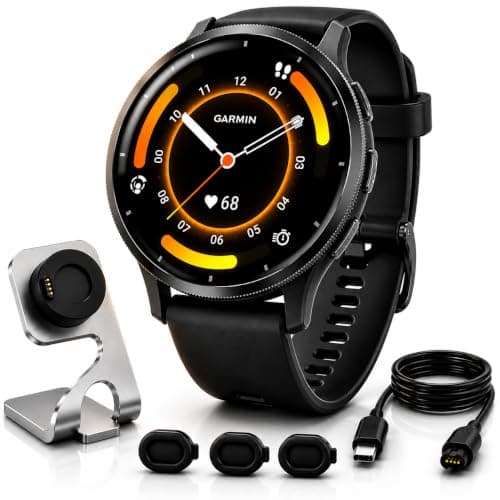
Top pick
One device for training and sleepGarmin Venu 3
The sleep-and-recovery watch for people who already trust Garmin's training data.
$289.9917% off
Price as of October 22, 2026. Prices move; Amazon's is the one that counts.
#ad · we may earn a commission from this link to Garmin Venu 3
The short answer
The Venu 3 states up to 14 days, which solves the real failure of watch-based sleep tracking: the watch being on the charger at bedtime. It carries no subscription and replaces two devices. Garmin's sleep staging has no independent polysomnography validation that we could find.
Ranked
Quick picks
| # | Device | Best for | Evidence | Score | Price |
|---|---|---|---|---|---|
| 01 | Garmin Venu 3 The sleep-and-recovery watch for people who already trust Garmin's training data. | One device for training and sleep | Manufacturer specification | 7.2/10 | $239.99Amazon |
#ad· Live prices from the Amazon Product API, as of October 22, 2026. Where we have no verified live price we show none. Scores come from the published rubric at How we rank — the Evidence column shows what each ranking actually rests on, including where the answer is nothing.
Why battery is a sleep specification
The most common reason someone's sleep data is wrong is that it does not exist.
Every sleep and recovery platform works by comparing tonight against your own rolling baseline. A baseline needs continuity. Miss two nights a week because the watch was charging and the baseline is mostly noise, which means the readiness score built on it is noise too, no matter how good the sensor is.
A two-day watch has to be charged roughly when you would otherwise be putting it on for the night, and human beings solve that by charging at bedtime. A watch stating 14 days gets charged on a Sunday afternoon and is on your wrist for the other 167 hours of the week.
That is the Venu 3's actual argument, and it is a better one than it sounds. It does not need a superior sensor to produce a more useful dataset than a device with a better sensor that you take off every night. Data completeness is doing the work here.
The evidence position, and it is a gap
Garmin's sleep staging has no independent polysomnography validation that we could find. None. Not for the Venu 3 and not for any Garmin device.
This is more conspicuous than it might appear. Robbins et al. (2024) tested Oura, Fitbit and Apple against clinical PSG. Garmin was not in it. For the largest sports-wearable maker in this space, there is no published head-to-head against the devices it competes with, on the metric a sleep watch exists to produce.
The company's HRV record does not help the case either. Dial et al. (2025) measured five wearables against a single-lead ECG across 536 nights. The Garmin fēnix 6 placed fourth of five on HRV agreement at 0.87 concordance and 10.52% error — and its resting heart rate could not be compared at all, because the 30-minute window Garmin derives it from is not timestamped.
That last detail is worth sitting with. A researcher trying to validate a Garmin number could not do so, because the device does not say which part of the night the figure came from. That is an unusually direct obstacle to being checked.
Different device, different generation, and not a measurement of the Venu 3. But it is the only published nocturnal data any Garmin has, and it does not support buying this watch for the sleep numbers specifically.
What it is genuinely good at
Being one device. A ring plus a sports watch means two chargers, two apps and two baselines that disagree. The Venu 3 records your training and your night in the same platform, and the load model and the sleep data at least share a device.
No subscription. Against a membership ring or a membership band, the three-year arithmetic is a different shape entirely — the sticker is the price.
The platform. Garmin Connect has the deepest third-party integration in this category, and the sleep coach and nap detection are more usable than most.
What it is not good at
The sensor site. A wrist is the weakest optical position in the published evidence. The 2025 placement study ran identical sensors at wrist, forearm and upper arm and found proximal placements better at every intensity tested. For overnight measurement the device with the best published result is a ring, on a finger, for the same anatomical reason.
Sleeping in a watch. A 45 mm case is a real object to wear to bed. Some people never notice; some never adapt. A ring or a night-only arm band exists partly because of this.
Its generation. Garmin announced the Venu 4 in September 2025, so the Venu 3 is the back-catalog watch now rather than the current one. That is most of why it is cheap. It does not move the evidence position either way: Garmin sleep staging has no published polysomnography validation in any generation, so the newer watch is not a better answer to the question this page is asking.
Venu 3, a ring, or a night band?
Buy the Venu 3 if you want one device, no subscription, and you will actually wear a watch overnight. Its stated battery makes that realistic.
Buy a ring if the stage data is the point and you want the one device with a strong published PSG result behind it. Accept the membership.
Buy a night band if you already own a sports watch you like and just want it to be on the charger overnight rather than on your wrist. An upper-arm band puts the sensor in the position the placement study favored, though its own sleep staging is equally unvalidated.
What we could not verify
- Sleep staging accuracy. No independent PSG validation of any Garmin device that we could find.
- Optical heart-rate accuracy for this model. Not measured.
- Battery.Garmin-stated, under Garmin's conditions. Real-world duration depends heavily on display settings and pulse-oximetry use.
- The sleep coach and nap detection. Features, not measurements. Nobody has evaluated their outputs.
Who should not buy it
Anyone buying specifically for sleep staging.The published record has nothing to say about Garmin's, and the device that does have a paper is a ring.
Anyone who will not sleep in a watch. Be honest before you buy. This whole argument rests on the device being on your wrist at night.
Serious runners who want running metrics. This is a lifestyle watch with strong sleep features, not a dedicated running watch.
Update: the Venu 4 is on sale, and this is now the previous generation
As of 21 September 2026 Garmin sells a Venu 4, listed at $549.99 in 41 mm and 45 mm, stating up to 12 days in smartwatch mode (4 with the display always on), 20 hours GPS-only, 19 hours All-Systems, 5 ATM, and a speaker and microphone. The Venu 3 is still sold, and its listing is what the live price above tracks.
Two things follow. First, the argument this review makes is about a stated battery figure long enough to keep the watch on your wrist at bedtime, and on Garmin's own numbers the older watch states more of it — 14 days against 12. Second, the successor changes nothing about the evidence position: Garmin sleep staging has no published polysomnography validation on any model, the Venu 4 included. We have not ranked the Venu 4 — no validation, no listing resolved into the roster — and on the two things this page is actually about, stated overnight battery and the absence of a sleep paper, it would not change the recommendation.
Updated 11 October 2026: the Venu 4 is now on the roster — its listing resolved against the live Creators API — and it is ranked with the running watches rather than here, because Garmin's own manual documents it with the Forerunner training stack and a multi-band satellite mode. The full read is the Venu 4 review, and Forerunner 570 vs Venu 4 sets it against the running watch at its own list price. Neither changes this page: on stated overnight battery the Venu 3 still states more (14 days against 12), and neither watch has a published sleep validation of any kind.
Updated 18 October 2026: we have now read Garmin's own Venu 3 battery table in full, which puts a figure on every mode rather than the headline alone — 14 smartwatch days, 26 hours GPS-only, 20 hours all-systems, 11 with music — and the full side-by-side with the successor is Venu 3 vs Venu 4. The older watch states the longer figure in every mode the two tables share.
In full
Every pick, and why
Garmin Venu 3
The sleep-and-recovery watch for people who already trust Garmin's training data.
- Display
- 45mm, AMOLED
- Battery (stated)
- Up to 14 days
- Extras
- Sleep coach, nap detection, wheelchair mode
What's good
- 14 stated days means it survives the nights as well as the days — the practical failure of sleep tracking on a sports watch is that it is on the charger at bedtime
- One device rather than a watch plus a ring
What isn't
- Garmin's sleep staging has no independent PSG validation we could find
- A wrist is a worse optical site than a finger
Skip this if
Skip this if sleep staging is the reason you are buying. The published record has nothing to say about Garmin's, and the device that does have a paper is a ring.
What the evidence says
Manufacturer specificationNo independent PSG validation of Garmin's sleep staging that we could find. Notably, Garmin was absent from the Robbins et al. (2024) comparison entirely, so there is no published head-to-head against Oura, Fitbit or Apple.
Show how this 7.2 was calculated
| Factor | Weight | Score |
|---|---|---|
| EvidencePublished specs only; conspicuously absent from the major PSG comparison study. | 30% | 4.5 |
| HardwareCurrent Garmin optical sensor in a wrist-worn AMOLED watch. | 20% | 8.0 |
| Metric coverageSleep, recovery, training and everyday smartwatch functions in one device. | 20% | 9.0 |
| Endurance14 stated days is enough to keep it on the wrist overnight. | 15% | 8.5 |
| Cost per capabilityNo subscription, and it replaces two devices. | 15% | 7.5 |
$289.9917% off
Price as of October 22, 2026. Prices move; Amazon's is the one that counts.
#ad · we may earn a commission from this link to Garmin Venu 3
Questions
Frequently asked
Is Garmin sleep tracking accurate?
Nobody has published a measurement, so we cannot say. Garmin was absent from the main polysomnography comparison of consumer devices entirely, which means there is no published head-to-head against Oura, Fitbit or Apple on the metric a sleep watch exists to produce.
How long does the Garmin Venu 3 battery last?
Garmin states up to 14 days. That figure is manufacturer-stated under Garmin's conditions and real duration depends on display settings and pulse-oximetry use — but even a fraction of it is enough to keep the watch on your wrist overnight, which is the point.
Venu 3 or Oura Ring?
The Oura has the published sleep result and the better sensor site; the Venu 3 has no subscription, replaces two devices and records your training too. If the stage breakdown is why you are buying, the ring. If you want one device you will actually wear, the watch.
Do I need a separate sleep tracker if I have a sports watch?
Only if your sports watch is on the charger at night, which is the usual reason sleep data goes missing. A watch with a long stated battery removes that problem; a night-only arm band solves it a different way by letting the watch charge while something else records.
Show your working
Sources
Every one of these was read in full before it was cited. Where we could not access a paper, we do not quote its numbers.
- [1]Peer-reviewed validation2024Robbins et al., “Accuracy of Three Commercial Wearable Devices for Sleep Tracking in Healthy Adults”, Sensors 24(20):6532
Brigham and Women’s Hospital. n = 35 healthy adults, single-night inpatient polysomnography, testing Oura Ring Gen3, Fitbit Sense 2 and Apple Watch Series 8. Authors’ stated limits: one night, lab conditions, healthy adults without insomnia, comparison only during scheduled sleep, and device failures on 6 Apple Watches and 2 Fitbits.
- [2]Peer-reviewed validation2025Dial, Hollander, Vatne, Emerson, Edwards & Hagen, “Validation of nocturnal resting heart rate and heart rate variability in consumer wearables”, Physiological Reports 13(16):e70527
DOI 10.14814/phy2.70527. n = 13 healthy adults (7 male, 6 female, 33.2 ± 8.6 years) across 536 nights, each wearing an Oura Gen 3, Oura Gen 4, Polar Grit X Pro, Garmin fēnix 6 and Whoop 4.0 simultaneously against a Polar H10 single-lead ECG reference sampled at 1000 Hz. Authors’ stated limits: healthy adults only, no atrial-fibrillation population, proprietary and periodically-updated algorithms, and unequal night counts per device. The Garmin was dropped from the resting-heart-rate comparison because the 30-minute window it uses is not timestamped.
- [3]Peer-reviewed validation2025“Impact of Anatomical Placement on the Accuracy of Wearable Heart Rate Monitors During Rest and Various Exercise Intensities”, Sensors (Basel)
n = 28 (14 male, 14 female). Polar H10 chest strap as the reference. Compared Polar Verity Sense (forearm), Garmin Forerunner 55 (wrist) and three simultaneous Whoop 4.0 units at wrist, forearm and upper arm, across rest, cycling warm-up, burpees and a modified Bruce treadmill protocol.
- [4]Peer-reviewed validation2024Svensson et al., “Validity and reliability of the Oura Ring Generation 3 with sleep staging algorithm 2.0 compared to multi-night ambulatory polysomnography”, Sleep Medicine
NOT READ — the publisher returned HTTP 403 to our fetch on 2026-07-24. Reported to cover 96 participants and 421,045 epochs. We quote no figure from it. Readers should also note it is the validation of Oura's own staging algorithm, and that a published comment on it exists.
- [5]Peer-reviewed validation2025Khan et al., “The Oura Ring Versus Medical-Grade Sleep Studies: A Systematic Review and Meta-Analysis”, OTO Open
NOT READ — the publisher returned HTTP 403 to our fetch on 2026-07-24. A pooled analysis would be stronger evidence than any single study, so this is a real gap in our record rather than a formality.
- [6]Manufacturer specification2026Garmin — Venu 4 product page, published specifications
Manufacturer-stated, read 2026-09-21. Listed at $549.99 in 41 mm (1.2" 390 x 390, 33 g without band) and 45 mm (1.4" 454 x 454, 38 g without band). Smartwatch mode up to 12 days (4 days always-on), Battery Saver up to 25 days, GPS-Only up to 20 hours, All-Systems up to 19 hours, All-Systems with music up to 9 hours; 5 ATM; Elevate wrist heart rate monitor; built-in speaker and microphone. Originally used only to establish that the Venu 3 has a shipping successor. The Venu 4 joined the roster on 2026-10-11, when its ASIN resolved against the live Creators API with a title matching brand and model; no validation of the watch exists, which is why it carries this site's evidence floor rather than a score its specification would otherwise earn.
- [7]Manufacturer specification2026Garmin — Venu 3 series owner’s manual, battery life information
Manufacturer-stated, read 2026-10-18, Venu 3S then Venu 3: smartwatch mode with activity tracking and continuous wrist-based heart rate up to 10 days / up to 14 days; smartwatch mode with battery saver up to 20 / 26 days; GPS Only mode up to 21 / 26 hours; All Systems GPS mode up to 15 / 20 hours; All Systems GPS mode with music playback up to 8 / 11 hours; Always On display mode up to 5 days for both. NOTE the shape of this table: there is no all-satellite-plus-multi-band row, because the Venu 3 has no multi-band mode — the Venu 4 manual is the first in the line to publish one. Garmin's own caveat on the page is that actual battery life depends on which features are enabled, including activity tracking, wrist-based heart rate, phone notifications, GPS and connected sensors.
- [8]Manufacturer specification2026Garmin — Venu 3 series owner’s manual, specifications
Manufacturer-stated, read 2026-10-18: rechargeable built-in lithium-ion battery; battery life up to 14 days in smartwatch mode for the Venu 3 and up to 10 days for the Venu 3S; water rating “Swim, 5 ATM”; operating temperature range −20 to 50 °C; charging temperature range 0 to 45 °C; wireless frequencies 2.4 GHz at 17 dBm maximum and 13.56 MHz at −40 dBm maximum. The web edition of this page does not publish case dimensions, weights, display resolution or memory, so this site quotes none of those for the Venu 3.
Read next
Related
- Venu 3 vs Venu 4
Both battery tables in full, and the one row only the newer watch has.
- Is Body Battery accurate?
What Garmin's recovery score is built from, and what has been measured.
- Best sleep trackers
Where the Venu 3 places against the rings and bands.
- Fix your sleep data
Including the compliance fix this watch is built around.
- Sleep accuracy by device
The published record, including Garmin's blank row.
- How sleep tracking works
What the watch is actually inferring overnight.
- WHOOP vs Garmin
Own the hardware or rent the coaching, with the measured HRV for both.
- Garmin Venu 4 review
The successor, ranked - and the training stack its manual quietly documents.
- The best Garmin watches, ranked
Both Venus against the Forerunner, fenix and Instinct lines on one rubric.