GPS and multisport
Garmin Venu 4
Sold as a lifestyle watch. Documented, in Garmin's own owner's manual, with training status, acute load, training readiness, PacePro and running dynamics — plus a longer published battery than the running watch at the same price.
We earn a commission when you buy through our Amazon links, at no extra cost to you. It never decides a ranking — the rubric that does is published in full, so you can check us rather than take our word for it. How this works.
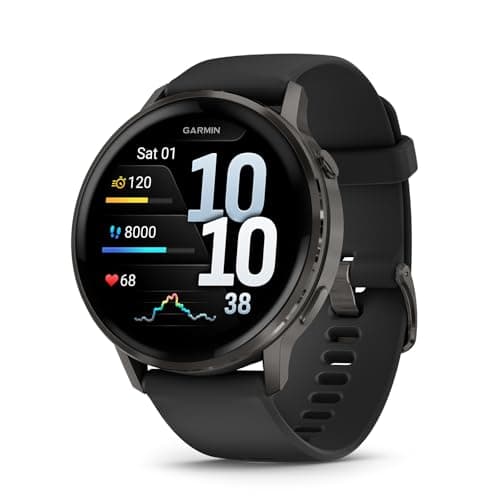
Top pick
One watch for training data and everyday wearGarmin Venu 4
A Forerunner's training stack in a steel lifestyle case, with a longer published battery than the running watch it is priced against.
Price as of October 22, 2026. Prices move; Amazon's is the one that counts.
#ad · we may earn a commission from this link to Garmin Venu 4
The short answer
A lifestyle-styled Garmin that Garmin's own manual documents with the Forerunner training stack, a multi-band satellite mode and 12 stated smartwatch days. At the same $549.99 list price it outlasts a Forerunner 570 on every published battery row. No independent validation of anything it measures exists.
Ranked
Quick picks
| # | Device | Best for | Evidence | Score | Price |
|---|---|---|---|---|---|
| 01 | Garmin Venu 4 A Forerunner's training stack in a steel lifestyle case, with a longer published battery than the running watch it is priced against. | One watch for training data and everyday wear | Manufacturer specification | 7.1/10 | $543.00Amazon |
#ad· Live prices from the Amazon Product API, as of October 22, 2026. Where we have no verified live price we show none. Scores come from the published rubric at How we rank — the Evidence column shows what each ranking actually rests on, including where the answer is nothing.
The surprise is in the manual, not the marketing
Garmin sells the Venu line on health and lifestyle, and the Venu 4 announcement is written that way: health status, lifestyle logging, sleep alignment, a spoken watch face, a flashlight, a speaker. Read the owner's manual instead and a different watch appears.
The Training section of Garmin's Venu 4 manual lists, in this order: activity tracking, workouts, interval workouts, setting a training target, PacePro training, racing a previous activity, race calendar and primary race, recording a critical swim speed test, virtual partner, the training calendar, self evaluation, performance measurements, training status, acute load, training readiness and recovery time. The appendix publishes VO2 max. standard ratings, running dynamics data and FTP ratings.
That is not a cut-down lifestyle feature set. It is the analysis stack Garmin ships on a Forerunner, in a stainless-steel case with a torch on the side. Whether those model outputs are any good is a separate question, and we have gone through them one by one on training status and Body Battery— but the Venu 4 computes them, and the line's reputation as the watch you buy once you have stopped caring about training data is now out of date.
Garmin's own battery table, both cases
Every figure below is manufacturer-stated, taken from the battery page of the Venu 4 owner's manual. Nobody here has run one down.
| Manufacturer-stated mode | 41 mm | 45 mm |
|---|---|---|
| Smartwatch mode | Up to 10 days | Up to 12 days |
| Battery saver watch mode | Up to 18 days | Up to 25 days |
| GPS only | Up to 15 h | Up to 20 h |
| All satellite systems | Up to 13 h | Up to 19 h |
| All satellite systems + multi-band | Up to 12 h | Up to 17 h |
| All systems + multi-band, with music | Up to 6 h | Up to 9 h |
The row that did not used to be there
Note the fifth row. A Venu with an all-satellite-plus-multi-band mode is new, and it is the most consequential line in the specification, because multi-band reception is the hardware that addresses the complaint people actually have about GPS watches — a track that wanders between buildings and under tree cover. What the mode does, and what nobody has measured about it, is in what dual-band GPS actually is.
We rank this watch on the 17-hour figure rather than the 20-hour GPS-only headline, for the same reason we rank the Instinct 3 and the fēnix 8 on their multi-band rows: it is the mode you would run if positioning accuracy is why you bought the receiver. The second thing the table says is that the 41 mm case is not simply a smaller version of the same watch. It states 12 multi-band hours against 17, and 10 smartwatch days against 12. If you want the battery, you have to want the bigger case.
The arithmetic, at today's price
At $31.94 per stated all-satellite-plus-multi-band hour, the Venu 4 lands mid-table on this site — and here is the part that surprised us: that is a better figure than the Forerunner 570's, which Garmin lists at the same $549.99 and states at 14 multi-band hours. The gap between the two at live prices is $3. The full side-by-side is here, because a lifestyle watch outlasting a running watch is the kind of claim that deserves both tables printed in full.
Against the cheaper end of the Forerunner line the arithmetic turns the other way. The Forerunner 265 records the same core metrics, has the same absent evidence record, and sits $108 below it. What the Venu 4 premium buys over that watch is a steel case, a speaker, a flashlight, an ECG app and three extra stated multi-band hours. It does not buy a better measurement of anything.
The evidence, which is none
No independent validation of this model exists that we could find — not of its optical heart rate, not of its sleep staging, not of its positioning. That is the normal state of this category rather than a scandal, and it is why the watch scores 7.1 here instead of the 8 its specification sheet would otherwise earn: evidence carries 30% of our published rubric and there is none to carry.
Two specifics are worth knowing before you buy it for the health features. Garmin was absent from the Robbins et al. (2024) polysomnography comparison entirely, so there is no published head-to-head of Garmin sleep staging against Oura, Fitbit or Apple. And in the one study that wore five devices on the same people for 536 nights, the Garmin finished last of the five on nocturnal HRV agreement — the authors called its agreement poor, and dropped it from the resting-heart-rate comparison because the 30-minute window it uses is not timestamped.
Garmin is candid in its own footnotes, which we would rather quote than bury: the health status feature that leads the announcement is "currently in beta", Pulse Ox is "not available in all countries", and the ECG app requires the latest software and is available only in select regions, for ages 22 and over. An ECG app is a genuine capability no Forerunner in this price class has. It is not a measurement improvement to anything the watch records during a run.
The one upgrade that does improve its data
A strap. Garmin's manual states the watch pairs over ANT+ or Bluetooth and names the compatible heart-rate sensors, including the HRM 600, the HRM 200, the HRM-Fit and the HRM-Pro series, alongside a foot pod, a running dynamics pod and cycling power meters. That matters more than any software feature on the page: the wrist is the worst-performing sensor position in every published placement comparison, and a chest strap is the one accessory with measured evidence behind it. Our ranked field is the chest straps that work with Garmin watches, and the measurements behind that advice are in wrist versus chest-strap accuracy.
Who it is actually for
Someone who trains seriously enough to want training readiness, acute load and PacePro, and who also wants a watch that does not look like sports equipment at work. Until this generation that person had to choose. On the published specification they no longer do, which is the real news here.
It is also a reasonable answer for the reader who wants one device rather than a watch plus a ring: 12 stated smartwatch days is enough that the watch is on your wrist at bedtime rather than on the charger, which is the practical failure of sleep tracking on a sports watch. The form-factor question, on the published sleep evidence, is settled in smart ring versus watch for sleep tracking.
It is not for a navigator or an ultra runner. There are no maps, 17 stated hours will not cover a hundred miles, and the watches that do both last twice as long. It is also not for anyone buying on the strength of the health screening — that is the part of this watch with the least published evidence behind it and the most marketing in front of it.
Who it beats, and who beats it
- Beats the Forerunner 570 on every published battery row. Twelve days against 11, 20 GPS-only hours against 18, 17 multi-band hours against 14 — at the same list price, from the two watches' own Garmin documentation.
- Beats every Forerunner under $600 on hardware breadth. ECG app, flashlight, speaker and microphone, steel case. None of which measures your running better.
- Loses to the Forerunner 265 on cost per capability. Same core metrics, same absent validation, materially cheaper watch.
- Loses to the fēnix 8 and the Instinct 3 on endurance, heavily. Thirty-five and 24 stated multi-band hours respectively, against 17 here. Both also outrank it on our rubric.
- Loses to a chest strap on the measurement that matters. Which is true of every watch on this site, and worth repeating on the one that lists at $549.99.
Two comparisons put this watch in context from opposite directions: fēnix 8 vs Venu 4 is the question of what roughly twice the money buys in Garmin's own figures, and Venu 3 vs Venu 4 is the generational one, where the older watch states the longer battery in every mode the two tables share.
In full
Every pick, and why
Garmin Venu 4
A Forerunner's training stack in a steel lifestyle case, with a longer published battery than the running watch it is priced against.
- Case
- 41mm or 45mm, AMOLED, stainless steel
- Satellite
- Multi-band GNSS (manufacturer-stated)
- Battery (stated)
- 12 days smartwatch / 17 h multi-band (45mm)
- Extras
- ECG app, LED flashlight, speaker and microphone
- Sensors
- Pairs ANT+ / Bluetooth straps, including the HRM 600
What's good
- Garmin's own manual gives it the Forerunner analysis stack — training status, acute load, training readiness, PacePro, performance measurements, running dynamics
- Publishes an all-satellite-plus-multi-band battery row, which the Venu line did not before: 17 stated hours at 45 mm
- Pairs the chest straps that actually improve its heart-rate data, HRM 600 and HRM 200 included
What isn't
- No independent validation of anything it measures, and the health features Garmin leads with are the newest and least checked
- Garmin labels the health status feature beta itself, and restricts the ECG app by region and to ages 22 and over
- No maps, and the 41 mm case states materially shorter battery than the 45 mm in every mode
Skip this if
Skip this if you are buying it for the health screening. Nothing published validates Garmin's sleep staging, its HRV figure came last of five brands in the only study that measured several at once, and the headline health-status feature is in beta by Garmin's own footnote. Buy it for the watch, not for the diagnosis.
What the evidence says
Manufacturer specificationNo independent validation of this model exists that we could find — not of its optical heart rate, not of its sleep staging, not of its positioning. Garmin was absent from the Robbins et al. (2024) polysomnography comparison entirely, and in the one study that wore three brands at once (Dial et al., 2025) the Garmin device finished last of five on nocturnal HRV agreement.
Show how this 7.1 was calculated
| Factor | Weight | Score |
|---|---|---|
| EvidenceDetailed published specification and a documented feature list, and no independent measurement of a single number this watch produces. | 30% | 4.5 |
| HardwareMulti-band GNSS, Garmin's Elevate wrist sensor, ECG electrodes, speaker and microphone, 5 ATM, and ANT+/Bluetooth pairing for external sensors — the same hardware checklist as a current Forerunner, in a stainless case. | 20% | 9.0 |
| Metric coverageTraining status, acute load, training readiness, PacePro, VO2 max, running dynamics, a swim test, HRV status, Body Battery, Pulse Ox, skin temperature and an ECG app. No maps, which is the one gap against the tier above. | 20% | 9.0 |
| EnduranceGarmin states 12 smartwatch days and 17 hours in all-satellite-plus-multi-band at 45 mm. Longer than the Forerunner it shares a price with, and half a fēnix 8. | 15% | 7.0 |
| Cost per capabilityLists at the same $549.99 as the Forerunner 570 and carries the better dollars-per-stated-multi-band-hour figure — but the premium over a 265 buys a metal case, a speaker and a flashlight, not better measurement. | 15% | 7.5 |
Price as of October 22, 2026. Prices move; Amazon's is the one that counts.
#ad · we may earn a commission from this link to Garmin Venu 4
Questions
Frequently asked
Is the Garmin Venu 4 a running watch?
On Garmin's own documentation, close to one. The manual's Training section lists PacePro, performance measurements, training status, acute load, training readiness and recovery time, and the appendix publishes running dynamics data and VO2 max. ratings. What it does not have is maps, and its 17 stated multi-band hours are short for long trail days. For road training it is specified like a Forerunner.
Does the Venu 4 have multi-band GPS?
Yes, and this is new for the line. Garmin's own battery table publishes an all-satellite-systems-plus-multi-band row for the Venu 4: up to 17 hours at 45 mm and up to 12 hours at 41 mm. We rank the watch on that figure rather than the 20-hour GPS-only headline.
Venu 4 or Forerunner 570?
They list at the same $549.99, and the Venu 4 states the longer battery in every published mode. The Forerunner is the right answer if you want the running-specific line and its firmware; the Venu is the right answer if you want the ECG app, the longer battery and a watch that passes for jewelry. Neither has any independent validation of its measurements. Full comparison here.
Is the Venu 4 ECG app a medical device?
We will not characterize it, because Garmin's own footnote is the honest answer: the ECG app requires the latest software and is available only in select regions, for ages 22 and over. Treat it as a feature with regulatory strings attached rather than a diagnosis, and note that it does not improve the accuracy of any training number the watch records.
How accurate is Venu 4 sleep tracking?
Unknown, and that is the complete answer. No polysomnography validation of Garmin sleep staging exists that we could find, and Garmin was not included in the 2024 Brigham and Women's Hospital comparison that tested Oura, Fitbit and Apple against lab sleep studies. The devices that do have published sleep evidence are ranked on most accurate sleep trackers.
Can you use a chest strap with the Venu 4?
Yes. Garmin's manual states the watch pairs with wireless sensors over ANT+ or Bluetooth and names the HRM 200, HRM 600, HRM-Fit and HRM-Pro series among them, plus a foot pod, a running dynamics pod and cycling power meters. On the published evidence a strap is the single largest improvement you can make to this watch's heart-rate data.
Show your working
Sources
Every one of these was read in full before it was cited. Where we could not access a paper, we do not quote its numbers.
- [1]Manufacturer specification2026Garmin — Venu 4 product page, published specifications
Manufacturer-stated, read 2026-09-21. Listed at $549.99 in 41 mm (1.2" 390 x 390, 33 g without band) and 45 mm (1.4" 454 x 454, 38 g without band). Smartwatch mode up to 12 days (4 days always-on), Battery Saver up to 25 days, GPS-Only up to 20 hours, All-Systems up to 19 hours, All-Systems with music up to 9 hours; 5 ATM; Elevate wrist heart rate monitor; built-in speaker and microphone. Originally used only to establish that the Venu 3 has a shipping successor. The Venu 4 joined the roster on 2026-10-11, when its ASIN resolved against the live Creators API with a title matching brand and model; no validation of the watch exists, which is why it carries this site's evidence floor rather than a score its specification would otherwise earn.
- [2]Manufacturer specification2026Garmin — Venu 4 Series owner’s manual, battery information
Manufacturer-stated, read 2026-10-11, 41 mm then 45 mm: smartwatch mode up to 10 days / up to 12 days; battery saver watch mode up to 18 / 25 days; GPS only mode up to 15 / 20 hours; all satellite systems mode up to 13 / 19 hours; all satellite systems with music up to 6 / 9 hours; all satellite systems plus multi-band up to 12 / 17 hours; all satellite systems plus multi-band with music up to 6 / 9 hours. Garmin's own caveat on the page: “the actual battery life depends on the features enabled on your watch, such as wrist-based heart rate, phone notifications, GPS, internal sensors, and connected sensors.”
- [3]Manufacturer specification2026Garmin — Venu 4 Series owner’s manual, Training section index
Manufacturer-documented, read 2026-10-11. The Training section of the Venu 4 manual lists: Activity Tracking, Workouts, Interval Workouts, Setting a Training Target, PacePro Training, Racing a Previous Activity, Race Calendar and Primary Race, Recording a Critical Swim Speed Test, Using Virtual Partner, About the Training Calendar, Enabling Self Evaluation, Performance Measurements, Training Status, Acute Load, Training Readiness and Recovery Time. The manual's appendix additionally publishes VO2 Max. Standard Ratings, Color Gauges and Running Dynamics Data, FTP Ratings and Wheel Size and Circumference. We make no claim about features the index does not name: an absence from a top-level index is not evidence that a watch cannot do something.
- [4]Manufacturer specification2026Garmin — Venu 4 Series owner’s manual, “Wireless Sensors”
Manufacturer-stated, read 2026-10-11. Garmin states that “your watch can be paired and used with wireless sensors using ANT+ or Bluetooth technology”, and lists the supported sensor types: Club Sensors (Approach CT10), eBike, Extended Display, Heart Rate (HRM 200, HRM 600, HRM-Fit and the HRM-Pro series are named), Foot Pod, Headphones, inReach, Lights, Power (Rally or Vector pedals), Radar, RD Pod, Shifting, Shimano Di2, Smart Trainer, Speed/Cadence and tempe. The US edition of this page was not reachable from here, so the Asia-Pacific edition of the same manual is cited.
- [5]Manufacturer claim only2026Garmin — “Take steps towards a healthier lifestyle with the Venu 4 from Garmin”
Garmin's own press release, read 2026-10-11. Announced 17 September 2025, on sale 22 September 2025, suggested retail price starting at $549.99, in 41 mm and 45 mm, stated at “up to 12 days of battery life in smartwatch mode”. Named features: Health status (monitoring whether heart rate, HRV, respiration, skin temperature and Pulse Ox drift from their usual ranges during sleep), lifestyle logging of choices such as caffeine and alcohol against sleep, stress and HRV, sleep alignment using circadian-rhythm data, sleep consistency over seven days, Garmin Fitness Coach with workouts across 25+ activities that adjust daily, a mixed-session activity profile, a spoken watch face, color filters for color blindness, an LED flashlight, a built-in speaker and microphone, HRV status, Body Battery, women's health tracking with skin temperature, the Garmin ECG App, training readiness and wrist-based running dynamics. Garmin's OWN footnotes, which matter more than the feature list: Pulse Ox is “not available in all countries”, the health status feature is “currently in beta”, cycle tracking is “not intended for contraception or conception support”, and the ECG app requires the latest software and is available only in select regions for ages 22 and over.
- [6]Peer-reviewed validation2024Robbins et al., “Accuracy of Three Commercial Wearable Devices for Sleep Tracking in Healthy Adults”, Sensors 24(20):6532
Brigham and Women’s Hospital. n = 35 healthy adults, single-night inpatient polysomnography, testing Oura Ring Gen3, Fitbit Sense 2 and Apple Watch Series 8. Authors’ stated limits: one night, lab conditions, healthy adults without insomnia, comparison only during scheduled sleep, and device failures on 6 Apple Watches and 2 Fitbits.
- [7]Peer-reviewed validation2025Dial, Hollander, Vatne, Emerson, Edwards & Hagen, “Validation of nocturnal resting heart rate and heart rate variability in consumer wearables”, Physiological Reports 13(16):e70527
DOI 10.14814/phy2.70527. n = 13 healthy adults (7 male, 6 female, 33.2 ± 8.6 years) across 536 nights, each wearing an Oura Gen 3, Oura Gen 4, Polar Grit X Pro, Garmin fēnix 6 and Whoop 4.0 simultaneously against a Polar H10 single-lead ECG reference sampled at 1000 Hz. Authors’ stated limits: healthy adults only, no atrial-fibrillation population, proprietary and periodically-updated algorithms, and unequal night counts per device. The Garmin was dropped from the resting-heart-rate comparison because the 30-minute window it uses is not timestamped.
Read next
Related
- Venu 3 vs Venu 4
The upgrade that adds a satellite mode and subtracts battery.
- fēnix 8 vs Venu 4
The endurance question: 35 stated multi-band hours against 17.
- Forerunner 570 vs Venu 4
Same price, two Garmin battery tables, one unexpected winner.
- The best Garmin watches, ranked
Where this one sits in Garmin's own lineup, by rubric score.
- Best chest straps for Garmin watches
The accessory that actually improves what this watch records.
- Garmin Venu 3 review
The watch it replaces, and what the previous generation left out.