Rings, bands and recovery
Oura Ring 4
The only consumer sleep device with a strong independent polysomnography result behind it — belonging, strictly speaking, to the generation before this one.
We earn a commission when you buy through our Amazon links, at no extra cost to you. It never decides a ranking — the rubric that does is published in full, so you can check us rather than take our word for it. How this works.
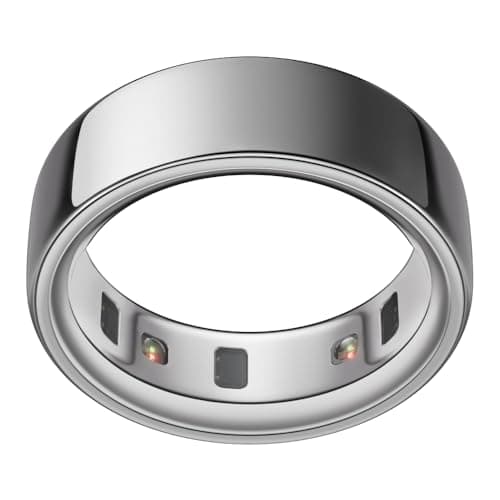
Top pick
Sleep staging you can actually citeOura Ring 4
The only consumer sleep device with a strong independent PSG result behind it — 76.3% four-stage agreement, and the best deep-sleep sensitivity of the three tested.
Price as of October 22, 2026. Prices move; Amazon's is the one that counts.
#ad · we may earn a commission from this link to Oura Ring 4
The short answer
In the 2024 Brigham and Women's Hospital study, the Oura Ring achieved 76.3% four-stage agreement with polysomnography (κ = 0.65) and 79.5% deep-sleep sensitivity — the best of the three devices tested — and matched PSG on seven of eight nightly summary measures. That study tested the Gen3, not the Ring 4.
Ranked
Quick picks
| # | Device | Best for | Evidence | Score | Price |
|---|---|---|---|---|---|
| 01 | Oura Ring 4 The only consumer sleep device with a strong independent PSG result behind it — 76.3% four-stage agreement, and the best deep-sleep sensitivity of the three tested. | Sleep staging you can actually cite | Peer-reviewed validation | 8.0/10 | $349.00Amazon |
#ad· Live prices from the Amazon Product API, as of October 22, 2026. Where we have no verified live price we show none. Scores come from the published rubric at How we rank — the Evidence column shows what each ranking actually rests on, including where the answer is nothing.
The result, in detail
Robbins et al., Sensors 24(20):6532, n = 35, single-night inpatient polysomnography, comparing an Oura Ring Gen3 against a Fitbit Sense 2 and an Apple Watch Series 8.
- Sleep versus wake: 92.0% agreement, κ = 0.60
- Four-stage: 76.3% agreement, κ = 0.65 — the highest of the three
- Sensitivity: light 78.2%, deep 79.5%, REM 76.0%
- Precision: light 79.5%, deep 77.0%, REM 79.1%
- No significant difference from PSG on seven of eight nightly summary measures; overestimated sleep latency by five minutes
The deep-sleep figure is the standout. Deep sleep is the hardest stage for a consumer device to identify and the one people most often act on. Oura's 79.5% sensitivity compares with 61.7% for Fitbit and 50.5% for the Apple Watch — the difference between a number worth paying some attention to and one that is right about half the time.
Why a finger works better than a wrist
This is not brand advantage, it is anatomy. Optical sensing infers pulse from light scattered back off moving blood, so it works better where perfusion is high, tissue is thin and the site moves little. A finger scores well on all three; a wrist — a joint that moves constantly, over tendon and bone — scores badly on all three.
The 2025 placement study demonstrated the same principle for heart rate directly, by running three identical sensors at wrist, forearm and upper arm at once and finding the proximal placements won at every intensity. Different site, same physics.
The three honest problems
1. The study tested the Gen3
Not the Ring 4. Oura's sensor package and algorithm have changed. It is reasonable to expect the result broadly carries — but expecting is not measuring, and we do not score it as though it were.
2. The subscription is not optional for the full product
The ring is the purchase; the membership is the ongoing cost, and the app is substantially limited without it. The sticker price is therefore not the price, which is why Oura scores 5.5 on cost per capability while a no-subscription ring scores 9.5. Worked through on the WHOOP versus Oura comparison.
3. Sizing, which trips people up
Rings are sized and the Amazon listing is per size — the ASIN differs. Oura supplies a sizing kit, and finger size changes with temperature and time of day, so this is a genuine extra step rather than a formality.
What we could not verify
- Any Ring 4-specific validation. The published result is Gen3.
- The Svensson multi-night validation in Sleep Medicine— publisher returned an error to our fetch. Reported to cover 96 participants and 421,045 epochs; we quote nothing from it. Readers should also weigh that it validates Oura's own staging algorithm, and that a published comment on it exists.
- The 2025 OTO Open systematic review — also inaccessible to us. A pooled meta-analysis would be stronger evidence than the single study we rely on.
- Battery life and long-term durability. Manufacturer figures only.
Who should not buy it
Anyone who lifts heavily. A rigid ring under a loaded barbell is uncomfortable at best, and Oura's own guidance is to take it off — which makes it a tracker you remove for exactly the training you most want tracked. And anyone unwilling to pay a subscription indefinitely: the honest three-year figure is a long way from the sticker.
In full
Every pick, and why
Oura Ring 4
The only consumer sleep device with a strong independent PSG result behind it — 76.3% four-stage agreement, and the best deep-sleep sensitivity of the three tested.
- Form
- Ring, worn on the index finger
- Sizing
- Size-specific — the ASIN is per size
- Subscription
- Membership required for full app features
What's good
- Robbins et al. (2024): highest four-stage agreement (76.3%, κ = 0.65) and best deep-sleep sensitivity (79.5%) of the three devices tested against polysomnography
- Matched PSG on seven of eight nightly summary measures, missing only sleep latency by five minutes
- A finger is a better optical site than a wrist for the same reason a forearm is
What isn't
- The membership is mandatory for the full app, so the sticker price is not the price — see our three-year arithmetic
- Rings are sized, so you need the sizing kit first and the ASIN varies by size
Skip this if
Skip this if you lift heavily. A rigid ring on a loaded barbell is uncomfortable at best, and Oura's own guidance is to take it off — a tracker you remove for training is not tracking your training.
What the evidence says
Peer-reviewed validationRobbins et al., Sensors 24(20):6532 (2024), n = 35, single-night inpatient polysomnography, testing the Oura Ring Gen3. Note the study tested Gen3, not the Ring 4. Note also that the manufacturer's press release rounded the four-stage figure to 79%; the paper says 76.3%. We use the paper.
Show how this 8.0 was calculated
| Factor | Weight | Score |
|---|---|---|
| EvidenceThe strongest peer-reviewed sleep result of any consumer device we found — with the honest caveats that it was one night, 35 people, and the previous generation. | 30% | 9.0 |
| HardwareFinger-mounted optical sensing, a better site than the wrist. | 20% | 8.5 |
| Metric coverageSleep, HRV, temperature and readiness; weak on exercise recording. | 20% | 8.0 |
| EnduranceMulti-day battery in normal use. | 15% | 8.0 |
| Cost per capabilityThe mandatory membership makes the true three-year cost materially higher than the sticker. | 15% | 5.5 |
Price as of October 22, 2026. Prices move; Amazon's is the one that counts.
#ad · we may earn a commission from this link to Oura Ring 4
Questions
Frequently asked
How accurate is the Oura Ring for sleep?
In the best published head-to-head, 76.3% four-stage agreement with clinical polysomnography and 79.5% deep-sleep sensitivity — the best of the three devices tested. Caveats: one night, 35 healthy adults, and it tested the Gen3 rather than the current ring.
Is Oura more accurate than an Apple Watch for sleep?
On four-stage classification, slightly: 76.3% against 75.0%. On deep sleep, substantially: 79.5% sensitivity against 50.5%. The Apple Watch was marginally better at the simpler sleep-versus-wake question, at 93.0% against 92.0%.
Does the Oura Ring need a subscription?
A membership is required for the full app experience. That makes the three-year cost materially higher than the purchase price, and it is the main reason it scores lower on cost per capability than a no-subscription ring.
Should I buy the Ring 4 or the Ring 5?
If you want the current generation, the Ring 5. If you want the device the published accuracy evidence actually belongs to, the Ring 4 is closer to it — and it is cheaper. No independent validation of the Ring 5 exists that we could find, which is why it scores lower here despite being the newer product.
Show your working
Sources
Every one of these was read in full before it was cited. Where we could not access a paper, we do not quote its numbers.
- [1]Peer-reviewed validation2024Robbins et al., “Accuracy of Three Commercial Wearable Devices for Sleep Tracking in Healthy Adults”, Sensors 24(20):6532
Brigham and Women’s Hospital. n = 35 healthy adults, single-night inpatient polysomnography, testing Oura Ring Gen3, Fitbit Sense 2 and Apple Watch Series 8. Authors’ stated limits: one night, lab conditions, healthy adults without insomnia, comparison only during scheduled sleep, and device failures on 6 Apple Watches and 2 Fitbits.
- [2]Peer-reviewed validation2025“Impact of Anatomical Placement on the Accuracy of Wearable Heart Rate Monitors During Rest and Various Exercise Intensities”, Sensors (Basel)
n = 28 (14 male, 14 female). Polar H10 chest strap as the reference. Compared Polar Verity Sense (forearm), Garmin Forerunner 55 (wrist) and three simultaneous Whoop 4.0 units at wrist, forearm and upper arm, across rest, cycling warm-up, burpees and a modified Bruce treadmill protocol.
- [3]Peer-reviewed validation2024Svensson et al., “Validity and reliability of the Oura Ring Generation 3 with sleep staging algorithm 2.0 compared to multi-night ambulatory polysomnography”, Sleep Medicine
NOT READ — the publisher returned HTTP 403 to our fetch on 2026-07-24. Reported to cover 96 participants and 421,045 epochs. We quote no figure from it. Readers should also note it is the validation of Oura's own staging algorithm, and that a published comment on it exists.
- [4]Peer-reviewed validation2025Khan et al., “The Oura Ring Versus Medical-Grade Sleep Studies: A Systematic Review and Meta-Analysis”, OTO Open
NOT READ — the publisher returned HTTP 403 to our fetch on 2026-07-24. A pooled analysis would be stronger evidence than any single study, so this is a real gap in our record rather than a formality.
Read next
Related
- Oura vs Apple Watch
Ring against watch, decided on the study that measured both.
- Oura Ring 5 review
The newer ring, and why it ranks below this one on the evidence rule.
- WHOOP vs Oura
Two subscription models, and the real three-year numbers.
- Most accurate sleep trackers
Where Oura sits against everything else measured.
- Sleep accuracy by device
The full evidence table.
- Oura Ring 4 vs Ring 5
Why the newer ring cannot outrank the older one on our evidence rules.
- Oura vs RingConn
The published study against the missing subscription, worked out in full.