GPS and multisport
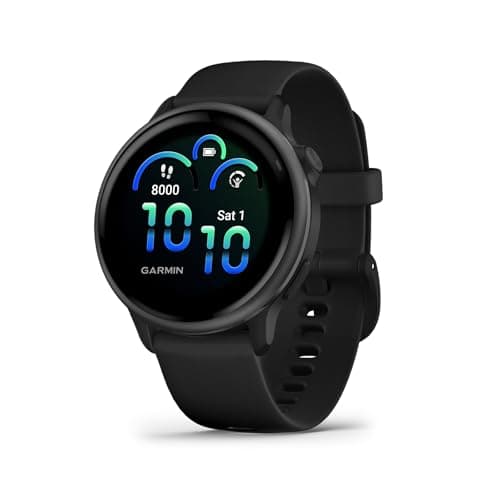
Garmin vívoactive 6
It outlasts a Forerunner 570 in every satellite mode both watches publish. The reason is not a better battery — it is a receiver that cannot run the mode that costs the most power.
We earn a commission when you buy through our Amazon links, at no extra cost to you. It never decides a ranking — the rubric that does is published in full, so you can check us rather than take our word for it. How this works.
Top pick
A $300 Garmin for someone who already owns the strapGarmin vívoactive 6
The cheapest Garmin that still pairs a chest strap and still estimates VO2 max — and the published battery table shows you why it outlasts a Forerunner.
Price as of November 1, 2026. Prices move; Amazon's is the one that counts.
#ad · we may earn a commission from this link to Garmin vívoactive 6
The short answer
A $299.99 Garmin that pairs an ANT+ or Bluetooth chest strap, estimates VO2 max, runs PacePro and states 11 smartwatch days. Garmin's own battery table publishes no all-satellite-plus-multi-band row for it, which is how you can tell the receiver is single-frequency — and it is why this watch outlasts a Forerunner. No independent validation of anything it measures exists.
Ranked
Quick picks
| # | Device | Best for | Evidence | Score | Price |
|---|---|---|---|---|---|
| 01 | Garmin vívoactive 6 The cheapest Garmin that still pairs a chest strap and still estimates VO2 max — and the published battery table shows you why it outlasts a Forerunner. | A $300 Garmin for someone who already owns the strap | Manufacturer specification | 6.6/10 | $299.00Amazon |
#ad· Live prices from the Amazon Product API, as of November 1, 2026. Where we have no verified live price we show none. Scores come from the published rubric at How we rank — the Evidence column shows what each ranking actually rests on, including where the answer is nothing.
The review is in a row that is not there
Garmin publishes a battery table for every watch it sells, broken out by satellite mode, and the shape of that table tells you more about the hardware than the marketing copy does. Here is the vívoactive 6 table from Garmin's own owner's manual, in full. Every figure is manufacturer-stated; nobody here has run one down.
| Manufacturer-stated mode | vívoactive 6 (42 mm) |
|---|---|
| Smartwatch mode | Up to 11 days |
| Battery saver watch mode | Up to 21 days |
| GPS only mode | Up to 21 h |
| All satellite systems mode | Up to 17 h |
| All satellite systems with music mode | Up to 8 h |
Five rows. Count them against the Venu 4's table, which has seven, because it publishes all satellite systems plus multi-band with and without music. Count them against the Forerunner 570's, which publishes GPS-Only, SatIQ and All-Systems + Multi-Band.
The vívoactive 6 has no multi-band row, and Garmin does not hide multi-band when a watch has it — multi-band is a selling point and Garmin sells it loudly. The absence of the row is the specification. This is a single-frequency, multi-constellation receiver, the same structural tell we recorded on the Forerunner 165.
Which is also why the battery looks so good
Put the two Garmins side by side in the modes both publish and something counter-intuitive happens. The vívoactive 6 states 21 GPS-only hours against the Forerunner 570's 18, and 17 all-systems hours against the Forerunner's 14 in all-systems-plus-multi-band. The $299 lifestyle watch outlasts the $549 running watch in every satellite mode they share.
That is a real, useful fact and it is not a win. Multi-band reception is the most power-hungry thing a GPS watch does; a receiver that cannot do it is not spending the power. You are not buying three extra hours of the same thing. You are buying three extra hours of a less capable thing, and the only like-for-like row between these two watches is the GPS-only one, where the vívoactive still leads by three hours.
What it measures, and the layer it does not get
On features, this is more watch than the price suggests. Garmin's own announcement names Body Battery, sleep coach with a sleep score, HRV status, stress tracking, Pulse Ox (Garmin's own footnote: “not available in all countries”), women's health tracking, a smart wake alarm, a morning report, 80+ sports apps, Garmin Coach plans, PacePro grade-adjusted pacing, running dynamics (cadence, stride length, ground contact time), workout benefit, recovery time, a wheelchair mode, Garmin Pay and on-watch music. The manual carries its own VO2 max topic, so the estimate is documented for this watch rather than inferred from the family.
Now the gap, and it is the gap that decides who this watch is for. Garmin names no training status, no acute load and no training readiness for the vívoactive 6. Those three are the analysis layer — the part that takes the raw metrics and tells you what to do tomorrow — and Garmin does name all three in the Venu 4 manual, a watch sold as a lifestyle device. So this is not a running-versus-lifestyle divide. It is a tier divide, and the vívoactive 6 is below the line.
We state that as an absence from Garmin's published feature list, not as a claim about what the watch is incapable of. But if training status is why you want a Garmin, note that Garmin's own definition builds it from VO2 max, acute load and HRV status together — and we have gone through what that output is actually worth on training status explained.
The feature that matters more than any of them
Garmin's manual documents wireless sensor pairing on this watch “using ANT+ or Bluetooth technology”, names the HRM 200, HRM 600, HRM-Fit and HRM-Pro series by model, and tells you to pair an HRM-Fit or HRM-Pro over ANT+ rather than Bluetooth if you want running pace and distance from the strap.
That single line is worth more to your data than any wrist-sensor revision Garmin has ever shipped. The 2025 placement study ran 28 people through rest, cycling, burpees and a treadmill ramp against a Polar H10 reference and found the wrist the worst of the three positions tested. The 2024 umbrella review of 249 primary validation studies puts consumer wrist heart rate at roughly ±3% with a mean bias of −3.39 bpm — fine at rest, and that average conceals what happens during intensity changes.
So the honest framing of this watch is not “cheap Garmin, worse sensor”. It is: a $299 Garmin plus a chest strap produces better heart-rate data than a $549 Garmin on its wrist sensor alone, and costs less. That trade is available here, it is documented by the manufacturer, and it is the single best reason to buy this watch.
What nobody has checked
No independent validation of the vívoactive 6 exists that we could find. Not of its optical heart rate, not of its sleep staging, not of its positioning. On our evidence hierarchy it sits at manufacturer specification: the documentation is detailed and checkable, and not one number the watch produces has been measured by anyone outside Garmin.
The nearest relevant findings are all about other devices. Gilgen-Ammann et al. (2020) measured eight watches against a trundle wheel accurate to 1 cm, two of them Garmins — and that study predates the dual-frequency era entirely, so it cannot describe this receiver either way. Dial et al. (2025) put five wearables against a single-lead ECG across 536 nights, and the Garmin finished last of the five on nocturnal HRV agreement. Garmin was absent from the Brigham and Women's polysomnography comparison altogether, so its sleep staging — the thing the sleep coach and the sleep score are built on — has no published validation at all.
None of those tested this watch. We are telling you what the record contains, which is a brand with a thin and mixed measurement history, and a specific model with none.
In full
Every pick, and why
Garmin vívoactive 6
The cheapest Garmin that still pairs a chest strap and still estimates VO2 max — and the published battery table shows you why it outlasts a Forerunner.
- Case
- 42mm, aluminum bezel, AMOLED
- Satellite
- GPS only or all systems — no multi-band row published
- Battery (stated)
- 11 days smartwatch / 17 h all satellite systems
- Maps
- None
- Sensors
- Pairs ANT+ / Bluetooth straps, HRM 600 and HRM 200 named
What's good
- Garmin's manual documents ANT+ and Bluetooth strap pairing, so the one real fix for wrist heart rate works on a $300 watch
- Carries its own VO2 max topic in the manual, plus PacePro, running dynamics, HRV status and Body Battery
- States longer endurance than a Forerunner 570 in every satellite mode it publishes — 21 h GPS-only against 18 h
What isn't
- No multi-band row exists anywhere in Garmin's own battery table, which is how you can tell the receiver is single-frequency
- Garmin's feature list names no training status, no acute load and no training readiness — the analysis layer a Forerunner or a Venu 4 gets
- No maps, one case size only, and no independent validation of anything it measures
Skip this if
Skip this if positioning accuracy is the weakness you are upgrading. The long battery here is partly a consequence of hardware that cannot run a multi-band mode, and no amount of software fixes a single-frequency receiver in a city or a canyon.
What the evidence says
Manufacturer specificationNo independent validation of this model exists that we could find — not of its optical heart rate, not of its sleep staging, not of its positioning. Garmin as a brand has at least been measured: two Garmin watches were among the eight tested against a trundle wheel by Gilgen-Ammann et al. (2020), and a Garmin device finished last of five on nocturnal HRV agreement in Dial et al. (2025). Neither study tested this watch, and the 2020 one predates the receiver generation it would need to describe.
Show how this 6.6 was calculated
| Factor | Weight | Score |
|---|---|---|
| EvidenceA detailed owner's manual with a per-mode battery table and documented feature definitions, and no independent measurement of a single number this watch produces. | 30% | 4.5 |
| HardwareGarmin's Elevate wrist sensor, an AMOLED display behind an aluminum bezel, multi-constellation GNSS — and no multi-band mode, which Garmin's own battery table gives away by having no row for one. Pairs ANT+ and Bluetooth sensors, including the HRM 600, which is worth more to heart-rate data than any wrist sensor revision. | 20% | 7.0 |
| Metric coverageVO2 max, PacePro, running dynamics, HRV status, Body Battery, sleep coach, Pulse Ox, stress, 80+ sports apps and a wheelchair mode. Missing: maps, an ECG app, and the training status / acute load / training readiness layer Garmin names on the tier above. | 20% | 7.5 |
| EnduranceGarmin states 11 smartwatch days, 21 days in battery saver, 21 hours GPS-only and 17 hours on all satellite systems. Longer than a Forerunner 570 in every mode both watches publish. | 15% | 8.0 |
| Cost per capabilityA $299.99 list price for a Garmin that estimates VO2 max and pairs a strap is a genuinely good number. It is not a great one, because an Amazfit Balance 2 publishes dual-band GNSS, offline maps, sapphire glass and 10 ATM at the same list price. | 15% | 7.5 |
Price as of November 1, 2026. Prices move; Amazon's is the one that counts.
#ad · we may earn a commission from this link to Garmin vívoactive 6
Who should buy it, and what to buy instead
Buy it if you want a Garmin at the bottom of the range that still does the two things that matter most for data: pair a strap, and estimate VO2 max. For road running, treadmill work, gym sessions and daily wear on a watch you will charge weekly rather than nightly, it is a sound $299 purchase and the battery figures are among the best Garmin publishes at any price.
Skip it if GPS drift is your complaint. Skip this if positioning accuracy is the weakness you are upgrading. The long battery here is partly a consequence of hardware that cannot run a multi-band mode, and no amount of software fixes a single-frequency receiver in a city or a canyon.
The three alternatives worth costing out
- Want the analysis layer? The Forerunner 570 adds training status, acute load, training readiness and a genuine multi-band mode for a $251 premium. We cost that decision out row by row in Forerunner 570 vs vívoactive 6.
- Want dual-band at this price?No Garmin offers it. An Amazfit Balance 2 publishes dual-band reception, free offline maps, sapphire glass and 10 ATM at the same $299.99 list — from a brand with no measurement record at all, which is the trade we work through in Garmin vs Amazfit.
- Want better heart rate for less money? Keep your current watch and buy the strap. The measured evidence says that is the bigger improvement, and the heart-rate accuracy upgrade path ranks the options.
Questions
Frequently asked
Does the Garmin vivoactive 6 have multi-band GPS?
No. Garmin's own battery table for this watch publishes five modes — smartwatch, battery saver, GPS only, all satellite systems, and all satellite systems with music — and no all-systems-plus-multi-band row. Garmin publishes that row for every watch that has the mode, including the Venu 4 and the Forerunner 570, so its absence here is the specification rather than a documentation gap.
Can you use a chest strap with the vivoactive 6?
Yes, and it is the best thing about the watch. Garmin's manual documents pairing wireless sensors over ANT+ or Bluetooth, names the HRM 200, HRM 600, HRM-Fit and HRM-Pro series specifically, and advises ANT+ over Bluetooth for an HRM-Fit or HRM-Pro if you want running pace and distance from the strap.
Does the vivoactive 6 have training status?
Garmin's feature list for this watch does not name training status, acute load or training readiness. It does name VO2 max, HRV status, Body Battery, PacePro, running dynamics, recovery time and workout benefit. We report that as an absence from the published list; if you specifically want the analysis layer, Garmin names all three on the Venu 4 and the Forerunner line.
How long does the vivoactive 6 battery last?
Garmin states up to 11 days in smartwatch mode, up to 21 days in battery saver, up to 21 hours in GPS-only mode, up to 17 hours on all satellite systems and up to 8 hours on all satellite systems with music. All manufacturer-stated, and Garmin's own caveat is that actual life depends on which features you leave switched on.
Is the vivoactive 6 accurate?
Nobody independent has measured it. No validation of this model's heart rate, sleep staging or positioning exists that we could find, which puts it at manufacturer specification on our hierarchy. The brand-level record is thin and mixed: two Garmins were among eight watches measured against a trundle wheel in 2020, a Garmin finished last of five on nocturnal HRV against an ECG reference in 2025, and Garmin was absent from the main polysomnography comparison entirely.
Show your working
Sources
Every one of these was read in full before it was cited. Where we could not access a paper, we do not quote its numbers.
- [1]Manufacturer specification2026Garmin — vívoactive 6 Owner’s Manual, battery life information
Manufacturer-stated, read 2026-11-01 from Garmin's own owner's manual: smartwatch mode up to 11 days; battery saver watch mode up to 21 days; GPS only mode up to 21 hours; all satellite systems mode up to 17 hours; all satellite systems with music mode up to 8 hours. Garmin's own caveat on the page: “the actual battery life depends on the features enabled on your watch.” NOTE the structure of the table — the highest-accuracy row Garmin publishes for this watch is all satellite systems. There is no all-systems-plus-multi-band row, because the hardware has no multi-band mode.
- [2]Manufacturer claim only2026Garmin — “Meet vívoactive 6, the latest health and fitness smartwatch from Garmin”
Garmin's own press release, read 2026-11-01. Dated 1 April 2025, orders from 4 April 2025, “suggested retail price of $299.99”, “an even brighter AMOLED display”, “lightweight, aluminum bezel and silicone band”, and “up to 11 days of battery life” with no per-mode figures given. Named features: Body Battery, sleep coach with sleep score, HRV status, stress tracking, Pulse Ox (“not available in all countries”), women's health tracking, smart wake alarm, morning report, 80+ preloaded sports apps, daily suggested walking workouts, Garmin Coach run and strength plans, PacePro grade-adjusted pacing, running dynamics (cadence, stride length, ground contact time), workout benefit, recovery time, VO2 max, wheelchair mode, Garmin Pay, on-watch music and Connect IQ. Two absences we rely on and state as absences rather than as capability claims: the release does not name training status, acute load or training readiness, and it does not name maps or an ECG app.
- [3]Manufacturer specification2026Garmin — vívoactive 6 Owner’s Manual, “Pairing Your Wireless Sensors”
Manufacturer-documented, read 2026-11-01. The watch pairs wireless sensors “using ANT+ or Bluetooth technology” and reconnects automatically “when you start an activity and the sensor is active and within range”. The US manual names the HRM 200, HRM 600, HRM-Fit and HRM-Pro series, and advises pairing an HRM-Fit or HRM-Pro over ANT+ rather than Bluetooth when you want running pace and distance from the strap. This is the single most consequential line in the manual for anyone who cares about heart-rate data: the watch can be told to stop guessing and read a chest electrode instead.
- [4]Manufacturer specification2026Garmin — vívoactive 6 Owner’s Manual, “Getting Your VO2 Max. Estimate for Running”
Manufacturer-documented, read 2026-11-01 — the vivoactive 6 manual carries its own VO2 max estimate topic, so the figure is a documented feature of this watch rather than something inferred from the family. Used on this site only to establish that the feature exists; what a wrist VO2 max estimate is worth is a separate question, answered with measured data on /data-quality/vo2-max-accuracy-by-device.
- [5]Manufacturer specification2026Garmin — Venu 4 Series owner’s manual, battery information
Manufacturer-stated, read 2026-10-11, 41 mm then 45 mm: smartwatch mode up to 10 days / up to 12 days; battery saver watch mode up to 18 / 25 days; GPS only mode up to 15 / 20 hours; all satellite systems mode up to 13 / 19 hours; all satellite systems with music up to 6 / 9 hours; all satellite systems plus multi-band up to 12 / 17 hours; all satellite systems plus multi-band with music up to 6 / 9 hours. Garmin's own caveat on the page: “the actual battery life depends on the features enabled on your watch, such as wrist-based heart rate, phone notifications, GPS, internal sensors, and connected sensors.”
- [6]Manufacturer specification2026Garmin — Venu 4 Series owner’s manual, Training section index
Manufacturer-documented, read 2026-10-11. The Training section of the Venu 4 manual lists: Activity Tracking, Workouts, Interval Workouts, Setting a Training Target, PacePro Training, Racing a Previous Activity, Race Calendar and Primary Race, Recording a Critical Swim Speed Test, Using Virtual Partner, About the Training Calendar, Enabling Self Evaluation, Performance Measurements, Training Status, Acute Load, Training Readiness and Recovery Time. The manual's appendix additionally publishes VO2 Max. Standard Ratings, Color Gauges and Running Dynamics Data, FTP Ratings and Wheel Size and Circumference. We make no claim about features the index does not name: an absence from a top-level index is not evidence that a watch cannot do something.
- [7]Manufacturer specification2026Garmin — Forerunner 570 product page, battery life by GNSS mode (42 mm and 47 mm)
Manufacturer-stated, read 2026-09-20. 47 mm: smartwatch mode up to 11 days; GPS-Only GNSS mode up to 18 hours; SatIQ (AutoSelect) GNSS mode up to 16 hours; All-Systems GNSS mode + Multi-Band up to 14 hours; with music 9 h GPS-only, 8 h SatIQ, 8 h All-Systems + Multi-Band. 42 mm: smartwatch up to 10 days; GPS-Only up to 18 hours; SatIQ up to 14 hours; All-Systems + Multi-Band up to 13 hours; with music 9 / 8 / 8 h. Also stated: 47 x 47 x 12.9 mm and 50 g (47 mm), 42.4 x 42.4 x 12.9 mm and 42 g (42 mm), 1.4" 454 x 454 AMOLED (47 mm) or 1.2" 390 x 390 (42 mm), Corning Gorilla Glass 3, aluminum bezel, 5 ATM, 8 GB memory, built-in speaker/microphone, Elevate wrist heart rate monitor, connectivity Bluetooth / ANT+ / Wi-Fi, Connect IQ, $549.99. Garmin publishes no plain All-Systems (single-frequency, multi-constellation) figure for this watch, only GPS-Only, SatIQ and All-Systems + Multi-Band.
- [8]Manufacturer specification2026Garmin — Forerunner 265 Series owner’s manual, “Training Status Levels”
Manufacturer-stated, read 2026-10-11. Garmin states that “your training status is based on changes to your VO2 max., acute load, and HRV status over an extended time period”, and defines each level: No Status (“the watch needs you to record multiple activities over two weeks, with VO2 max. results from running or cycling”), Detraining, Recovery, Maintaining (“your current training load is enough to maintain your fitness level”), Productive, Peaking (“you are in ideal race condition”), Overreaching (“your training load is very high and counterproductive”), Unproductive (“your training load is at a good level, but your fitness is decreasing”) and Strained (“there is imbalance between your recovery and training load”). The definitions are Garmin's; the inputs they rest on are what this site can check.
- [9]Peer-reviewed validation2025“Impact of Anatomical Placement on the Accuracy of Wearable Heart Rate Monitors During Rest and Various Exercise Intensities”, Sensors (Basel)
n = 28 (14 male, 14 female). Polar H10 chest strap as the reference. Compared Polar Verity Sense (forearm), Garmin Forerunner 55 (wrist) and three simultaneous Whoop 4.0 units at wrist, forearm and upper arm, across rest, cycling warm-up, burpees and a modified Bruce treadmill protocol.
- [10]Peer-reviewed validation2024Doherty, Baldwin, Keogh, Caulfield & Argent, “Keeping Pace with Wearables: A Living Umbrella Review of Systematic Reviews Evaluating the Accuracy of Consumer Wearable Technologies in Health Measurement”, Sports Medicine
DOI 10.1007/s40279-024-02077-2. An umbrella review: 24 systematic reviews covering 249 unique primary validation studies and 430,465 participants (43% female), across 11 biometric outcomes, with roughly 34 of 310 identified consumer wearables ever validated. Reported accuracy by metric: heart rate approximately ±3% (mean bias −3.39 bpm); step count mean absolute percentage error from −9% to 12%; energy expenditure mean bias −3 kcal per minute with error ranging from −21.27% to 14.76%. Authors’ stated limits: a temporal lag between device release and published research, the intrinsic bias of a tertiary synthesis, and heterogeneity of protocols, devices, criterion measures and statistics severe enough that the authors did not pool a meta-analysis.
- [11]Peer-reviewed validation2020Gilgen-Ammann, Schweizer & Wyss, “Accuracy of Distance Recordings in Eight Positioning-Enabled Sport Watches: Instrument Validation Study”, JMIR mHealth and uHealth
DOI 10.2196/17118. Eight watches (Apple Watch Series 4, Coros Apex 46mm, Garmin Fenix 5X Plus, Garmin Forerunner 935, Polar Vantage M, Polar Vantage V, Polar V800, Suunto 9 Baro) measured against a trundle wheel accurate to 1 cm, across urban, forest and 400 m track conditions. IMPORTANT: this predates the dual-frequency receivers now standard, so it describes brand engineering history, not any watch currently sold.
- [12]Peer-reviewed validation2025Dial, Hollander, Vatne, Emerson, Edwards & Hagen, “Validation of nocturnal resting heart rate and heart rate variability in consumer wearables”, Physiological Reports 13(16):e70527
DOI 10.14814/phy2.70527. n = 13 healthy adults (7 male, 6 female, 33.2 ± 8.6 years) across 536 nights, each wearing an Oura Gen 3, Oura Gen 4, Polar Grit X Pro, Garmin fēnix 6 and Whoop 4.0 simultaneously against a Polar H10 single-lead ECG reference sampled at 1000 Hz. Authors’ stated limits: healthy adults only, no atrial-fibrillation population, proprietary and periodically-updated algorithms, and unequal night counts per device. The Garmin was dropped from the resting-heart-rate comparison because the 30-minute window it uses is not timestamped.
- [13]Peer-reviewed validation2024Robbins et al., “Accuracy of Three Commercial Wearable Devices for Sleep Tracking in Healthy Adults”, Sensors 24(20):6532
Brigham and Women’s Hospital. n = 35 healthy adults, single-night inpatient polysomnography, testing Oura Ring Gen3, Fitbit Sense 2 and Apple Watch Series 8. Authors’ stated limits: one night, lab conditions, healthy adults without insomnia, comparison only during scheduled sleep, and device failures on 6 Apple Watches and 2 Fitbits.
- [14]Peer-reviewed validation2024Svensson et al., “Validity and reliability of the Oura Ring Generation 3 with sleep staging algorithm 2.0 compared to multi-night ambulatory polysomnography”, Sleep Medicine
NOT READ — the publisher returned HTTP 403 to our fetch on 2026-07-24. Reported to cover 96 participants and 421,045 epochs. We quote no figure from it. Readers should also note it is the validation of Oura's own staging algorithm, and that a published comment on it exists.
- [15]Peer-reviewed validation2025Khan et al., “The Oura Ring Versus Medical-Grade Sleep Studies: A Systematic Review and Meta-Analysis”, OTO Open
NOT READ — the publisher returned HTTP 403 to our fetch on 2026-07-24. A pooled analysis would be stronger evidence than any single study, so this is a real gap in our record rather than a formality.
Read next
Related
- Forerunner 570 vs vívoactive 6
What $250 more inside Garmin's own range buys, row by row.
- Garmin vs Amazfit
The same list price, and a spec sheet that beats this one everywhere but evidence.
- Garmin Venu 4 review
The lifestyle Garmin that does get the analysis layer and a multi-band row.
- Best heart rate monitors for Garmin
The straps this watch is documented to pair with, ranked.
- Best running watches on a budget
The whole sub-$300 field on the same rubric.
- What is dual-band GPS
What the missing row in this watch's battery table actually costs you.