GPS and multisport
The best running watches under $500
Under five hundred dollars you can buy more stated GPS hours than any flagship on this site states. What you cannot reliably buy is a multi-band receiver, and the battery table is how you tell which watches have one.
We earn a commission when you buy through our Amazon links, at no extra cost to you. It never decides a ranking — the rubric that does is published in full, so you can check us rather than take our word for it. How this works.
Top pick
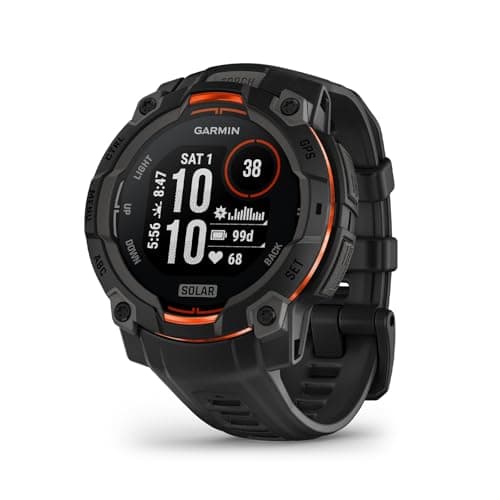
Multi-day trail and backcountry daysGarmin Instinct 3 Solar (45mm)
The watch that wins this site's rubric by publishing an honest battery table and then filling every row of it. No maps, and it still ranks first on trail.
$399.9938% off
Price as of November 21, 2026. Prices move; Amazon's is the one that counts.
#ad · we may earn a commission from this link to Garmin Instinct 3 Solar (45mm)
The short answer
The Garmin Instinct 3 Solar is the pick under $500: 24 stated hours in all-satellite plus multi-band mode, 40 GPS-only, 28 smartwatch days and a 10 ATM case. The budget pick is the COROS PACE 4 at under $500 today, which states 41 GPS hours in a 32-gram watch. Neither has ever been independently measured.
Ranked
Quick picks
| # | Device | Best for | Evidence | Score | Price |
|---|---|---|---|---|---|
| 01 | Garmin Instinct 3 Solar (45mm) The watch that wins this site's rubric by publishing an honest battery table and then filling every row of it. No maps, and it still ranks first on trail. | Multi-day trail and backcountry days | Manufacturer specification | 7.7/10 | $249.99Amazon |
| 02 | 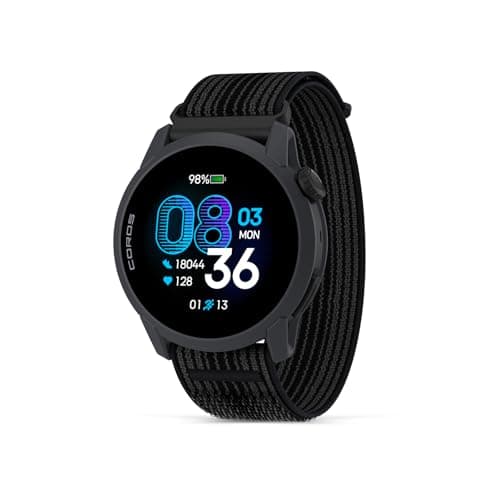 COROS PACE 4 41 stated GPS hours in a 32-gram watch, for a third of the Forerunner 970's money. The endurance-per-dollar winner by a distance. | Long days on a budget | Independent measured test | 7.5/10 | $249.00Amazon |
| 03 | 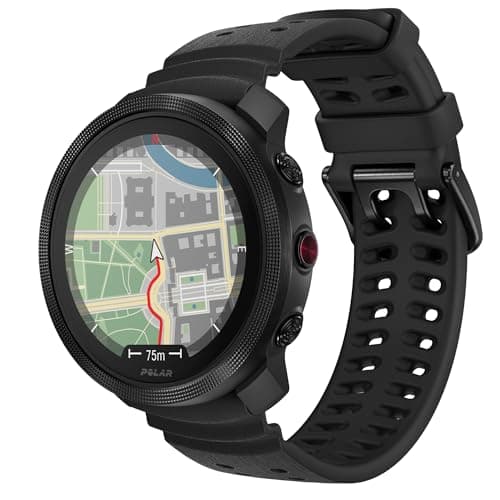 Polar Vantage M3 The pick when positioning accuracy is the thing you actually care about — Polar was the one brand under 5% error in the eight-watch validation study. | Runners who want the best-validated GPS | Peer-reviewed validation | 7.5/10 | $412.36Amazon |
| 04 | 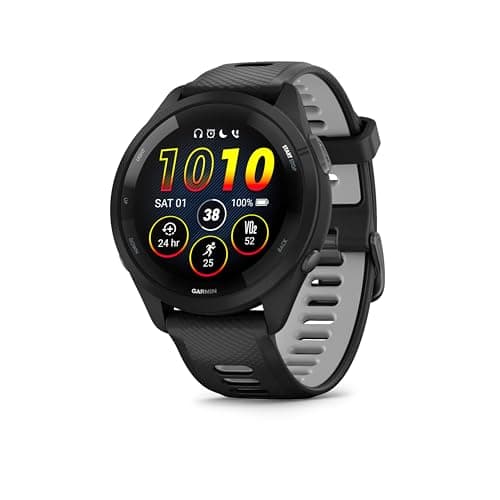 Garmin Forerunner 265 One of the very few watches on this site whose training estimates have actually been measured against a laboratory — and the measurement was not kind. | Runners who want a measured device, flaws included | Peer-reviewed validation | 7.2/10 | $299.99Amazon |
| 05 | 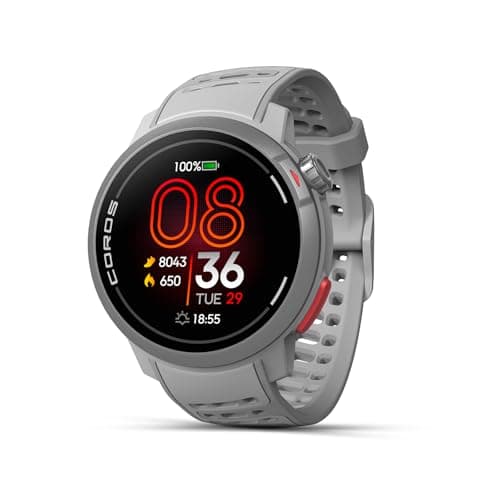 COROS PACE Pro The cheapest route to global maps with turn-by-turn navigation on a wrist, and the only watch in the PACE line whose dual-frequency battery figure COROS is willing to publish. | Navigation on a PACE budget | No validation study exists | 6.9/10 | $299.00Amazon |
#ad· Live prices from the Amazon Product API, as of November 21, 2026. Where we have no verified live price we show none. Scores come from the published rubric at How we rank — the Evidence column shows what each ranking actually rests on, including where the answer is nothing.
What the $500 line actually buys
This is the widest band on the site. Below $300 you are choosing between watches that each gave something up, and that field is ranked on its own page at best running watches on a budget. Above $1,000 you are buying case materials, maps and satellite messaging, costed at best running watches under $1,000. The band in between is where the interesting trade sits, because it is the first place a runner can buy the two things that actually change a recorded file: a receiver that can see two satellite frequencies, and enough battery to still be recording at the end of a long day.
Here is the part the sticker price hides. The longest stated GPS endurance figure of any watch on this site belongs to a watch in this bracket, not to a flagship. COROS states 41 hours for the PACE 4 in All-Systems mode; Garmin states 26 hours for the Forerunner 970. That is not a rounding difference and it is not a cherry-picked mode: both numbers are the maker's own figure for a satellite mode you would actually run. The price gap between those two watches is $401.
How this page ranks, before any picks
Three published rows decide the order, and all three are things you can check yourself on a manufacturer page before you spend anything.
One: does the battery table have a multi-band row at all? Garmin publishes a separate line for every satellite mode a watch supports, so the absence of an all-systems-plus-multi-band row is not an omission, it is the specification. The Instinct 3 Solar manual carries five rows including multi-band. The vivoactive 6 manual, at the same list price as two watches on this page, has no such row anywhere, and that is how you know its receiver is single-frequency. What dual-frequency reception is for, and when it matters, is at what dual-band GPS actually is.
Two: how many hours does the maker claim in that accurate mode? Not the headline GPS-only figure, and not the power-saving one. Every number on this page names the mode it describes, because a 40-hour figure from a single-frequency mode and a 24-hour figure from a multi-band mode are not comparable quantities, and printing them next to each other without the labels is how spec tables mislead people.
Three: has anything about this watch ever been measured by someone who does not sell it? This is the row that moves our ranking most, because it carries the largest weight in the published rubric. It is also the row where this bracket is unusual: one watch here has a peer-reviewed measurement of its own threshold feature, which almost nothing in the category can claim, and the measurement was unflattering enough to cost it two places.
The pick: the Instinct 3 Solar, because it publishes everything and then fills it
The Garmin Instinct 3 Solar(45 mm) tops this page on the rubric and it is not close. Garmin's own manual states 28 days in smartwatch mode, 40 hours GPS-only, 28 hours all-satellite, 24 hours all-satellite plus multi-band and 36 days in expedition mode, each with a separate solar-assisted figure alongside it, and a 10 ATM water rating. Five satellite rows, each named, with the assumptions stated: the solar numbers assume all-day wear in 50,000 lux, which is Garmin's assumption and not a measurement anyone here made. That is the most honest battery table of any watch on this site, and at $10.42 per stated multi-band hour it is also the cheapest accurate-mode endurance in the bracket.
The honest cons are real and there are two. It has no maps at all, which on an unfamiliar trail is the feature people miss first - breadcrumb navigation on a route you have never run is genuinely worse than a map, and no amount of battery compensates. And no independent validation of its heart rate or positioning exists that we could find. It wins here on the quality and completeness of what Garmin publishes, plus arithmetic. It does not win on measurement, because there is no measurement.
The budget pick: the COROS PACE 4, and the endurance that embarrasses the price list
The COROS PACE 4 is under $500 today and is the cheapest watch on this page. COROS states 41 GPS hours in All-Systems mode, 19 days of daily training and sleep tracking, a 32-gram weight with the nylon band, an 11.8 mm case and both All-Systems and Dual-Frequency satellite modes behind a 1.2-inch AMOLED. At $6.07 per stated GPS hour it is the strongest cost-per-endurance figure anywhere on this site.
Thirty-two grams deserves a sentence of its own. Over a four-hour run, weight is the spec you notice and satellite constellations are the spec you do not, and this is the lightest watch in the bracket by a clear margin.
Two honest cons. First, COROS publishes no battery figure for Dual-Frequency mode on the PACE 4 - the 41-hour number is the All-Systems row, so the accurate mode on this watch is uncosted, and that is the single reason it does not take first place here. Second, it carries the only unfavorable independent heart-rate result in the range: the5krunner's ten-mile comparison of the previous-generation PACE 3 found wrist heart rate diverged during and after rapid intensity change. That tested the PACE 3, not the PACE 4, and the author cautions the dataset was limited; COROS states the PACE 4 has a redesigned sensor, and no independent test of the new sensor has been published that we could find. If you train by heart rate, budget for a strap - see the last section.
The Polar Vantage M3 carries the only favorable GPS study in the category
The Polar Vantage M3 ties the PACE 4 on the rubric at 7.5 and gets there along a completely different route: it is the only watch in this bracket whose brand has a favorable peer-reviewed positioning result attached to it. In Gilgen-Ammann et al. (2020), eight watches were measured against a trundle wheel accurate to 1 cm across urban, forest and 400 m track conditions, and only Polar's receivers stayed under 5% distance error in every condition. Polar states dual-frequency GNSS for the M3, plus turn-by-turn navigation and offline maps - navigation at this price, which the two watches above it do not offer at all.
The cons here are unusually important, because the study is the entire case for the watch. That paper is from 2020 and tested the Vantage M, Vantage V and V800- none of them this watch, and all of them single-frequency receivers that predate the hardware generation now standard. It is evidence about Polar's GNSS engineering history, not a measurement of the M3. And separately, this site quotes no stated battery figure for the M3 at all: Polar's own specification page for it has not been readable from here on any attempt since August, so there is no manufacturer-stated hour count to put in the table, and we will not print one we have not read. Polar's wider record is at the best Polar watches.
The Forerunner 265 is the one watch here that has actually been measured
The Garmin Forerunner 265 is the only watch on this page with a peer-reviewed measurement of its own output, and it ranks fourth because of what the measurement said. In Lu et al. (2025), 100 recreational runners were tested against a treadmill graded exercise test with fingertip blood lactate; 23 of them wore a Forerunner 265 or 265s. Its threshold pace estimate carried a mean error of 25.78% and overestimated rather than erring low; its threshold heart rate was much closer, inside the 5.95-7.15% band shared by all three watches tested; and its threshold test returned a usable result 65.2% of the time. The authors note the Garmin protocol required an ECG chest strap while the other two devices used wrist sensing.
On specification, Garmin states 20 GPS-only hours, 14 hours all-satellite plus multi-band and 13 smartwatch days, with up to 8 GB of media storage, a 46 mm AMOLED case (42 mm as the 265S) and a 5 ATM rating. Multi-band at this price is the real value, and it is the row the cheaper lifestyle Garmins do not have.
The cons: those 14 multi-band hours are the shortest accurate-mode figure on this page, roughly a third of what the Instinct 3 Solar states, and the published threshold result means you should not set training zones from the watch's own test. Skip it on that basis if that feature is why you were buying. What a watch-derived threshold is worth in general is at what a lactate threshold estimate is worth.
The COROS PACE Pro is the cheapest route to real maps, and it costs hours
The COROS PACE Pro ranks last here at 6.9 and still earns its place, because it answers a question none of the four above it does: it is the cheapest watch in the bracket with global maps and turn-by-turn navigation, and it is the only watch in the PACE line for which COROS publishes a dual-frequency battery figure - 31 hours, alongside 38 hours of GPS activity tracking, 20 days of daily use, a 37-gram weight and a 1500-nit always-on AMOLED. That 31-hour number is the only costed accurate mode in the COROS range, which is worth more than it sounds: it is the one place the brand tells you what dual-frequency reception costs in battery.
The cons are blunt. It is heavier, shorter-lived and more expensive than the PACE 4 on every stated number except daily use, its optical sensor predates the redesigned one COROS describes on the newer watch, and no independent measurement of it exists at all- its evidence tier on this site is "no validation study exists", said out loud rather than hidden. Strip the maps out of your decision and the PACE 4 is the better buy. The full brand field is at the best COROS watches.
What is deliberately not on this page
Three absences, each for a reason. The sub-$300 watches are not ranked here even though several of them qualify on price, because they are a different purchase with a different criterion and they already have a page of their own; the COROS PACE 3 in particular scores 7.4 and would slot between the Vantage M3 and the Forerunner 265 on raw rubric. If your budget is really $250, read that page instead of this one.
No watch here has full-color built-in mapping of the fenix kind, because nothing under $500 on this roster offers it - the Vantage M3 and PACE Pro offer navigation, which is not the same experience. And nothing here has been validated for sleep staging, which is true of every watch on this site and is why the sleep field is a separate category entirely at the most accurate sleep trackers.
The accuracy upgrade that costs about a hundred dollars
If the reason you are shopping in this bracket is that you stopped trusting your current watch's heart rate, the cheapest real fix is not on this page. It is a chest electrode. The 2025 placement study used a Polar H10 as its reference instrument and measured three identical Whoop units at wrist, forearm and upper arm: position beat device, and the wrist was the weakest site, with limits of agreement of plus or minus 10-19 bpm at warm-up. Whether a given watch will read a strap is worth confirming in its own manual before you buy: Garmin documents ANT+ and Bluetooth sensor pairing explicitly in the owner's manuals for its watches, naming the HRM 200 and HRM 600 by model.
The category-wide picture is worth holding onto while you spend this money. The 2024 living umbrella review covered 24 systematic reviews over 249 primary validation studies and 430,465 participants, and found roughly 34 of 310 identified consumer wearables had ever been validated at all, with heart rate at approximately plus or minus 3% and a mean bias of -3.39 bpm across the category. There is no published basis for the claim that a $500 wrist sensor reads better than a $250 one. What the extra money buys in this bracket is satellite modes, battery, materials and navigation - all four of which are real, and none of which is the sensor. The strap field is at the most accurate heart rate monitors.
The same ceiling, for a walk instead of a run
If the days you actually record are long walks rather than sessions, the ranking under the same $500 ceiling comes out differently: navigation becomes the row that decides the order and raw sampling accuracy matters less. That field, with the Suunto tour-mode figure and the Polar navigation claim weighed properly, is at best hiking watches under $500.
In full
Every pick, and why
Garmin Instinct 3 Solar (45mm)
The watch that wins this site's rubric by publishing an honest battery table and then filling every row of it. No maps, and it still ranks first on trail.
- Battery, smartwatch (stated)
- 28 days, unlimited with solar
- Battery, GPS-only (stated)
- 40 h, up to 130 h with solar
- Battery, multi-band (stated)
- 24 h, up to 40 h with solar
- Battery, expedition (stated)
- 36 days, unlimited with solar
- Water rating
- 10 ATM
What's good
- Garmin publishes five separate GPS endurance figures for it, mode by mode — the most honest battery table of any watch on this site
- 24 stated hours in all-satellite multi-band mode, which is the mode you would actually run for accuracy
- Solar charging turns the smartwatch and expedition figures into 'unlimited' under Garmin's stated light conditions
What isn't
- No built-in maps at all, which on unfamiliar trail is the feature people miss first
- No independent validation of its heart rate or positioning that we could find
Skip this if
Skip this if you navigate unfamiliar routes rather than repeat known ones. Breadcrumb navigation on a trail you have never run is a genuinely worse experience than a map, and no amount of battery compensates for it.
What the evidence says
Manufacturer specificationNo independent validation of this device that we could find. What Garmin does publish is unusually complete: a five-row battery table naming each satellite mode separately, with the solar-assisted figures stated separately from the unassisted ones. We rank the unassisted multi-band row, because that is the number you can rely on in a forest.
Show how this 7.7 was calculated
| Factor | Weight | Score |
|---|---|---|
| EvidenceNo measured validation, but the published specification is more granular and more honest about its own assumptions than any other spec sheet here. | 30% | 5.5 |
| HardwareAll-satellite plus multi-band positioning, a solar charging lens and a 10 ATM case. | 20% | 8.5 |
| Metric coverageFull Garmin training and outdoor feature set, minus maps — which on trail is a real omission. | 20% | 7.5 |
| Endurance40 stated GPS-only hours, 24 in multi-band, 28 smartwatch days and 36 expedition days, before solar is counted at all. | 15% | 10.0 |
| Cost per capabilityFlagship endurance at roughly a third of flagship money. | 15% | 9.0 |
$399.9938% off
Price as of November 21, 2026. Prices move; Amazon's is the one that counts.
#ad · we may earn a commission from this link to Garmin Instinct 3 Solar (45mm)
COROS PACE 4
41 stated GPS hours in a 32-gram watch, for a third of the Forerunner 970's money. The endurance-per-dollar winner by a distance.
- Display
- 1.2" AMOLED touchscreen
- Weight
- 32 g with nylon band, 40 g with silicone
- Satellite
- All-Systems and Dual-Frequency modes
- Battery (stated)
- 19 days daily use / 41 h GPS (All-Systems)
- Thickness
- 11.8 mm
What's good
- 41 manufacturer-stated GPS hours — more than the Forerunner 970 and the 570 combined
- 32 g is light enough that you stop noticing it, which matters more over 100 miles than any feature
- Dual-frequency positioning at an entry-level price
What isn't
- COROS wrist heart rate is the one area where an independent test has published a specific problem — see the evidence note
- Smaller third-party app ecosystem than Garmin's
Skip this if
Skip this if you train by heart rate off the wrist and will not wear a strap. The one independent test we found flagged COROS wrist HR during exactly the intervals you would be buying it for.
What the evidence says
Independent measured testThe5krunner's measured comparison found the previous-generation PACE 3's wrist heart rate diverged during and after rapid intensity changes. That test was of the PACE 3, not the PACE 4, and the author cautions the dataset was limited. COROS states the PACE 4 has a redesigned sensor; no independent test of the new sensor has been published that we could find.
Show how this 7.5 was calculated
| Factor | Weight | Score |
|---|---|---|
| EvidenceThe only independent measured evidence in the range is a limited-dataset test of the PREVIOUS model, and it was unfavorable. The redesigned sensor is unvalidated. | 30% | 4.5 |
| HardwareDual-frequency GNSS and a redesigned optical sensor, per the COROS spec page. | 20% | 8.0 |
| Metric coverageStrong training metrics; a narrower ecosystem than Garmin for third-party integrations. | 20% | 7.5 |
| Endurance41 stated GPS hours in All-Systems mode is the best in this roundup by a wide margin. | 15% | 10.0 |
| Cost per capabilityComfortably the strongest dollars-per-GPS-hour figure on the site. | 15% | 10.0 |
Price as of November 21, 2026. Prices move; Amazon's is the one that counts.
#ad · we may earn a commission from this link to COROS PACE 4
Polar Vantage M3
The pick when positioning accuracy is the thing you actually care about — Polar was the one brand under 5% error in the eight-watch validation study.
- Display
- AMOLED
- Satellite
- Dual-frequency GNSS
- Extras
- Turn-by-turn navigation, offline maps
What's good
- Polar is the only brand that came in under 5% distance error across all conditions in the JMIR eight-watch study
- Dual-frequency positioning plus offline maps at a mid-range price
What isn't
- The validation that flatters Polar is from 2020 and tested older models — it is evidence about the brand's GNSS engineering, not a measurement of this watch
- Smaller ecosystem than Garmin
Skip this if
Skip this if you are deep in Garmin's ecosystem already. Nothing here is enough better to justify rebuilding your training history somewhere else.
What the evidence says
Peer-reviewed validationThe peer-reviewed evidence is brand-level and dated: Gilgen-Ammann et al. (2020) measured eight watches against a trundle wheel and found only Polar's receivers stayed under 5% error. That study tested the Vantage M, Vantage V and V800 — not the M3.
Show how this 7.5 was calculated
| Factor | Weight | Score |
|---|---|---|
| EvidenceThe only brand in this roundup with a favorable peer-reviewed positioning result — but the study is from 2020 and tested earlier models, so it is dated brand evidence, not a measurement of this watch. | 30% | 7.0 |
| HardwareDual-frequency GNSS with offline maps. | 20% | 8.5 |
| Metric coverageStrong training-load and recovery platform; good sensor support. | 20% | 8.0 |
| EnduranceCompetitive for an AMOLED multi-sport watch, per Polar's stated figures. | 15% | 7.0 |
| Cost per capabilityMid-range pricing for dual-frequency plus maps. | 15% | 7.0 |
$499.9918% off
Price as of November 21, 2026. Prices move; Amazon's is the one that counts.
#ad · we may earn a commission from this link to Polar Vantage M3
Garmin Forerunner 265
One of the very few watches on this site whose training estimates have actually been measured against a laboratory — and the measurement was not kind.
- Case
- 46mm AMOLED (the 265S is 42mm)
- Satellite
- All + Multi-Band GPS
- Battery (stated)
- 13 days smartwatch / 20 h GPS-only / 14 h all + multi-band
- Storage
- Up to 8 GB media, 5 ATM
What's good
- Multi-band positioning and an AMOLED screen in a mid-range Forerunner, in two case sizes
- It has actually been tested: in a 2025 study of 100 recreational runners, 23 of them wore a Forerunner 265 against fingertip blood lactate — more than can be said for most watches sold today
- 8 GB of on-watch music storage, so the phone can stay at home
What isn't
- In that study its threshold PACE estimate overshot the laboratory value by 25.78% on average, and it overestimated rather than erring low
- Its threshold test also failed to return a usable result 34.8% of the time
Skip this if
Skip this if you plan to set training zones from the watch's own threshold test. The one published measurement of that feature says it overestimates by roughly a quarter, and no firmware note undoes a published result.
What the evidence says
Peer-reviewed validationLu et al., Frontiers in Physiology 16:1621996 (2025), tested 100 recreational runners against fingertip blood lactate; 23 of them wore a Forerunner 265 or 265s. Its threshold pace estimate carried a mean error of 25.78% and overestimated; its threshold heart rate was much closer, inside the 5.95-7.15% band shared by the three watches tested; and its test produced a usable result 65.2% of the time. The authors note the Garmin protocol required an ECG chest strap while the other two devices used wrist sensing. That is a peer-reviewed measurement of this exact model — unusual in this category, and unflattering.
Show how this 7.2 was calculated
| Factor | Weight | Score |
|---|---|---|
| EvidenceA peer-reviewed measurement of this specific watch exists, which almost nothing else in the range can claim. It went badly, so this cannot score higher than mid. | 30% | 6.0 |
| HardwareAll + Multi-Band GPS and an AMOLED display in a mid-range case. | 20% | 8.5 |
| Metric coverageFull Garmin training platform and music storage; no maps. | 20% | 8.5 |
| EnduranceGarmin states 20 hours GPS-only, 14 hours all + multi-band, 13 days smartwatch. | 15% | 6.5 |
| Cost per capabilityMid-range sticker; a multi-band receiver at this price is the value here. | 15% | 7.0 |
$449.9933% off
Price as of November 21, 2026. Prices move; Amazon's is the one that counts.
#ad · we may earn a commission from this link to Garmin Forerunner 265
COROS PACE Pro
The cheapest route to global maps with turn-by-turn navigation on a wrist, and the only watch in the PACE line whose dual-frequency battery figure COROS is willing to publish.
- Display
- 1.3" always-on AMOLED touchscreen, 1500 nits
- Weight
- 37 g with the nylon band
- Satellite
- All-Systems and Dual-Frequency modes
- Battery (stated)
- 20 days daily use / 38 h GPS / 31 h dual-frequency
- Navigation
- Global maps with turn-by-turn navigation
- Processor
- Ambiq Apollo510
What's good
- The only device in the PACE line for which COROS publishes a dual-frequency battery figure — 31 hours — instead of leaving the accurate mode uncosted
- Global maps with turn-by-turn navigation, which the PACE 4 does not claim at any price
- A 1500-nit always-on AMOLED, which is the brightest screen COROS publishes a figure for in this range
What isn't
- No independent validation of its heart rate or positioning exists that we could find, and its optical sensor predates the redesigned one COROS describes on the PACE 4
- Heavier and shorter-lived than the cheaper PACE 4 on every stated number except daily use
Skip this if
Skip this if you never navigate. Strip the maps out of the decision and the PACE 4 is lighter, cheaper and longer-lived, and you are paying a premium for a screen and a menu you will not open.
What the evidence says
No validation study existsNo independent measurement of this watch exists that we could find as of August 2026. The only measured COROS heart-rate result on record is the5krunner's limited-dataset comparison of the PACE 3, which found divergence during and after rapid intensity change. That test was of a different watch, so it is not evidence about this one either way — which is the point: there is nothing here to weigh.
Show how this 6.9 was calculated
| Factor | Weight | Score |
|---|---|---|
| EvidenceNothing published measures this watch. The only COROS result on record tested the PACE 3, so this device is ranked on specification alone — which is exactly what caps it. | 30% | 4.5 |
| HardwareAll-Systems and Dual-Frequency satellite modes and an Ambiq Apollo510 processor, per COROS. Its optical sensor predates the redesigned one COROS describes on the PACE 4. | 20% | 7.5 |
| Metric coverageFull COROS training platform plus SpO2, and global maps with turn-by-turn navigation the PACE 4 does not claim. Same narrower third-party ecosystem as the rest of the range. | 20% | 8.0 |
| EnduranceCOROS states 31 hours in dual-frequency mode, 38 hours of GPS activity tracking and 20 days of daily use. We carry the dual-frequency number, because that is the mode the positioning hardware was bought for. | 15% | 9.0 |
| Cost per capabilityMid-range sticker for dual-frequency plus maps. Per dual-frequency GPS hour it sits behind both the PACE 4 and the PACE 3 — that gap is what the maps cost. | 15% | 7.5 |
Price as of November 21, 2026. Prices move; Amazon's is the one that counts.
#ad · we may earn a commission from this link to COROS PACE Pro
What to check before you spend $500 on a running watch
- Open the maker's battery table and count the satellite rows. If there is no multi-band or dual-frequency line, the hardware does not have the mode. That single check separates this bracket more cleanly than any review score.
- Read which mode each hour figure names. Forty hours GPS-only and 24 hours multi-band can be the same watch. Compare accurate mode to accurate mode or you are comparing nothing.
- Decide whether you navigate or just record. Navigation is the one capability in this band you cannot add later, and it is the entire reason the PACE Pro costs more than the PACE 4.
- Check for an independent measurement, and expect not to find one. Four of these five watches have none. That is normal in this category, and it is why this site weights evidence at 30% rather than pretending the gap does not exist.
- Budget about $100 of your $500 for a chest strap if heart rate matters to you. It is the only upgrade here with a peer-reviewed reason behind it.
- Check the live price before you commit. Every bracket claim on this page is computed from the price layer on the date shown rather than typed in - watches in this band move in and out of it on discount.
How this ranking was built
Every score on this page comes from one published rubric, applied identically to every device on the site, with the weights written down and the inputs shown. We have not worn any of these devices and we never say we have. Read the method and check us.
Questions
Frequently asked
What is the best running watch under $500?
The Garmin Instinct 3 Solar on this site's rubric: Garmin publishes 24 stated hours in all-satellite plus multi-band mode, 40 GPS-only, 28 smartwatch days and a 10 ATM case, mode by mode. Its weaknesses are no maps and no independent validation of anything it measures.
Can you get a multi-band GPS watch under $500?
Yes, and it is the main thing worth paying for in this band. The Instinct 3 Solar and the Forerunner 265 both publish an all-satellite-plus-multi-band battery row, and the Vantage M3 and PACE Pro state dual-frequency modes. Garmin's cheaper lifestyle watches do not, and Garmin's own battery table is how you can tell.
Which watch under $500 has the longest battery life?
On manufacturer-stated figures, the COROS PACE 4 at 41 GPS hours in All-Systems mode and 19 days of daily use. The Instinct 3 Solar states 40 GPS-only hours but publishes a multi-band row the PACE 4 does not, plus solar figures on top of every row.
Is a $500 running watch more accurate than a $250 one?
Not for heart rate, on the published record - the umbrella review reports category-wide accuracy rather than a price gradient, and most consumer wearables have never been validated at any price. Positioning is the exception: a dual-frequency receiver is real hardware that a single-frequency watch cannot match in cities or under tree cover.
Should I spend the rest on a chest strap instead of a better watch?
If heart rate is the number you train by, yes. A chest electrode is what researchers use as their reference instrument and it costs around a hundred dollars. Check the manual for whichever watch you shortlist - Garmin documents ANT+ and Bluetooth strap pairing explicitly, naming the HRM 200 and HRM 600. The field is at best chest strap heart rate monitors.
Show your working
Sources
Every one of these was read in full before it was cited. Where we could not access a paper, we do not quote its numbers.
- [1]Manufacturer specification2026Garmin — Instinct 3 Solar owner’s manual, battery life information
Manufacturer-stated for the 45 mm Solar: 28 days smartwatch (unlimited with solar), 40 hours GPS-only (130 hours with solar), 28 hours all-satellite (50 with solar), 24 hours all-satellite plus multi-band (40 with solar), 36 days expedition GPS (unlimited with solar), 65 days battery-saver. Water rating 10 ATM per the same manual’s specification page. Solar figures assume all-day wear in 50,000 lux conditions, which is Garmin’s assumption and not a measurement of ours.
- [2]Manufacturer specification2026COROS — PACE 4 published specifications
Manufacturer-stated: 1.2" AMOLED, 32 g with nylon band, 11.8 mm thick, All-Systems and Dual-Frequency satellite modes, 41 GPS hours, 19 days of daily training and sleep.
- [3]Manufacturer specification2026COROS — PACE Pro published specifications
Manufacturer-stated: 1.3" always-on AMOLED touchscreen at 1500 nits, 37 g with the nylon band, All-Systems and Dual-Frequency satellite modes, 38 hours of GPS activity tracking, 31 hours with dual-frequency GPS, 20 days of daily use and sleep tracking, 6 days with the always-on display, global maps with turn-by-turn navigation, an Ambiq Apollo510 processor and an optical heart-rate plus SpO2 sensor. COROS's own launch release dates the watch to 31 October 2024 at $349.
- [4]Peer-reviewed validation2020Gilgen-Ammann, Schweizer & Wyss, “Accuracy of Distance Recordings in Eight Positioning-Enabled Sport Watches: Instrument Validation Study”, JMIR mHealth and uHealth
DOI 10.2196/17118. Eight watches (Apple Watch Series 4, Coros Apex 46mm, Garmin Fenix 5X Plus, Garmin Forerunner 935, Polar Vantage M, Polar Vantage V, Polar V800, Suunto 9 Baro) measured against a trundle wheel accurate to 1 cm, across urban, forest and 400 m track conditions. IMPORTANT: this predates the dual-frequency receivers now standard, so it describes brand engineering history, not any watch currently sold.
- [5]Peer-reviewed validation2025Lu, Cui, Zhu, Wu, Xing, Pan & Shen, “Validity of smartwatch-derived estimates of lactate threshold heart rate and pace compared to graded exercise testing”, Frontiers in Physiology 16:1621996
DOI 10.3389/fphys.2025.1621996. 100 healthy recreational runners (61 male, 39 female, 28.0 ± 9.6 years) against a treadmill graded exercise test with fingertip blood lactate (Biosen C-line), threshold determined by the modified Dmax method. Device counts were unequal: Huawei GT Runner n = 100, Garmin Forerunner 265/265s n = 23, COROS PACE 3 n = 17. Authors’ stated limits: unbalanced samples, indoor reference against outdoor watch tests, day-to-day threshold variability, and different heart-rate acquisition between devices — the Garmin protocol required an ECG chest strap while the other two used wrist PPG — plus undisclosed manufacturer algorithms.
- [6]Manufacturer specification2026Garmin — Forerunner 265 Series owner’s manual, battery life information and specifications
Manufacturer-stated, read 2026-08-18. Forerunner 265 (46 mm): up to 13 days smartwatch mode, 20 h GPS-only, 16 h Auto Select GPS, 14 h All + Multi-Band GPS, and 7 h GPS-only with music playback. Forerunner 265S (42 mm): 15 days, 24 h, 18 h, 15 h and 7.5 h for the same modes. The manual’s specification page states 5 ATM and up to 8 GB of media storage.
- [7]Independent measured test2023the5krunner, measured heart-rate comparison of the COROS PACE 3
An independent measured test, not a peer-reviewed study, and the author explicitly cautions the dataset was limited. Compared against Garmin HRM-Pro Plus and Polar Verity Sense across easy runs, intervals and cycling. Found divergence during and after rapid intensity change. Tests the PACE 3, not the PACE 4.
- [8]Manufacturer specification2026Garmin — Forerunner 970 published specifications
Manufacturer-stated battery: up to 15 days smartwatch mode, up to 26 hours GPS mode.
- [9]Peer-reviewed validation2025“Impact of Anatomical Placement on the Accuracy of Wearable Heart Rate Monitors During Rest and Various Exercise Intensities”, Sensors (Basel)
n = 28 (14 male, 14 female). Polar H10 chest strap as the reference. Compared Polar Verity Sense (forearm), Garmin Forerunner 55 (wrist) and three simultaneous Whoop 4.0 units at wrist, forearm and upper arm, across rest, cycling warm-up, burpees and a modified Bruce treadmill protocol.
- [10]Peer-reviewed validation2024Doherty, Baldwin, Keogh, Caulfield & Argent, “Keeping Pace with Wearables: A Living Umbrella Review of Systematic Reviews Evaluating the Accuracy of Consumer Wearable Technologies in Health Measurement”, Sports Medicine
DOI 10.1007/s40279-024-02077-2. An umbrella review: 24 systematic reviews covering 249 unique primary validation studies and 430,465 participants (43% female), across 11 biometric outcomes, with roughly 34 of 310 identified consumer wearables ever validated. Reported accuracy by metric: heart rate approximately ±3% (mean bias −3.39 bpm); step count mean absolute percentage error from −9% to 12%; energy expenditure mean bias −3 kcal per minute with error ranging from −21.27% to 14.76%. Authors’ stated limits: a temporal lag between device release and published research, the intrinsic bias of a tertiary synthesis, and heterogeneity of protocols, devices, criterion measures and statistics severe enough that the authors did not pool a meta-analysis.
Read next
Related
- Best running watches on a budget
The sub-$300 field, deliberately kept off this page.
- Best Garmin watches under $500
The same ceiling, one brand, five picks.
- What is dual-band GPS?
The capability this bracket is really deciding about.
- Best fitness trackers under $300
The cross-form-factor version of this question, one band lower.
- Best hiking watches under $500
The same price ceiling, ranked for multi-day walking rather than running.