GPS and multisport
The best Garmin watches under $500
Under five hundred dollars the Garmin range divides on a single published row, and most buyers never see it. Two of these five watches have a multi-band satellite mode. The other three do not, and Garmin tells you so by leaving the row out.
We earn a commission when you buy through our Amazon links, at no extra cost to you. It never decides a ranking — the rubric that does is published in full, so you can check us rather than take our word for it. How this works.
Top pick
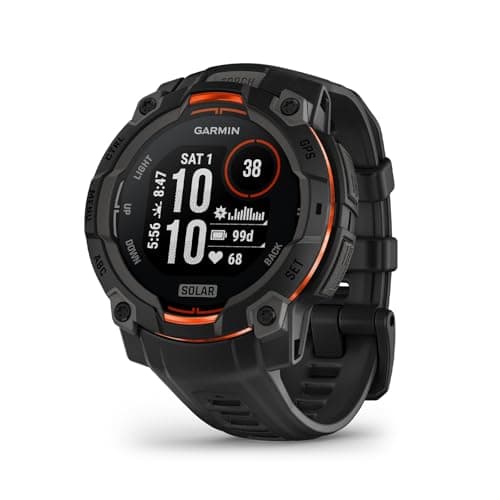
Multi-day trail and backcountry daysGarmin Instinct 3 Solar (45mm)
The watch that wins this site's rubric by publishing an honest battery table and then filling every row of it. No maps, and it still ranks first on trail.
$399.9938% off
Price as of November 21, 2026. Prices move; Amazon's is the one that counts.
#ad · we may earn a commission from this link to Garmin Instinct 3 Solar (45mm)
The short answer
The Garmin Instinct 3 Solar is the pick under $500: it is the only watch here with both a multi-band satellite mode and a 10 ATM case, and Garmin states 24 hours in that mode or 40 with solar. The budget pick is the Forerunner 165 at under $200 today - a real training watch, with no multi-band mode. If you want one watch for training and everyday wear instead, the Venu 3 is the answer.
Ranked
Quick picks
| # | Device | Best for | Evidence | Score | Price |
|---|---|---|---|---|---|
| 01 | Garmin Instinct 3 Solar (45mm) The watch that wins this site's rubric by publishing an honest battery table and then filling every row of it. No maps, and it still ranks first on trail. | Multi-day trail and backcountry days | Manufacturer specification | 7.7/10 | $249.99Amazon |
| 02 | 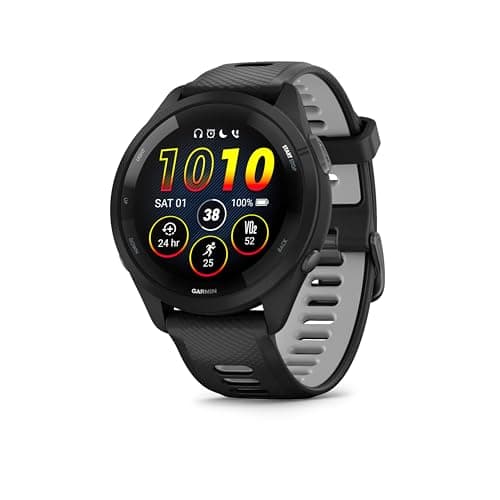 Garmin Forerunner 265 One of the very few watches on this site whose training estimates have actually been measured against a laboratory — and the measurement was not kind. | Runners who want a measured device, flaws included | Peer-reviewed validation | 7.2/10 | $299.99Amazon |
| 03 | 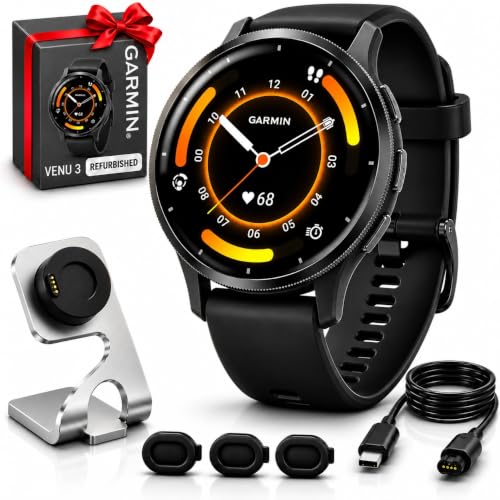 Garmin Venu 3 The sleep-and-recovery watch for people who already trust Garmin's training data. | One device for training and sleep | Manufacturer specification | 7.2/10 | $269.99Amazon |
| 04 | 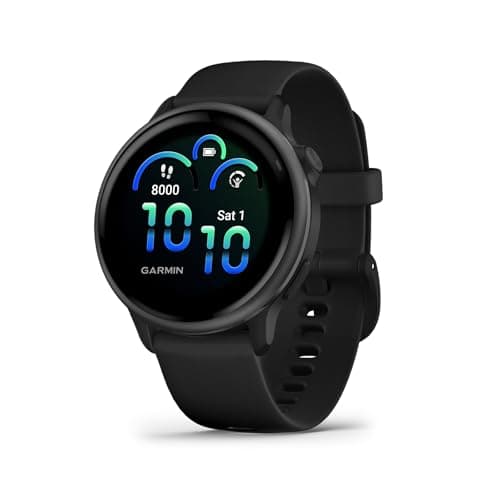 Garmin vívoactive 6 The cheapest Garmin that still pairs a chest strap and still estimates VO2 max — and the published battery table shows you why it outlasts a Forerunner. | A $300 Garmin for someone who already owns the strap | Manufacturer specification | 6.6/10 | $249.00Amazon |
| 05 | 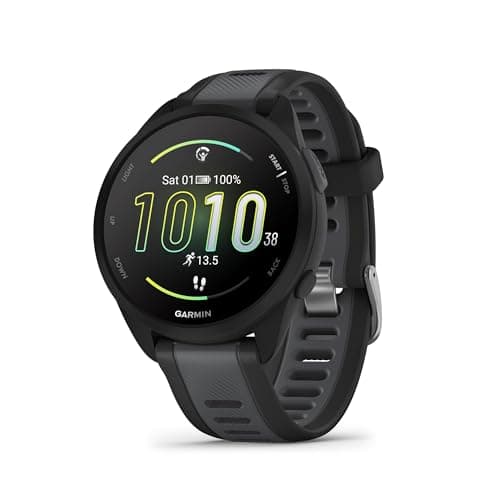 Garmin Forerunner 165 The cheapest way into a genuinely good AMOLED Garmin, provided you accept single-band positioning. | First real running watch | Manufacturer specification | 6.4/10 | $191.00Amazon |
#ad· Live prices from the Amazon Product API, as of November 21, 2026. Where we have no verified live price we show none. Scores come from the published rubric at How we rank — the Evidence column shows what each ranking actually rests on, including where the answer is nothing.
The row that splits the Garmin range under $500
Garmin publishes battery life per satellite mode, one row per mode, in every owner's manual. That habit is more useful than any review score, because the shape of the table tells you what the hardware can do. Of the five watches here, exactly two have an all-satellite-plus-multi-band row:
The Instinct 3 Solar at 45 mm states 24 hours all-satellite plus multi-band (40 with solar), 28 hours all-satellite (50 with solar), 40 hours GPS-only (130 with solar), 28 days smartwatch and 36 days expedition. The Forerunner 265 at 46 mm states 14 hours All + Multi-Band, 16 hours Auto Select, 20 hours GPS-only and 13 days smartwatch.
The other three publish no such row. The Venu 3 tops out at All Systems GPS - 20 hours, against 26 GPS-only and 14 days smartwatch. The vivoactive 6 tops out at all satellite systems - 17 hours, against 21 GPS-only and 11 days. The Forerunner 165 tops out at All Systems - 17 hours, against 19 GPS-only and 11 days. In all three cases the highest-accuracy row Garmin publishes is the top of what the hardware offers, because there is no multi-band mode to publish. Garmin prints that row for every watch that has one, so the absence is the specification.
Why it matters: multi-band is the mode that helps where positioning is hardest - cities, canyons, heavy tree cover. If you train on open roads it changes little. If you race in a downtown or run under canopy, it is the only thing on this page that addresses it. The mechanism is explained at what is dual-band GPS.
The cheapest watch here states more accurate-mode hours than the dearest
Put the two groups side by side and the price order inverts. The Forerunner 165, the cheapest watch on this page, states 17 hours in its best satellite mode. The Forerunner 265, at more than twice the money, states 14 hours in its best satellite mode. That is not a mistake on Garmin's part - multi-band costs battery, so the watch with the better receiver reports the shorter accurate-mode figure. Anyone reading only the headline endurance number would conclude the cheap watch is the better one, and on that one row they would be right.
What the 265 actually buys is the receiver, the AMOLED screen, 8 GB of media storage and Garmin's full training stack - plus the only peer-reviewed result in this group. The comparison with the 165 is at Forerunner 165 vs 265.
Why the Instinct 3 Solar leads a field of AMOLED watches
The Instinct 3 Solaris the only watch here you could take somewhere with no power. Twenty-eight stated smartwatch days become unlimited with solar on Garmin's own assumption of all-day wear in 50,000 lux - which is Garmin's assumption and not a measurement of ours - and the 10 ATM case is two tiers above the 5 ATM swim rating every other watch on the page carries. It also has the multi-band mode, which no watch near its price other than the 265 does.
It is under $500 today, and $10.42 per stated GPS hour in its multi-band mode. Skip it if you want a bright screen: this is a monochrome memory-in-pixel watch and it looks it indoors. Full review: Garmin Instinct 3.
The Forerunner 265 is the one watch here anybody has measured
The Forerunner 265 is the only pick on this page with a peer-reviewed result attached, and the result is not kind. Lu and colleagues tested smartwatch-derived lactate-threshold estimates against graded exercise testing and the Garmin figures diverged substantially from the laboratory values. We rank it highly anyway, and on purpose: a device with a published measurement - even an unflattering one - is a device whose limits you can know, and that is precisely the trade this site exists to argue for. It is under $500 today. Full review: Garmin Forerunner 265.
The Venu 3 and the vivoactive 6 are the everyday pair
The Venu 3 is the longest-lasting watch in this group in daily use - 14 stated smartwatch days - and Garmin's specification page states a 5 ATM swim rating and a rechargeable built-in lithium-ion battery. Its case to the point: it is the Garmin you can wear to bed, with sleep coach and nap detection, and it costs less than the Forerunner 265. If you want to know what the newer model adds, the comparison is at Venu 3 vs Venu 4.
The vivoactive 6 is the cheapest AMOLED Garmin with the broadest everyday feature list, and its most consequential published line is the sensors page: it pairs ANT+ and Bluetooth sensors and Garmin names the HRM 600, HRM 200, HRM-Fit and HRM-Pro series. A vivoactive 6 and a chest strap measure heart rate better than any watch on this page does on its own. It is under $500 today and the review is at Garmin vivoactive 6.
The budget pick, and where the last fifty dollars should go
The Forerunner 165 is the cheapest real training watch Garmin sells and the honest entry point to the brand: an AMOLED screen, the training metrics, 4 GB of media storage on the Music edition, 5 ATM, and 17 stated All Systems GPS hours. No maps, no multi-band, no premium case.
And here is the recommendation that costs us money. If your budget is $500 and heart rate matters to you, the better purchase is not the $440 watch - it is the $190 watch plus a chest electrode. The 2025 anatomical-placement study put identical sensors at wrist, forearm and upper arm against a Polar H10 reference and found position, not brand, was the biggest variable - with the wrist weakest. Every Garmin on this page pairs a strap, and Garmin's own current strap lineup starts well under $100. The field is at best heart rate monitors for Garmin.
If your budget is not actually capped at $500, the full brand ladder including the flagships is at best Garmin watches.
Open the same ceiling to every brand and the ranking changes: at best running watches under $500 three of the five picks are not Garmins, and the longest stated GPS figure in the band belongs to a COROS rather than to anything in this list.
In full
Every pick, and why
Garmin Instinct 3 Solar (45mm)
The watch that wins this site's rubric by publishing an honest battery table and then filling every row of it. No maps, and it still ranks first on trail.
- Battery, smartwatch (stated)
- 28 days, unlimited with solar
- Battery, GPS-only (stated)
- 40 h, up to 130 h with solar
- Battery, multi-band (stated)
- 24 h, up to 40 h with solar
- Battery, expedition (stated)
- 36 days, unlimited with solar
- Water rating
- 10 ATM
What's good
- Garmin publishes five separate GPS endurance figures for it, mode by mode — the most honest battery table of any watch on this site
- 24 stated hours in all-satellite multi-band mode, which is the mode you would actually run for accuracy
- Solar charging turns the smartwatch and expedition figures into 'unlimited' under Garmin's stated light conditions
What isn't
- No built-in maps at all, which on unfamiliar trail is the feature people miss first
- No independent validation of its heart rate or positioning that we could find
Skip this if
Skip this if you navigate unfamiliar routes rather than repeat known ones. Breadcrumb navigation on a trail you have never run is a genuinely worse experience than a map, and no amount of battery compensates for it.
What the evidence says
Manufacturer specificationNo independent validation of this device that we could find. What Garmin does publish is unusually complete: a five-row battery table naming each satellite mode separately, with the solar-assisted figures stated separately from the unassisted ones. We rank the unassisted multi-band row, because that is the number you can rely on in a forest.
Show how this 7.7 was calculated
| Factor | Weight | Score |
|---|---|---|
| EvidenceNo measured validation, but the published specification is more granular and more honest about its own assumptions than any other spec sheet here. | 30% | 5.5 |
| HardwareAll-satellite plus multi-band positioning, a solar charging lens and a 10 ATM case. | 20% | 8.5 |
| Metric coverageFull Garmin training and outdoor feature set, minus maps — which on trail is a real omission. | 20% | 7.5 |
| Endurance40 stated GPS-only hours, 24 in multi-band, 28 smartwatch days and 36 expedition days, before solar is counted at all. | 15% | 10.0 |
| Cost per capabilityFlagship endurance at roughly a third of flagship money. | 15% | 9.0 |
$399.9938% off
Price as of November 21, 2026. Prices move; Amazon's is the one that counts.
#ad · we may earn a commission from this link to Garmin Instinct 3 Solar (45mm)
Garmin Forerunner 265
One of the very few watches on this site whose training estimates have actually been measured against a laboratory — and the measurement was not kind.
- Case
- 46mm AMOLED (the 265S is 42mm)
- Satellite
- All + Multi-Band GPS
- Battery (stated)
- 13 days smartwatch / 20 h GPS-only / 14 h all + multi-band
- Storage
- Up to 8 GB media, 5 ATM
What's good
- Multi-band positioning and an AMOLED screen in a mid-range Forerunner, in two case sizes
- It has actually been tested: in a 2025 study of 100 recreational runners, 23 of them wore a Forerunner 265 against fingertip blood lactate — more than can be said for most watches sold today
- 8 GB of on-watch music storage, so the phone can stay at home
What isn't
- In that study its threshold PACE estimate overshot the laboratory value by 25.78% on average, and it overestimated rather than erring low
- Its threshold test also failed to return a usable result 34.8% of the time
Skip this if
Skip this if you plan to set training zones from the watch's own threshold test. The one published measurement of that feature says it overestimates by roughly a quarter, and no firmware note undoes a published result.
What the evidence says
Peer-reviewed validationLu et al., Frontiers in Physiology 16:1621996 (2025), tested 100 recreational runners against fingertip blood lactate; 23 of them wore a Forerunner 265 or 265s. Its threshold pace estimate carried a mean error of 25.78% and overestimated; its threshold heart rate was much closer, inside the 5.95-7.15% band shared by the three watches tested; and its test produced a usable result 65.2% of the time. The authors note the Garmin protocol required an ECG chest strap while the other two devices used wrist sensing. That is a peer-reviewed measurement of this exact model — unusual in this category, and unflattering.
Show how this 7.2 was calculated
| Factor | Weight | Score |
|---|---|---|
| EvidenceA peer-reviewed measurement of this specific watch exists, which almost nothing else in the range can claim. It went badly, so this cannot score higher than mid. | 30% | 6.0 |
| HardwareAll + Multi-Band GPS and an AMOLED display in a mid-range case. | 20% | 8.5 |
| Metric coverageFull Garmin training platform and music storage; no maps. | 20% | 8.5 |
| EnduranceGarmin states 20 hours GPS-only, 14 hours all + multi-band, 13 days smartwatch. | 15% | 6.5 |
| Cost per capabilityMid-range sticker; a multi-band receiver at this price is the value here. | 15% | 7.0 |
$449.9933% off
Price as of November 21, 2026. Prices move; Amazon's is the one that counts.
#ad · we may earn a commission from this link to Garmin Forerunner 265
Garmin Venu 3
The sleep-and-recovery watch for people who already trust Garmin's training data.
- Display
- 45mm, AMOLED
- Battery (stated)
- Up to 14 days
- Extras
- Sleep coach, nap detection, wheelchair mode
What's good
- 14 stated days means it survives the nights as well as the days — the practical failure of sleep tracking on a sports watch is that it is on the charger at bedtime
- One device rather than a watch plus a ring
What isn't
- Garmin's sleep staging has no independent PSG validation we could find
- A wrist is a worse optical site than a finger
Skip this if
Skip this if sleep staging is the reason you are buying. The published record has nothing to say about Garmin's, and the device that does have a paper is a ring.
What the evidence says
Manufacturer specificationNo independent PSG validation of Garmin's sleep staging that we could find. Notably, Garmin was absent from the Robbins et al. (2024) comparison entirely, so there is no published head-to-head against Oura, Fitbit or Apple.
Show how this 7.2 was calculated
| Factor | Weight | Score |
|---|---|---|
| EvidencePublished specs only; conspicuously absent from the major PSG comparison study. | 30% | 4.5 |
| HardwareCurrent Garmin optical sensor in a wrist-worn AMOLED watch. | 20% | 8.0 |
| Metric coverageSleep, recovery, training and everyday smartwatch functions in one device. | 20% | 9.0 |
| Endurance14 stated days is enough to keep it on the wrist overnight. | 15% | 8.5 |
| Cost per capabilityNo subscription, and it replaces two devices. | 15% | 7.5 |
Price as of November 21, 2026. Prices move; Amazon's is the one that counts.
#ad · we may earn a commission from this link to Garmin Venu 3
Garmin vívoactive 6
The cheapest Garmin that still pairs a chest strap and still estimates VO2 max — and the published battery table shows you why it outlasts a Forerunner.
- Case
- 42mm, aluminum bezel, AMOLED
- Satellite
- GPS only or all systems — no multi-band row published
- Battery (stated)
- 11 days smartwatch / 17 h all satellite systems
- Maps
- None
- Sensors
- Pairs ANT+ / Bluetooth straps, HRM 600 and HRM 200 named
What's good
- Garmin's manual documents ANT+ and Bluetooth strap pairing, so the one real fix for wrist heart rate works on a $300 watch
- Carries its own VO2 max topic in the manual, plus PacePro, running dynamics, HRV status and Body Battery
- States longer endurance than a Forerunner 570 in every satellite mode it publishes — 21 h GPS-only against 18 h
What isn't
- No multi-band row exists anywhere in Garmin's own battery table, which is how you can tell the receiver is single-frequency
- Garmin's feature list names no training status, no acute load and no training readiness — the analysis layer a Forerunner or a Venu 4 gets
- No maps, one case size only, and no independent validation of anything it measures
Skip this if
Skip this if positioning accuracy is the weakness you are upgrading. The long battery here is partly a consequence of hardware that cannot run a multi-band mode, and no amount of software fixes a single-frequency receiver in a city or a canyon.
What the evidence says
Manufacturer specificationNo independent validation of this model exists that we could find — not of its optical heart rate, not of its sleep staging, not of its positioning. Garmin as a brand has at least been measured: two Garmin watches were among the eight tested against a trundle wheel by Gilgen-Ammann et al. (2020), and a Garmin device finished last of five on nocturnal HRV agreement in Dial et al. (2025). Neither study tested this watch, and the 2020 one predates the receiver generation it would need to describe.
Show how this 6.6 was calculated
| Factor | Weight | Score |
|---|---|---|
| EvidenceA detailed owner's manual with a per-mode battery table and documented feature definitions, and no independent measurement of a single number this watch produces. | 30% | 4.5 |
| HardwareGarmin's Elevate wrist sensor, an AMOLED display behind an aluminum bezel, multi-constellation GNSS — and no multi-band mode, which Garmin's own battery table gives away by having no row for one. Pairs ANT+ and Bluetooth sensors, including the HRM 600, which is worth more to heart-rate data than any wrist sensor revision. | 20% | 7.0 |
| Metric coverageVO2 max, PacePro, running dynamics, HRV status, Body Battery, sleep coach, Pulse Ox, stress, 80+ sports apps and a wheelchair mode. Missing: maps, an ECG app, and the training status / acute load / training readiness layer Garmin names on the tier above. | 20% | 7.5 |
| EnduranceGarmin states 11 smartwatch days, 21 days in battery saver, 21 hours GPS-only and 17 hours on all satellite systems. Longer than a Forerunner 570 in every mode both watches publish. | 15% | 8.0 |
| Cost per capabilityA $299.99 list price for a Garmin that estimates VO2 max and pairs a strap is a genuinely good number. It is not a great one, because an Amazfit Balance 2 publishes dual-band GNSS, offline maps, sapphire glass and 10 ATM at the same list price. | 15% | 7.5 |
$299.9917% off
Price as of November 21, 2026. Prices move; Amazon's is the one that counts.
#ad · we may earn a commission from this link to Garmin vívoactive 6
Garmin Forerunner 165
The cheapest way into a genuinely good AMOLED Garmin, provided you accept single-band positioning.
- Display
- AMOLED
- Satellite
- Single-band GNSS
- Extras
- Training metrics, sleep tracking, music on the Music edition
What's good
- AMOLED and Garmin's training platform at the bottom of the range
- Light, simple, and hard to get wrong as a first watch
What isn't
- Single-band positioning, which is the specification that actually degrades in cities and under tree cover
- No multi-band means it is the wrong upgrade if GPS drift is your complaint
Skip this if
Skip this if you are here because your GPS track wanders between buildings. Single-band is the hardware that causes that, and this watch has it.
What the evidence says
Manufacturer specificationPublished specifications only; no independent validation of this model that we could find.
Show how this 6.4 was calculated
| Factor | Weight | Score |
|---|---|---|
| EvidencePublished specs, no independent measured validation. | 30% | 5.0 |
| HardwareSingle-band GNSS — a genuine step down from the multi-band models above it. | 20% | 6.0 |
| Metric coverageFull Garmin training platform; fewer advanced running-dynamics metrics. | 20% | 7.0 |
| EnduranceSolid for the class, per Garmin's stated figures. | 15% | 7.0 |
| Cost per capabilityLowest entry price to the Garmin ecosystem with an AMOLED screen. | 15% | 8.5 |
$249.9924% off
Price as of November 21, 2026. Prices move; Amazon's is the one that counts.
#ad · we may earn a commission from this link to Garmin Forerunner 165
What to check before you buy a Garmin under $500
- Open the battery page in the manual and look for a multi-band row. If it is there, the watch has the mode. If it is not, the watch does not - and that is the cleanest capability check available on any brand.
- Compare satellite modes, never headline numbers. A GPS-only hour and a multi-band hour are not the same unit. Every figure on this site names its mode for that reason.
- Check the water rating against what you do. Four of these five are 5 ATM - swim rated. The Instinct 3 Solar is 10 ATM.
- Confirm strap pairing if heart rate matters. Garmin documents ANT+ and Bluetooth sensor pairing by name in its manuals. That line is worth more than any wrist sensor upgrade in this price band.
- Decide whether you want a screen you can read in sun or indoors.The Instinct's memory-in-pixel panel and the AMOLED watches are genuinely different tools, not better and worse versions of each other.
How this ranking was built
Every score on this page comes from one published rubric, applied identically to every device on the site, with the weights written down and the inputs shown. We have not worn any of these devices and we never say we have. Read the method and check us.
Questions
Frequently asked
Which Garmin under $500 has the best GPS?
The Instinct 3 Solar and the Forerunner 265 are the only two with a multi-band satellite mode, which is the highest-accuracy positioning Garmin ships. Garmin publishes a multi-band battery row for both and for neither of the other three.
Is the Forerunner 165 enough for marathon training?
On published figures, yes - 17 stated All Systems GPS hours covers any marathon with a large margin, and it carries Garmin's training metrics. What it lacks is maps, multi-band positioning and media storage beyond 4 GB. The marathon field in full is at best running watches for marathon training.
Should I buy a cheaper Garmin and a chest strap instead?
If heart rate is what you care about, yes. The published record favors a chest electrode over every wrist sensor in this price band, Garmin documents strap pairing on all five watches, and the combination costs less than the top watch here alone.
Which Garmin under $500 lasts longest?
In daily use, the Instinct 3 Solar at 28 stated smartwatch days, or unlimited under Garmin's solar assumption. Among the AMOLED watches, the Venu 3 at up to 14 days.
Show your working
Sources
Every one of these was read in full before it was cited. Where we could not access a paper, we do not quote its numbers.
- [1]Manufacturer specification2026Garmin — Instinct 3 Solar owner’s manual, battery life information
Manufacturer-stated for the 45 mm Solar: 28 days smartwatch (unlimited with solar), 40 hours GPS-only (130 hours with solar), 28 hours all-satellite (50 with solar), 24 hours all-satellite plus multi-band (40 with solar), 36 days expedition GPS (unlimited with solar), 65 days battery-saver. Water rating 10 ATM per the same manual’s specification page. Solar figures assume all-day wear in 50,000 lux conditions, which is Garmin’s assumption and not a measurement of ours.
- [2]Manufacturer specification2026Garmin — Forerunner 265 Series owner’s manual, battery life information and specifications
Manufacturer-stated, read 2026-08-18. Forerunner 265 (46 mm): up to 13 days smartwatch mode, 20 h GPS-only, 16 h Auto Select GPS, 14 h All + Multi-Band GPS, and 7 h GPS-only with music playback. Forerunner 265S (42 mm): 15 days, 24 h, 18 h, 15 h and 7.5 h for the same modes. The manual’s specification page states 5 ATM and up to 8 GB of media storage.
- [3]Manufacturer specification2026Garmin — Venu 3 series owner’s manual, battery life information
Manufacturer-stated, read 2026-10-18, Venu 3S then Venu 3: smartwatch mode with activity tracking and continuous wrist-based heart rate up to 10 days / up to 14 days; smartwatch mode with battery saver up to 20 / 26 days; GPS Only mode up to 21 / 26 hours; All Systems GPS mode up to 15 / 20 hours; All Systems GPS mode with music playback up to 8 / 11 hours; Always On display mode up to 5 days for both. NOTE the shape of this table: there is no all-satellite-plus-multi-band row, because the Venu 3 has no multi-band mode — the Venu 4 manual is the first in the line to publish one. Garmin's own caveat on the page is that actual battery life depends on which features are enabled, including activity tracking, wrist-based heart rate, phone notifications, GPS and connected sensors.
- [4]Manufacturer specification2026Garmin — Venu 3 series owner’s manual, specifications
Manufacturer-stated, read 2026-10-18: rechargeable built-in lithium-ion battery; battery life up to 14 days in smartwatch mode for the Venu 3 and up to 10 days for the Venu 3S; water rating “Swim, 5 ATM”; operating temperature range −20 to 50 °C; charging temperature range 0 to 45 °C; wireless frequencies 2.4 GHz at 17 dBm maximum and 13.56 MHz at −40 dBm maximum. The web edition of this page does not publish case dimensions, weights, display resolution or memory, so this site quotes none of those for the Venu 3.
- [5]Manufacturer specification2026Garmin — vívoactive 6 Owner’s Manual, battery life information
Manufacturer-stated, read 2026-11-01 from Garmin's own owner's manual: smartwatch mode up to 11 days; battery saver watch mode up to 21 days; GPS only mode up to 21 hours; all satellite systems mode up to 17 hours; all satellite systems with music mode up to 8 hours. Garmin's own caveat on the page: “the actual battery life depends on the features enabled on your watch.” NOTE the structure of the table — the highest-accuracy row Garmin publishes for this watch is all satellite systems. There is no all-systems-plus-multi-band row, because the hardware has no multi-band mode.
- [6]Manufacturer specification2026Garmin — vívoactive 6 Owner’s Manual, “Pairing Your Wireless Sensors”
Manufacturer-documented, read 2026-11-01. The watch pairs wireless sensors “using ANT+ or Bluetooth technology” and reconnects automatically “when you start an activity and the sensor is active and within range”. The US manual names the HRM 200, HRM 600, HRM-Fit and HRM-Pro series, and advises pairing an HRM-Fit or HRM-Pro over ANT+ rather than Bluetooth when you want running pace and distance from the strap. This is the single most consequential line in the manual for anyone who cares about heart-rate data: the watch can be told to stop guessing and read a chest electrode instead.
- [7]Manufacturer specification2026Garmin — Forerunner 165 Series owner’s manual, battery life information and specifications
Manufacturer-stated, read 2026-10-11 from Garmin's own owner's manual. Battery: up to 11 days in smartwatch mode with activity tracking, phone notifications and wrist heart rate; up to 19 h in activity mode with GPS Only; up to 17 h with All Systems GPS; up to 25 h with UltraTrac; up to 7 h GPS Only with music playback and 6.5 h All Systems with music. The specification page states a rechargeable built-in lithium-ion battery, a 5 ATM swim water rating, up to 4 GB of media storage, an operating range of −20 to 60 °C and a charging range of 0 to 45 °C. NOTE the structure of the table: the highest-accuracy row Garmin publishes for this watch is All Systems — there is no all-systems multi-band row, because the hardware has no multi-band mode.
- [8]Peer-reviewed validation2025Lu, Cui, Zhu, Wu, Xing, Pan & Shen, “Validity of smartwatch-derived estimates of lactate threshold heart rate and pace compared to graded exercise testing”, Frontiers in Physiology 16:1621996
DOI 10.3389/fphys.2025.1621996. 100 healthy recreational runners (61 male, 39 female, 28.0 ± 9.6 years) against a treadmill graded exercise test with fingertip blood lactate (Biosen C-line), threshold determined by the modified Dmax method. Device counts were unequal: Huawei GT Runner n = 100, Garmin Forerunner 265/265s n = 23, COROS PACE 3 n = 17. Authors’ stated limits: unbalanced samples, indoor reference against outdoor watch tests, day-to-day threshold variability, and different heart-rate acquisition between devices — the Garmin protocol required an ECG chest strap while the other two used wrist PPG — plus undisclosed manufacturer algorithms.
- [9]Peer-reviewed validation2025“Impact of Anatomical Placement on the Accuracy of Wearable Heart Rate Monitors During Rest and Various Exercise Intensities”, Sensors (Basel)
n = 28 (14 male, 14 female). Polar H10 chest strap as the reference. Compared Polar Verity Sense (forearm), Garmin Forerunner 55 (wrist) and three simultaneous Whoop 4.0 units at wrist, forearm and upper arm, across rest, cycling warm-up, burpees and a modified Bruce treadmill protocol.
- [10]Manufacturer specification2026Polar — H10 heart rate sensor published specifications
Manufacturer-stated: electrical (ECG) measurement, Bluetooth LE + ANT+, internal memory for one session up to 30 hours, up to 400 h on a CR2025 coin cell, WR30.
- [11]Manufacturer claim only2025Garmin — “Which Garmin heart rate monitor is right for you?”
Garmin’s own buying guide, dated 9 September 2025 and read 2026-08-26. It presents three straps — HRM 200, HRM-Fit and HRM 600 — and attributes step speed loss, stride length, vertical oscillation and ground contact time balance to the HRM 600. The HRM-Pro Plus does not appear in it. Tiered as a manufacturer claim rather than a specification: it is marketing copy, and we use it only for what Garmin says its own current line-up is.
Read next
Related
- Best Garmin watches
The whole brand ladder, flagships included, when the budget is not capped.
- Forerunner 165 vs 265
The budget pick against the measured one, row by row.
- Garmin Instinct 3 review
The full write-up on this page's first pick, solar caveats included.
- Best heart rate monitors for Garmin
Where the last fifty dollars of a sub-$500 budget should go.
- Best running watches under $500
The same ceiling, every brand, five picks.