GPS and multisport
The best hiking watches under $500
A hiking watch is judged on two published numbers and one published claim: how long it records, in which satellite mode, and whether it can show you the way back without your phone. All three are checkable before you spend anything.
We earn a commission when you buy through our Amazon links, at no extra cost to you. It never decides a ranking — the rubric that does is published in full, so you can check us rather than take our word for it. How this works.
Top pick
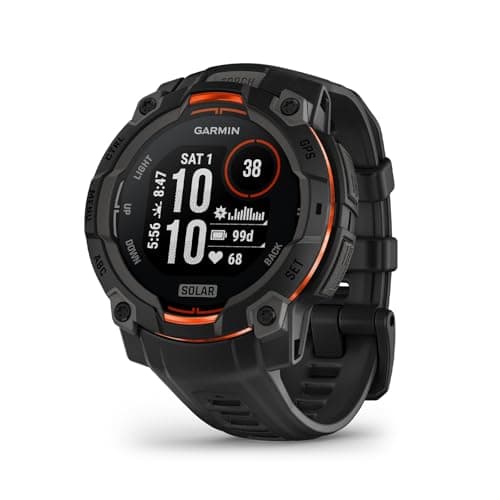
Multi-day trail and backcountry daysGarmin Instinct 3 Solar (45mm)
The watch that wins this site's rubric by publishing an honest battery table and then filling every row of it. No maps, and it still ranks first on trail.
$399.9938% off
Price as of November 21, 2026. Prices move; Amazon's is the one that counts.
#ad · we may earn a commission from this link to Garmin Instinct 3 Solar (45mm)
The short answer
The Garmin Instinct 3 Solar wins this bracket on the rubric: Garmin states 24 hours in all-satellite plus multi-band mode, 40 GPS-only, 36 expedition days and a 10 ATM case. It has no maps at all. If you need to follow an unfamiliar route, the COROS PACE Pro is the cheapest watch here publishing turn-by-turn navigation.
Ranked
Quick picks
| # | Device | Best for | Evidence | Score | Price |
|---|---|---|---|---|---|
| 01 | Garmin Instinct 3 Solar (45mm) The watch that wins this site's rubric by publishing an honest battery table and then filling every row of it. No maps, and it still ranks first on trail. | Multi-day trail and backcountry days | Manufacturer specification | 7.7/10 | $249.99Amazon |
| 02 | 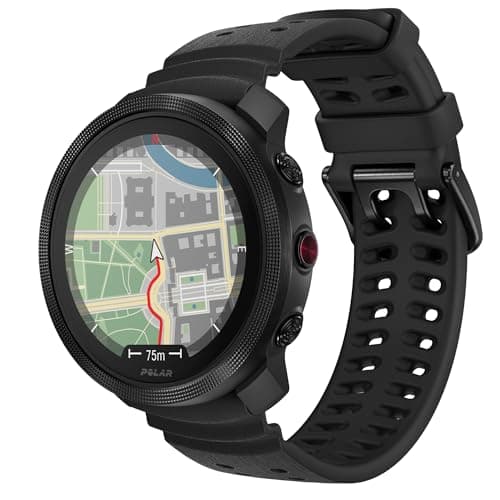 Polar Vantage M3 The pick when positioning accuracy is the thing you actually care about — Polar was the one brand under 5% error in the eight-watch validation study. | Runners who want the best-validated GPS | Peer-reviewed validation | 7.5/10 | $412.36Amazon |
| 03 | 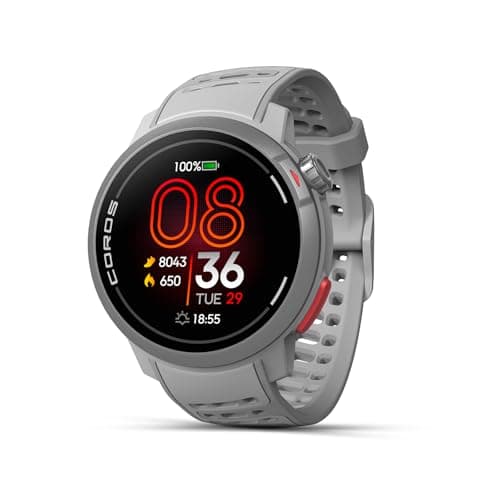 COROS PACE Pro The cheapest route to global maps with turn-by-turn navigation on a wrist, and the only watch in the PACE line whose dual-frequency battery figure COROS is willing to publish. | Navigation on a PACE budget | No validation study exists | 6.9/10 | $299.00Amazon |
| 04 | 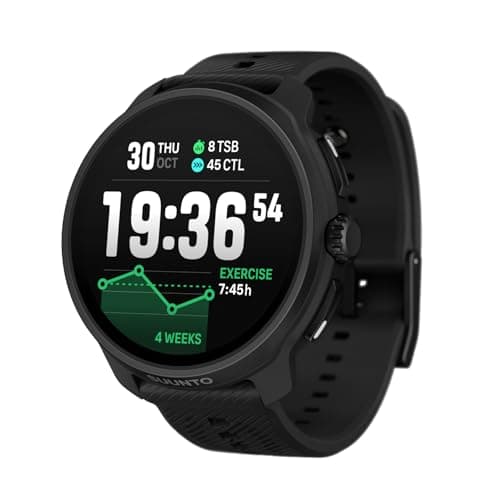 Suunto Race 2 A 1.5" AMOLED and 115+ sport modes, priced under most of the flagships it lines up against. | Big-screen multi-sport value | No validation study exists | 6.7/10 | $399.00Amazon |
| 05 | 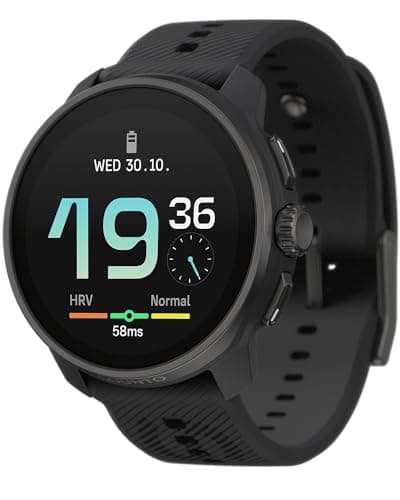 Suunto Race S A big AMOLED and dual-frequency positioning at a price that undercuts the mid-range Garmins. | Value AMOLED multi-sport | No validation study exists | 6.5/10 | $249.00Amazon |
#ad· Live prices from the Amazon Product API, as of November 21, 2026. Where we have no verified live price we show none. Scores come from the published rubric at How we rank — the Evidence column shows what each ranking actually rests on, including where the answer is nothing.
What the $500 line actually buys a hiker
Hiking asks a watch for different things than running does. A long day is measured in hours of recording rather than in pace, the terrain is frequently somewhere you have never been, and the failure mode is not a soft split - it is a flat battery at the point you needed the track log. So the specification that matters is not the one most watch reviews lead with. It is the endurance figure, the satellite mode that figure describes, and whether the maker will put a navigation claim in writing.
Every watch on this page is under $500 at the live price shown on its card, and the band is better stocked than the price list suggests. The two watches that most hiking roundups open with sit above it: Garmin's fēnix 8 and Polar's Grit X2 Pro are both real outdoor watches and both cost materially more - the gap between the fēnix 8 and the watch that wins this page is $496. What that money buys is covered further down, because the honest answer is "some of it matters and some of it does not".
One thing to settle before the picks. This is not the trail-running field. Those watches are ranked on their own page at best GPS watches for trail running, where the criterion is positioning under tree cover during an effort. Hiking shares the tree cover and drops the effort, which changes the weighting: a watch that records for two days and navigates is worth more to a hiker than a watch that samples faster for six hours. Two picks appear on both pages, for the reason that they are genuinely good at both.
How this page ranks, before any picks
Three published rows decide the order here, and you can check all three yourself on a manufacturer page in about five minutes.
One: does the maker publish a maps or navigation claim at all? This is a yes/no row and it is the single biggest practical difference in the bracket. Three of the five publish one as quotable text. The watch that wins the rubric publishes nothing of the kind, because it has no maps, and breadcrumb navigation on a route you have never walked is a different and worse experience than a map. We rank it first anyway, for reasons that are about what Garmin publishes rather than about what the watch can show you, and we would rather explain that tension than hide it.
Two: how many hours does the maker claim, and in which satellite mode?A figure without a mode attached is not a quantity. Garmin publishes a separate row for each satellite mode an Instinct 3 supports; Suunto publishes a long figure for a reduced-accuracy "tour" mode and a much shorter one at best accuracy, and says which is which; COROS publishes one dual-frequency figure in the whole PACE line. Printing the flattering number from each of those tables side by side would produce a comparison of nothing, so every hour count on this page names its mode in the same sentence.
Three: has anything about this watch ever been measured by somebody who does not sell it? This row carries the largest single weight in the published rubric, and in this bracket it is brutal: one of the five has a favorable peer-reviewed positioning result attached to its brand, and that result is six years old and tested different hardware. Three have nothing at all. That is the normal state of this category rather than a failing of this particular field, and the size of the gap is documented at the most accurate fitness trackers.
The pick: the Instinct 3 Solar, because its battery table hides nothing
The Garmin Instinct 3 Solar(45 mm) tops this page and the reason is the document rather than the watch. Garmin's own manual states 28 days in smartwatch mode, 40 hours GPS-only, 28 hours all-satellite, 24 hours all-satellite plus multi-band and 36 days in expedition mode, each with a separate solar-assisted figure beside it, plus a 10 ATM water rating. Five named satellite rows and an explicit assumption behind the solar numbers - all-day wear in 50,000 lux, which is Garmin's stated condition and not a measurement anyone here made. For a multi-day walk, expedition mode is the row that matters, and 36 days is the longest stated figure of any watch on this entire site. At $10.42 per stated multi-band hour it is also the cheapest accurate-mode endurance in the bracket.
The honest cons are serious and there are two. It has no maps. On a signed trail you will not care; on an unfamiliar mountain traverse you will care a great deal, and no battery figure compensates for not being able to see where the path goes. And no independent validation of its heart rate or positioning existsthat we could find, so its position here rests on the completeness of Garmin's specification plus arithmetic - not on anybody's measurement. Skip it if you navigate new routes rather than repeat known ones.
The Polar Vantage M3 carries the only favorable GPS study in the bracket
The Polar Vantage M3 is second and arrives by a completely different route: it is the only watch here whose brand has a favorable peer-reviewed positioning result attached to it. In Gilgen-Ammann et al. (2020), eight positioning-enabled sport watches were measured against a trundle wheel accurate to 1 cm across urban, forest and 400 m track conditions, and only Polar's receivers stayed under 5% distance error in every condition. Forest is the condition a hiker actually cares about. Polar states dual-frequency GNSS for the M3 along with turn-by-turn navigation and offline maps, which is real navigation at a mid-bracket price.
The cons matter more than usual here, because the study is most of the case for the watch. That paper is from 2020 and tested the Vantage M, Vantage V and V800- none of them this watch, and all of them single-frequency receivers from an earlier hardware generation. It is evidence about Polar's GNSS engineering history, not a measurement of the M3. Separately, and importantly for a hiking page: this site quotes no stated battery figure for the M3 at all. Polar's own specification page for it has not been readable from here on any attempt since August 2026, so there is no manufacturer-stated hour count to put in the table and we will not print one we have not read. If a multi-day endurance figure is the thing you are shopping for, that absence should push you to one of the watches above or below it. Polar's wider record is at the best Polar watches.
The COROS PACE Pro is the cheapest published maps claim on the site
The COROS PACE Pro is the value pick of this page: it is the cheapest watch anywhere on this roster that publishes global maps with turn-by-turn navigation, and under $500 today. COROS states 31 hours in dual-frequency mode, 38 hours of GPS activity tracking, 20 days of daily use, a 37-gram weight and a 1500-nit always-on AMOLED. That 31-hour number deserves its own sentence: it is the only dual-frequency endurance figure COROS publishes anywhere in the PACE line, which means this is the one watch in the range where the brand tells you what accurate positioning costs in battery. At $9.65 per stated dual-frequency hour, a hiker gets maps and a costed accurate mode for roughly the price of a mid-range running watch.
The cons are blunt. No independent measurement of this watch exists at all - its evidence tier on this site is "no validation study exists", printed rather than quietly omitted - and its optical sensor predates the redesigned one COROS describes on the cheaper PACE 4. It is also heavier and shorter-lived than that cheaper sibling on every stated number except daily use. Strip navigation out of your decision and the PACE 4 is the better buy; keep navigation in and this is the cheapest way to get it.
The Suunto Race 2 publishes a 200-hour figure, and says what it costs
The Suunto Race 2 is the most interesting battery table in the bracket because Suunto does the thing this site keeps asking for: it publishes a long figure and a short figure and labels both. Suunto states up to 55 hours of training with continuous tracking at best GPS accuracy, up to 200 hours in tour mode at lower GPS accuracy, up to 18 days of daily use with heart rate on and up to 30 days with it off, behind a 1.5-inch AMOLED with 115+ sport modes and dual-frequency GNSS. Two hundred hours is more than eight days of continuous recording, which is a genuinely useful number for a thru-hike - and the words "at lower GPS accuracy" are Suunto's own, which is the part a spec-sheet summary usually drops. A hiking day spent in tour mode is a day of coarser fixes. For following a known trail that is a fair trade; for recording a route you intend to share, it is not.
The cons: no independent validation of this watch exists that we could find, Suunto's analytics and third-party ecosystem are the thinnest of the four brands here, and Suunto renders part of its specification table dynamically, so this site quotes only the figures that appear as published text - which is why you will not see a navigation or altimeter row for the Race 2 anywhere on this page. It is also the most expensive watch in this field, which is why it sits fourth despite the strongest stated endurance range.
The Suunto Race S puts offline maps at the bottom of the bracket
The Suunto Race S ranks last at 6.5 and still earns a slot, because Suunto states free offline maps for it along with an AMOLED touchscreen in a smaller case, up to 30 hours of training with continuous GPS tracking, up to 9 days of daily use with heart rate on and up to 13 days with it off. Offline maps on a watch at this price is the cheapest published navigation claim in the bracket alongside the PACE Pro, and the smaller case is a real advantage for anyone whose wrist disappears under a 47 mm watch.
The cons are the reason for the ranking. Thirty hours at best accuracy is the shortest full-accuracy endurance figure Suunto publishes for either watch here - roughly a seventh of what the Race 2 claims in tour mode - and nine days of daily use means it will be on a charger partway through a long trip. There is no independent validation of its heart rate or positioning that we could find either. Buy it for maps plus a small case, not for endurance.
What is deliberately not on this page
The fēnix 8 and the Grit X2 Pro are both above the band, and both are better hiking watches than anything on this list. Garmin's manual states 35 hours all-satellite plus multi-band and 16 smartwatch days for the 47 mm fēnix 8, with preloaded maps and a dive rating; Polar states sapphire glass, WR100, dual-frequency GPS, offline maps preinstalled for North America and Europe, 43 hours in training mode with GPS and 10 days in smartwatch mode for the Grit X2 Pro. Neither fits under $500, and saying so is more useful than quietly stretching the bracket. If your budget can reach them, the full flagship field is at best running watches under $1,000.
There is no barometric-altimeter row on this page, and that is an absence rather than a verdict. Elevation is the measurement a hiker is most likely to want, and the manufacturer pages read for this site do not all publish an altimeter specification as text we could quote - so rather than infer one, we are telling you to open the spec sheet for whichever watch you shortlist and look for it yourself. That check is in the list below.
Nothing here has been validated for sleep staging, which is true of every watch on this site and matters on a hiking page only because multi-day trips are exactly when people start reading their recovery screens. The form factor that does have published sleep papers behind it is a ring, and that field is separate at the most accurate sleep trackers.
The accuracy upgrade that costs about a hundred dollars
If you are shopping in this bracket because you stopped believing your current watch's heart rate, the cheapest real fix is not a watch at all. The 2025 placement study used a Polar H10 chest strap as its reference instrument and measured three identical Whoop units at wrist, forearm and upper arm: position beat device, and the wrist was the weakest site, with limits of agreement of plus or minus 10-19 bpm at warm-up. On a hike - low intensity, cold hands, a pack strap pressing on the wrist - that is the signal environment you are asking an optical sensor to work in.
Hold the category-wide picture while you spend this money. The 2024 living umbrella review covered 24 systematic reviews across 249 primary validation studies and 430,465 participants, and found roughly 34 of 310 identified consumer wearables had ever been validated at all, with heart rate at approximately plus or minus 3% and a mean bias of -3.39 bpm across the category. There is no published basis for the claim that a $500 wrist sensor reads a hiker's heart rate better than a $250 one. What the extra money buys in this bracket is satellite modes, battery and navigation - three real things, none of which is the sensor. The strap field is at the most accurate heart rate monitors.
In full
Every pick, and why
Garmin Instinct 3 Solar (45mm)
The watch that wins this site's rubric by publishing an honest battery table and then filling every row of it. No maps, and it still ranks first on trail.
- Battery, smartwatch (stated)
- 28 days, unlimited with solar
- Battery, GPS-only (stated)
- 40 h, up to 130 h with solar
- Battery, multi-band (stated)
- 24 h, up to 40 h with solar
- Battery, expedition (stated)
- 36 days, unlimited with solar
- Water rating
- 10 ATM
What's good
- Garmin publishes five separate GPS endurance figures for it, mode by mode — the most honest battery table of any watch on this site
- 24 stated hours in all-satellite multi-band mode, which is the mode you would actually run for accuracy
- Solar charging turns the smartwatch and expedition figures into 'unlimited' under Garmin's stated light conditions
What isn't
- No built-in maps at all, which on unfamiliar trail is the feature people miss first
- No independent validation of its heart rate or positioning that we could find
Skip this if
Skip this if you navigate unfamiliar routes rather than repeat known ones. Breadcrumb navigation on a trail you have never run is a genuinely worse experience than a map, and no amount of battery compensates for it.
What the evidence says
Manufacturer specificationNo independent validation of this device that we could find. What Garmin does publish is unusually complete: a five-row battery table naming each satellite mode separately, with the solar-assisted figures stated separately from the unassisted ones. We rank the unassisted multi-band row, because that is the number you can rely on in a forest.
Show how this 7.7 was calculated
| Factor | Weight | Score |
|---|---|---|
| EvidenceNo measured validation, but the published specification is more granular and more honest about its own assumptions than any other spec sheet here. | 30% | 5.5 |
| HardwareAll-satellite plus multi-band positioning, a solar charging lens and a 10 ATM case. | 20% | 8.5 |
| Metric coverageFull Garmin training and outdoor feature set, minus maps — which on trail is a real omission. | 20% | 7.5 |
| Endurance40 stated GPS-only hours, 24 in multi-band, 28 smartwatch days and 36 expedition days, before solar is counted at all. | 15% | 10.0 |
| Cost per capabilityFlagship endurance at roughly a third of flagship money. | 15% | 9.0 |
$399.9938% off
Price as of November 21, 2026. Prices move; Amazon's is the one that counts.
#ad · we may earn a commission from this link to Garmin Instinct 3 Solar (45mm)
Polar Vantage M3
The pick when positioning accuracy is the thing you actually care about — Polar was the one brand under 5% error in the eight-watch validation study.
- Display
- AMOLED
- Satellite
- Dual-frequency GNSS
- Extras
- Turn-by-turn navigation, offline maps
What's good
- Polar is the only brand that came in under 5% distance error across all conditions in the JMIR eight-watch study
- Dual-frequency positioning plus offline maps at a mid-range price
What isn't
- The validation that flatters Polar is from 2020 and tested older models — it is evidence about the brand's GNSS engineering, not a measurement of this watch
- Smaller ecosystem than Garmin
Skip this if
Skip this if you are deep in Garmin's ecosystem already. Nothing here is enough better to justify rebuilding your training history somewhere else.
What the evidence says
Peer-reviewed validationThe peer-reviewed evidence is brand-level and dated: Gilgen-Ammann et al. (2020) measured eight watches against a trundle wheel and found only Polar's receivers stayed under 5% error. That study tested the Vantage M, Vantage V and V800 — not the M3.
Show how this 7.5 was calculated
| Factor | Weight | Score |
|---|---|---|
| EvidenceThe only brand in this roundup with a favorable peer-reviewed positioning result — but the study is from 2020 and tested earlier models, so it is dated brand evidence, not a measurement of this watch. | 30% | 7.0 |
| HardwareDual-frequency GNSS with offline maps. | 20% | 8.5 |
| Metric coverageStrong training-load and recovery platform; good sensor support. | 20% | 8.0 |
| EnduranceCompetitive for an AMOLED multi-sport watch, per Polar's stated figures. | 15% | 7.0 |
| Cost per capabilityMid-range pricing for dual-frequency plus maps. | 15% | 7.0 |
$499.9918% off
Price as of November 21, 2026. Prices move; Amazon's is the one that counts.
#ad · we may earn a commission from this link to Polar Vantage M3
COROS PACE Pro
The cheapest route to global maps with turn-by-turn navigation on a wrist, and the only watch in the PACE line whose dual-frequency battery figure COROS is willing to publish.
- Display
- 1.3" always-on AMOLED touchscreen, 1500 nits
- Weight
- 37 g with the nylon band
- Satellite
- All-Systems and Dual-Frequency modes
- Battery (stated)
- 20 days daily use / 38 h GPS / 31 h dual-frequency
- Navigation
- Global maps with turn-by-turn navigation
- Processor
- Ambiq Apollo510
What's good
- The only device in the PACE line for which COROS publishes a dual-frequency battery figure — 31 hours — instead of leaving the accurate mode uncosted
- Global maps with turn-by-turn navigation, which the PACE 4 does not claim at any price
- A 1500-nit always-on AMOLED, which is the brightest screen COROS publishes a figure for in this range
What isn't
- No independent validation of its heart rate or positioning exists that we could find, and its optical sensor predates the redesigned one COROS describes on the PACE 4
- Heavier and shorter-lived than the cheaper PACE 4 on every stated number except daily use
Skip this if
Skip this if you never navigate. Strip the maps out of the decision and the PACE 4 is lighter, cheaper and longer-lived, and you are paying a premium for a screen and a menu you will not open.
What the evidence says
No validation study existsNo independent measurement of this watch exists that we could find as of August 2026. The only measured COROS heart-rate result on record is the5krunner's limited-dataset comparison of the PACE 3, which found divergence during and after rapid intensity change. That test was of a different watch, so it is not evidence about this one either way — which is the point: there is nothing here to weigh.
Show how this 6.9 was calculated
| Factor | Weight | Score |
|---|---|---|
| EvidenceNothing published measures this watch. The only COROS result on record tested the PACE 3, so this device is ranked on specification alone — which is exactly what caps it. | 30% | 4.5 |
| HardwareAll-Systems and Dual-Frequency satellite modes and an Ambiq Apollo510 processor, per COROS. Its optical sensor predates the redesigned one COROS describes on the PACE 4. | 20% | 7.5 |
| Metric coverageFull COROS training platform plus SpO2, and global maps with turn-by-turn navigation the PACE 4 does not claim. Same narrower third-party ecosystem as the rest of the range. | 20% | 8.0 |
| EnduranceCOROS states 31 hours in dual-frequency mode, 38 hours of GPS activity tracking and 20 days of daily use. We carry the dual-frequency number, because that is the mode the positioning hardware was bought for. | 15% | 9.0 |
| Cost per capabilityMid-range sticker for dual-frequency plus maps. Per dual-frequency GPS hour it sits behind both the PACE 4 and the PACE 3 — that gap is what the maps cost. | 15% | 7.5 |
Price as of November 21, 2026. Prices move; Amazon's is the one that counts.
#ad · we may earn a commission from this link to COROS PACE Pro
Suunto Race 2
A 1.5" AMOLED and 115+ sport modes, priced under most of the flagships it lines up against.
- Display
- 1.5" AMOLED
- Sport modes
- 115+
- Satellite
- Dual-frequency GNSS
What's good
- The largest AMOLED in this roundup
- Undercuts the flagship tier substantially
What isn't
- No independent validation we could find
- Ecosystem and third-party support remain the weak point
Skip this if
Skip this if you need a proven training-load model. Suunto's analytics are the least documented of the brands here.
What the evidence says
No validation study existsNo independent validation study exists for this device that we could find as of July 2026.
Show how this 6.7 was calculated
| Factor | Weight | Score |
|---|---|---|
| EvidenceNo validation of any kind that we could find; capped accordingly. | 30% | 3.0 |
| HardwareDual-frequency GNSS with the biggest display here. | 20% | 8.5 |
| Metric coverage115+ modes, lighter analytics. | 20% | 8.0 |
| EnduranceStrong stated figures for the screen size. | 15% | 8.0 |
| Cost per capabilityWell under the flagship tier it competes with on specification. | 15% | 8.5 |
$499.0020% off
Price as of November 21, 2026. Prices move; Amazon's is the one that counts.
#ad · we may earn a commission from this link to Suunto Race 2
Suunto Race S
A big AMOLED and dual-frequency positioning at a price that undercuts the mid-range Garmins.
- Display
- 1.32" AMOLED
- Sport modes
- 95+
- Satellite
- Dual-frequency GNSS
What's good
- Dual-frequency positioning well below the price the same feature costs at Garmin
- Large, bright AMOLED for the money
What isn't
- No independent validation of its heart rate or positioning that we could find
- Smallest third-party ecosystem of the brands here
Skip this if
Skip this if you want structured workouts pushed from a coaching platform. Suunto's integrations are the thinnest in this group.
What the evidence says
No validation study existsNo independent validation study exists for this device that we could find as of July 2026. It is ranked on published hardware specification and price alone, and that is why it does not place higher.
Show how this 6.5 was calculated
| Factor | Weight | Score |
|---|---|---|
| EvidenceNo validation of any kind that we could find. Under our evidence hierarchy this caps how high it can rank, regardless of its hardware. | 30% | 3.0 |
| HardwareDual-frequency GNSS and a large AMOLED, per Suunto's spec page. | 20% | 8.0 |
| Metric coverage95+ sport modes; a lighter analytics platform than Garmin or Polar. | 20% | 7.5 |
| EnduranceStrong stated battery for an AMOLED watch at this size. | 15% | 7.5 |
| Cost per capabilityThe cheapest dual-frequency AMOLED watch in this roundup. | 15% | 9.0 |
$349.0029% off
Price as of November 21, 2026. Prices move; Amazon's is the one that counts.
#ad · we may earn a commission from this link to Suunto Race S
What to check before you spend $500 on a hiking watch
- Decide whether you follow maps or repeat known routes. This is the one capability in the bracket you cannot add later, and it is the entire reason the PACE Pro and the Race S cost what they do. If the answer is maps, the rubric winner is not your watch.
- Read which mode every hour figure names. Two hundred hours in tour mode and 55 hours at best accuracy are the same watch. Compare accurate mode to accurate mode, or tour mode to tour mode, and never one against the other.
- Look for a barometric altimeter row on the maker's own page. Elevation from satellites and elevation from air pressure are different measurements with different error behavior, and this site does not carry a quotable altimeter row for every watch here. Check it yourself before you commit.
- Check the water rating, not the marketing word."Water resistant" is not a number. The Instinct 3 Solar publishes 10 ATM; several makers in this bracket render their rating in a table our fetcher cannot read, which is why only the verified figure appears above.
- Expect to find no independent measurement, and plan around it. Four of these five watches have none at all. That is normal in this category, and it is why evidence carries 30% of the weight here instead of being quietly assumed.
- Budget about a hundred dollars of your five hundred for a chest strap if heart rate is a number you act on. It is the only upgrade in this price range with a peer-reviewed reason behind it.
- Check the live price before you commit. Every bracket claim on this page is computed from the price layer on the date shown rather than typed in - watches in this band cross the $500 line in both directions on discount.
How this ranking was built
Every score on this page comes from one published rubric, applied identically to every device on the site, with the weights written down and the inputs shown. We have not worn any of these devices and we never say we have. Read the method and check us.
Questions
Frequently asked
What is the best hiking watch under $500?
The Garmin Instinct 3 Solar on this site's rubric: Garmin publishes 40 hours GPS-only, 24 hours all-satellite plus multi-band, 28 smartwatch days, 36 expedition days and a 10 ATM rating, mode by mode, with the solar assumption stated. Its weakness for hiking specifically is that it has no maps, and no independent validation of anything it measures exists that we could find.
Which hiking watch under $500 has offline maps?
Three of the five. COROS states global maps with turn-by-turn navigation for the PACE Pro, Suunto states free offline maps for the Race S, and Polar states turn-by-turn navigation with offline maps for the Vantage M3. The Instinct 3 Solar has none - it offers breadcrumb navigation only, which is a different thing on a route you have not walked before.
Which watch here lasts longest on a multi-day hike?
On manufacturer-stated figures it depends which figure you accept. Garmin states 36 expedition days for the Instinct 3 Solar, which is the longest stated endurance on this site. Suunto states up to 200 hours of continuous recording for the Race 2, but explicitly in tour mode at lower GPS accuracy. Those are not the same claim, and neither has been independently measured.
Do I need a $700 outdoor watch like the fenix 8 for hiking?
Not for recording a walk. What the flagship tier adds over this bracket is full-color preloaded mapping, case materials, a dive rating and - on the fēnix 8 - a stated 35 hours in all-satellite plus multi-band mode. If you navigate unfamiliar terrain regularly, the mapping is worth real money. If you walk marked trails and want the track log, the savings buy a strap and a lot of socks.
Is a hiking watch more accurate than my phone?
For positioning, a dual-frequency watch receiver is genuinely better hardware than most phones in a forest or a canyon, and every watch here states a dual-frequency or multi-band mode. For heart rate, no. The published record shows category-wide optical accuracy around plus or minus 3% with most consumer wearables never validated at all, and a wrist is the weakest optical site measured in the 2025 placement study.
Show your working
Sources
Every one of these was read in full before it was cited. Where we could not access a paper, we do not quote its numbers.
- [1]Manufacturer specification2026Garmin — Instinct 3 Solar owner’s manual, battery life information
Manufacturer-stated for the 45 mm Solar: 28 days smartwatch (unlimited with solar), 40 hours GPS-only (130 hours with solar), 28 hours all-satellite (50 with solar), 24 hours all-satellite plus multi-band (40 with solar), 36 days expedition GPS (unlimited with solar), 65 days battery-saver. Water rating 10 ATM per the same manual’s specification page. Solar figures assume all-day wear in 50,000 lux conditions, which is Garmin’s assumption and not a measurement of ours.
- [2]Manufacturer specification2026COROS — PACE Pro published specifications
Manufacturer-stated: 1.3" always-on AMOLED touchscreen at 1500 nits, 37 g with the nylon band, All-Systems and Dual-Frequency satellite modes, 38 hours of GPS activity tracking, 31 hours with dual-frequency GPS, 20 days of daily use and sleep tracking, 6 days with the always-on display, global maps with turn-by-turn navigation, an Ambiq Apollo510 processor and an optical heart-rate plus SpO2 sensor. COROS's own launch release dates the watch to 31 October 2024 at $349.
- [3]Manufacturer specification2026Suunto — Race 2 published product specifications
Manufacturer-stated, read 2026-08-18: 1.5-inch AMOLED, 115+ sport modes, up to 55 hours of training with continuous tracking at best GPS accuracy, up to 200 hours in tour mode at lower GPS accuracy, up to 18 days of daily use with heart rate on and up to 30 days with it off. Suunto renders part of its specification table dynamically, so we quote only the figures that appear as published text on the page.
- [4]Manufacturer specification2026Suunto — Race S published product specifications
Manufacturer-stated, read 2026-08-18: AMOLED touchscreen in a smaller case than the Race, up to 30 hours of training with continuous GPS tracking, up to 9 days of daily use with heart rate on and up to 13 days with it off, plus free offline maps. As with the Race 2 page, the full specification table loads dynamically and we quote only the published text figures.
- [5]Peer-reviewed validation2020Gilgen-Ammann, Schweizer & Wyss, “Accuracy of Distance Recordings in Eight Positioning-Enabled Sport Watches: Instrument Validation Study”, JMIR mHealth and uHealth
DOI 10.2196/17118. Eight watches (Apple Watch Series 4, Coros Apex 46mm, Garmin Fenix 5X Plus, Garmin Forerunner 935, Polar Vantage M, Polar Vantage V, Polar V800, Suunto 9 Baro) measured against a trundle wheel accurate to 1 cm, across urban, forest and 400 m track conditions. IMPORTANT: this predates the dual-frequency receivers now standard, so it describes brand engineering history, not any watch currently sold.
- [6]Manufacturer specification2026Garmin — fēnix 8 Series owner’s manual, battery information
Manufacturer-stated, read 2026-08-18. One table covers the fēnix 8 and the fēnix 8 Pro, which is why the two can be compared here without mixing sources. fēnix 8 AMOLED 47 mm: 16 days smartwatch with Gesture (7 with Always On Display), 47 h GPS-only (37 AOD), 35 h all satellite systems plus multi-band (28 AOD). fēnix 8 Pro 47 mm: 15 days (8 AOD), 44 h GPS-only (33 AOD), 30 h all systems plus multi-band (23 AOD). fēnix 8 Pro 51 mm: 27 days (15 AOD), 78 h GPS-only (56 AOD), 53 h all systems plus multi-band (41 AOD), and 21 h all systems plus multi-band with LTE LiveTrack (19 AOD).
- [7]Manufacturer specification2026Polar — Grit X2 Pro published specifications
Manufacturer-stated: 1.39" AMOLED at 454 × 454 behind sapphire glass, stainless steel case, dual-frequency GPS plus GLONASS, Galileo, BeiDou and QZSS, 43 hours in training mode with GPS, 10 days in smartwatch mode, WR100, on-wrist ECG, skin temperature and SpO2 sensors, offline maps preinstalled for North America and Europe.
- [8]Peer-reviewed validation2025“Impact of Anatomical Placement on the Accuracy of Wearable Heart Rate Monitors During Rest and Various Exercise Intensities”, Sensors (Basel)
n = 28 (14 male, 14 female). Polar H10 chest strap as the reference. Compared Polar Verity Sense (forearm), Garmin Forerunner 55 (wrist) and three simultaneous Whoop 4.0 units at wrist, forearm and upper arm, across rest, cycling warm-up, burpees and a modified Bruce treadmill protocol.
- [9]Peer-reviewed validation2024Doherty, Baldwin, Keogh, Caulfield & Argent, “Keeping Pace with Wearables: A Living Umbrella Review of Systematic Reviews Evaluating the Accuracy of Consumer Wearable Technologies in Health Measurement”, Sports Medicine
DOI 10.1007/s40279-024-02077-2. An umbrella review: 24 systematic reviews covering 249 unique primary validation studies and 430,465 participants (43% female), across 11 biometric outcomes, with roughly 34 of 310 identified consumer wearables ever validated. Reported accuracy by metric: heart rate approximately ±3% (mean bias −3.39 bpm); step count mean absolute percentage error from −9% to 12%; energy expenditure mean bias −3 kcal per minute with error ranging from −21.27% to 14.76%. Authors’ stated limits: a temporal lag between device release and published research, the intrinsic bias of a tertiary synthesis, and heterogeneity of protocols, devices, criterion measures and statistics severe enough that the authors did not pool a meta-analysis.
Read next
Related
- Best GPS watches for trail running
The same terrain judged on effort rather than endurance, with the flagships included.
- Best running watches under $500
The same ceiling, ranked for recording a run instead of a walk.
- Alternatives to the Garmin fenix 8
What to buy instead of the outdoor flagship sitting just above this bracket.
- What is dual-band GPS?
The receiver capability four of these five watches state, and what it fixes.