GPS and multisport
Garmin Instinct 3 Solar
It wins our trail ranking without a map screen, on the strength of a battery table that names its own assumptions instead of quoting the flattering row.
We earn a commission when you buy through our Amazon links, at no extra cost to you. It never decides a ranking — the rubric that does is published in full, so you can check us rather than take our word for it. How this works.
Top pick
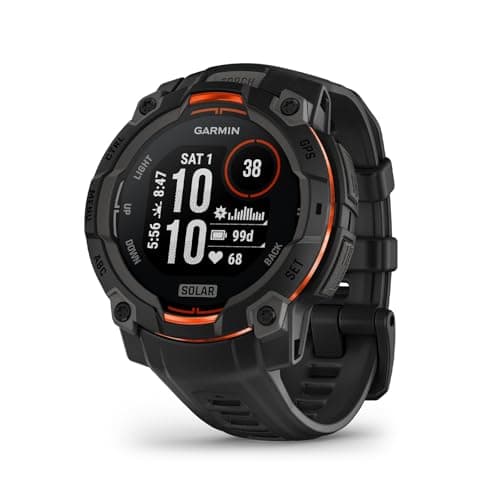
Multi-day trail and backcountry daysGarmin Instinct 3 Solar (45mm)
The watch that wins this site's rubric by publishing an honest battery table and then filling every row of it. No maps, and it still ranks first on trail.
$399.9915% off
Price as of October 21, 2026. Prices move; Amazon's is the one that counts.
#ad · we may earn a commission from this link to Garmin Instinct 3 Solar (45mm)
The short answer
Garmin publishes five separate GPS endurance figures for the Instinct 3 Solar, each naming its satellite mode. The one that matters is 24 hours in all-satellite plus multi-band without solar assistance. There are no maps, at any price, and no independent validation of its sensors that we could find.
Ranked
Quick picks
| # | Device | Best for | Evidence | Score | Price |
|---|---|---|---|---|---|
| 01 | Garmin Instinct 3 Solar (45mm) The watch that wins this site's rubric by publishing an honest battery table and then filling every row of it. No maps, and it still ranks first on trail. | Multi-day trail and backcountry days | Manufacturer specification | 7.7/10 | $339.99Amazon |
#ad· Live prices from the Amazon Product API, as of October 21, 2026. Where we have no verified live price we show none. Scores come from the published rubric at How we rank — the Evidence column shows what each ranking actually rests on, including where the answer is nothing.
Why the specification sheet is the story
Almost every watch on this site publishes one GPS battery figure. It is invariably the largest one — the mode with the fewest satellites and the lowest sampling rate — and the spec sheet rarely says so. That is how a battery number misleads without technically lying.
Garmin's own manual for the 45 mm Instinct 3 Solar does something different. It publishes five, and names the mode on each:
| Mode | Stated, no solar | Stated, with solar |
|---|---|---|
| Smartwatch | 28 days | Unlimited |
| GPS only | 40 hours | 130 hours |
| All-satellite | 28 hours | 50 hours |
| All-satellite + multi-band | 24 hours | 40 hours |
| Expedition GPS | 36 days | Unlimited |
| Battery saver | 65 days | — |
Look at the spread. The headline-friendly number is 40 hours; the number you get if you switch on the reception mode that actually resists reflected signals is 24. That is a 40% difference between two rows of the same table, and most manufacturers would print only the first.
We rank the 24-hour row.If positioning accuracy is why you bought a watch for the forest, multi-band is the mode you run, so it is the only figure that describes your day. We also ignore every solar column entirely: those assume all-day wear in 50,000 lux, which is Garmin's stated assumption and not a measurement of ours. Under tree cover — the exact place you would want the endurance — that assumption is not met.
The arithmetic
Against the live listing price, the unassisted multi-band figure works out at $14.17. That number is computed at page load from the current price and Garmin's stated 24 hours, and it is deliberately the least flattering version of the calculation available.
For context on how unusual that is: were we to use the 130-hour solar-assisted GPS-only row instead, the same watch would appear several times cheaper per hour than anything else on this site. That figure would be arithmetically correct and practically useless, which is why we do not publish it.
The thing it does not have, and why it still wins on trail
There are no maps. Not a reduced map, not a downloadable one — the Instinct 3 has no cartography at all. Navigation is a breadcrumb line and a compass bearing.
On a route you have run before, or one you loaded in advance and will not deviate from, that is genuinely sufficient. On unfamiliar trail with a junction every few hundred meters, it is a materially worse experience, and it is the omission people notice first. We say so in the pick itself rather than burying it.
It still ranks first in our trail ranking because the rubric weights endurance at 15% and cost per capability at another 15%, and because no watch on this site has independent sensor validation — so the mapping flagships cannot pull ahead on evidence either. A watch that publishes a complete battery table and then fills every row of it earns more on this rubric than one that publishes a map screen and one flattering number.
The evidence position, stated plainly
No independent validation of this device exists that we could find. Not of its optical heart rate, not of its positioning. It sits at manufacturer specification on our evidence hierarchy, which caps how high it can score on the largest single weight in the rubric.
What Garmin does publish is unusually complete, and we score that — but publishing detailed specifications is not the same as having been measured, and we will not let one stand in for the other. The relevant comparison is the Polar models, which carry a dated but genuine peer-reviewed positioning result at brand level and score higher on evidence as a consequence.
There is one measured finding that touches Garmin's wrist optical sensing generally and is worth knowing: the 2025 Sensors placement study recorded a bias of roughly 33 bpm on a wrist-worn Garmin Forerunner 55 during burpees, the largest error in the paper. That was a different, cheaper watch and a different sensor generation, so it is not evidence about this device. It is evidence about wrist optical sensing during explosive work, which applies to every watch here — and the fix is a strap, not a better watch.
What the 10 ATM rating means and does not
Garmin states 10 ATM on the same specification page. That is a pressure rating, not a depth rating, and it comfortably covers swimming, rain and immersion. It does not make the watch a dive computer, and Garmin does not claim it is one.
What we could not verify
- Every battery figure on this page.They are Garmin's, under Garmin's test conditions. We have not run one down and we do not own one.
- The solar figures in particular. They assume 50,000 lux for the whole wearing period. We have not tested that assumption and neither, as far as we can find, has anyone independent.
- Optical heart-rate accuracy. No published measurement of this model.
- Multi-band positioning accuracy. No published measurement of this model, and no current multi-band watch of any brand has been independently validated that we could find.
Who should not buy it
Anyone who navigates unfamiliar routes. A breadcrumb on a trail you have never run is a worse experience than a map, and no quantity of battery compensates for being at the wrong junction. Buy a mapping watch.
Anyone shopping on screen quality. The Instinct line is a deliberately utilitarian device and the display is the most visible part of that. If you want a bright AMOLED, look at the Forerunner or fēnix line instead.
Anyone buying it for better heart-rate data. It has the same class of wrist optical sensor as every other watch here, with no validation of its own.
Against Garmin's own flagship the case for this watch is almost entirely cost per capability, which we work through in fenix 8 vs Instinct 3.
In full
Every pick, and why
Garmin Instinct 3 Solar (45mm)
The watch that wins this site's rubric by publishing an honest battery table and then filling every row of it. No maps, and it still ranks first on trail.
- Battery, smartwatch (stated)
- 28 days, unlimited with solar
- Battery, GPS-only (stated)
- 40 h, up to 130 h with solar
- Battery, multi-band (stated)
- 24 h, up to 40 h with solar
- Battery, expedition (stated)
- 36 days, unlimited with solar
- Water rating
- 10 ATM
What's good
- Garmin publishes five separate GPS endurance figures for it, mode by mode — the most honest battery table of any watch on this site
- 24 stated hours in all-satellite multi-band mode, which is the mode you would actually run for accuracy
- Solar charging turns the smartwatch and expedition figures into 'unlimited' under Garmin's stated light conditions
What isn't
- No built-in maps at all, which on unfamiliar trail is the feature people miss first
- No independent validation of its heart rate or positioning that we could find
Skip this if
Skip this if you navigate unfamiliar routes rather than repeat known ones. Breadcrumb navigation on a trail you have never run is a genuinely worse experience than a map, and no amount of battery compensates for it.
What the evidence says
Manufacturer specificationNo independent validation of this device that we could find. What Garmin does publish is unusually complete: a five-row battery table naming each satellite mode separately, with the solar-assisted figures stated separately from the unassisted ones. We rank the unassisted multi-band row, because that is the number you can rely on in a forest.
Show how this 7.7 was calculated
| Factor | Weight | Score |
|---|---|---|
| EvidenceNo measured validation, but the published specification is more granular and more honest about its own assumptions than any other spec sheet here. | 30% | 5.5 |
| HardwareAll-satellite plus multi-band positioning, a solar charging lens and a 10 ATM case. | 20% | 8.5 |
| Metric coverageFull Garmin training and outdoor feature set, minus maps — which on trail is a real omission. | 20% | 7.5 |
| Endurance40 stated GPS-only hours, 24 in multi-band, 28 smartwatch days and 36 expedition days, before solar is counted at all. | 15% | 10.0 |
| Cost per capabilityFlagship endurance at roughly a third of flagship money. | 15% | 9.0 |
$399.9915% off
Price as of October 21, 2026. Prices move; Amazon's is the one that counts.
#ad · we may earn a commission from this link to Garmin Instinct 3 Solar (45mm)
Questions
Frequently asked
How long does the Garmin Instinct 3 Solar battery actually last?
Garmin states 28 smartwatch days, 40 GPS-only hours, 28 all-satellite hours, 24 hours with all-satellite plus multi-band, 36 expedition days and 65 days in battery saver — all without solar. We rank the 24-hour figure, because that is the reception mode you would use if positioning accuracy is the point. Every one of these is manufacturer-stated; we have not tested any of them.
Does the Instinct 3 have maps?
No. There is no cartography of any kind — navigation is a breadcrumb trail and a compass bearing. On known or preloaded routes that is usually enough. On unfamiliar trail it is the single biggest reason to buy something else.
Is the solar charging worth anything in practice?
Garmin's solar figures assume all-day wear at 50,000 lux, which is bright, direct sunlight. Under forest canopy, in winter or with the watch under a sleeve, you are far closer to the unassisted column. We rank the unassisted numbers for exactly that reason rather than treating the solar row as the specification.
Instinct 3 or fēnix 8?
The fēnix 8 adds maps, an AMOLED option and dive ratings; the Instinct adds a great deal of stated battery and costs far less. Neither has any independent validation of its sensors, so the decision is genuinely about maps and screen, not about data quality. See the fēnix 8 review.
Is the Instinct 3 accurate?
Nobody has published a measurement of it, so the honest answer is that we do not know. It carries multi-band reception, which is the hardware that addresses reflected-signal drift, but hardware capability is not a measured result and we do not present it as one.
Show your working
Sources
Every one of these was read in full before it was cited. Where we could not access a paper, we do not quote its numbers.
- [1]Manufacturer specification2026Garmin — Instinct 3 Solar owner’s manual, battery life information
Manufacturer-stated for the 45 mm Solar: 28 days smartwatch (unlimited with solar), 40 hours GPS-only (130 hours with solar), 28 hours all-satellite (50 with solar), 24 hours all-satellite plus multi-band (40 with solar), 36 days expedition GPS (unlimited with solar), 65 days battery-saver. Water rating 10 ATM per the same manual’s specification page. Solar figures assume all-day wear in 50,000 lux conditions, which is Garmin’s assumption and not a measurement of ours.
- [2]Peer-reviewed validation2025“Impact of Anatomical Placement on the Accuracy of Wearable Heart Rate Monitors During Rest and Various Exercise Intensities”, Sensors (Basel)
n = 28 (14 male, 14 female). Polar H10 chest strap as the reference. Compared Polar Verity Sense (forearm), Garmin Forerunner 55 (wrist) and three simultaneous Whoop 4.0 units at wrist, forearm and upper arm, across rest, cycling warm-up, burpees and a modified Bruce treadmill protocol.
- [3]Peer-reviewed validation2020Gilgen-Ammann, Schweizer & Wyss, “Accuracy of Distance Recordings in Eight Positioning-Enabled Sport Watches: Instrument Validation Study”, JMIR mHealth and uHealth
DOI 10.2196/17118. Eight watches (Apple Watch Series 4, Coros Apex 46mm, Garmin Fenix 5X Plus, Garmin Forerunner 935, Polar Vantage M, Polar Vantage V, Polar V800, Suunto 9 Baro) measured against a trundle wheel accurate to 1 cm, across urban, forest and 400 m track conditions. IMPORTANT: this predates the dual-frequency receivers now standard, so it describes brand engineering history, not any watch currently sold.
Read next
Related
- fenix 8 vs Instinct 3
The clearest illustration of cost per capability on this site.
- Best GPS watches for ultra running
Where the solar figures stop being a bonus and start being a plan.
- Best trail GPS watches
The ranking this watch leads, and what it beat.
- Fix your battery life
The upgrade path this watch sits at the top of.
- Garmin fēnix 8
What the maps and the AMOLED screen actually cost.
- Do you need maps?
The decision this watch forces you to make.
- GPS accuracy by device
Every published positioning figure, and every blank.