Head to head
Garmin Forerunner 165 vs 265
Read as a spec list these two look a generation apart on screen and price. Read Garmin's own battery tables side by side and the difference is one satellite mode the cheaper watch does not have.
We earn a commission when you buy through our Amazon links, at no extra cost to you. It never decides a ranking — the rubric that does is published in full, so you can check us rather than take our word for it. How this works.
Top pick
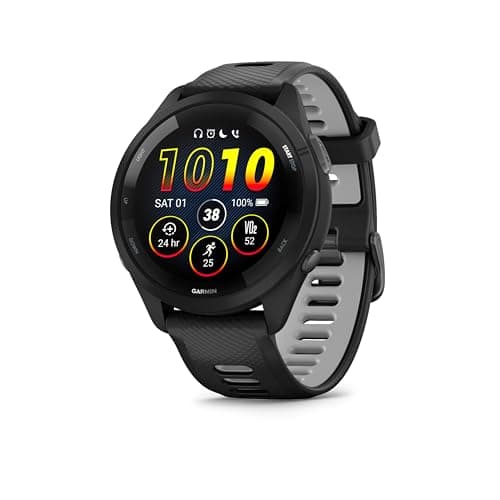
Runners who want a measured device, flaws includedGarmin Forerunner 265
One of the very few watches on this site whose training estimates have actually been measured against a laboratory — and the measurement was not kind.
Price as of October 10, 2026. Prices move; Amazon's is the one that counts.
#ad · we may earn a commission from this link to Garmin Forerunner 265
The short answer
Buy the Forerunner 265 if your GPS track wanders between buildings or under trees: it is the only one of these two with an all-systems multi-band mode, which is the hardware that fixes that. Buy the 165 if it does not, and keep the difference. The 55 is the floor below both.
Ranked
Quick picks
| # | Device | Best for | Evidence | Score | Price |
|---|---|---|---|---|---|
| 01 | Garmin Forerunner 265 One of the very few watches on this site whose training estimates have actually been measured against a laboratory — and the measurement was not kind. | Runners who want a measured device, flaws included | Peer-reviewed validation | 7.2/10 | $439.00Amazon |
| 02 | 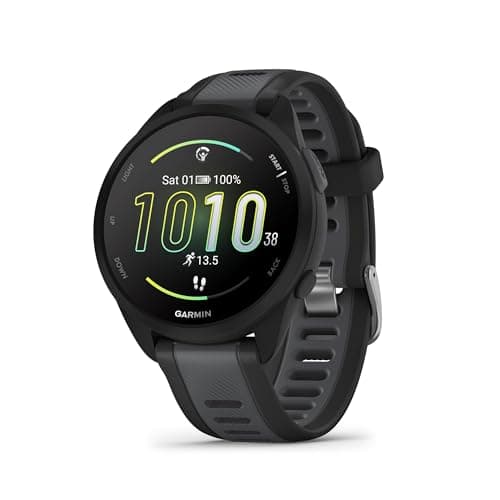 Garmin Forerunner 165 The cheapest way into a genuinely good AMOLED Garmin, provided you accept single-band positioning. | First real running watch | Manufacturer specification | 6.4/10 | $199.99Amazon |
| 03 | 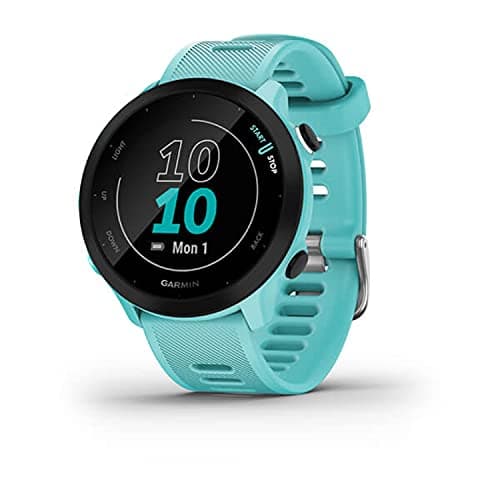 Garmin Forerunner 55 Garmin's cheapest running watch, and — awkwardly — the only Garmin on this site with a peer-reviewed heart-rate measurement behind it. It came last in the paper. | A first Garmin, at the lowest price | Peer-reviewed validation | 6.0/10 | $199.99Amazon |
#ad· Live prices from the Amazon Product API, as of October 10, 2026. Where we have no verified live price we show none. Scores come from the published rubric at How we rank — the Evidence column shows what each ranking actually rests on, including where the answer is nothing.
The row that is missing from one of these tables
Garmin publishes a battery table per watch, broken down by satellite mode. Lay the Forerunner 165 and Forerunner 265 tables next to each other and the interesting thing is not a number, it is an absence: the 265 has a row called All + Multi-Band GPSand the 165 does not. The 165's best row is All Systems GPS. There is no multi-band figure for it because there is no multi-band mode in it.
That matters more than the screen, the price or the strap, because multi-band reception is the specific hardware that addresses the complaint most people have about a cheap running watch: a track that drifts through buildings, bridges and tree cover. No firmware update adds a frequency band the receiver cannot hear.
Garmin's own figures, mode by mode
| Manufacturer-stated | Forerunner 165 | Forerunner 265 (46 mm) | Forerunner 55 |
|---|---|---|---|
| Smartwatch mode | Up to 11 days | Up to 13 days | Up to 14 days |
| GPS-Only | Up to 19 h | Up to 20 h | Up to 20 h (the only GPS row Garmin publishes for it) |
| Auto Select / SatIQ | Not published | Up to 16 h | Not published |
| All Systems | Up to 17 h | Not published separately | Not published |
| All Systems + Multi-Band | No such mode | Up to 14 h | No such mode |
| With music | 7 h GPS-Only, 6.5 h All Systems | 7 h GPS-Only | No on-watch music |
| Media storage | Up to 4 GB | Up to 8 GB | None |
| Water rating | 5 ATM (swim) | 5 ATM (swim) | 5 ATM (swim) |
Now read the two best-accuracy rows against each other, because this is the part every other comparison of these watches gets backwards. In its most accurate mode the 165 states 17 hours. In its most accurate mode the 265 states 14. The cheaper watch lasts longer in its best mode — because its best mode is the weaker one. That is not a win, and anyone quoting 17 against 14 as a battery advantage is comparing two different specifications.
The same trap appears in our own derived arithmetic, so we will say it out loud: per manufacturer-stated GPS hour in each watch's best mode, the 165 works out at $11.76 and the 265 at $31.36. Those two figures are not like-for-like, because the modes behind them are not. They are published together anyway, because hiding the unit is how a spec sheet misleads without lying. The live gap between the two watches today is $239.
What has actually been measured on these watches
This is where the pair separates in a way no amount of price-cutting changes.
The Forerunner 265 has a peer-reviewed measurement.In a 2025 Frontiers in Physiology study of 100 recreational runners, the 265 and 265S were tested against a treadmill graded exercise test with fingertip blood lactate. The watch returned a usable threshold result 65.2% of the time across 23 participants — the best completion rate of the three watches in the study — while overestimating threshold pace by roughly a quarter. Note what that protocol required: the Garmin arm of the study used an ECG chest strap, not the wrist sensor. So the completion figure is a vote of confidence in Garmin's algorithm, not in its optical hardware.
The Forerunner 165 has nothing. No independent validation of this model exists that we could find, which is the normal state of affairs in this category and the reason it scores 5 out of 10 on evidence rather than higher.
The Forerunner 55 has the worst measurement on this site. It is one of the very few watches ever tested in a peer-reviewed heart-rate study, and in the 2025 placement study it recorded a bias of approximately 33 bpm during burpees — the largest error in that paper. Being measured at all is unusual; being measured and coming last is why it cannot rank above the other two here. We would rather publish that than quietly leave the watch off the page.
Which one to buy
Buy the 265 if any of these is true: your usual route has buildings, canyons or heavy tree cover; you want the most accurate positioning Garmin sells at this price; you want the longer-lasting smaller case, because the 265S actually states better figures than the 46 mm in every mode (15 days, 24 h GPS-Only, 15 h multi-band). The full record is in our 265 review.
Buy the 165if your running is on roads and trails with open sky, and the money matters. It is a genuinely good watch with Garmin's full training platform, an AMOLED screen and an 11-day stated battery; what it lacks is the one receiver mode that fixes GPS drift, and if you do not have GPS drift you are paying for nothing. Our 165 review has the detail.
Buy neitherif endurance is what you came for. At the money these two occupy, a COROS PACE 4 states 41 GPS hours in All-Systems mode against the 265's 20 GPS-Only hours, with dual-frequency positioning included — the trade is COROS's unvalidated optical sensor and a smaller app ecosystem. We put that case properly in Forerunner 570 vs COROS PACE 4 and rank the whole field in best running watches on a budget.
What neither watch fixes
Both use a wrist optical sensor, and no current-generation Garmin optical sensor has been independently validated. If your reason for upgrading is that heart rate reads 150 while you are warming up, the multi-band receiver will not help, the AMOLED screen will not help, and the extra 4 GB of music storage will not help. The measured answer to that problem is a strap or an armband — the evidence is in wrist vs chest strap accuracy, and the cheap fix is in better heart rate accuracy.
In full
Every pick, and why
Garmin Forerunner 265
One of the very few watches on this site whose training estimates have actually been measured against a laboratory — and the measurement was not kind.
- Case
- 46mm AMOLED (the 265S is 42mm)
- Satellite
- All + Multi-Band GPS
- Battery (stated)
- 13 days smartwatch / 20 h GPS-only / 14 h all + multi-band
- Storage
- Up to 8 GB media, 5 ATM
What's good
- Multi-band positioning and an AMOLED screen in a mid-range Forerunner, in two case sizes
- It has actually been tested: in a 2025 study of 100 recreational runners, 23 of them wore a Forerunner 265 against fingertip blood lactate — more than can be said for most watches sold today
- 8 GB of on-watch music storage, so the phone can stay at home
What isn't
- In that study its threshold PACE estimate overshot the laboratory value by 25.78% on average, and it overestimated rather than erring low
- Its threshold test also failed to return a usable result 34.8% of the time
Skip this if
Skip this if you plan to set training zones from the watch's own threshold test. The one published measurement of that feature says it overestimates by roughly a quarter, and no firmware note undoes a published result.
What the evidence says
Peer-reviewed validationLu et al., Frontiers in Physiology 16:1621996 (2025), tested 100 recreational runners against fingertip blood lactate; 23 of them wore a Forerunner 265 or 265s. Its threshold pace estimate carried a mean error of 25.78% and overestimated; its threshold heart rate was much closer, inside the 5.95-7.15% band shared by the three watches tested; and its test produced a usable result 65.2% of the time. The authors note the Garmin protocol required an ECG chest strap while the other two devices used wrist sensing. That is a peer-reviewed measurement of this exact model — unusual in this category, and unflattering.
Show how this 7.2 was calculated
| Factor | Weight | Score |
|---|---|---|
| EvidenceA peer-reviewed measurement of this specific watch exists, which almost nothing else in the range can claim. It went badly, so this cannot score higher than mid. | 30% | 6.0 |
| HardwareAll + Multi-Band GPS and an AMOLED display in a mid-range case. | 20% | 8.5 |
| Metric coverageFull Garmin training platform and music storage; no maps. | 20% | 8.5 |
| EnduranceGarmin states 20 hours GPS-only, 14 hours all + multi-band, 13 days smartwatch. | 15% | 6.5 |
| Cost per capabilityMid-range sticker; a multi-band receiver at this price is the value here. | 15% | 7.0 |
Price as of October 10, 2026. Prices move; Amazon's is the one that counts.
#ad · we may earn a commission from this link to Garmin Forerunner 265
Garmin Forerunner 165
The cheapest way into a genuinely good AMOLED Garmin, provided you accept single-band positioning.
- Display
- AMOLED
- Satellite
- Single-band GNSS
- Extras
- Training metrics, sleep tracking, music on the Music edition
What's good
- AMOLED and Garmin's training platform at the bottom of the range
- Light, simple, and hard to get wrong as a first watch
What isn't
- Single-band positioning, which is the specification that actually degrades in cities and under tree cover
- No multi-band means it is the wrong upgrade if GPS drift is your complaint
Skip this if
Skip this if you are here because your GPS track wanders between buildings. Single-band is the hardware that causes that, and this watch has it.
What the evidence says
Manufacturer specificationPublished specifications only; no independent validation of this model that we could find.
Show how this 6.4 was calculated
| Factor | Weight | Score |
|---|---|---|
| EvidencePublished specs, no independent measured validation. | 30% | 5.0 |
| HardwareSingle-band GNSS — a genuine step down from the multi-band models above it. | 20% | 6.0 |
| Metric coverageFull Garmin training platform; fewer advanced running-dynamics metrics. | 20% | 7.0 |
| EnduranceSolid for the class, per Garmin's stated figures. | 15% | 7.0 |
| Cost per capabilityLowest entry price to the Garmin ecosystem with an AMOLED screen. | 15% | 8.5 |
$249.9920% off
Price as of October 10, 2026. Prices move; Amazon's is the one that counts.
#ad · we may earn a commission from this link to Garmin Forerunner 165
Garmin Forerunner 55
Garmin's cheapest running watch, and — awkwardly — the only Garmin on this site with a peer-reviewed heart-rate measurement behind it. It came last in the paper.
- Battery (stated)
- 14 days smartwatch / 20 h GPS mode
- Water rating
- 5 ATM (swim)
- Satellite
- Built-in GPS; Garmin's table lists no multi-band mode
- Operating range
- -20 °C to 60 °C
- Extras
- Daily suggested workouts, wrist heart rate, sleep tracking
What's good
- The cheapest route into Garmin Connect, which is the strongest training platform here
- 14 stated smartwatch days means it is on your wrist at night rather than on the charger
- Simple enough that a new runner will actually use all of it
What isn't
- The 2025 Sensors placement study recorded a bias of roughly 33 bpm on this watch during burpees — the highest error in the paper
- Garmin's own specification table lists one GPS-mode figure and no all-systems multi-band row, so the drift-in-cities problem is not fixed here
Skip this if
Skip this if you do interval or stop-start training and intend to trust the heart-rate number. This is the specific device the placement study caught at ~33 bpm of error during explosive work, and no firmware update rewrites a published measurement.
What the evidence says
Peer-reviewed validationMeasured directly in Sensors (2025), n = 28, against a Polar H10 reference: during the burpee protocol the wrist-worn Forerunner 55 showed a bias of approximately 33 bpm, the largest error recorded in the study. Being measured at all is unusual in this category. Being measured and coming last is the reason this watch cannot rank higher here, and we would rather say that than quietly leave it out.
Show how this 6.0 was calculated
| Factor | Weight | Score |
|---|---|---|
| EvidencePeer-reviewed measurement of this exact device exists, which almost nothing here can say — and the result was the worst in the paper. Both halves of that count. | 30% | 4.5 |
| HardwareGarmin's published battery table lists a single GPS-mode figure with no multi-band row, unlike every multi-band watch on this site. | 20% | 5.5 |
| Metric coverageCore running metrics, daily suggested workouts and sleep; none of the advanced running-dynamics set. | 20% | 6.0 |
| EnduranceGarmin states 14 days smartwatch and 20 hours GPS. | 15% | 7.0 |
| Cost per capabilityThe lowest price of entry to Garmin's platform on this site. | 15% | 8.5 |
Price as of October 10, 2026. Prices move; Amazon's is the one that counts.
#ad · we may earn a commission from this link to Garmin Forerunner 55
Three checks that settle it
- Look at your last ten GPS tracks. If the line is clean, multi-band buys you nothing and the 165 is the better value. If it cuts corners through buildings, that is exactly the failure multi-band addresses.
- Decide whether you want the smaller case. Garmin states better battery figures for the 42 mm 265S than for the 46 mm in every single mode, which is unusual and worth knowing before you default to the bigger watch.
- Check whether you need music on the watch. The 165 publishes 4 GB and a 6.5-hour all-systems-with-music figure; the 265 publishes 8 GB. The 55 has neither, and that is the real reason it is a different class of watch rather than a cheaper one.
How this ranking was built
Every score on this page comes from one published rubric, applied identically to every device on the site, with the weights written down and the inputs shown. We have not worn any of these devices and we never say we have. Read the method and check us.
Questions
Frequently asked
Does the Forerunner 165 have multi-band GPS?
No. Garmin's own battery table for the 165 lists GPS-Only, All Systems and UltraTrac and has no All + Multi-Band row, because the watch has no multi-band mode. The 265 publishes up to 14 hours in that mode. This is the clearest hardware difference between the two.
Is the Forerunner 165 battery better than the 265?
Not like-for-like. The 165 states 19 h GPS-Only and 11 days smartwatch; the 265 states 20 h GPS-Only and 13 days. The 165's 17-hour All Systems figure beats the 265's 14-hour multi-band figure only because the 165 cannot run the more accurate mode at all.
Is the Forerunner 265 worth the extra money over the 165?
It is if you need multi-band positioning, the 8 GB of music storage or the 265S's longer stated battery. It is also the only one of the two with a peer-reviewed measurement behind any of its numbers. If your GPS tracks are already clean, the honest answer is no.
Should I just buy the Forerunner 55 and save more?
Only if you want the simplest possible Garmin. It has no music, no AMOLED screen, and one GPS mode — and it is the device the 2025 placement study caught with roughly 33 bpm of heart-rate bias during explosive work, the largest error in that paper.
Show your working
Sources
Every one of these was read in full before it was cited. Where we could not access a paper, we do not quote its numbers.
- [1]Manufacturer specification2026Garmin — Forerunner 165 Series owner’s manual, battery life information and specifications
Manufacturer-stated, read 2026-10-11 from Garmin's own owner's manual. Battery: up to 11 days in smartwatch mode with activity tracking, phone notifications and wrist heart rate; up to 19 h in activity mode with GPS Only; up to 17 h with All Systems GPS; up to 25 h with UltraTrac; up to 7 h GPS Only with music playback and 6.5 h All Systems with music. The specification page states a rechargeable built-in lithium-ion battery, a 5 ATM swim water rating, up to 4 GB of media storage, an operating range of −20 to 60 °C and a charging range of 0 to 45 °C. NOTE the structure of the table: the highest-accuracy row Garmin publishes for this watch is All Systems — there is no all-systems multi-band row, because the hardware has no multi-band mode.
- [2]Manufacturer specification2026Garmin — Forerunner 265 Series owner’s manual, battery life information and specifications
Manufacturer-stated, read 2026-08-18. Forerunner 265 (46 mm): up to 13 days smartwatch mode, 20 h GPS-only, 16 h Auto Select GPS, 14 h All + Multi-Band GPS, and 7 h GPS-only with music playback. Forerunner 265S (42 mm): 15 days, 24 h, 18 h, 15 h and 7.5 h for the same modes. The manual’s specification page states 5 ATM and up to 8 GB of media storage.
- [3]Manufacturer specification2026Garmin — Forerunner 55 owner’s manual, specifications
Manufacturer-stated: up to 14 days in smartwatch mode with notifications and wrist heart rate, up to 20 hours in GPS mode, 5 ATM (swim), operating range -20 °C to 60 °C. The table lists ONE GPS-mode figure — there is no separate all-systems multi-band row of the kind Garmin publishes for its multi-band watches.
- [4]Peer-reviewed validation2025Lu, Cui, Zhu, Wu, Xing, Pan & Shen, “Validity of smartwatch-derived estimates of lactate threshold heart rate and pace compared to graded exercise testing”, Frontiers in Physiology 16:1621996
DOI 10.3389/fphys.2025.1621996. 100 healthy recreational runners (61 male, 39 female, 28.0 ± 9.6 years) against a treadmill graded exercise test with fingertip blood lactate (Biosen C-line), threshold determined by the modified Dmax method. Device counts were unequal: Huawei GT Runner n = 100, Garmin Forerunner 265/265s n = 23, COROS PACE 3 n = 17. Authors’ stated limits: unbalanced samples, indoor reference against outdoor watch tests, day-to-day threshold variability, and different heart-rate acquisition between devices — the Garmin protocol required an ECG chest strap while the other two used wrist PPG — plus undisclosed manufacturer algorithms.
- [5]Peer-reviewed validation2025“Impact of Anatomical Placement on the Accuracy of Wearable Heart Rate Monitors During Rest and Various Exercise Intensities”, Sensors (Basel)
n = 28 (14 male, 14 female). Polar H10 chest strap as the reference. Compared Polar Verity Sense (forearm), Garmin Forerunner 55 (wrist) and three simultaneous Whoop 4.0 units at wrist, forearm and upper arm, across rest, cycling warm-up, burpees and a modified Bruce treadmill protocol.
Read next
Related
- Garmin Forerunner 165 review
The cheapest AMOLED Garmin, and the specification it is missing.
- Garmin Forerunner 265 review
The mid-range Garmin with a peer-reviewed threshold measurement.
- Forerunner 570 vs 265
The next rung up, decided on the same receiver question.
- What is dual-band GPS
What multi-band actually does, and what nobody has measured about it.