GPS and multisport
Garmin Forerunner 570
Same sensor generation as the 970, two case sizes, no maps. For most runners that is the correct trade — but not for the reason people usually give.
We earn a commission when you buy through our Amazon links, at no extra cost to you. It never decides a ranking — the rubric that does is published in full, so you can check us rather than take our word for it. How this works.
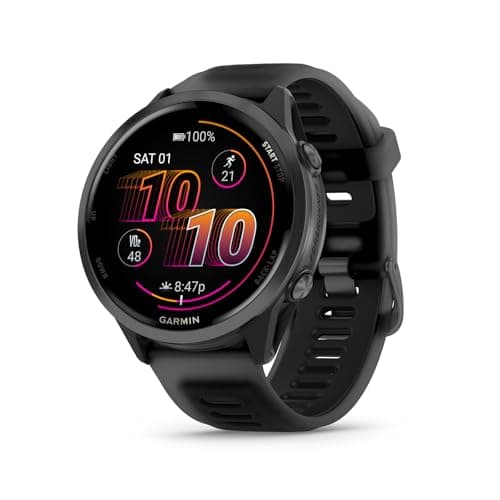
Top pick
Most runners, most of the timeGarmin Forerunner 570
Same sensor family as the 970, $200 less, and no maps. For most runners that is the correct trade.
Price as of October 22, 2026. Prices move; Amazon's is the one that counts.
#ad · we may earn a commission from this link to Garmin Forerunner 570
The short answer
The Forerunner 570 records the same core data as the Forerunner 970 — multi-band GNSS, the same sensor generation — for around $200 less, and adds a 42 mm case option the 970 does not have. The real compromise is not the missing maps but the battery: 18 stated GPS hours against 26.
Ranked
Quick picks
| # | Device | Best for | Evidence | Score | Price |
|---|---|---|---|---|---|
| 01 | Garmin Forerunner 570 Same sensor family as the 970, $200 less, and no maps. For most runners that is the correct trade. | Most runners, most of the time | Manufacturer specification | 7.3/10 | $546.00Amazon |
#ad· Live prices from the Amazon Product API, as of October 22, 2026. Where we have no verified live price we show none. Scores come from the published rubric at How we rank — the Evidence column shows what each ranking actually rests on, including where the answer is nothing.
What you give up, and what you do not
Garmin publishes the 570 as available in 42 mm and 47 mm, with an AMOLED display, multi-band GNSS, a speaker and microphone, on-watch music, and up to 11 days smartwatch or 18 hours GPS on the 47 mm case.
What you do notgive up is the data. The 570 uses the same generation of optical sensor and the same class of multi-band receiver as the 970. The numbers it records are not a cut-down version of the flagship's. That is the single most useful fact about this watch and the reason it is the sensible default for most runners.
What you give up is maps, the titanium bezel, the ECG app, and eight hours of stated GPS endurance.
The battery is the real decision, not the maps
People frame this choice around mapping, but maps are a feature most runners use twice. The constraint that actually bites is endurance. Eighteen stated hours is comfortable for a marathon with an enormous margin and thin for anything beyond about twelve hours of moving time.
And per hour it is the worse deal: $30.33 against the 970's $28.85. That is a genuinely counter-intuitive result and it is why we compute these figures rather than describing watches as offering "good value".
The 42 mm option deserves more attention than it gets. A 47 mm case on a small wrist is not a cosmetic problem — a sensor that does not sit flat measures worse, which makes case size a data-quality question rather than a styling one.
What we could not verify
- Heart-rate accuracy. No independent validation of this watch that we could find.
- Positioning accuracy in the field. Same gap as the 970 — the useful peer-reviewed study is from 2020 and tested single-band hardware.
- The 42 mm battery figure.Garmin's published 18-hour GPS number is for the 47 mm case. Smaller cases carry smaller batteries; we have not seen a confirmed figure for the 42 mm and are not going to estimate one.
Who should not buy it
Anyone racing beyond about twelve hours, and anyone who navigates unfamiliar trails. Breadcrumb navigation without a map is workable in principle and unpleasant in practice when you are tired and it is getting dark. If that describes you, the rugged flagship is the comparison worth reading — Forerunner 570 vs fēnix 8 matches every GNSS mode properly, which most spec tables of those two do not.
Update: the 42 mm figures, and the cross-brand comparison
As of our 20 September 2026 read, Garmin's product page lists the 42 mm case separately: up to 10 days in smartwatch mode, 18 hours GPS-only, 14 hours SatIQ and 13 hours All-Systems + Multi-Band, at 42 g. The 47 mm case is stated at 11 days, 18, 16 and 14 hours, at 50 g. Those are the 42 mm figures the launch-day text above declined to estimate, read from Garmin's own page rather than guessed, and they close the gap in the honest direction: the small case gives up one multi-band hour, not several.
The question most 570 shoppers actually type is not 570-versus-970 but whether to leave Garmin altogether for the watch that states 41 GPS hours at about half the money. That is resolved, mode by mode, on Forerunner 570 vs COROS PACE 4.
Update: the watch at the same price that is not a Forerunner
Garmin lists the Venu 4 at the same $549.99 as this watch, and — this surprised us — its own owner's manual documents that watch with the Forerunner analysis stack and states a longer battery in every published mode, including 17 hours in all-systems multi-band against the 570's 14. Both tables are printed in full on Forerunner 570 vs Venu 4, and the device write-up is the Venu 4 review. What the 570 keeps is the SatIQ mode and the running line's tooling, which is the honest case for it.
In full
Every pick, and why
Garmin Forerunner 570
Same sensor family as the 970, $200 less, and no maps. For most runners that is the correct trade.
- Case
- 42mm or 47mm, AMOLED
- Satellite
- Multi-band GNSS
- Battery (stated)
- 11 days smartwatch / 18 h GPS (47mm)
- Maps
- None
- Extras
- Speaker and microphone, on-watch music
What's good
- Records the same core metrics as the 970 — the data you get back is not a cut-down version
- Two case sizes, which the 970 does not offer
- Multi-band GNSS at a mid-range price
What isn't
- 18 stated GPS hours is thin for ultra distances
- No maps, so navigation is breadcrumb-only
Skip this if
Skip this if you race beyond about 12 hours or navigate unfamiliar trails. The battery and the missing maps are both real limits, and neither is fixable in software.
What the evidence says
Manufacturer specificationAs with the 970, no independent validation of this model's optical heart rate has been published that we could find.
Show how this 7.3 was calculated
| Factor | Weight | Score |
|---|---|---|
| EvidenceDetailed published specs, no independent measured validation of this model. | 30% | 5.5 |
| HardwareMulti-band GNSS and the same current-generation optical sensor family as the 970. | 20% | 9.0 |
| Metric coverageEverything the 970 records except maps and the ECG app. | 20% | 8.5 |
| EnduranceGarmin states 18 hours GPS, 11 days smartwatch, on the 47mm case. | 15% | 6.0 |
| Cost per capabilityMaterially cheaper than the 970 for the same recorded data. | 15% | 8.0 |
Price as of October 22, 2026. Prices move; Amazon's is the one that counts.
#ad · we may earn a commission from this link to Garmin Forerunner 570
Questions
Frequently asked
Does the Forerunner 570 have maps?
No. Navigation is breadcrumb-only. If you want maps in this range you need the 970 — it is the primary functional difference between the two.
Is the Forerunner 570 accurate enough for serious training?
Its positioning hardware is the same class as the flagship's: multi-band GNSS. For heart rate, the same caveat applies as to every wrist device — the published literature shows optical wrist sensing degrading during intensity changes across all brands. Pair a strap if you train by heart rate.
42 mm or 47 mm?
Fit is a data-quality question, not a styling one — an optical sensor that does not sit flat against the skin measures worse. Choose the size that sits properly on your wrist. Note that Garmin's published 18-hour GPS figure is for the 47 mm case.
Show your working
Sources
Every one of these was read in full before it was cited. Where we could not access a paper, we do not quote its numbers.
- [1]Manufacturer specification2026Garmin — Forerunner 570 (47 mm) published specifications
Manufacturer-stated battery: up to 11 days smartwatch mode, up to 18 hours GPS mode.
- [2]Manufacturer specification2026Garmin — Forerunner 570 product page, battery life by GNSS mode (42 mm and 47 mm)
Manufacturer-stated, read 2026-09-20. 47 mm: smartwatch mode up to 11 days; GPS-Only GNSS mode up to 18 hours; SatIQ (AutoSelect) GNSS mode up to 16 hours; All-Systems GNSS mode + Multi-Band up to 14 hours; with music 9 h GPS-only, 8 h SatIQ, 8 h All-Systems + Multi-Band. 42 mm: smartwatch up to 10 days; GPS-Only up to 18 hours; SatIQ up to 14 hours; All-Systems + Multi-Band up to 13 hours; with music 9 / 8 / 8 h. Also stated: 47 x 47 x 12.9 mm and 50 g (47 mm), 42.4 x 42.4 x 12.9 mm and 42 g (42 mm), 1.4" 454 x 454 AMOLED (47 mm) or 1.2" 390 x 390 (42 mm), Corning Gorilla Glass 3, aluminum bezel, 5 ATM, 8 GB memory, built-in speaker/microphone, Elevate wrist heart rate monitor, connectivity Bluetooth / ANT+ / Wi-Fi, Connect IQ, $549.99. Garmin publishes no plain All-Systems (single-frequency, multi-constellation) figure for this watch, only GPS-Only, SatIQ and All-Systems + Multi-Band.
- [3]Manufacturer specification2026Garmin — Forerunner 970 published specifications
Manufacturer-stated battery: up to 15 days smartwatch mode, up to 26 hours GPS mode.
- [4]Peer-reviewed validation2025“Impact of Anatomical Placement on the Accuracy of Wearable Heart Rate Monitors During Rest and Various Exercise Intensities”, Sensors (Basel)
n = 28 (14 male, 14 female). Polar H10 chest strap as the reference. Compared Polar Verity Sense (forearm), Garmin Forerunner 55 (wrist) and three simultaneous Whoop 4.0 units at wrist, forearm and upper arm, across rest, cycling warm-up, burpees and a modified Bruce treadmill protocol.
- [5]Peer-reviewed validation2020Gilgen-Ammann, Schweizer & Wyss, “Accuracy of Distance Recordings in Eight Positioning-Enabled Sport Watches: Instrument Validation Study”, JMIR mHealth and uHealth
DOI 10.2196/17118. Eight watches (Apple Watch Series 4, Coros Apex 46mm, Garmin Fenix 5X Plus, Garmin Forerunner 935, Polar Vantage M, Polar Vantage V, Polar V800, Suunto 9 Baro) measured against a trundle wheel accurate to 1 cm, across urban, forest and 400 m track conditions. IMPORTANT: this predates the dual-frequency receivers now standard, so it describes brand engineering history, not any watch currently sold.
Read next
Related
- Forerunner 570 vs fēnix 8
Every GNSS mode matched properly, against the rugged flagship.
- Forerunner 570 vs 970
Both watches side by side, with the arithmetic.
- Forerunner 970
The flagship: maps, titanium and eight more stated GPS hours.
- Best running watches
Where the 570 lands against the wider field.
- Forerunner 570 vs COROS PACE 4
The cross-brand version: every battery mode both makers publish, with the modes named.
- Forerunner 570 vs Venu 4
Same list price, and Garmin's own tables disagree with its product lines.
- The best Garmin watches, ranked
Where this watch sits in the whole lineup, on one rubric.