GPS and multisport
COROS PACE 4
The best endurance-per-dollar figure on this site by a distance — attached to the one brand with a published heart-rate problem.
We earn a commission when you buy through our Amazon links, at no extra cost to you. It never decides a ranking — the rubric that does is published in full, so you can check us rather than take our word for it. How this works.
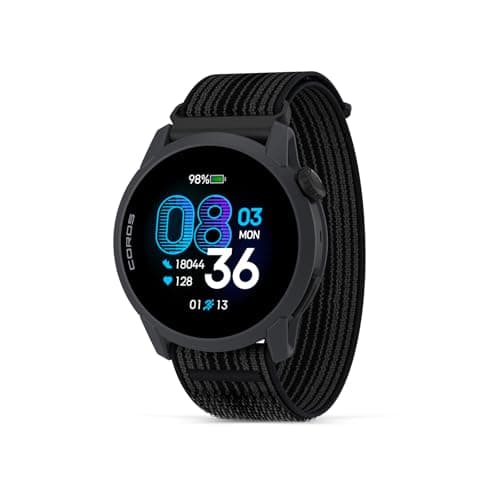
Top pick
Long days on a budgetCOROS PACE 4
41 stated GPS hours in a 32-gram watch, for a third of the Forerunner 970's money. The endurance-per-dollar winner by a distance.
Price as of October 22, 2026. Prices move; Amazon's is the one that counts.
#ad · we may earn a commission from this link to COROS PACE 4
The short answer
The COROS PACE 4 states 41 GPS hours in All-Systems mode in a 32-gram case, which works out at $6.07 per GPS hour — by a distance the best endurance-per-dollar figure on this site. The caveat is heart rate: the only independent COROS test we found was unfavorable, and it tested the previous model.
Ranked
Quick picks
| # | Device | Best for | Evidence | Score | Price |
|---|---|---|---|---|---|
| 01 | COROS PACE 4 41 stated GPS hours in a 32-gram watch, for a third of the Forerunner 970's money. The endurance-per-dollar winner by a distance. | Long days on a budget | Independent measured test | 7.5/10 | $249.00Amazon |
#ad· Live prices from the Amazon Product API, as of October 22, 2026. Where we have no verified live price we show none. Scores come from the published rubric at How we rank — the Evidence column shows what each ranking actually rests on, including where the answer is nothing.
The specification, and why it is remarkable
COROS publishes: a 1.2-inch AMOLED touchscreen, 32 grams with the nylon band and 40 with silicone, 11.8 mm thick, All-Systems and Dual-Frequency satellite modes, a redesigned heart-rate sensor with larger LEDs, 41 GPS hours on a single charge and 19 days of daily training and sleep.
Put that next to the flagships and the numbers are genuinely strange. The PACE 4 states more GPS hours than the Forerunner 970 and the 570 combined, in a case that weighs roughly half as much, at about a third of the 970's price. On cost per GPS hour it is not a close contest.
The 32 grams deserves as much attention as the battery. Over an hour, watch weight is irrelevant. Over a hundred miles it is the difference between forgetting the watch is there and noticing it every step. This is a specification that is honestly reported and genuinely consequential, which is a rarer combination than it should be.
The heart-rate problem, stated fairly
Here is why this watch does not rank first overall despite winning two of the five rubric categories outright.
In 2023, the5krunner published a measured comparison of the COROS PACE 3 against a Garmin HRM-Pro Plus and a Polar Verity Sense, across easy runs, intervals and cycling. The finding was that COROS wrist heart rate diverged during and after rapid intensity change — precisely the situation you would be relying on it for during interval work.
Three things must be said about that, all of them at once:
- It tested the PACE 3, not the PACE 4. COROS states the PACE 4 has a redesigned sensor with larger LEDs.
- It is an independent measured test, not a peer-reviewed study, and the author explicitly cautions that the dataset was limited.
- No independent test of the redesigned sensor has been published that we could find. The unfavorable result may well have been fixed. Nobody has checked.
Under our evidence hierarchy that combination — a bad result on the predecessor and no measurement of the successor — scores 4.5 out of 10. Not the 2.5 we give a device with no evidence at all, and not the high mark the hardware might otherwise earn. If you think that is harsh, the weights are published and you can see it is 30% of the total.
What we could not verify
- Whether the redesigned sensor fixed the problem. This is the single most decision-relevant fact about this watch and there is no published answer.
- The 41-hour figure.COROS's number, in All-Systems mode. We have not run one down. Note also that Dual-Frequency mode — the most accurate — will be shorter than the All-Systems headline figure.
- Positioning accuracy. The 2020 eight-watch study included a COROS Apex 46 mm, but that is a different watch from six years ago with a different receiver.
Who should not buy it
Anyone who trains by wrist heart rate and will not wear a strap. That is the one weakness in the published record and it happens to sit exactly where an interval-focused runner would lean on it. Pair a strap and the objection disappears entirely — at which point this is arguably the best-value watch on the site.
The PACE 4 does not claim maps at any price, and the cheapest COROS that does is the generation above it: the PACE Pro, which is also the only watch in the line for which COROS publishes a dual-frequency battery figure.
In full
Every pick, and why
COROS PACE 4
41 stated GPS hours in a 32-gram watch, for a third of the Forerunner 970's money. The endurance-per-dollar winner by a distance.
- Display
- 1.2" AMOLED touchscreen
- Weight
- 32 g with nylon band, 40 g with silicone
- Satellite
- All-Systems and Dual-Frequency modes
- Battery (stated)
- 19 days daily use / 41 h GPS (All-Systems)
- Thickness
- 11.8 mm
What's good
- 41 manufacturer-stated GPS hours — more than the Forerunner 970 and the 570 combined
- 32 g is light enough that you stop noticing it, which matters more over 100 miles than any feature
- Dual-frequency positioning at an entry-level price
What isn't
- COROS wrist heart rate is the one area where an independent test has published a specific problem — see the evidence note
- Smaller third-party app ecosystem than Garmin's
Skip this if
Skip this if you train by heart rate off the wrist and will not wear a strap. The one independent test we found flagged COROS wrist HR during exactly the intervals you would be buying it for.
What the evidence says
Independent measured testThe5krunner's measured comparison found the previous-generation PACE 3's wrist heart rate diverged during and after rapid intensity changes. That test was of the PACE 3, not the PACE 4, and the author cautions the dataset was limited. COROS states the PACE 4 has a redesigned sensor; no independent test of the new sensor has been published that we could find.
Show how this 7.5 was calculated
| Factor | Weight | Score |
|---|---|---|
| EvidenceThe only independent measured evidence in the range is a limited-dataset test of the PREVIOUS model, and it was unfavorable. The redesigned sensor is unvalidated. | 30% | 4.5 |
| HardwareDual-frequency GNSS and a redesigned optical sensor, per the COROS spec page. | 20% | 8.0 |
| Metric coverageStrong training metrics; a narrower ecosystem than Garmin for third-party integrations. | 20% | 7.5 |
| Endurance41 stated GPS hours in All-Systems mode is the best in this roundup by a wide margin. | 15% | 10.0 |
| Cost per capabilityComfortably the strongest dollars-per-GPS-hour figure on the site. | 15% | 10.0 |
Price as of October 22, 2026. Prices move; Amazon's is the one that counts.
#ad · we may earn a commission from this link to COROS PACE 4
Questions
Frequently asked
How long does the COROS PACE 4 battery actually last?
COROS states 41 GPS hours in All-Systems mode and 19 days of daily training and sleep. Those are manufacturer figures. Dual-Frequency mode — the most accurate positioning setting — will be shorter than the headline number, so check which mode you intend to run.
Is COROS heart rate accurate?
The one independent measured test we found, of the previous PACE 3, found it diverged during rapid intensity changes. COROS states the PACE 4 has a redesigned sensor, and no independent test of that new sensor has been published that we could find. So the honest answer is that nobody currently knows — which is why we score it below devices with published results and above devices with nothing at all.
Is the PACE 4 good enough to replace a Garmin?
On battery, weight and price, comfortably. Where Garmin is ahead is ecosystem breadth — third-party integrations, coaching-platform support and the size of the accessory market. If you use structured workouts pushed from a coaching platform, check compatibility before switching.
Show your working
Sources
Every one of these was read in full before it was cited. Where we could not access a paper, we do not quote its numbers.
- [1]Manufacturer specification2026COROS — PACE 4 published specifications
Manufacturer-stated: 1.2" AMOLED, 32 g with nylon band, 11.8 mm thick, All-Systems and Dual-Frequency satellite modes, 41 GPS hours, 19 days of daily training and sleep.
- [2]Independent measured test2023the5krunner, measured heart-rate comparison of the COROS PACE 3
An independent measured test, not a peer-reviewed study, and the author explicitly cautions the dataset was limited. Compared against Garmin HRM-Pro Plus and Polar Verity Sense across easy runs, intervals and cycling. Found divergence during and after rapid intensity change. Tests the PACE 3, not the PACE 4.
- [3]Peer-reviewed validation2025“Impact of Anatomical Placement on the Accuracy of Wearable Heart Rate Monitors During Rest and Various Exercise Intensities”, Sensors (Basel)
n = 28 (14 male, 14 female). Polar H10 chest strap as the reference. Compared Polar Verity Sense (forearm), Garmin Forerunner 55 (wrist) and three simultaneous Whoop 4.0 units at wrist, forearm and upper arm, across rest, cycling warm-up, burpees and a modified Bruce treadmill protocol.
- [4]Peer-reviewed validation2020Gilgen-Ammann, Schweizer & Wyss, “Accuracy of Distance Recordings in Eight Positioning-Enabled Sport Watches: Instrument Validation Study”, JMIR mHealth and uHealth
DOI 10.2196/17118. Eight watches (Apple Watch Series 4, Coros Apex 46mm, Garmin Fenix 5X Plus, Garmin Forerunner 935, Polar Vantage M, Polar Vantage V, Polar V800, Suunto 9 Baro) measured against a trundle wheel accurate to 1 cm, across urban, forest and 400 m track conditions. IMPORTANT: this predates the dual-frequency receivers now standard, so it describes brand engineering history, not any watch currently sold.
Read next
Related
- COROS PACE Pro review
The one PACE with global maps, and the older sensor generation.
- Best budget running watches
The dual-frequency options that cost under $300.
- COROS vs Garmin
Tier by tier, because the two ranges do not line up model for model.
- Best running watches
Where the PACE 4 lands on the full rubric.
- Fix your heart rate data
The strap that removes this watch's only real weakness.
- COROS PACE Pro review
The full review of the mapping PACE, and what its dual-frequency figure costs.
- PACE 3 vs PACE 4
The older watch is the one anybody actually measured. It matters here.
- PACE 4 vs PACE Pro
The maps question, and the dual-frequency battery figure COROS publishes for only one of them.
- PACE 4 vs Garmin Forerunner 570
What roughly double the money buys from Garmin, and what it does not.