GPS and multisport
COROS PACE Pro
Global maps, a 1500-nit always-on screen, and the one endurance figure COROS is willing to state for the mode you actually bought the receiver for.
We earn a commission when you buy through our Amazon links, at no extra cost to you. It never decides a ranking — the rubric that does is published in full, so you can check us rather than take our word for it. How this works.
The short answer
COROS states 31 hours of dual-frequency GPS, 38 hours of GPS activity tracking and 20 days of daily use for the PACE Pro, plus global maps with turn-by-turn navigation. It is the only watch in the PACE line with a published dual-frequency figure. No independent measurement of its heart rate or positioning exists that we could find.
Ranked
Quick picks
| # | Device | Best for | Evidence | Score | Price |
|---|---|---|---|---|---|
| 01 | 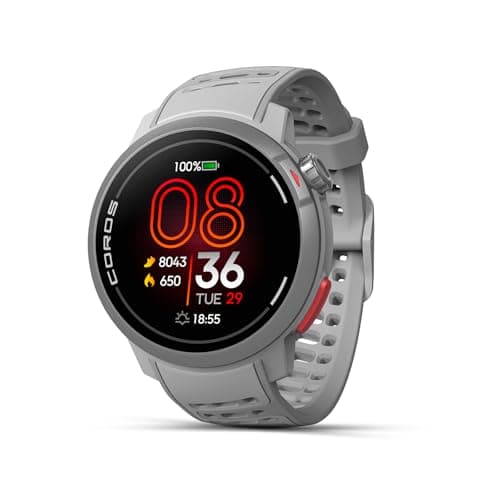 COROS PACE Pro The cheapest route to global maps with turn-by-turn navigation on a wrist, and the only watch in the PACE line whose dual-frequency battery figure COROS is willing to publish. | Navigation on a PACE budget | No validation study exists | 6.9/10 | $299.00Amazon |
#ad· Live prices from the Amazon Product API, as of Sep 15, 2026. Where we have no verified live price we show none. Scores come from the published rubric at How we rank — the Evidence column shows what each ranking actually rests on, including where the answer is nothing.
The number COROS publishes here and nowhere else in the PACE line
Almost every watch in this category publishes one flattering battery number and lets you assume it applies to the mode you will actually run. It does not. A dual-frequency receiver hears each satellite on two frequencies and uses the disagreement between them to identify signals that bounced off a building or a rock face before reaching you. That is the mode worth buying, and it is also the mode that drains the battery fastest.
COROS publishes both numbers for this watch: 38 hours of GPS activity tracking and 31 hours with dual-frequency GPS. That second figure is the one this site carries into every calculation on this page, because quoting 38 hours for a watch you bought for positioning accuracy describes a mode you would switch off.
It matters more than it sounds, because the cheaper PACE 4does not publish a dual-frequency figure at all. Its 41-hour headline is an All-Systems number. So the usual "41 beats 31" comparison is not a like-for-like row, and this is the only watch in the line where the accurate mode has a stated cost at all. At today's price that works out at $9.65 per stated dual-frequency GPS hour.
Publishing the less flattering number is a small act of honesty that most of this category avoids, and it is the single best reason to take the rest of COROS's specification sheet seriously.
What the maps actually buy you
COROS lists global maps with turn-by-turn navigation on this watch. The PACE 4 does not claim them at any price, and neither does the PACE 3, which makes the PACE Pro the cheapest route into COROS mapping.
Be honest with yourself about whether that is your problem. Breadcrumb navigation — a line showing where you have been, with no map underneath it — solves "get me back to the car" and costs nothing. A real map solves "I do not know this trail network and I want to improvise a route inside it". Those are different problems, and only one of them is worth a premium. We work through the distinction in full on the maps guide.
If you race on roads, run known loops, or navigate with your phone in a pocket, the maps on this watch will be a feature you demonstrate to people rather than one you use.
The screen, the processor, and what COROS is claiming
The display is a 1.3-inch always-on AMOLED touchscreen that COROS rates at 1500 nits, the brightest figure the company publishes in this range. The watch weighs 37 grams with the optional nylon band.
The always-on setting has a stated price attached, and COROS states it plainly: 20 days of daily use becomes 6 full dayswith the always-on display enabled. That is a more than threefold reduction for a setting many buyers switch on within a week of unboxing, and it is worth knowing before you compare this watch's daily-use figure against anything else.
COROS also fits the Ambiq Apollo510 here, and claims it delivers more than twice the processor speed of the PACE 3 and 30 times faster map and graphic rendering than the APEX 2 Pro. Those are the manufacturer's own comparative claims with no published method behind them, so this site files them as claims rather than measurements. Rendering speed is also the kind of thing you notice within a minute of handling one, which makes it one of the few specifications you can check yourself before buying.
The evidence position: nothing here has been measured
No independent validation of the PACE Pro's heart rate or positioning exists that we could find, as of September 2026. It sits at the bottom of our evidence hierarchy, and that single fact caps its score no matter how good the specification sheet is. It scores 4.5 on evidence, which is what pulls an otherwise capable watch down the ranking.
Two independent measurements of a COROS watch do exist, and both tested the PACE 3 rather than this device:
- The5krunner's measured 10-mile comparison put a PACE 3 against a Garmin HRM-Pro Plus and a Polar Verity Sense and found its wrist heart rate diverged during and after rapid intensity change. The author cautions that the dataset was limited.
- Lu et al. (2025), in Frontiers in Physiology, tested watch-estimated lactate threshold against a graded exercise test with fingertip blood lactate. Before accuracy, completion: the COROS protocol returned an estimate on 47.1% of attempts, the lowest of the three brands tested. That arm of the study had 17 participants on a PACE 3, and the authors list the unbalanced samples among their own limitations.
Neither result is evidence about the PACE Pro, and we will not present them as such. What they establish is narrower and still useful: on the two occasions anyone independently measured a COROS watch, the result was unflattering. So "COROS sensors are fine" is not a claim anyone can currently support either. The honest position is that this device is unmeasured, in a brand whose measurements have not gone well.
There is one more wrinkle specific to this watch. COROS describes a redesigned optical sensor on the newer, cheaper PACE 4. The PACE Pro predates it. So the newest sensor in the PACE line is not in the watch with "Pro" in its name — and neither sensor has been independently tested.
If wrist heart rate during intervals is your actual complaint, the published record says that is an argument for a strap, not for a different watch. Placement beats brand, and no wrist optical sensor at any price has solved it.
What the battery figures are worth
Every endurance number on this page is COROS's own, produced under COROS's conditions. Nobody here has run one down, and we will not imply otherwise.
COROS is unusually direct about this on its own product page, where it notes that all battery claims depend on feature usage — music, backlight, navigation and other factors — and that actual results will vary. Read that alongside the always-on figure above and the practical reading becomes clear: the 20-day number describes a watch with the screen asleep and the maps unopened, which is not the watch you are buying if maps are why you are here.
Why this watch got cheaper
The PACE Pro is not new. COROS launched it on 31 October 2024 at $349, then cut it to $299 alongside the PACE 4 launch in its own published pricing note — with no language calling the reduction temporary. Both of those are price history from COROS rather than a live quote; the current number is whatever the buy row on this page says today.
That repositioning is the useful context for this watch. It is an outgoing-generation flagship that was moved down a tier rather than discontinued, which is exactly the circumstance in which a watch becomes good value — and also the circumstance in which you should check whether the newer, cheaper model in the same line already does what you need.
PACE Pro or PACE 4?
This is the decision almost everyone reading this page is actually making, and it is close enough that we gave it a page of its own.
The short version: the newer PACE 4 is lighter at 32 grams, thinner, states more GPS hours in its own headline mode, carries the redesigned sensor, and costs less — the current gap is $50. What the Pro adds is the maps, the brighter and larger always-on screen, the faster processor, SpO2, and a stated dual-frequency endurance figure to compare against.
If you will not use maps, the PACE 4 is the better buy and it is not close. If you will, this is the cheapest watch that has them in this brand.
What we could not verify
- Optical heart-rate accuracy. No published measurement of this model exists that we could find.
- Positioning accuracy. No published measurement of this model, and no current dual-frequency watch of any brand has been independently validated that we could find.
- Every battery figure. Manufacturer-stated, under conditions COROS itself says will vary with use.
- SpO2 and sleep outputs. Unvalidated on this device, as on nearly every watch in this category.
- The processor and rendering claims.COROS's own comparisons against its older models, with no published method.
Who should not buy it
Anyone who never navigates. Strip the maps out of the decision and the PACE 4 is lighter, cheaper and longer-lived on its own stated numbers. You would be paying for a screen and a menu you will not open.
Anyone who needs the measurement, not the specification. If you want a watch whose numbers somebody outside the manufacturer has checked, this is not it — and on this site that is a ranking position rather than an insult.
Anyone buying it to fix interval heart rate. Not because this watch is worse than its rivals, but because the problem is wrist optical sensing itself, and a strap fixes it with the watch you already own.
In full
Every pick, and why
COROS PACE Pro
The cheapest route to global maps with turn-by-turn navigation on a wrist, and the only watch in the PACE line whose dual-frequency battery figure COROS is willing to publish.
- Display
- 1.3" always-on AMOLED touchscreen, 1500 nits
- Weight
- 37 g with the nylon band
- Satellite
- All-Systems and Dual-Frequency modes
- Battery (stated)
- 20 days daily use / 38 h GPS / 31 h dual-frequency
- Navigation
- Global maps with turn-by-turn navigation
- Processor
- Ambiq Apollo510
What's good
- The only device in the PACE line for which COROS publishes a dual-frequency battery figure — 31 hours — instead of leaving the accurate mode uncosted
- Global maps with turn-by-turn navigation, which the PACE 4 does not claim at any price
- A 1500-nit always-on AMOLED, which is the brightest screen COROS publishes a figure for in this range
What isn't
- No independent validation of its heart rate or positioning exists that we could find, and its optical sensor predates the redesigned one COROS describes on the PACE 4
- Heavier and shorter-lived than the cheaper PACE 4 on every stated number except daily use
Skip this if
Skip this if you never navigate. Strip the maps out of the decision and the PACE 4 is lighter, cheaper and longer-lived, and you are paying a premium for a screen and a menu you will not open.
What the evidence says
No validation study existsNo independent measurement of this watch exists that we could find as of August 2026. The only measured COROS heart-rate result on record is the5krunner's limited-dataset comparison of the PACE 3, which found divergence during and after rapid intensity change. That test was of a different watch, so it is not evidence about this one either way — which is the point: there is nothing here to weigh.
Show how this 6.9 was calculated
| Factor | Weight | Score |
|---|---|---|
| EvidenceNothing published measures this watch. The only COROS result on record tested the PACE 3, so this device is ranked on specification alone — which is exactly what caps it. | 30% | 4.5 |
| HardwareAll-Systems and Dual-Frequency satellite modes and an Ambiq Apollo510 processor, per COROS. Its optical sensor predates the redesigned one COROS describes on the PACE 4. | 20% | 7.5 |
| Metric coverageFull COROS training platform plus SpO2, and global maps with turn-by-turn navigation the PACE 4 does not claim. Same narrower third-party ecosystem as the rest of the range. | 20% | 8.0 |
| EnduranceCOROS states 31 hours in dual-frequency mode, 38 hours of GPS activity tracking and 20 days of daily use. We carry the dual-frequency number, because that is the mode the positioning hardware was bought for. | 15% | 9.0 |
| Cost per capabilityMid-range sticker for dual-frequency plus maps. Per dual-frequency GPS hour it sits behind both the PACE 4 and the PACE 3 — that gap is what the maps cost. | 15% | 7.5 |
Price as of Sep 15, 2026. Prices move; Amazon's is the one that counts.
#ad · we may earn a commission from this link to COROS PACE Pro
Questions
Frequently asked
Is the COROS PACE Pro worth it?
It is worth it for one specific reason: it is the cheapest COROS with global maps and turn-by-turn navigation, and the only watch in the PACE line with a published dual-frequency battery figure. If you do not navigate, the newer PACE 4 is lighter, cheaper and states more GPS hours in its own headline mode, and you should buy that instead.
Does the COROS PACE Pro have maps?
Yes. COROS lists global maps with turn-by-turn navigation on the PACE Pro. Neither the PACE 4 nor the PACE 3 claims them, which is the main thing the Pro badge buys inside this line.
How accurate is the COROS PACE Pro?
Nobody has published a measurement of it, so nobody can tell you — including us. The only two independent COROS results on record both tested the PACE 3: one found wrist heart rate diverging during rapid intensity change, and a 2025 peer-reviewed study returned a lactate-threshold estimate on only 47.1% of COROS attempts. Different watch, so it neither clears nor condemns this one.
How long does the COROS PACE Pro battery last?
COROS states 31 hours in dual-frequency GPS, 38 hours of GPS activity tracking, and 20 days of daily use — dropping to 6 full days with the always-on display enabled. All of those are manufacturer figures, and COROS itself notes that real results vary with music, backlight and navigation use.
Show your working
Sources
Every one of these was read in full before it was cited. Where we could not access a paper, we do not quote its numbers.
- [1]Manufacturer specification2026COROS — PACE Pro published specifications
Manufacturer-stated: 1.3" always-on AMOLED touchscreen at 1500 nits, 37 g with the nylon band, All-Systems and Dual-Frequency satellite modes, 38 hours of GPS activity tracking, 31 hours with dual-frequency GPS, 20 days of daily use and sleep tracking, 6 days with the always-on display, global maps with turn-by-turn navigation, an Ambiq Apollo510 processor and an optical heart-rate plus SpO2 sensor. COROS's own launch release dates the watch to 31 October 2024 at $349.
- [2]Manufacturer claim only2024COROS — PACE Pro launch announcement
COROS's own press release: 1.3" always-on AMOLED at 1500 nits, 37 grams with the nylon band, "up to 38 hours of GPS battery life or 20 days in standard mode", All-Systems and Dual-Frequency modes, $349 USD, on sale from 31 October 2024 in three colorways. Marketing copy, so the comparative performance claims in it are labeled as claims, not measurements.
- [3]Manufacturer claim only2025COROS — “COROS Black Friday 2025”, coros.com latest news
COROS's own page. Promotion 24 November to 2 December 2025: 25% off a COROS Heart Rate Monitor with any COROS GPS watch or DURA purchase. The PACE 3 ($229 to $199) and PACE Pro ($349 to $299) moves are described as price reductions alongside the PACE 4 launch, with no language calling them temporary. PACE 4 and APEX 4 are not discounted on the page.
- [4]Independent measured test2023the5krunner, measured heart-rate comparison of the COROS PACE 3
An independent measured test, not a peer-reviewed study, and the author explicitly cautions the dataset was limited. Compared against Garmin HRM-Pro Plus and Polar Verity Sense across easy runs, intervals and cycling. Found divergence during and after rapid intensity change. Tests the PACE 3, not the PACE 4.
- [5]Peer-reviewed validation2025Lu, Cui, Zhu, Wu, Xing, Pan & Shen, “Validity of smartwatch-derived estimates of lactate threshold heart rate and pace compared to graded exercise testing”, Frontiers in Physiology 16:1621996
DOI 10.3389/fphys.2025.1621996. 100 healthy recreational runners (61 male, 39 female, 28.0 ± 9.6 years) against a treadmill graded exercise test with fingertip blood lactate (Biosen C-line), threshold determined by the modified Dmax method. Device counts were unequal: Huawei GT Runner n = 100, Garmin Forerunner 265/265s n = 23, COROS PACE 3 n = 17. Authors’ stated limits: unbalanced samples, indoor reference against outdoor watch tests, day-to-day threshold variability, and different heart-rate acquisition between devices — the Garmin protocol required an ECG chest strap while the other two used wrist PPG — plus undisclosed manufacturer algorithms.
- [6]Manufacturer specification2026COROS — PACE 4 published specifications
Manufacturer-stated: 1.2" AMOLED, 32 g with nylon band, 11.8 mm thick, All-Systems and Dual-Frequency satellite modes, 41 GPS hours, 19 days of daily training and sleep.
Read next
Related
- PACE 4 vs PACE Pro
The head-to-head, and why the two headline battery numbers are not the same mode.
- COROS PACE 4 review
The lighter, cheaper sibling with the redesigned sensor.
- Do you need maps on a running watch?
The question this watch's whole premium rests on.
- Best trail GPS watches
Where navigation and multi-band endurance both get ranked.