Head to head
Garmin Forerunner 570 vs 265
The same 14 stated multi-band hours and the same 8 GB of music. The real gap is that one of these watches has been measured.
We earn a commission when you buy through our Amazon links, at no extra cost to you. It never decides a ranking — the rubric that does is published in full, so you can check us rather than take our word for it. How this works.
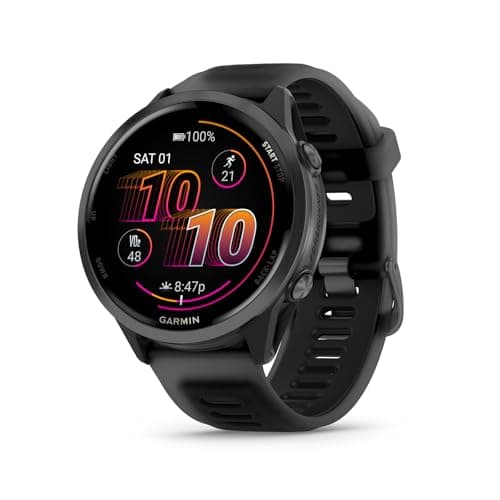
Top pick
Most runners, most of the timeGarmin Forerunner 570
Same sensor family as the 970, $200 less, and no maps. For most runners that is the correct trade.
Price as of October 22, 2026. Prices move; Amazon's is the one that counts.
#ad · we may earn a commission from this link to Garmin Forerunner 570
The short answer
Buy the 265 if it is meaningfully cheaper, because on Garmin's own figures the two match where it counts: 14 stated hours in All + Multi-Band GPS and 8 GB of music storage each. The 570 is newer, offers a 42mm case and adds a speaker and microphone. The 265 is the only one of the two that has been tested against a laboratory — and it did poorly, which we would rather tell you than hide.
Ranked
Quick picks
| # | Device | Best for | Evidence | Score | Price |
|---|---|---|---|---|---|
| 01 | Garmin Forerunner 570 Same sensor family as the 970, $200 less, and no maps. For most runners that is the correct trade. | Most runners, most of the time | Manufacturer specification | 7.3/10 | $546.00Amazon |
| 02 | 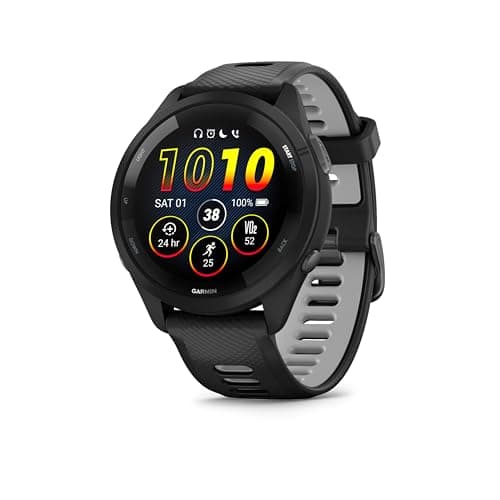 Garmin Forerunner 265 One of the very few watches on this site whose training estimates have actually been measured against a laboratory — and the measurement was not kind. | Runners who want a measured device, flaws included | Peer-reviewed validation | 7.2/10 | $434.90Amazon |
#ad· Live prices from the Amazon Product API, as of October 22, 2026. Where we have no verified live price we show none. Scores come from the published rubric at How we rank — the Evidence column shows what each ranking actually rests on, including where the answer is nothing.
The specification table
All battery figures are Garmin's own, taken from each watch's owner's manual with the mode named. Garmin publishes three GNSS modes for both watches, and the gap between the flattering figure and the accuracy figure is roughly a third on each.
| Specification | Forerunner 570 (47mm) | Forerunner 265 (46mm) |
|---|---|---|
| Case sizes | 42mm or 47mm | 42mm (265S) or 46mm |
| Smartwatch mode (stated) | 11 days | 13 days |
| GPS-only (stated) | 18 h | 20 h |
| All + Multi-Band (stated) | 14 h | 14 h |
| With music playback (stated) | 8 h multi-band, 9 h GPS-only | 6 h multi-band, 7 h GPS-only |
| Media storage | Up to 8 GB | Up to 8 GB |
| Extras | Speaker and microphone, newer sensor generation | None of those; two years older |
| Independent validation | None we could find | Yes — and unflattering |
The one difference that has actually been measured
In 2025 a team published a comparison of smartwatch threshold estimates against fingertip blood lactate in 100 recreational runners, 23 of whom wore a Forerunner 265. Its threshold pace estimate carried a mean error of 25.78% and overestimated — it told runners they could hold a faster pace than the laboratory said they could. Its thresholdheart rate was far better, inside the 5.95-7.15% band the three watches shared, which is roughly 9-11 bpm. And the test failed to return a usable result 34.8% of the time.
Nobody has run that test on the Forerunner 570. Its threshold feature uses the same family of models on a newer sensor, so the honest position is that it is unmeasured rather than better. Under our evidence hierarchy an unmeasured device cannot outrank a measured one on accuracy grounds — but a measured device that did badly does not get to hide behind the paper either.
Where the newer watch genuinely wins
- Case size choice.The 570 comes in 42mm and 47mm with the same feature set. Garmin's 42mm 265S actually has the longer stated battery of the two 265s, at 15 hours multi-band and 15 smartwatch days, so this is a fit decision rather than a capability one.
- Speaker and microphone. Calls and voice assistant from the wrist, which the 265 cannot do at all.
- Music endurance.The 570 states 8 hours of multi-band recording with music playing against the 265's 6 — a real gap on a long run with headphones.
Where the older watch wins
Battery, marginally: 20 stated GPS-only hours and 13 smartwatch days against 18 and 11. Price, usually substantially — the gap today is $111. And evidence, in the peculiar sense this site means it: the 265 is a known quantity with a published flaw, while the 570 is an unknown one.
Neither watch has maps. If that is what you are shopping for, the decision is between the 570 and the Forerunner 965 instead.
Who should buy which
- You want the most watch per dollar.The 265, and set your training zones from a real test rather than the watch's estimate.
- You want a 42mm case with full features, or calls from the wrist. The 570.
- You are buying because of the threshold feature. Neither. Read what the lactate study found first — all three watches tested overestimated, and two failed the test outright more than a third of the time.
The 42mm question, with real numbers
Both watches come in a smaller case, and the small versions do not behave the same way. Garmin publishes a separate battery table for each:
| Small case | All + Multi-Band | GPS-only | Smartwatch mode |
|---|---|---|---|
| Forerunner 570, 42mm | 13 h | 18 h | 10 days |
| Forerunner 265S, 42mm | 15 h | 24 h | 15 days |
The 265S is the stronger small watch on every published row, and it is the only case in Garmin's current line-up where the smaller model states longer battery than its larger sibling. If you want a 42mm watch and endurance matters, that table is the answer.
Music, if you run without a phone
Both carry up to 8 GB of media storage, so the capacity question is a tie. The endurance question is not: with music playing, Garmin states 8 hours in All + Multi-Band for the 570 against 6 for the 265, and 9 hours against 7 in GPS-only. Two extra hours of audio is a real difference on a long Sunday, and it is the clearest practical win the newer watch has.
If you want more than 8 GB, neither of these is the watch — the storage figures are published and the jump is to a 32 GB flagship.
In full
Every pick, and why
Garmin Forerunner 570
Same sensor family as the 970, $200 less, and no maps. For most runners that is the correct trade.
- Case
- 42mm or 47mm, AMOLED
- Satellite
- Multi-band GNSS
- Battery (stated)
- 11 days smartwatch / 18 h GPS (47mm)
- Maps
- None
- Extras
- Speaker and microphone, on-watch music
What's good
- Records the same core metrics as the 970 — the data you get back is not a cut-down version
- Two case sizes, which the 970 does not offer
- Multi-band GNSS at a mid-range price
What isn't
- 18 stated GPS hours is thin for ultra distances
- No maps, so navigation is breadcrumb-only
Skip this if
Skip this if you race beyond about 12 hours or navigate unfamiliar trails. The battery and the missing maps are both real limits, and neither is fixable in software.
What the evidence says
Manufacturer specificationAs with the 970, no independent validation of this model's optical heart rate has been published that we could find.
Show how this 7.3 was calculated
| Factor | Weight | Score |
|---|---|---|
| EvidenceDetailed published specs, no independent measured validation of this model. | 30% | 5.5 |
| HardwareMulti-band GNSS and the same current-generation optical sensor family as the 970. | 20% | 9.0 |
| Metric coverageEverything the 970 records except maps and the ECG app. | 20% | 8.5 |
| EnduranceGarmin states 18 hours GPS, 11 days smartwatch, on the 47mm case. | 15% | 6.0 |
| Cost per capabilityMaterially cheaper than the 970 for the same recorded data. | 15% | 8.0 |
Price as of October 22, 2026. Prices move; Amazon's is the one that counts.
#ad · we may earn a commission from this link to Garmin Forerunner 570
Garmin Forerunner 265
One of the very few watches on this site whose training estimates have actually been measured against a laboratory — and the measurement was not kind.
- Case
- 46mm AMOLED (the 265S is 42mm)
- Satellite
- All + Multi-Band GPS
- Battery (stated)
- 13 days smartwatch / 20 h GPS-only / 14 h all + multi-band
- Storage
- Up to 8 GB media, 5 ATM
What's good
- Multi-band positioning and an AMOLED screen in a mid-range Forerunner, in two case sizes
- It has actually been tested: in a 2025 study of 100 recreational runners, 23 of them wore a Forerunner 265 against fingertip blood lactate — more than can be said for most watches sold today
- 8 GB of on-watch music storage, so the phone can stay at home
What isn't
- In that study its threshold PACE estimate overshot the laboratory value by 25.78% on average, and it overestimated rather than erring low
- Its threshold test also failed to return a usable result 34.8% of the time
Skip this if
Skip this if you plan to set training zones from the watch's own threshold test. The one published measurement of that feature says it overestimates by roughly a quarter, and no firmware note undoes a published result.
What the evidence says
Peer-reviewed validationLu et al., Frontiers in Physiology 16:1621996 (2025), tested 100 recreational runners against fingertip blood lactate; 23 of them wore a Forerunner 265 or 265s. Its threshold pace estimate carried a mean error of 25.78% and overestimated; its threshold heart rate was much closer, inside the 5.95-7.15% band shared by the three watches tested; and its test produced a usable result 65.2% of the time. The authors note the Garmin protocol required an ECG chest strap while the other two devices used wrist sensing. That is a peer-reviewed measurement of this exact model — unusual in this category, and unflattering.
Show how this 7.2 was calculated
| Factor | Weight | Score |
|---|---|---|
| EvidenceA peer-reviewed measurement of this specific watch exists, which almost nothing else in the range can claim. It went badly, so this cannot score higher than mid. | 30% | 6.0 |
| HardwareAll + Multi-Band GPS and an AMOLED display in a mid-range case. | 20% | 8.5 |
| Metric coverageFull Garmin training platform and music storage; no maps. | 20% | 8.5 |
| EnduranceGarmin states 20 hours GPS-only, 14 hours all + multi-band, 13 days smartwatch. | 15% | 6.5 |
| Cost per capabilityMid-range sticker; a multi-band receiver at this price is the value here. | 15% | 7.0 |
Price as of October 22, 2026. Prices move; Amazon's is the one that counts.
#ad · we may earn a commission from this link to Garmin Forerunner 265
How this ranking was built
Every score on this page comes from one published rubric, applied identically to every device on the site, with the weights written down and the inputs shown. We have not worn any of these devices and we never say we have. Read the method and check us.
Questions
Frequently asked
Is the Forerunner 570 a big upgrade over the 265?
Not in what it records. The stated All + Multi-Band battery is 14 hours on both, media storage is 8 GB on both, and neither has maps. The 570 adds a speaker and microphone, a 42mm option with the full feature set, and a newer sensor generation with no published validation behind it.
Which one has better battery life?
The 265, slightly, in the modes Garmin publishes: 20 hours GPS-only against 18, and 13 smartwatch days against 11. In All + Multi-Band — the mode you would actually use for accuracy — they are identical at 14 hours. The 570 pulls ahead only with music playing.
Is the Forerunner 265's lactate threshold feature accurate?
Against blood lactate in a 2025 study it was not. Threshold pace carried a mean error of 25.78% and overestimated, and the test failed to produce a usable result 34.8% of the time. Threshold heart rate did much better, at roughly 9-11 bpm of error. Treat the pace number as a suggestion, not a prescription.
Show your working
Sources
Every one of these was read in full before it was cited. Where we could not access a paper, we do not quote its numbers.
- [1]Manufacturer specification2026Garmin — Forerunner 570 Series owner’s manual, specifications
Manufacturer-stated, read 2026-08-18: rechargeable lithium-ion battery, 5 ATM (swim) water rating, and up to 8 GB of media storage — a quarter of what the 970 carries, on a watch that records the same data.
- [2]Manufacturer specification2026Garmin — Forerunner 265 Series owner’s manual, battery life information and specifications
Manufacturer-stated, read 2026-08-18. Forerunner 265 (46 mm): up to 13 days smartwatch mode, 20 h GPS-only, 16 h Auto Select GPS, 14 h All + Multi-Band GPS, and 7 h GPS-only with music playback. Forerunner 265S (42 mm): 15 days, 24 h, 18 h, 15 h and 7.5 h for the same modes. The manual’s specification page states 5 ATM and up to 8 GB of media storage.
- [3]Peer-reviewed validation2025Lu, Cui, Zhu, Wu, Xing, Pan & Shen, “Validity of smartwatch-derived estimates of lactate threshold heart rate and pace compared to graded exercise testing”, Frontiers in Physiology 16:1621996
DOI 10.3389/fphys.2025.1621996. 100 healthy recreational runners (61 male, 39 female, 28.0 ± 9.6 years) against a treadmill graded exercise test with fingertip blood lactate (Biosen C-line), threshold determined by the modified Dmax method. Device counts were unequal: Huawei GT Runner n = 100, Garmin Forerunner 265/265s n = 23, COROS PACE 3 n = 17. Authors’ stated limits: unbalanced samples, indoor reference against outdoor watch tests, day-to-day threshold variability, and different heart-rate acquisition between devices — the Garmin protocol required an ECG chest strap while the other two used wrist PPG — plus undisclosed manufacturer algorithms.
Read next
Related
- Forerunner 165 vs 265
The rung below, decided on the same multi-band question.
- Garmin Forerunner 265 review
The measured watch, with the study result in full.
- Garmin Forerunner 570 review
The newer watch on the same rubric.
- Forerunner 570 vs 965
The same question, with maps and 32 GB of music added.
- Lactate threshold, explained
Why every watch tested overestimated, and what to do instead.
- Forerunner 570 vs COROS PACE 4
The same 570, against the watch that states more than twice its GPS hours for about half the money.
- Forerunner 570 vs Venu 4
The same 570 against the lifestyle watch at its own list price, which states the longer battery.