GPS and multisport
Garmin Forerunner 965
A previous-generation flagship that still out-specifies the current mid-range on every number that decides a long run.
We earn a commission when you buy through our Amazon links, at no extra cost to you. It never decides a ranking — the rubric that does is published in full, so you can check us rather than take our word for it. How this works.
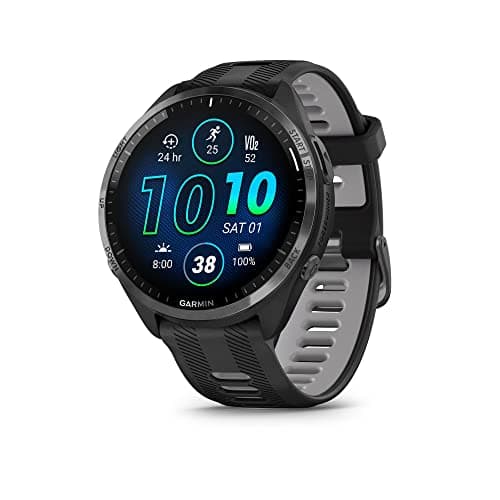
Top pick
Maps and music without the current-flagship priceGarmin Forerunner 965
The previous flagship Forerunner, still on sale: maps, 32 GB of music storage and 31 stated GPS hours, usually for less than the 970.
$599.9913% off
Price as of October 21, 2026. Prices move; Amazon's is the one that counts.
#ad · we may earn a commission from this link to Garmin Forerunner 965
The short answer
Garmin states 31 hours in GPS-only mode, 19 hours in All + Multi-Band and 23 days in smartwatch mode, with built-in maps and up to 32 GB of media storage. It is a generation old, which in this category mostly means cheaper. No independent validation of its sensors has been published that we could find.
Ranked
Quick picks
| # | Device | Best for | Evidence | Score | Price |
|---|---|---|---|---|---|
| 01 | Garmin Forerunner 965 The previous flagship Forerunner, still on sale: maps, 32 GB of music storage and 31 stated GPS hours, usually for less than the 970. | Maps and music without the current-flagship price | Manufacturer specification | 7.5/10 | $524.00Amazon |
#ad· Live prices from the Amazon Product API, as of October 21, 2026. Where we have no verified live price we show none. Scores come from the published rubric at How we rank — the Evidence column shows what each ranking actually rests on, including where the answer is nothing.
The battery table, with the modes named
Straight from Garmin's owner's manual. The spread between the top and bottom rows is the point: a watch advertised at 31 hours records for 19 in the mode you would choose for positioning accuracy, and 8.5 with music playing.
| Mode | Stated |
|---|---|
| Smartwatch mode | 23 days |
| GPS only | 31 h |
| Auto Select GPS | 22 h |
| All + Multi-Band GPS | 19 h |
| GPS only, with music | 10.5 h |
| All + Multi-Band, with music | 8.5 h |
| UltraTrac | 34 h |
The manual also states 5 ATM and up to 32 GB of media storage — four times what the current mid-range Forerunners carry, and the specification that decides whether you can leave the phone at home for a month of long runs.
Where an old flagship beats a new mid-range
Everything that costs silicon and battery. The 965 has maps; the Forerunner 570 does not. It states 19 multi-band hours against the 570's 14, and 23 smartwatch days against 11. Those gaps exist because it was built to sit at the top of the range, and being superseded did not shrink its battery.
What it lacks is the newer generation's conveniences: no speaker or microphone, no ECG app, and none of the newest running-economy metrics. It is also 47mm only, so a small wrist has no option here. We work through that decision in full on the 570 versus 965 comparison.
The evidence position
There is no independent validation of this watch — not of its optical heart rate, not of its positioning. That is the norm rather than the exception in this category and it is why the watch scores 5.5 on evidence, the largest single weight in our rubric.
One nearby data point deserves stating, carefully. The Forerunner 265 — same platform, same estimation models, different watch — was measured against blood lactate in 2025 and its threshold pace estimate overshot by 25.78%. We do not transfer that number onto the 965, because a different watch is a different watch. We do think anyone buying either for the threshold feature should read it.
The arithmetic
At $27.58per stated hour in the accuracy mode, the 965 sits in the same band as the rest of Garmin's upper range — which is to say expensive next to a COROS PACE 4, and reasonable next to a fēnix 8. Since this is a back-catalog watch, that figure moves with the discount on the day, which is the entire reason to consider it.
What to check before buying a superseded flagship
- The variant.Colorways and bundles list separately at different prices, and a bundle's sticker includes accessories you may not want. Read the title, not the photograph.
- The discount, on the day.The entire argument for this watch is price. The arithmetic on this page recomputes from the live price every time it is served, so the figure you see is today's, not a number we typed in months ago.
- What you are actually giving up. A newer sensor generation with no published validation behind it, an ECG app, and a speaker. None of those changes pace, distance or training load.
Where it sits in the current range
Against the mid-range Forerunner 570 it wins the numbers that decide long runs — 19 stated multi-band hours against 14, 23 smartwatch days against 11, 32 GB of media against 8, and maps against none. Against the current Forerunner 970 it gives up the ECG app, the speaker and the newest sensor, and keeps the maps and the storage.
The pattern is worth internalizing, because it repeats every product cycle in this category: last year's flagship generally beats this year's mid-range on hardware, and loses on convenience features that do not touch the data.
In full
Every pick, and why
Garmin Forerunner 965
The previous flagship Forerunner, still on sale: maps, 32 GB of music storage and 31 stated GPS hours, usually for less than the 970.
- Case
- 47mm, titanium bezel, AMOLED
- Satellite
- All + Multi-Band GPS
- Battery (stated)
- 23 days smartwatch / 31 h GPS-only / 19 h all + multi-band
- Maps
- Built-in, full color
- Storage
- Up to 32 GB media, 5 ATM
What's good
- Built-in maps and 32 GB of music storage — the two specifications that usually force the jump to a flagship
- 31 stated GPS-only hours and 23 smartwatch days, both longer than the current mid-range Forerunner 570
- A generation old, which in this category mostly means cheaper rather than worse
What isn't
- No ECG app, no speaker or microphone, and none of the 970's newer running-economy metrics
- Its stated multi-band figure is 19 hours — the mode you would actually run for accuracy costs it a third of the headline number
Skip this if
Skip this if you want the newest sensor generation or the ECG app. This is the previous flagship, and the honest reason to buy it is price, not capability.
What the evidence says
Manufacturer specificationPublished specifications only; no independent validation of this model that we could find. Its sibling the Forerunner 265 WAS measured in the 2025 lactate-threshold study — same platform, same estimation models, different watch — and that result was poor. We do not transfer the finding onto this watch, and we do not pretend it is unrelated either.
Show how this 7.5 was calculated
| Factor | Weight | Score |
|---|---|---|
| EvidenceDetailed published specs, no measured validation of this model. A sibling watch on the same platform was measured and did badly on threshold estimates. | 30% | 5.5 |
| HardwareAll + Multi-Band GPS behind a 47mm AMOLED with a titanium bezel. | 20% | 9.0 |
| Metric coverageMaps, 32 GB of music storage, the full Garmin training platform and a documented export path. | 20% | 9.5 |
| EnduranceGarmin states 31 hours GPS-only, 19 hours all + multi-band, 23 days smartwatch. | 15% | 8.0 |
| Cost per capabilityFlagship-tier sticker for a previous-generation watch; the value depends entirely on the discount on the day. | 15% | 6.5 |
$599.9913% off
Price as of October 21, 2026. Prices move; Amazon's is the one that counts.
#ad · we may earn a commission from this link to Garmin Forerunner 965
Questions
Frequently asked
Is the Forerunner 965 still a good buy in 2026?
If it is discounted, yes. Maps, 32 GB of media storage, 19 stated hours in All + Multi-Band and 23 smartwatch days are flagship figures, and the current mid-range does not match them. Buy it for the specification and the price, not for newness.
What is the difference between the Forerunner 965 and 970?
Generation. The 970 is the current flagship with a newer sensor, an ECG app and a speaker and microphone; the 965 is the previous one with the same core job. Both have maps, both carry 32 GB of media storage, and neither has published validation behind its heart-rate sensor.
How long does the Forerunner 965 last with music?
Garmin states 10.5 hours in GPS-only mode with music playback and 8.5 hours in All + Multi-Band with music. Playing audio roughly halves recording time on every watch that publishes both figures, which is worth planning around on a long day.
Does it work with a chest strap?
Yes, over ANT+ and Bluetooth — and on the published evidence that is the upgrade worth making. Our strap roundup ranks the options on measured accuracy rather than brand.
Show your working
Sources
Every one of these was read in full before it was cited. Where we could not access a paper, we do not quote its numbers.
- [1]Manufacturer specification2026Garmin — Forerunner 965 owner’s manual, battery life information and specifications
Manufacturer-stated, read 2026-08-18: up to 23 days smartwatch mode, 31 h GPS-only, 22 h Auto Select GPS, 19 h All + Multi-Band GPS, 34 h UltraTrac, and 10.5 / 9.5 / 8.5 h for those three GPS modes with music playback. The manual’s specification page states 5 ATM and up to 32 GB of media storage.
- [2]Peer-reviewed validation2025Lu, Cui, Zhu, Wu, Xing, Pan & Shen, “Validity of smartwatch-derived estimates of lactate threshold heart rate and pace compared to graded exercise testing”, Frontiers in Physiology 16:1621996
DOI 10.3389/fphys.2025.1621996. 100 healthy recreational runners (61 male, 39 female, 28.0 ± 9.6 years) against a treadmill graded exercise test with fingertip blood lactate (Biosen C-line), threshold determined by the modified Dmax method. Device counts were unequal: Huawei GT Runner n = 100, Garmin Forerunner 265/265s n = 23, COROS PACE 3 n = 17. Authors’ stated limits: unbalanced samples, indoor reference against outdoor watch tests, day-to-day threshold variability, and different heart-rate acquisition between devices — the Garmin protocol required an ECG chest strap while the other two used wrist PPG — plus undisclosed manufacturer algorithms.
- [3]Peer-reviewed validation2025“Impact of Anatomical Placement on the Accuracy of Wearable Heart Rate Monitors During Rest and Various Exercise Intensities”, Sensors (Basel)
n = 28 (14 male, 14 female). Polar H10 chest strap as the reference. Compared Polar Verity Sense (forearm), Garmin Forerunner 55 (wrist) and three simultaneous Whoop 4.0 units at wrist, forearm and upper arm, across rest, cycling warm-up, burpees and a modified Bruce treadmill protocol.
Read next
Related
- Forerunner 570 vs 965
Old flagship against new mid-range, with both battery tables.
- Garmin Forerunner 970 review
The current flagship, and what the extra money buys.
- Best running watches with music
Where 32 GB of storage decides a ranking.
- Do you need maps?
The question that justifies this watch, or does not.