Head to head
Apple Watch Ultra 3 vs Ultra 2
Six more stated hours, a published GNSS specification and a satellite link — against a price gap you can measure today.
We earn a commission when you buy through our Amazon links, at no extra cost to you. It never decides a ranking — the rubric that does is published in full, so you can check us rather than take our word for it. How this works.
Top pick
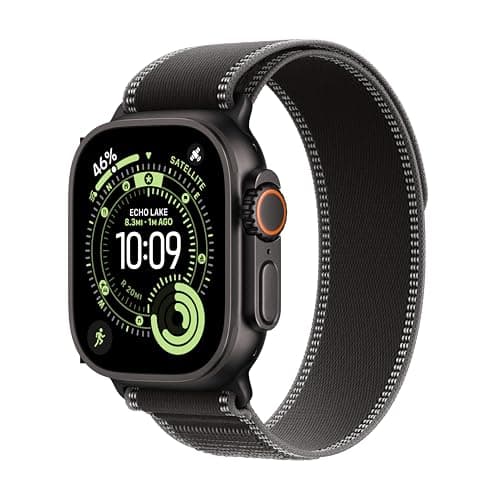
iPhone owners who train and want one deviceApple Watch Ultra 3
Excellent positioning hardware and the best screen here, attached to the weakest deep-sleep measurement in the published record.
Price as of October 22, 2026. Prices move; Amazon's is the one that counts.
#ad · we may earn a commission from this link to Apple Watch Ultra 3
The short answer
Buy the Ultra 2 if you find it discounted and you train inside cell coverage. Apple states 42 hours of normal use for the Ultra 3 against 36 for the Ultra 2, and publishes L1 and L5 dual-frequency GPS plus satellite connectivity for the newer watch. Neither has been validated independently, and the one peer-reviewed sleep result on Apple's platform is unflattering for both.
Ranked
Quick picks
| # | Device | Best for | Evidence | Score | Price |
|---|---|---|---|---|---|
| 01 | Apple Watch Ultra 3 Excellent positioning hardware and the best screen here, attached to the weakest deep-sleep measurement in the published record. | iPhone owners who train and want one device | Peer-reviewed validation | 6.8/10 | $588.83Amazon |
| 02 | 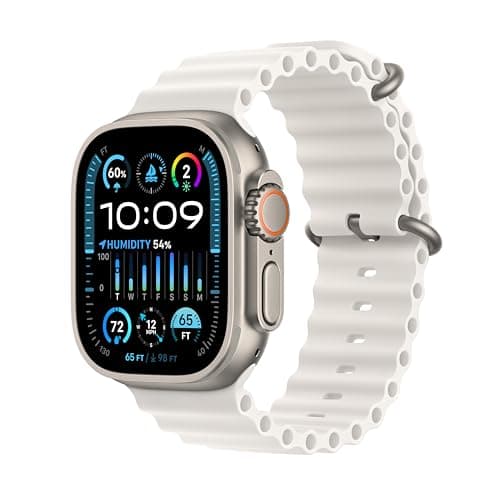 Apple Watch Ultra 2 The previous Ultra, still widely stocked and much cheaper. The same sleep-staging weakness in the published record, for roughly half the money. | iPhone owners who want an Ultra without the current price | Peer-reviewed validation | 6.8/10 | $389.99Amazon |
#ad· Live prices from the Amazon Product API, as of October 22, 2026. Where we have no verified live price we show none. Scores come from the published rubric at How we rank — the Evidence column shows what each ranking actually rests on, including where the answer is nothing.
The specification table
One column is thinner than the other, and that is a finding rather than an omission. Apple has retired the Ultra 2 from its line-up and its technical specifications page no longer renders for us, so the Ultra 2 column below comes from Apple's own launch announcement — the most detailed published figure set for that watch we could actually read. Where Apple no longer publishes a number, we leave it blank instead of borrowing one from the newer model.
| Specification | Ultra 3 | Ultra 2 |
|---|---|---|
| Case | Grade 5 titanium, 49 × 44 × 12 mm | 49 mm titanium |
| Display (stated peak) | Up to 3000 nits | Up to 3000 nits |
| Battery, normal use (stated) | Up to 42 h | Up to 36 h |
| Low Power Mode (stated) | Up to 72 h | Up to 72 h |
| Positioning | L1 and L5 precision dual-frequency GPS, plus GLONASS, Galileo, QZSS, BeiDou | Not published in the announcement we could read |
| Satellite features | Emergency SOS, Messages and Find My via satellite | Not published in the announcement we could read |
| Water | 100 m, EN13319 recreational scuba to 40 m | Recreational scuba to 40 m |
What six hours is worth
Apple's 42 and 36 hours are "normal use" figures built on a stated mix of time checks, notifications and one hour of workout with music. They are not GPS-recording hours, and Apple does not publish a GPS-hours figure the way Garmin, COROS and Polar do. That is the single biggest difference between an Apple Watch and a dedicated sports watch on this site: you cannot do the endurance arithmetic, because the input does not exist.
For a marathon, either watch is fine. For a long trail day, an ultra or a multi-day trip, neither is — and that is not a jab at Apple, it is what the published numbers say next to 41 stated days on a COROS APEX 4 or 53 stated multi-band hours on a fēnix 8 Pro.
The evidence, which does not favor the newer watch
Neither Ultra has been independently validated. What exists is Apple platform evidence, and all of it applies to both:
- Sleep.In the Brigham and Women's polysomnography study, the Apple Watch Series 8 reached 75.0% four-stage agreement but only 50.5% deep-sleep sensitivity — the weakest of the three devices tested, overestimating light sleep by 45 minutes and underestimating deep sleep by 43.
- VO2 max. Two laboratory validations found systematic underestimation: 6.07 mL/kg/min in PLOS ONE (2025) and 4.51 mL/kg/min in JMIR Biomedical Engineering (2024), with error growing as fitness rose — 21.5% in the fittest group.
Apple has revised its algorithms since both studies, and neither tested an Ultra. That is exactly why the newer watch cannot claim an evidence advantage here: nobody has measured it either.
The money
Today the gap between the two is $199. What that buys is six stated hours, a published dual-frequency GPS specification, a satellite link and the current chip. What it does not buy is a better-measured watch, because neither has been measured.
Who should buy which
- You want the Ultra experience for less. Ultra 2, discounted, without hesitation. It runs the same watchOS training features.
- You hike, sail or run out of coverage. Ultra 3 — the satellite features and the published positioning specification are the reason.
- You bought an Ultra for sleep or VO2 max. Read the sleep evidence first. On the published record, neither watch is the right tool for that job.
What "no published figure" means when you are shopping
Apple retires the technical-specification pages of discontinued models. That is normal housekeeping and it has a real consequence: for the Ultra 2 there is now no first-party page we can read that states its GNSS bands, its storage or its sensor list. Third-party listings repeat those numbers, and repeating a repeat is exactly how wrong specifications spread.
So this comparison leaves those cells blank rather than filling them from memory or from a retailer. If Apple republishes them, they will appear here. The practical effect for a buyer is small — the two watches are one generation apart — but it is worth knowing that the older watch is now harder to verify than the newer one, and that anyone quoting a confident Ultra 2 spec sheet is quoting somebody else.
If you are coming from a sports watch
Two things will surprise you, and neither is fixed by choosing between these two models. First, there is no ANT+ radio, so any chest strap you already own must support Bluetooth — our Apple Watch heart-rate roundup lists the ones that do. Second, neither watch publishes hours of GPS recording, so if your buying habit is to compare endurance figures, that comparison simply cannot be made against a Garmin, COROS or Polar spec sheet.
Pairing a strap is worth doing on either. The published evidence on wrist optical sensing under load is unambiguous, and it applies to Apple exactly as it applies to everyone else.
Update: both of these watches are now back-catalog
Apple announced the Apple Watch Ultra 4 on 9 September 2026 at $799, in stores from 18 September. Checked again on 19 October 2026, Apple's own Ultra page sells the Ultra 4 only and does not mention the Ultra 3 or the Ultra 2 anywhere on it. Both watches on this page are therefore retired from Apple's line-up, and both are bought from retailers now rather than from Apple.
That does not change the comparison, and it is worth being precise about why. The specification gap between these two watches is unaffected by a third watch existing, and the evidence position is unaffected because there is nothing to move: no independent validation of the Ultra 3, the Ultra 2 or the Ultra 4 has been published that we could find, and the one peer-reviewed sleep result on Apple's platform tested a Series 8. We have not ranked the Ultra 4 — no validation of it exists and no listing has been resolved onto our roster — so this page stays a comparison of the two watches you can actually buy at a discount.
What it does change is the price question. The Ultra 2 has had a year longer to fall and the Ultra 3 has just started, which on the record we keep at our Black Friday price-history page is the pattern worth watching: in 2025 the then-new Ultra 3 reached $120 off over the Cyber weekend while the outgoing Ultra 2 was $200 off. If you want the newest Apple watch rather than the best-value one, the Ultra 3 review carries the same update and the same caveat.
In full
Every pick, and why
Apple Watch Ultra 3
Excellent positioning hardware and the best screen here, attached to the weakest deep-sleep measurement in the published record.
- Case
- 49mm titanium
- Satellite
- Dual-frequency GNSS
- Connectivity
- GPS + Cellular
What's good
- Dual-frequency positioning and a genuinely excellent display
- Best-in-class as a general smartwatch, by a distance
What isn't
- In the Brigham and Women's PSG study, the Apple Watch's deep-sleep sensitivity was 50.5% — the weakest of the three devices tested
- Battery is short next to every dedicated sports watch here
Skip this if
Skip this if you bought it to fix your sleep data. The peer-reviewed result says that is the one thing it is worst at, and no firmware update changes a published measurement.
What the evidence says
Peer-reviewed validationRobbins et al. (2024) tested the Apple Watch Series 8 against polysomnography: 75.0% four-stage agreement, but deep-sleep sensitivity of only 50.5%, overestimating light sleep by 45 minutes and underestimating deep sleep by 43 minutes. That was the Series 8, not the Ultra 3, and Apple has revised its algorithm since.
Show how this 6.8 was calculated
| Factor | Weight | Score |
|---|---|---|
| EvidenceGenuine peer-reviewed sleep data exists, which most rivals lack — but the result was unfavorable, and it tested an earlier model. | 30% | 6.0 |
| HardwareDual-frequency GNSS and the best display in this group. | 20% | 9.0 |
| Metric coverageVery wide metric coverage; export off-platform is more awkward than Garmin's. | 20% | 8.5 |
| EnduranceMaterially shorter than every dedicated sports watch here. | 15% | 4.0 |
| Cost per capabilityFlagship pricing; the cellular model costs more again. | 15% | 6.0 |
Price as of October 22, 2026. Prices move; Amazon's is the one that counts.
#ad · we may earn a commission from this link to Apple Watch Ultra 3
Apple Watch Ultra 2
The previous Ultra, still widely stocked and much cheaper. The same sleep-staging weakness in the published record, for roughly half the money.
- Case
- 49mm titanium
- Display
- Apple states up to 3000 nits
- Battery (stated)
- 36 h regular use / 72 h Low Power Mode
- Water
- Recreational scuba to 40 meters
What's good
- 36 stated hours of regular use, which is long for a smartwatch and short for a sports watch
- Materially cheaper than the Ultra 3 while running the same watchOS training features
- Titanium, a 40-meter dive rating and a display Apple states reaches 3000 nits
What isn't
- The published sleep evidence for Apple's platform is the weakest deep-sleep result of the three devices in the Brigham and Women's study
- Apple no longer publishes a tech-specs page for it that we could read, so we will not assert its GNSS band specification
Skip this if
Skip this if you are buying a watch to fix your sleep data or to record 12-hour days. Neither is what an Apple Watch is best at, and the published record says so on the first count.
What the evidence says
Peer-reviewed validationRobbins et al. (2024) tested the Apple Watch Series 8 against polysomnography: 75.0% four-stage agreement with deep-sleep sensitivity of 50.5%, the weakest of the three devices tested. That was the Series 8, not the Ultra 2, and Apple has revised its staging since — but it is the only peer-reviewed sleep measurement of Apple's platform we have, and it is the same platform.
Show how this 6.8 was calculated
| Factor | Weight | Score |
|---|---|---|
| EvidencePeer-reviewed sleep data exists for the platform and it was unfavorable; the tested device was a sibling, not this watch. | 30% | 6.0 |
| HardwareTitanium, a 3000-nit display and a 40-meter dive rating; a generation behind the Ultra 3, with no readable band-level GNSS specification. | 20% | 8.0 |
| Metric coverageVery wide metric coverage inside Apple's ecosystem; export off-platform is more awkward than Garmin's. | 20% | 8.5 |
| Endurance36 stated hours of regular use is short against every dedicated sports watch here. | 15% | 4.0 |
| Cost per capabilityRoughly half the Ultra 3's sticker for the same watchOS feature set — the clearest value case in Apple's line. | 15% | 7.5 |
Price as of October 22, 2026. Prices move; Amazon's is the one that counts.
#ad · we may earn a commission from this link to Apple Watch Ultra 2
How this ranking was built
Every score on this page comes from one published rubric, applied identically to every device on the site, with the weights written down and the inputs shown. We have not worn any of these devices and we never say we have. Read the method and check us.
Questions
Frequently asked
Is the Apple Watch Ultra 2 still worth buying?
If it is discounted, yes — it runs the same training features and Apple states 36 hours of normal use against the Ultra 3's 42. What you give up is the published dual-frequency GPS specification, the satellite connectivity and the newer chip. What you do not give up is measured accuracy, because neither watch has been independently validated.
How long does an Apple Watch Ultra last while recording GPS?
Apple does not publish that figure for either watch. Its 42-hour and 36-hour numbers are "normal use" figures based on a stated mix of time checks, notifications and one hour of workout. Every dedicated sports watch on this site publishes hours in a named GPS mode instead, which is why we can compute cost per GPS hour for them and not for these.
Which Apple Watch Ultra is more accurate?
No published evidence separates them. The Ultra 3 has the newer receiver and Apple publishes L1 and L5 dual-frequency GPS for it, which is the better specification on paper — but a specification is not a measurement, and no independent test of either model has been published that we could find.
Do either of these track sleep well?
The only peer-reviewed sleep measurement on Apple's platform tested a Series 8 and found 50.5% deep-sleep sensitivity, the weakest of the three devices in that study. Apple has changed its algorithm since, and no one has re-measured it. If sleep staging is the point of the purchase, an Oura Ring 4 carries the stronger published record.
Show your working
Sources
Every one of these was read in full before it was cited. Where we could not access a paper, we do not quote its numbers.
- [1]Manufacturer specification2026Apple — Apple Watch Ultra 3 published technical specifications
Manufacturer-stated, read 2026-08-18: Grade 5 titanium case, 49 mm high by 44 mm wide by 12 mm deep, always-on Retina display at up to 3000 nits, up to 42 hours of normal use and up to 72 hours in Low Power Mode, L1 and L5 precision dual-frequency GPS across GPS, GLONASS, Galileo, QZSS and BeiDou, satellite connectivity for Emergency SOS, Messages and Find My, 100 m water resistance and EN13319 certification for recreational scuba to 40 m. Apple publishes this level of detail for the Ultra 3 and no longer publishes it for the Ultra 2 — which is why the older watch is described more thinly here.
- [2]Manufacturer specification2023Apple — “Apple unveils Apple Watch Ultra 2”, published specifications
Manufacturer-stated, read 2026-08-18: 49 mm titanium case, a display Apple states reaches 3000 nits, 36-hour battery life in regular use and up to 72 hours in Low Power Mode, and a rating for recreational scuba diving to 40 meters. Apple has retired the Ultra 2 from its current line-up and its tech-specs page no longer renders for our fetcher, so this launch announcement is the published figure set we could actually read — which is why no GNSS band specification for this watch appears anywhere on this site.
- [3]Manufacturer claim only2026Apple — “Apple unveils Apple Watch Ultra 4”, Apple Newsroom
Apple press release, 9 September 2026. Ultra 4 “starts at $799 (U.S.)”, in stores 18 September 2026. Used here only to establish that the Ultra 3 is now the outgoing model. No Ultra 4 is ranked on this site — no validation exists and no ASIN has been resolved.
- [4]Peer-reviewed validation2024Robbins et al., “Accuracy of Three Commercial Wearable Devices for Sleep Tracking in Healthy Adults”, Sensors 24(20):6532
Brigham and Women’s Hospital. n = 35 healthy adults, single-night inpatient polysomnography, testing Oura Ring Gen3, Fitbit Sense 2 and Apple Watch Series 8. Authors’ stated limits: one night, lab conditions, healthy adults without insomnia, comparison only during scheduled sleep, and device failures on 6 Apple Watches and 2 Fitbits.
- [5]Peer-reviewed validation2025Lambe, O’Grady, Baldwin & Doherty, “Investigating the accuracy of Apple Watch VO2 max measurements: A validation study”, PLOS ONE 20(5):e0323741
DOI 10.1371/journal.pone.0323741. 28 analyzed participants across Apple Watch Series 5-9, SE 2 and Ultra 2 on watchOS 10+, against indirect calorimetry (COSMED Quark CPET, modified Åstrand treadmill protocol). Authors’ stated limits: the sample skewed strongly toward high cardiorespiratory fitness, watch estimates were generated uncontrolled, and only one estimate per participant was collected.
- [6]Peer-reviewed validation2024Caserman, Yum, Göbel, Reif & Matura, “Assessing the Accuracy of Smartwatch-Based Estimation of Maximum Oxygen Uptake Using the Apple Watch Series 7: Validation Study”, JMIR Biomedical Engineering 9:e59459
DOI 10.2196/59459. n = 19 (12 male, 7 female, mean age 28.4), Apple Watch Series 7 against a VO2 Master portable gas analyzer on a graded cycle ergometer test. Authors’ stated limits: the sample was 19 rather than the 30 planned, testing was submaximal, no blood lactate was taken, and the watch figure came from a single outdoor session where Apple’s own validation used an average of 441 days of data.
- [7]Independent measured test20259to5Toys — “Apple Watch Ultra 3 is now nearly $100 off for Black Friday 2025”
Independent price record, 28 November 2025. Amazon: Apple Watch Ultra 3 from $699.99, regularly $799, $99 off on select band configurations, matching an early-November low. Apple Watch Ultra 2 (the outgoing model) $200 off at the same time. Not a device test.
- [8]Independent measured test2025MacRumors — “Apple Watch Ultra 3 Hits New Record Low Price of $679 ($120 Off)”
Independent price record, 29 November 2025. Ultra 3 $679 ($120 off) at Best Buy and Amazon on the Cyber weekend, “beats the prices we just saw on Black Friday by about $20”, with Amazon delivery slipping to late December. The deepest recorded Ultra 3 price in its launch year.
Read next
Related
- Apple Watch Ultra 3 review
The newer watch, scored on the same rubric as everything else here.
- Garmin vs Apple Watch
The comparison that decides the ecosystem, not the model.
- fēnix 8 vs Apple Watch Ultra 3
Sports watch against smartwatch, with the endurance numbers named.
- VO2 max accuracy by device
Both Apple validations, with the error growing as fitness rises.