Head to head
Garmin vs Apple Watch
One of these brands has been measured and the results are mixed. The other has not been measured at all. That is a stranger comparison than it sounds.
We earn a commission when you buy through our Amazon links, at no extra cost to you. It never decides a ranking — the rubric that does is published in full, so you can check us rather than take our word for it. How this works.
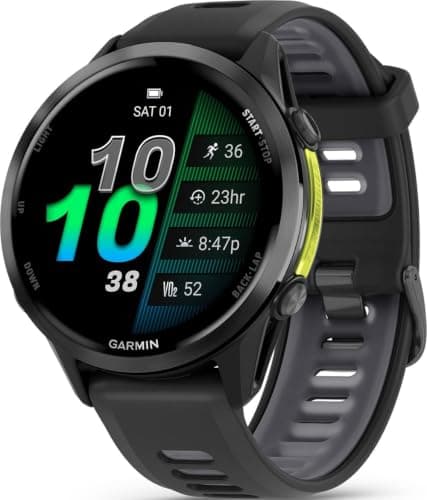
Top pick
Long-course athletes who want mapsGarmin Forerunner 970
The most complete running watch Garmin sells, and — counter-intuitively — the cheapest of the pair per hour of GPS you get.
Price as of October 22, 2026. Prices move; Amazon's is the one that counts.
#ad · we may earn a commission from this link to Garmin Forerunner 970
The short answer
For training specifically, Garmin — mainly on battery, where the Ultra 3 scores 4 on our rubric against the Forerunner 970's 7.5, and on export depth. For one device that does everything, Apple. On evidence the comparison is odd: Apple has been measured repeatedly and the results are unflattering, while Garmin has essentially not been measured at all.
Ranked
Quick picks
| # | Device | Best for | Evidence | Score | Price |
|---|---|---|---|---|---|
| 01 | Garmin Forerunner 970 The most complete running watch Garmin sells, and — counter-intuitively — the cheapest of the pair per hour of GPS you get. | Long-course athletes who want maps | Manufacturer specification | 7.7/10 | $749.99Amazon |
| 02 | 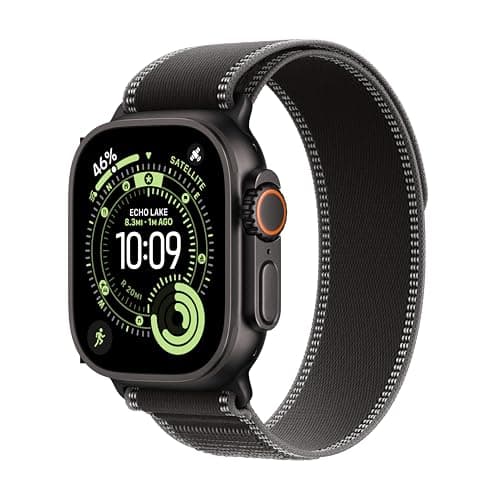 Apple Watch Ultra 3 Excellent positioning hardware and the best screen here, attached to the weakest deep-sleep measurement in the published record. | iPhone owners who train and want one device | Peer-reviewed validation | 6.8/10 | $588.83Amazon |
#ad· Live prices from the Amazon Product API, as of October 22, 2026. Where we have no verified live price we show none. Scores come from the published rubric at How we rank — the Evidence column shows what each ranking actually rests on, including where the answer is nothing.
The evidence comparison is the interesting one
Apple is the most-measured brand in consumer wearables and it has not enjoyed the experience.
- Sleep: in the Brigham and Women's PSG study, a Series 8 reached 75.0% four-stage agreement but 50.5% deep-sleep sensitivity — weakest of three devices — overestimating light sleep by 45 minutes and underestimating deep sleep by 43.
- VO2 max, twice: Lambe et al. (2025) measured a 6.07 mL/kg/min underestimation (13.3% MAPE) across 28 participants, and Caserman et al. (2024) found 15.79% MAPE with an intraclass correlation of 0.47 — poor reliability — with the error growing to 21.5% in the fittest participants.
Garmin's record is thinner in every direction. It was absent from the PSG comparison entirely, so there is no published head-to-head on sleep staging. Its only appearances are a fēnix 6 measured at poor HRV agreement (0.87 concordance, 10.52% MAPE) in the 2025 nocturnal study — where its resting heart rate could not be compared at all because the window it uses is not timestamped — and a Forerunner 55 measured at roughly 33 bpm of bias during burpees in the placement study, the largest error in that paper.
So this is not "Apple is inaccurate and Garmin is accurate". It is "Apple has been checked and Garmin mostly has not", and our rubric treats those as different rather than treating silence as a pass.
Battery, which decides most real purchases
This is where the comparison stops being subtle. Garmin states 26 GPS hours for the Forerunner 970 — $28.85per stated GPS hour at today's price — and considerably more for its outdoor line, where the Instinct 3 Solar publishes 40 GPS-only hours and 36 expedition days.
The Ultra 3 scores 4 out of 10 on endurance in our rubric, the lowest of any watch we cover. For a marathon that is irrelevant. For an ultra, a multi-day hike, or simply not wanting to charge daily, it is the whole decision.
Where Apple is genuinely better
As a watch you wear all day, it is not close. Notifications, apps, cellular, payments, the display, and the fact that it is the only device here you would wear to something other than training. Its positioning hardware is dual-frequency and competitive with anything Garmin sells.
If the realistic alternative is wearing no tracker because a sports watch does not suit your life, the Ultra is the better instrument by a wide margin — a device you wear beats a device you do not, every time.
Export, and why it matters more than it sounds
Garmin has the more documented path for getting your data out and into third-party analysis platforms. Apple's data is more awkward to move off-platform.
This is a slow-burn consideration. It does not matter in year one and it matters a great deal in year five, when you want your training history somewhere that is not tied to a phone manufacturer's roadmap.
What neither of them fixes
Wrist heart rate during intervals. Both read optically at the wrist, and the placement evidence is consistent across brands. If that is your complaint, a strap fixes it for around a hundred dollars and works with either watch.
The honest summary
Buy Garmin if training is the point: battery, export, ecosystem depth and a much wider range of purpose-built hardware. Buy Apple if one device has to do everything and your longest session is a few hours. Do not buy either one to fix sleep staging or to get a trustworthy VO2 max number — the published evidence does not support that purchase from either brand.
In full
Every pick, and why
Garmin Forerunner 970
The most complete running watch Garmin sells, and — counter-intuitively — the cheapest of the pair per hour of GPS you get.
- Case
- 47mm, titanium bezel, AMOLED
- Satellite
- Multi-band GNSS with SatIQ
- Battery (stated)
- 15 days smartwatch / 26 h GPS
- Maps
- Built-in, full color
- Extras
- ECG app, speaker and microphone
What's good
- Multi-band GNSS with SatIQ — the current top tier of consumer positioning hardware
- 26 stated GPS hours is enough for an ironman-distance day with a wide margin
- Built-in maps, which the 570 does not have at any price
What isn't
- The wrist optical sensor is the same class of hardware as the 570's — the premium buys features, not a better heart-rate signal
- 47mm only; there is no smaller case in this model
Skip this if
Skip this if you never race longer than a marathon and never navigate. Maps and titanium are the entire difference, and neither changes a single number the watch records.
What the evidence says
Manufacturer specificationNo independent validation study of the Forerunner 970's optical heart rate has been published that we could find. The specification figures are Garmin's own.
Show how this 7.7 was calculated
| Factor | Weight | Score |
|---|---|---|
| EvidenceSpecs are published and detailed, but no peer-reviewed or independent measured validation of this specific model exists yet. | 30% | 5.5 |
| HardwareMulti-band GNSS with SatIQ and Garmin's current-generation optical sensor — the top hardware tier available. | 20% | 9.5 |
| Metric coverageRunning dynamics, ECG, training load, maps, and a documented export path off the watch. | 20% | 9.5 |
| EnduranceGarmin states 26 hours in GPS mode, 15 days smartwatch. | 15% | 7.5 |
| Cost per capabilityHighest sticker in the range, but the strongest dollars-per-GPS-hour of the two Forerunners — see the arithmetic on the comparison page. | 15% | 7.5 |
Price as of October 22, 2026. Prices move; Amazon's is the one that counts.
#ad · we may earn a commission from this link to Garmin Forerunner 970
Apple Watch Ultra 3
Excellent positioning hardware and the best screen here, attached to the weakest deep-sleep measurement in the published record.
- Case
- 49mm titanium
- Satellite
- Dual-frequency GNSS
- Connectivity
- GPS + Cellular
What's good
- Dual-frequency positioning and a genuinely excellent display
- Best-in-class as a general smartwatch, by a distance
What isn't
- In the Brigham and Women's PSG study, the Apple Watch's deep-sleep sensitivity was 50.5% — the weakest of the three devices tested
- Battery is short next to every dedicated sports watch here
Skip this if
Skip this if you bought it to fix your sleep data. The peer-reviewed result says that is the one thing it is worst at, and no firmware update changes a published measurement.
What the evidence says
Peer-reviewed validationRobbins et al. (2024) tested the Apple Watch Series 8 against polysomnography: 75.0% four-stage agreement, but deep-sleep sensitivity of only 50.5%, overestimating light sleep by 45 minutes and underestimating deep sleep by 43 minutes. That was the Series 8, not the Ultra 3, and Apple has revised its algorithm since.
Show how this 6.8 was calculated
| Factor | Weight | Score |
|---|---|---|
| EvidenceGenuine peer-reviewed sleep data exists, which most rivals lack — but the result was unfavorable, and it tested an earlier model. | 30% | 6.0 |
| HardwareDual-frequency GNSS and the best display in this group. | 20% | 9.0 |
| Metric coverageVery wide metric coverage; export off-platform is more awkward than Garmin's. | 20% | 8.5 |
| EnduranceMaterially shorter than every dedicated sports watch here. | 15% | 4.0 |
| Cost per capabilityFlagship pricing; the cellular model costs more again. | 15% | 6.0 |
Price as of October 22, 2026. Prices move; Amazon's is the one that counts.
#ad · we may earn a commission from this link to Apple Watch Ultra 3
How this ranking was built
Every score on this page comes from one published rubric, applied identically to every device on the site, with the weights written down and the inputs shown. We have not worn any of these devices and we never say we have. Read the method and check us.
Questions
Frequently asked
Is Garmin more accurate than Apple Watch?
Unknown, and that is the honest answer. Apple has been measured several times with mixed to poor results — 50.5% deep-sleep sensitivity, VO2 max underestimated by around 6 mL/kg/min. Garmin has barely been measured at all: absent from the main sleep study, poor HRV agreement in the one study that included it, and the largest heart-rate error in the placement study on the one model it tested.
Which is better for marathon training?
Garmin, primarily on battery and export. A Forerunner 970 states 26 GPS hours against the Ultra 3's materially shorter figure, and Garmin's analytics platform and third-party integrations are deeper. For the marathon itself either watch will last; the difference shows up across a training block.
Is Apple Watch VO2 max accurate?
Two validation studies say no. Both found systematic underestimation against laboratory gas analysis — 6.07 mL/kg/min in 2025 and 4.51 in 2024 — and the 2024 study reported an intraclass correlation of 0.47, which is poor reliability, with the largest errors in the fittest participants.
Can I use a chest strap with an Apple Watch?
Yes, over Bluetooth. Apple Watches do not receive ANT+, so choose a strap that broadcasts Bluetooth — which every pick in our chest-strap ranking does. That is the cheapest way to fix interval heart rate on an Apple Watch by a wide margin.
Show your working
Sources
Every one of these was read in full before it was cited. Where we could not access a paper, we do not quote its numbers.
- [1]Peer-reviewed validation2024Robbins et al., “Accuracy of Three Commercial Wearable Devices for Sleep Tracking in Healthy Adults”, Sensors 24(20):6532
Brigham and Women’s Hospital. n = 35 healthy adults, single-night inpatient polysomnography, testing Oura Ring Gen3, Fitbit Sense 2 and Apple Watch Series 8. Authors’ stated limits: one night, lab conditions, healthy adults without insomnia, comparison only during scheduled sleep, and device failures on 6 Apple Watches and 2 Fitbits.
- [2]Peer-reviewed validation2025Lambe, O’Grady, Baldwin & Doherty, “Investigating the accuracy of Apple Watch VO2 max measurements: A validation study”, PLOS ONE 20(5):e0323741
DOI 10.1371/journal.pone.0323741. 28 analyzed participants across Apple Watch Series 5-9, SE 2 and Ultra 2 on watchOS 10+, against indirect calorimetry (COSMED Quark CPET, modified Åstrand treadmill protocol). Authors’ stated limits: the sample skewed strongly toward high cardiorespiratory fitness, watch estimates were generated uncontrolled, and only one estimate per participant was collected.
- [3]Peer-reviewed validation2024Caserman, Yum, Göbel, Reif & Matura, “Assessing the Accuracy of Smartwatch-Based Estimation of Maximum Oxygen Uptake Using the Apple Watch Series 7: Validation Study”, JMIR Biomedical Engineering 9:e59459
DOI 10.2196/59459. n = 19 (12 male, 7 female, mean age 28.4), Apple Watch Series 7 against a VO2 Master portable gas analyzer on a graded cycle ergometer test. Authors’ stated limits: the sample was 19 rather than the 30 planned, testing was submaximal, no blood lactate was taken, and the watch figure came from a single outdoor session where Apple’s own validation used an average of 441 days of data.
- [4]Peer-reviewed validation2025Dial, Hollander, Vatne, Emerson, Edwards & Hagen, “Validation of nocturnal resting heart rate and heart rate variability in consumer wearables”, Physiological Reports 13(16):e70527
DOI 10.14814/phy2.70527. n = 13 healthy adults (7 male, 6 female, 33.2 ± 8.6 years) across 536 nights, each wearing an Oura Gen 3, Oura Gen 4, Polar Grit X Pro, Garmin fēnix 6 and Whoop 4.0 simultaneously against a Polar H10 single-lead ECG reference sampled at 1000 Hz. Authors’ stated limits: healthy adults only, no atrial-fibrillation population, proprietary and periodically-updated algorithms, and unequal night counts per device. The Garmin was dropped from the resting-heart-rate comparison because the 30-minute window it uses is not timestamped.
- [5]Peer-reviewed validation2025“Impact of Anatomical Placement on the Accuracy of Wearable Heart Rate Monitors During Rest and Various Exercise Intensities”, Sensors (Basel)
n = 28 (14 male, 14 female). Polar H10 chest strap as the reference. Compared Polar Verity Sense (forearm), Garmin Forerunner 55 (wrist) and three simultaneous Whoop 4.0 units at wrist, forearm and upper arm, across rest, cycling warm-up, burpees and a modified Bruce treadmill protocol.
- [6]Manufacturer specification2026Garmin — Forerunner 970 published specifications
Manufacturer-stated battery: up to 15 days smartwatch mode, up to 26 hours GPS mode.
Read next
Related
- Apple Watch Ultra 3 review
Every measurement that exists, in full.
- fēnix 8 vs Forerunner 970
If you have decided on Garmin and need to pick one.
- What VO2 max on a watch is worth
Both validation studies, and what the number is good for.
- fēnix 8 vs Apple Watch Ultra 3
The same decision at the flagship tier, model against model.