GPS and multisport
Apple Watch Ultra 3
The best general smartwatch on this site, and the only one whose measurements you can actually look up. That turns out to be a double-edged position.
We earn a commission when you buy through our Amazon links, at no extra cost to you. It never decides a ranking — the rubric that does is published in full, so you can check us rather than take our word for it. How this works.
Top pick
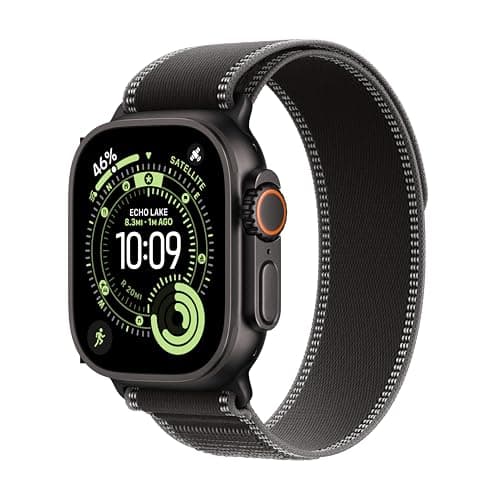
iPhone owners who train and want one deviceApple Watch Ultra 3
Excellent positioning hardware and the best screen here, attached to the weakest deep-sleep measurement in the published record.
Price as of October 20, 2026. Prices move; Amazon's is the one that counts.
#ad · we may earn a commission from this link to Apple Watch Ultra 3
The short answer
The Ultra 3 has dual-frequency positioning and the best display in this category. It is also the only device on this site with multiple peer-reviewed accuracy measurements — and they are not flattering: 50.5% deep-sleep sensitivity in a polysomnography study, and a VO2 max estimate that ran 6.07 mL/kg/min low against laboratory calorimetry.
Ranked
Quick picks
| # | Device | Best for | Evidence | Score | Price |
|---|---|---|---|---|---|
| 01 | Apple Watch Ultra 3 Excellent positioning hardware and the best screen here, attached to the weakest deep-sleep measurement in the published record. | iPhone owners who train and want one device | Peer-reviewed validation | 6.8/10 | $617.60Amazon |
#ad· Live prices from the Amazon Product API, as of October 20, 2026. Where we have no verified live price we show none. Scores come from the published rubric at How we rank — the Evidence column shows what each ranking actually rests on, including where the answer is nothing.
Being measured is the interesting thing about this watch
Almost nothing on this site has been measured by anybody independent. Apple is the exception, and that alone puts it in an unusual position: its weaknesses are documented, while its rivals' weaknesses are merely unknown.
We want to be scrupulous about this. Every study below tested an earlier model, none tested an Ultra 3, and Apple revises its algorithms between generations. The results are the best published evidence about this platform and they are not measurements of this watch.
The sleep result
In the Brigham and Women's polysomnography study (n = 35, single-night inpatient PSG), the Apple Watch Series 8 achieved 75.0% four-stage agreement — respectable — but deep-sleep sensitivity of only 50.5%, the weakest of the three devices tested. It overestimated light sleep by 45 minutes a night and underestimated deep sleep by 43.
Fifty percent sensitivity on a two-outcome question is worth sitting with for a second. It means that on the specific stage most people care about, the watch and the clinical reference agreed about half the time.
The VO2 max result, which is newer and clearer
Two peer-reviewed validations of Apple's cardio-fitness estimate now exist, and they agree with each other.
Lambe et al. (2025) tested 28 participants across Series 5-9, SE 2 and Ultra 2 against indirect calorimetry. The watches underestimated VO2 max by 6.07 mL/kg/minon average (MAPE 13.31%), with limits of agreement from −6.11 to +18.26. The authors' conclusion is that the estimates "are not sufficiently accurate to inform clinical decision-making" while remaining useful for general fitness monitoring.
Caserman et al. (2024) found the same direction on a Series 7: lab 45.88 against watch 41.37 mL/kg/min, MAPE 15.79%, and an intraclass correlation of 0.47 — poor reliability. Their stratification is the useful part: the error grew with fitness, from 10.7% MAPE in the poor-fitness group to 21.5% in the excellent-fitness group.
If you are a trained runner buying an Ultra to watch your VO2 max trend, that last sentence is the one that matters. The published evidence says the estimate gets less accurate the fitter you are, and both studies note the sample skewed toward fit participants. The full VO2 max evidence page lays out what the number is actually good for.
What it is genuinely excellent at
Positioning hardware and display. Dual-frequency GNSS puts it in the top tier of consumer receivers, and no watch on this site has a better screen. As a general smartwatch it is not close — nothing here competes on notifications, apps, cellular or ecosystem.
Its weakness against dedicated sports watches is endurance: it scores 4 on our rubric where the Instinct 3 Solar scores 10. For a marathon that is irrelevant. For a hundred-miler it is disqualifying.
What we could not verify
- Anything about the Ultra 3 specifically.Every result above tested an earlier model. We are describing a platform's published record, not this watch.
- Heart rate during exercise. No Apple device appears in the 2025 placement study, so the direct wrist-optical comparison that covers Garmin and Whoop does not cover Apple.
- Positioning accuracy. The 2020 eight-watch study included an Apple Watch Series 4 — single-band, six years ago. It says nothing about a dual-frequency Ultra.
- Whether the sleep algorithm improved.Apple has revised it since the Series 8. Nobody has published a re-measurement, so "probably better" is a reasonable guess and not evidence.
Who should not buy it
Anyone buying it to fix their sleep data. The one published measurement says that is the thing it was worst at, and no firmware update rewrites a published measurement — the sleep accuracy ranking has better answers. Also anyone racing beyond about a day, where the battery is the binding constraint rather than any feature.
Update: the Apple Watch Ultra 4 is in stores, and this is now the outgoing model
Apple announced the Apple Watch Ultra 4 on 9 September 2026, from $799, with availability stated from 18 September. As of 21 September Apple's own Ultra page sells only the Ultra 4 and does not mention the Ultra 3. The Ultra 3 is still listed at Amazon, which is where the live price above comes from.
Nothing in this review changes, because every measurement on it was made on an older Apple Watch and applies to the Ultra 4 exactly as loosely as it applied to the Ultra 3. We have not ranked the Ultra 4: there is no validation of it and no listing resolved into the roster. Practically, this is the same position the Ultra 2 was in a year ago, which we laid out on Ultra 3 vs Ultra 2 — the outgoing Ultra becomes the value buy if and when its price drops, and not before.
In full
Every pick, and why
Apple Watch Ultra 3
Excellent positioning hardware and the best screen here, attached to the weakest deep-sleep measurement in the published record.
- Case
- 49mm titanium
- Satellite
- Dual-frequency GNSS
- Connectivity
- GPS + Cellular
What's good
- Dual-frequency positioning and a genuinely excellent display
- Best-in-class as a general smartwatch, by a distance
What isn't
- In the Brigham and Women's PSG study, the Apple Watch's deep-sleep sensitivity was 50.5% — the weakest of the three devices tested
- Battery is short next to every dedicated sports watch here
Skip this if
Skip this if you bought it to fix your sleep data. The peer-reviewed result says that is the one thing it is worst at, and no firmware update changes a published measurement.
What the evidence says
Peer-reviewed validationRobbins et al. (2024) tested the Apple Watch Series 8 against polysomnography: 75.0% four-stage agreement, but deep-sleep sensitivity of only 50.5%, overestimating light sleep by 45 minutes and underestimating deep sleep by 43 minutes. That was the Series 8, not the Ultra 3, and Apple has revised its algorithm since.
Show how this 6.8 was calculated
| Factor | Weight | Score |
|---|---|---|
| EvidenceGenuine peer-reviewed sleep data exists, which most rivals lack — but the result was unfavorable, and it tested an earlier model. | 30% | 6.0 |
| HardwareDual-frequency GNSS and the best display in this group. | 20% | 9.0 |
| Metric coverageVery wide metric coverage; export off-platform is more awkward than Garmin's. | 20% | 8.5 |
| EnduranceMaterially shorter than every dedicated sports watch here. | 15% | 4.0 |
| Cost per capabilityFlagship pricing; the cellular model costs more again. | 15% | 6.0 |
Price as of October 20, 2026. Prices move; Amazon's is the one that counts.
#ad · we may earn a commission from this link to Apple Watch Ultra 3
Questions
Frequently asked
Is the Apple Watch Ultra 3 accurate for running?
Its positioning hardware is dual-frequency, which is the current top tier, and no independent field measurement of it has been published that we could find. Its VO2 max estimate has been measured twice and ran low both times — by 6.07 mL/kg/min in the 2025 study — with the error growing in fitter participants. Distance and pace are likely fine; the derived physiology is where the published record is unkind.
How accurate is Apple Watch sleep tracking?
In the one peer-reviewed head-to-head we found, a Series 8 reached 75.0% four-stage agreement against clinical polysomnography with deep-sleep sensitivity of 50.5% — the weakest of the three devices tested. It overestimated light sleep by 45 minutes and underestimated deep sleep by 43. Apple has revised the algorithm since and nobody has re-measured it.
Is Apple Watch VO2 max reliable?
Two validation studies say not for anything that matters clinically. Both found systematic underestimation — 6.07 mL/kg/min in 2025 and 4.51 in 2024 — and the 2024 study reported an intraclass correlation of 0.47, which is poor reliability. Its error was largest in the most fit participants. As a trend line for general fitness it is useful; as a number, it is not the number.
Ultra 3 or a Garmin for training?
For training specifically, a Garmin — mainly on battery, which is where the Ultra scores 4 out of 10 on our rubric against dedicated sports watches, and on export and analytics depth. For one device that does everything and happens to train well, the Ultra. Our full Garmin versus Apple Watch comparison works through it tier by tier.
Show your working
Sources
Every one of these was read in full before it was cited. Where we could not access a paper, we do not quote its numbers.
- [1]Peer-reviewed validation2024Robbins et al., “Accuracy of Three Commercial Wearable Devices for Sleep Tracking in Healthy Adults”, Sensors 24(20):6532
Brigham and Women’s Hospital. n = 35 healthy adults, single-night inpatient polysomnography, testing Oura Ring Gen3, Fitbit Sense 2 and Apple Watch Series 8. Authors’ stated limits: one night, lab conditions, healthy adults without insomnia, comparison only during scheduled sleep, and device failures on 6 Apple Watches and 2 Fitbits.
- [2]Peer-reviewed validation2025Lambe, O’Grady, Baldwin & Doherty, “Investigating the accuracy of Apple Watch VO2 max measurements: A validation study”, PLOS ONE 20(5):e0323741
DOI 10.1371/journal.pone.0323741. 28 analyzed participants across Apple Watch Series 5-9, SE 2 and Ultra 2 on watchOS 10+, against indirect calorimetry (COSMED Quark CPET, modified Åstrand treadmill protocol). Authors’ stated limits: the sample skewed strongly toward high cardiorespiratory fitness, watch estimates were generated uncontrolled, and only one estimate per participant was collected.
- [3]Peer-reviewed validation2024Caserman, Yum, Göbel, Reif & Matura, “Assessing the Accuracy of Smartwatch-Based Estimation of Maximum Oxygen Uptake Using the Apple Watch Series 7: Validation Study”, JMIR Biomedical Engineering 9:e59459
DOI 10.2196/59459. n = 19 (12 male, 7 female, mean age 28.4), Apple Watch Series 7 against a VO2 Master portable gas analyzer on a graded cycle ergometer test. Authors’ stated limits: the sample was 19 rather than the 30 planned, testing was submaximal, no blood lactate was taken, and the watch figure came from a single outdoor session where Apple’s own validation used an average of 441 days of data.
- [4]Peer-reviewed validation2020Gilgen-Ammann, Schweizer & Wyss, “Accuracy of Distance Recordings in Eight Positioning-Enabled Sport Watches: Instrument Validation Study”, JMIR mHealth and uHealth
DOI 10.2196/17118. Eight watches (Apple Watch Series 4, Coros Apex 46mm, Garmin Fenix 5X Plus, Garmin Forerunner 935, Polar Vantage M, Polar Vantage V, Polar V800, Suunto 9 Baro) measured against a trundle wheel accurate to 1 cm, across urban, forest and 400 m track conditions. IMPORTANT: this predates the dual-frequency receivers now standard, so it describes brand engineering history, not any watch currently sold.
- [5]Peer-reviewed validation2025“Impact of Anatomical Placement on the Accuracy of Wearable Heart Rate Monitors During Rest and Various Exercise Intensities”, Sensors (Basel)
n = 28 (14 male, 14 female). Polar H10 chest strap as the reference. Compared Polar Verity Sense (forearm), Garmin Forerunner 55 (wrist) and three simultaneous Whoop 4.0 units at wrist, forearm and upper arm, across rest, cycling warm-up, burpees and a modified Bruce treadmill protocol.
- [6]Manufacturer claim only2026Apple — “Apple unveils Apple Watch Ultra 4”, Apple Newsroom
Apple press release, 9 September 2026. Ultra 4 “starts at $799 (U.S.)”, in stores 18 September 2026. Used here only to establish that the Ultra 3 is now the outgoing model. No Ultra 4 is ranked on this site — no validation exists and no ASIN has been resolved.
Read next
Related
- Oura vs Apple Watch
What the ring measures better, and what this watch measures better.
- Ultra 3 vs Ultra 2
The generational comparison, and the specification Apple no longer publishes.
- Garmin vs Apple Watch
Tier by tier, for people who train.
- What VO2 max on a watch is worth
Both validation studies, and what the number is actually good for.
- Most accurate sleep trackers
Where the 50.5% figure places Apple against the field.
- fēnix 8 vs Apple Watch Ultra 3
Measured results against no results, and the battery gap between them.
- WHOOP vs Apple Watch Ultra
Whether adding a band to this watch buys you anything measured.