GPS and multisport
Suunto Race 2
The largest display in this roundup, dual-frequency positioning, and a price that undercuts the watches it lines up against on paper. The catch is that nobody has measured it.
We earn a commission when you buy through our Amazon links, at no extra cost to you. It never decides a ranking — the rubric that does is published in full, so you can check us rather than take our word for it. How this works.
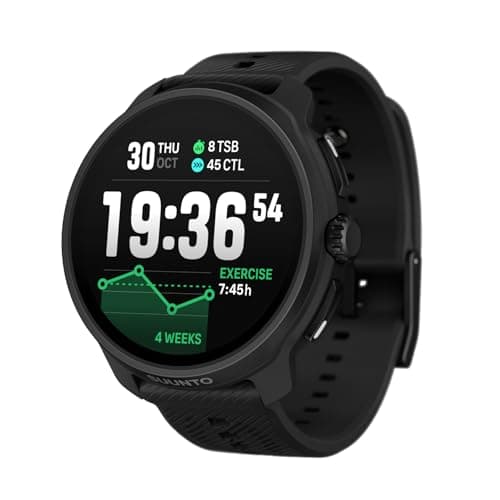
Top pick
Big-screen multi-sport valueSuunto Race 2
A 1.5" AMOLED and 115+ sport modes, priced under most of the flagships it lines up against.
Price as of October 21, 2026. Prices move; Amazon's is the one that counts.
#ad · we may earn a commission from this link to Suunto Race 2
The short answer
The Race 2 offers a 1.5-inch AMOLED, 115+ sport modes and dual-frequency reception substantially below flagship pricing. No independent validation study of this device exists that we could find, which under our evidence hierarchy caps how high it can rank regardless of its hardware.
Ranked
Quick picks
| # | Device | Best for | Evidence | Score | Price |
|---|---|---|---|---|---|
| 01 | Suunto Race 2 A 1.5" AMOLED and 115+ sport modes, priced under most of the flagships it lines up against. | Big-screen multi-sport value | No validation study exists | 6.7/10 | $499.00Amazon |
#ad· Live prices from the Amazon Product API, as of October 21, 2026. Where we have no verified live price we show none. Scores come from the published rubric at How we rank — the Evidence column shows what each ranking actually rests on, including where the answer is nothing.
The specification, which is genuinely strong
On paper the Race 2 competes directly with watches costing considerably more. Suunto publishes a 1.5-inch AMOLED — the largest display of any watch we cover — 115+ sport modes, and dual-frequency satellite reception, which is the hardware that lets a receiver identify and discard signals that have bounced off buildings or tree canopy.
Dual-frequency is the specification worth paying for if your tracks drift in cities or under forest, and Suunto delivering it below the tier where it usually appears is a real proposition rather than a spec-sheet trick. The mechanism is worth understanding before you decide whether you need it, because on open roads single-band hardware is already performing close to its limit.
Why it does not rank higher here
Our rubric weights evidence at 30%, the single largest share, and the Race 2 scores 3 out of 10 on it. That is not a judgment about Suunto's engineering. It is the mechanical consequence of a rule we apply to every device on the site: a device with no independent validation cannot take a top accuracy rank on hardware alone.
We could find no peer-reviewed study, no independent measured test, nothing, for this watch — not for its optical heart rate, not for its positioning. It sits at no validation study exists, the bottom tier of our hierarchy.
It is worth being clear-eyed about what that does and does not mean. It does not mean the watch is inaccurate. It means nobody has checked, so nobody — us, Suunto's marketing, or any reviewer who wore one for two weeks — can tell you how accurate it is. Every site that ranks it on "excellent GPS accuracy" is describing the specification and calling it a measurement.
The same rule costs other devices dearly and we apply it without exception: the Oura Ring 5 ranks below the Ring 4 for precisely this reason, and it is a newer, probably better product.
The context that makes this less damning than it sounds
Nearly every current watch on this site is in the same evidentiary position. Neither the Forerunner 970, the fēnix 8, the Instinct 3 nor the PACE 4 has a published validation of its optical sensor or its positioning that we could find.
The differences are at the margins. Garmin and COROS publish more granular specifications than Suunto. Polar carries a dated brand-level positioning result that no other maker can point to. COROS has one unfavorable independent heart-rate test of a previous model — being measured badly still counts as being measured, which is why it scores above devices with nothing.
Suunto has none of those things, which is why it sits at the bottom of the evidence column rather than the middle. But the honest framing is that this is a category-wide failure and Suunto is simply the clearest example of it.
The ecosystem question, which is the real one
The practical argument against Suunto is not accuracy. It is that the third-party integration is the thinnest of the brands here.
If you push structured workouts from a coaching platform, sync to several analysis services, or depend on a specific integration, Garmin Connect has by a distance the deepest support. Suunto's analytics layer is lighter and less documented, and its training-load model — like every training-load model — has never been independently validated, with the additional problem that Suunto publishes less about how it works.
If you record runs, look at the data yourself and want a big bright screen with good reception, none of that costs you anything.
Race 2 or Race S?
We cover both. The Race S is the smaller, cheaper watch with a 1.32-inch AMOLED and 95+ sport modes; the Race 2 is the 1.5-inch screen and 115+ modes. Both have dual-frequency reception and both have exactly the same evidence position, which is none.
The choice is wrist size and money. There is no data-quality argument between them, and we will not manufacture one.
What we could not verify
- Anything measured about this device. No validation of any kind exists that we could find, as of August 2026.
- Battery figures.Suunto's, under Suunto's conditions.
- Positioning accuracy. Unmeasured — as it is for every current multi-band watch of any brand.
- The training-load and recovery models.Unvalidated and less documented than the competition's equally unvalidated models.
Who should not buy it
Anyone who needs a number they can defend. If you want the device with the strongest published record, this is not it, and the honest recommendation is a chest strap paired to whatever watch you own.
Anyone dependent on third-party integrations. Check yours before you buy. This is the concrete, everyday cost of leaving Garmin.
Anyone who wants a validated training-load model. Nobody sells one, but Suunto documents its own the least.
Suunto sells a smaller and cheaper version of this watch, and the trade is published rather than hidden: Suunto Race S.
In full
Every pick, and why
Suunto Race 2
A 1.5" AMOLED and 115+ sport modes, priced under most of the flagships it lines up against.
- Display
- 1.5" AMOLED
- Sport modes
- 115+
- Satellite
- Dual-frequency GNSS
What's good
- The largest AMOLED in this roundup
- Undercuts the flagship tier substantially
What isn't
- No independent validation we could find
- Ecosystem and third-party support remain the weak point
Skip this if
Skip this if you need a proven training-load model. Suunto's analytics are the least documented of the brands here.
What the evidence says
No validation study existsNo independent validation study exists for this device that we could find as of July 2026.
Show how this 6.7 was calculated
| Factor | Weight | Score |
|---|---|---|
| EvidenceNo validation of any kind that we could find; capped accordingly. | 30% | 3.0 |
| HardwareDual-frequency GNSS with the biggest display here. | 20% | 8.5 |
| Metric coverage115+ modes, lighter analytics. | 20% | 8.0 |
| EnduranceStrong stated figures for the screen size. | 15% | 8.0 |
| Cost per capabilityWell under the flagship tier it competes with on specification. | 15% | 8.5 |
Price as of October 21, 2026. Prices move; Amazon's is the one that counts.
#ad · we may earn a commission from this link to Suunto Race 2
Questions
Frequently asked
Is the Suunto Race 2 accurate?
Nobody knows, and we would rather say that than guess. No independent validation study of this device exists that we could find. It carries dual-frequency reception, which is the right hardware for rejecting reflected signals, but hardware capability is not a measured result.
Why does the Suunto Race 2 rank below cheaper watches here?
Because evidence is 30% of our rubric and this watch has none. A device with no independent validation cannot take a top accuracy rank on specification alone — the same rule that puts the Oura Ring 5 below the Ring 4. It is a ranking about what has been measured, not about which watch is nicer.
Suunto Race 2 or Garmin Forerunner 970?
The Garmin for ecosystem depth, maps and a more detailed published specification; the Suunto for a bigger screen at a lower price. Neither has any independent validation of its sensors, so this is a features-and-platform decision rather than an accuracy one. See the full brand comparison.
Race 2 or Race S?
Screen size and price. The Race S has a 1.32-inch AMOLED and 95+ sport modes; the Race 2 has 1.5 inches and 115+. Both are dual-frequency and both have identical evidence positions, which is none, so there is no data-quality argument between them.
Show your working
Sources
Every one of these was read in full before it was cited. Where we could not access a paper, we do not quote its numbers.
- [1]Peer-reviewed validation2020Gilgen-Ammann, Schweizer & Wyss, “Accuracy of Distance Recordings in Eight Positioning-Enabled Sport Watches: Instrument Validation Study”, JMIR mHealth and uHealth
DOI 10.2196/17118. Eight watches (Apple Watch Series 4, Coros Apex 46mm, Garmin Fenix 5X Plus, Garmin Forerunner 935, Polar Vantage M, Polar Vantage V, Polar V800, Suunto 9 Baro) measured against a trundle wheel accurate to 1 cm, across urban, forest and 400 m track conditions. IMPORTANT: this predates the dual-frequency receivers now standard, so it describes brand engineering history, not any watch currently sold.
- [2]Peer-reviewed validation2025“Impact of Anatomical Placement on the Accuracy of Wearable Heart Rate Monitors During Rest and Various Exercise Intensities”, Sensors (Basel)
n = 28 (14 male, 14 female). Polar H10 chest strap as the reference. Compared Polar Verity Sense (forearm), Garmin Forerunner 55 (wrist) and three simultaneous Whoop 4.0 units at wrist, forearm and upper arm, across rest, cycling warm-up, burpees and a modified Bruce treadmill protocol.
- [3]Manufacturer specification2026Polar — H10 heart rate sensor published specifications
Manufacturer-stated: electrical (ECG) measurement, Bluetooth LE + ANT+, internal memory for one session up to 30 hours, up to 400 h on a CR2025 coin cell, WR30.
Read next
Related
- Suunto Race S review
The smaller, cheaper Suunto, and what it gives up.
- Suunto vs Garmin
The brand comparison, including what the ecosystem gap actually costs.
- Best multisport watches
Where the Race 2 places against the field.
- How we rank
The evidence hierarchy that caps this watch, written out in full.
- Fix your GPS accuracy
Whether dual-frequency is the upgrade your symptom calls for.