Straps, armbands and sensors
Polar H10
When researchers need something to measure other devices against, this is what they strap on. That is the review.
We earn a commission when you buy through our Amazon links, at no extra cost to you. It never decides a ranking — the rubric that does is published in full, so you can check us rather than take our word for it. How this works.
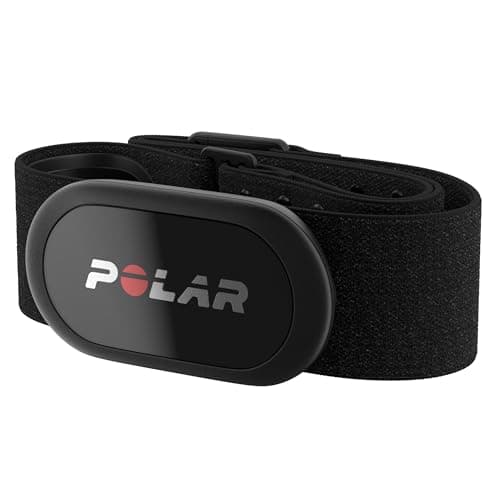
Top pick
Anyone who trains by heart ratePolar H10
The device other people's validation studies use as the reference. That is the strongest recommendation a sensor can have.
Price as of October 22, 2026. Prices move; Amazon's is the one that counts.
#ad · we may earn a commission from this link to Polar H10
The short answer
The Polar H10 is used as the reference standard in peer-reviewed validation studies — including the 2025 Sensors placement study cited throughout this site. It measures electrical heart activity, pairs to Bluetooth and ANT+ simultaneously, stores 30 hours internally, and Polar states up to 400 hours on a replaceable CR2025 coin cell.
Ranked
Quick picks
| # | Device | Best for | Evidence | Score | Price |
|---|---|---|---|---|---|
| 01 | Polar H10 The device other people's validation studies use as the reference. That is the strongest recommendation a sensor can have. | Anyone who trains by heart rate | Peer-reviewed validation | 8.9/10 | $104.45Amazon |
#ad· Live prices from the Amazon Product API, as of October 22, 2026. Where we have no verified live price we show none. Scores come from the published rubric at How we rank — the Evidence column shows what each ranking actually rests on, including where the answer is nothing.
Why "researchers use it" is the strongest thing we can say
Most product claims in this category are assertions. This one is structural: when scientists design a study to measure how accurate a wearable is, they need something to measure it against, and that choice is scrutinized by reviewers. The H10 keeps getting chosen.
In the 2025 anatomical-placement study, the H10 is the criterion against which a Polar Verity Sense, a Garmin Forerunner 55 and three Whoop 4.0 units were assessed across rest, cycling, burpees and a graded treadmill protocol.
The honest limitation of that, which we would rather state than let you infer: because it is the reference, the study cannot measure the H10's own error. Its error is defined as zero within the study's own frame. Repeated selection by independent researchers is powerful evidence of trust in the instrument — it is not the same thing as a published error bar for the H10 itself.
The published specification
Polar publishes the following:
- Electrical (ECG-based) measurement via a chest strap
- Bluetooth LE and ANT+ (version 2.1), broadcast range 295 ft
- Internal memory for one session, up to 30 hours
- CR2025 coin cell, up to 400 hours — Polar describes this as more than a year of training an hour a day
- WR30 water resistance
- 2.1 oz total, 0.7 oz without the strap
Two of those matter more than they look. Simultaneous Bluetooth and ANT+ means one strap serves a watch and a bike computer at the same time. And 30 hours of onboard memory is what makes swimming viable at all — Bluetooth does not transmit reliably through water, so the strap records and syncs afterwards.
What it deliberately does not do
It measures heart rate and R-R intervals. It does not do running dynamics, it has no screen, it does not track sleep, and it will not tell you your VO2 max. That focus is most of why it is good — and it means the comparison with a $159 Garmin HRM 600 is not about accuracy but about whether you want running-dynamics metrics inside Garmin's platform.
What we could not verify
- The H10's own error rate. As above: being the reference means nothing has measured it. We have not found a study that treats the H10 as the subject.
- The 400-hour battery figure.Polar's number. We have not run one down.
- Long-term strap durability. Widely reported to be the wear item, but we have no measured data and will not pretend to.
Who should not buy it
Anyone who knows they will not wear a chest strap. This is not a small caveat — a strap in a drawer has an accuracy of zero, and a Verity Sense armband you actually wear measured a bias under 0.1 bpm on a treadmill protocol. Comfort is a real variable and a spec sheet cannot settle it for you.
Polar sells a cheaper strap built on the same sensing principle, and the difference is one specification rather than a tier: Polar H10 vs H9.
Once you own one, the parts that decide whether it keeps reading are the strap, the coin cell and the chest measurement - none of them the sensor. Those are covered in the H10 battery and strap guide, including Polar's own published size chart.
In full
Every pick, and why
Polar H10
The device other people's validation studies use as the reference. That is the strongest recommendation a sensor can have.
- Sensor
- Electrical (ECG), chest strap
- Connectivity
- Bluetooth LE + ANT+
- Memory
- One session, up to 30 hours
- Battery (stated)
- Up to 400 h, CR2025 coin cell
- Water rating
- WR30
What's good
- Used as the criterion measure in published research — including the 2025 Sensors placement study on this site
- Simultaneous Bluetooth and ANT+, so it pairs to a watch and a bike computer at once
- 400 stated hours on a coin cell you replace rather than recharge
What isn't
- It is a chest strap, and a chest strap is less comfortable than a watch
- The strap wears out well before the sensor does
Skip this if
Skip this if you know yourself well enough to know you will not wear it. An unworn ECG strap measures nothing, and a wrist sensor you actually wear beats it every time.
What the evidence says
Peer-reviewed validationUsed as the reference standard in Sensors (2025), the anatomical-placement study of 28 participants. Being chosen as the criterion is an implicit validation by the researchers, though it means the study cannot measure the H10's own error.
Show how this 8.9 was calculated
| Factor | Weight | Score |
|---|---|---|
| EvidenceResearchers use it as the criterion measure. Nothing else in this category has a stronger evidentiary position. | 30% | 10.0 |
| HardwareElectrical ECG measurement rather than optical — a different and better physical principle for this job. | 20% | 9.5 |
| Metric coverageHeart rate and R-R intervals only; it does not pretend to do anything else. | 20% | 6.5 |
| Endurance400 stated hours on a replaceable coin cell. | 15% | 9.5 |
| Cost per capabilityInexpensive next to any watch, and it outlasts several of them. | 15% | 8.5 |
Price as of October 22, 2026. Prices move; Amazon's is the one that counts.
#ad · we may earn a commission from this link to Polar H10
Questions
Frequently asked
Is the Polar H10 worth it over a cheaper strap?
If you want the device with the strongest evidence behind it, yes — it is the reference standard in published research, and no budget strap has any validation we could find. If you simply want the correct measurement principle at the lowest price, a cheap electrical strap uses the same physics and costs a quarter as much, with no evidence to support it.
Does the Polar H10 work with Garmin watches?
Yes. It broadcasts on both ANT+ and Bluetooth simultaneously, so it pairs with Garmin watches and head units as well as Apple Watch, Wahoo devices, Zwift and most gym equipment. See our compatibility guide for the platform-by-platform detail.
Can the Polar H10 record without a watch?
Yes — it stores one session of up to 30 hours internally and syncs afterwards. That is what makes it usable for swimming, where Bluetooth will not transmit through water.
Show your working
Sources
Every one of these was read in full before it was cited. Where we could not access a paper, we do not quote its numbers.
- [1]Manufacturer specification2026Polar — H10 heart rate sensor published specifications
Manufacturer-stated: electrical (ECG) measurement, Bluetooth LE + ANT+, internal memory for one session up to 30 hours, up to 400 h on a CR2025 coin cell, WR30.
- [2]Peer-reviewed validation2025“Impact of Anatomical Placement on the Accuracy of Wearable Heart Rate Monitors During Rest and Various Exercise Intensities”, Sensors (Basel)
n = 28 (14 male, 14 female). Polar H10 chest strap as the reference. Compared Polar Verity Sense (forearm), Garmin Forerunner 55 (wrist) and three simultaneous Whoop 4.0 units at wrist, forearm and upper arm, across rest, cycling warm-up, burpees and a modified Bruce treadmill protocol.
- [3]Peer-reviewed validation2024Robbins et al., “Accuracy of Three Commercial Wearable Devices for Sleep Tracking in Healthy Adults”, Sensors 24(20):6532
Brigham and Women’s Hospital. n = 35 healthy adults, single-night inpatient polysomnography, testing Oura Ring Gen3, Fitbit Sense 2 and Apple Watch Series 8. Authors’ stated limits: one night, lab conditions, healthy adults without insomnia, comparison only during scheduled sleep, and device failures on 6 Apple Watches and 2 Fitbits.
Read next
Related
- Polar H10 battery and strap guide
CR2025 cells, strap sizing, and why most dropouts are strap failures.
- Best heart rate monitors for women
Where the XS-S strap size decides the recommendation.
- How chest straps work
Why electrical measurement is a different class of instrument.
- Best chest straps
How the H10 compares with the four main alternatives.
- Wrist vs chest strap
The measured difference, at four exercise intensities.
- Compatibility guide
What it pairs with, and the two platforms that are awkward.
- Polar H10 vs H9
Whether the memory and the missing analog radio are worth the gap.
- Best for swimming
The use case the 30-hour memory exists for.