GPS and multisport
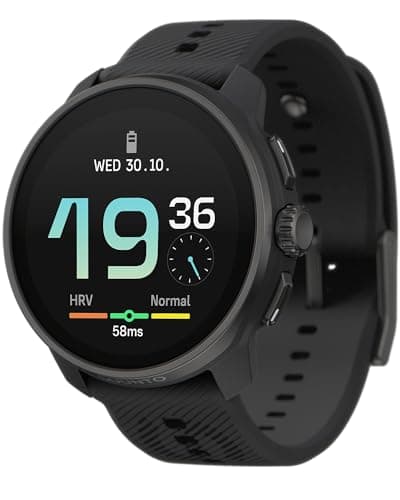
Suunto Race S
A dual-frequency AMOLED watch at a price Garmin does not compete at — and a validation record that is completely empty.
We earn a commission when you buy through our Amazon links, at no extra cost to you. It never decides a ranking — the rubric that does is published in full, so you can check us rather than take our word for it. How this works.
Top pick
Value AMOLED multi-sportSuunto Race S
A big AMOLED and dual-frequency positioning at a price that undercuts the mid-range Garmins.
$349.0014% off
Price as of October 22, 2026. Prices move; Amazon's is the one that counts.
#ad · we may earn a commission from this link to Suunto Race S
The short answer
Suunto states up to 30 hours of training with continuous GPS tracking and up to 9 days of daily use with heart rate on, in a smaller AMOLED case than the Race 2. It is the cheapest dual-frequency AMOLED watch we cover. No independent validation of its heart rate or positioning has been published that we could find, and under our evidence hierarchy that caps how high it can rank.
Ranked
Quick picks
| # | Device | Best for | Evidence | Score | Price |
|---|---|---|---|---|---|
| 01 | Suunto Race S A big AMOLED and dual-frequency positioning at a price that undercuts the mid-range Garmins. | Value AMOLED multi-sport | No validation study exists | 6.5/10 | $299.00Amazon |
#ad· Live prices from the Amazon Product API, as of October 22, 2026. Where we have no verified live price we show none. Scores come from the published rubric at How we rank — the Evidence column shows what each ranking actually rests on, including where the answer is nothing.
What Suunto publishes
From Suunto's own product page, read on 18 August 2026: an AMOLED touchscreen in a smaller case than the Race, up to 30 hours of training with continuous GPS tracking, up to 9 days of daily use with heart rate on and up to 13 days with it off, HRV tracking, and free offline maps. Part of Suunto's specification table loads dynamically and did not render for us, so those are the figures we quote and the only ones.
Free offline maps deserve a line of their own. Suunto includes them; Garmin reserves mapping for its upper tiers and charges accordingly. On paper that is a real advantage at this price.
The evidence gap, stated plainly
Nobody has measured this watch. Not its optical heart rate, not its positioning, not its training-load model. That is not a criticism unique to Suunto — most watches on this site are in the same position — but it is why the Race S scores 3 out of 10 on evidence, which is 30% of our published rubric and enough to keep a well-specified watch out of the top places.
The nearest thing to Suunto evidence in the literature is a 2020 validation that included a Suunto 9 Baro among eight watches measured against a trundle wheel. Error across the eight ran 3.2-6.1%, with only Polar under 5% throughout. It is a different watch from a pre-dual-frequency era, and we cite it as brand history rather than as a measurement of this device.
Where it fits
The Race S is the value AMOLED pick: dual-frequency positioning, a bright screen, offline maps and 30 stated training hours, all below the price of the equivalent Garmin. What you give up is analytics depth and third-party integration — Suunto's training-load and recovery models are the least documented of the brands we cover — and the reassurance of a measured device.
If your longest sessions run past 30 hours, or you want the bigger screen and roughly double the endurance, the Race 2 comparison lays out both stated battery tables side by side.
How to get good data out of it
Pair a chest strap for anything with intervals in it. That advice applies to every wrist-worn optical sensor on this site — the 2025 placement study found all of them losing agreement badly during rapid intensity changes — but it applies with extra force to a watch whose sensor nobody has tested. The Polar H10 is the strap used as ground truth in the studies we cite, and it pairs over Bluetooth here.
What 30 stated hours actually covers
- Every road race up to a marathon, several times over, with music and navigation running.
- A full mountain day or a 100 km effort, with hours in hand at best GPS accuracy.
- Not a 100-mile finish for most runners, at best accuracy. That is the line where the larger Race 2 and its 55 stated hours start to matter.
Daily wear is the other half of the picture: Suunto states up to 9 days with heart rate on and 13 with it off, so this is a watch you charge weekly rather than monthly.
How to check a watch nobody has measured
Since no validation of this model exists, here is what you can do yourself in a week, none of which requires equipment you do not already have:
- Repeat a known distance. Four laps of a 400 m track in lane one is 1,600 m. Run it twice in the same satellite mode and compare. You are testing repeatability, which is the part a home test can actually establish.
- Pair a chest strap for one interval session. If the wrist trace lags the strap on the hard efforts, you have learned the single most useful fact about your watch — and it is the fact the published placement evidence predicts.
- Run the same route on different days. Consistent distances mean a consistent receiver. They do not mean an accurate one, and no home test can tell you that.
In full
Every pick, and why
Suunto Race S
A big AMOLED and dual-frequency positioning at a price that undercuts the mid-range Garmins.
- Display
- 1.32" AMOLED
- Sport modes
- 95+
- Satellite
- Dual-frequency GNSS
What's good
- Dual-frequency positioning well below the price the same feature costs at Garmin
- Large, bright AMOLED for the money
What isn't
- No independent validation of its heart rate or positioning that we could find
- Smallest third-party ecosystem of the brands here
Skip this if
Skip this if you want structured workouts pushed from a coaching platform. Suunto's integrations are the thinnest in this group.
What the evidence says
No validation study existsNo independent validation study exists for this device that we could find as of July 2026. It is ranked on published hardware specification and price alone, and that is why it does not place higher.
Show how this 6.5 was calculated
| Factor | Weight | Score |
|---|---|---|
| EvidenceNo validation of any kind that we could find. Under our evidence hierarchy this caps how high it can rank, regardless of its hardware. | 30% | 3.0 |
| HardwareDual-frequency GNSS and a large AMOLED, per Suunto's spec page. | 20% | 8.0 |
| Metric coverage95+ sport modes; a lighter analytics platform than Garmin or Polar. | 20% | 7.5 |
| EnduranceStrong stated battery for an AMOLED watch at this size. | 15% | 7.5 |
| Cost per capabilityThe cheapest dual-frequency AMOLED watch in this roundup. | 15% | 9.0 |
$349.0014% off
Price as of October 22, 2026. Prices move; Amazon's is the one that counts.
#ad · we may earn a commission from this link to Suunto Race S
Questions
Frequently asked
How long does the Suunto Race S battery last?
Suunto states up to 30 hours of training with continuous GPS tracking, up to 9 days of daily use with heart rate on and up to 13 days with heart rate off. The Race 2 roughly doubles all three figures, because it is the larger watch.
Is the Suunto Race S accurate?
No published evidence exists either way — no independent validation of this watch's heart rate or positioning has been published that we could find. It has dual-frequency positioning hardware, which is the specification most associated with better tracks, but a specification is not a measurement and we do not treat it as one.
Does the Race S include maps?
Yes — Suunto states free offline maps, which is unusual at this price. Garmin reserves built-in mapping for higher tiers, so this is one of the clearest value arguments for the watch.
Suunto Race S or Garmin Forerunner 165?
The Race S has dual-frequency positioning and maps; the Forerunner 165has single-band positioning and Garmin's much deeper training platform. If GPS quality in cities or under trees is the complaint, the Suunto has the better hardware. If you want analytics and ecosystem, Garmin.
Show your working
Sources
Every one of these was read in full before it was cited. Where we could not access a paper, we do not quote its numbers.
- [1]Manufacturer specification2026Suunto — Race S published product specifications
Manufacturer-stated, read 2026-08-18: AMOLED touchscreen in a smaller case than the Race, up to 30 hours of training with continuous GPS tracking, up to 9 days of daily use with heart rate on and up to 13 days with it off, plus free offline maps. As with the Race 2 page, the full specification table loads dynamically and we quote only the published text figures.
- [2]Manufacturer specification2026Suunto — Race 2 published product specifications
Manufacturer-stated, read 2026-08-18: 1.5-inch AMOLED, 115+ sport modes, up to 55 hours of training with continuous tracking at best GPS accuracy, up to 200 hours in tour mode at lower GPS accuracy, up to 18 days of daily use with heart rate on and up to 30 days with it off. Suunto renders part of its specification table dynamically, so we quote only the figures that appear as published text on the page.
- [3]Peer-reviewed validation2020Gilgen-Ammann, Schweizer & Wyss, “Accuracy of Distance Recordings in Eight Positioning-Enabled Sport Watches: Instrument Validation Study”, JMIR mHealth and uHealth
DOI 10.2196/17118. Eight watches (Apple Watch Series 4, Coros Apex 46mm, Garmin Fenix 5X Plus, Garmin Forerunner 935, Polar Vantage M, Polar Vantage V, Polar V800, Suunto 9 Baro) measured against a trundle wheel accurate to 1 cm, across urban, forest and 400 m track conditions. IMPORTANT: this predates the dual-frequency receivers now standard, so it describes brand engineering history, not any watch currently sold.
- [4]Peer-reviewed validation2025“Impact of Anatomical Placement on the Accuracy of Wearable Heart Rate Monitors During Rest and Various Exercise Intensities”, Sensors (Basel)
n = 28 (14 male, 14 female). Polar H10 chest strap as the reference. Compared Polar Verity Sense (forearm), Garmin Forerunner 55 (wrist) and three simultaneous Whoop 4.0 units at wrist, forearm and upper arm, across rest, cycling warm-up, burpees and a modified Bruce treadmill protocol.
Read next
Related
- Suunto Race 2 vs Race S
Both stated battery tables, and what the smaller case costs.
- Suunto Race 2 review
The bigger, longer-lived version of this watch.
- Best running watches for women
Where a smaller case is the actual specification that matters.
- Suunto vs Garmin
Hardware value against ecosystem depth, at brand level.