Fix what's failing
Your watch dies before you finish. This one really is a hardware problem.
Unlike heart rate, there is no cheap accessory fix here. But the fix is checkable on a spec sheet before you spend anything — provided you read the right row.
We earn a commission when you buy through our Amazon links, at no extra cost to you. It never decides a ranking — the rubric that does is published in full, so you can check us rather than take our word for it. How this works.
Top pick
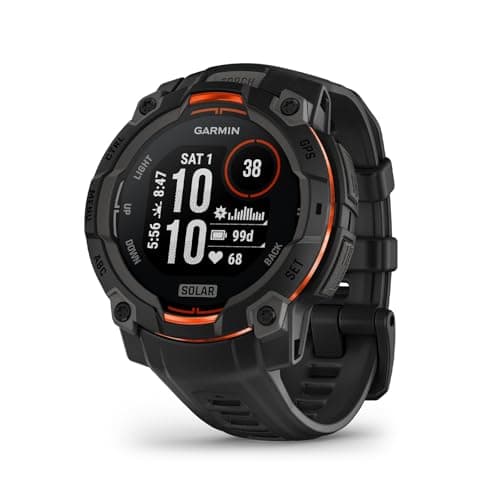
Multi-day trail and backcountry daysGarmin Instinct 3 Solar (45mm)
The watch that wins this site's rubric by publishing an honest battery table and then filling every row of it. No maps, and it still ranks first on trail.
$399.9915% off
Price as of October 22, 2026. Prices move; Amazon's is the one that counts.
#ad · we may earn a commission from this link to Garmin Instinct 3 Solar (45mm)
The short answer
Battery cannot be fixed with an accessory, so this is one of the few genuine reasons to buy a new watch. Read the specification carefully first: "GPS mode" and "all-satellite multi-band" can differ by nearly two to one on the same watch, and makers quote the flattering row.
Ranked
Quick picks
| # | Device | Best for | Evidence | Score | Price |
|---|---|---|---|---|---|
| 01 | Garmin Instinct 3 Solar (45mm) The watch that wins this site's rubric by publishing an honest battery table and then filling every row of it. No maps, and it still ranks first on trail. | Multi-day trail and backcountry days | Manufacturer specification | 7.7/10 | $339.99Amazon |
| 02 | 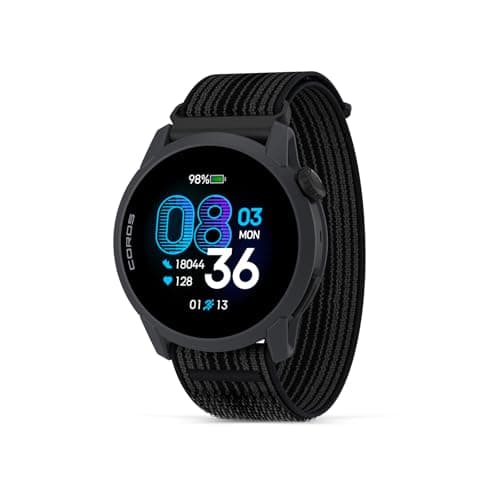 COROS PACE 4 41 stated GPS hours in a 32-gram watch, for a third of the Forerunner 970's money. The endurance-per-dollar winner by a distance. | Long days on a budget | Independent measured test | 7.5/10 | $249.00Amazon |
| 03 | No image COROS APEX 4 (46mm) 41 days of daily battery and a MIP screen you can read in direct sun. The anti-AMOLED choice. | Multi-day efforts | Manufacturer specification | 7.3/10 | Check price → |
#ad· Live prices from the Amazon Product API, as of October 22, 2026. Where we have no verified live price we show none. Scores come from the published rubric at How we rank — the Evidence column shows what each ranking actually rests on, including where the answer is nothing.
The symptom
- The watch died at hour 20 of a hundred-miler, or with two hours of an ultra left
- You charge it every night, so it is never on your wrist for sleep tracking
- A long weekend in the mountains means carrying a battery pack for a watch
- You turn features off before a long race and still finish anxious about it
- The stated figure said 20 hours and you got noticeably less
The last one is the most common and it is usually not a fault. It is a specification you read correctly and the manufacturer wrote misleadingly.
Why the number on the box is not the number you get
A GPS watch has several satellite reception modes, and they draw very different amounts of power:
- GPS only. One constellation, lowest power, longest battery, worst accuracy under buildings and canopy.
- All-systems. GPS plus GLONASS, Galileo, BeiDou and QZSS. More satellites, more power, better fix in difficult terrain.
- All-systems plus multi-band. Every constellation on two frequencies. The best rejection of reflected signals, and the mode you would run for accuracy. The shortest battery by a wide margin.
Most manufacturers publish one figure and do not tell you which mode it describes. It is almost always the first one.
Garmin's Instinct 3 Solar manual is the exception, and it is worth seeing what full disclosure looks like: 40 stated hours GPS-only, 28 all-satellite, and 24 with multi-band added. Same watch, same battery, 40% difference between the top and bottom rows.
So the first thing to do is not to buy anything. Find out which mode your current watch is in. If you have been running all-systems multi-band for a park run, switching to GPS-only may add hours and change nothing you can measure, and it costs nothing.
Work out what you actually need
Take your longest realistic event, add 30% for a bad day, then add whatever the watch does before and after — waiting at the start with GPS locked, and not being charged that evening.
- Marathon, 3-5 hours. Almost every watch on this site covers this comfortably. Battery is not your problem and a new watch will not fix whatever is.
- Ironman-distance, 10-15 hours. Mid-range watches manage it. Check the figure for the mode you intend to run, not the headline.
- Hundred-mile ultra, 24-30 hours. This is where stated figures start mattering a great deal, and where multi-band mode can genuinely put you short.
- Multi-day. You need either an expedition mode with a reduced fix rate or a watch you can charge while wearing.
Then apply a discount. Every figure on this page is manufacturer-stated under the manufacturer's own conditions, and nobody here has run one down. Cold weather, a bright always-on display, music playback, pulse oximetry and constant navigation all reduce it.
The other reason battery matters, which nobody buys for
A watch you charge every night is a watch that is on the charger at bedtime — which is the most common reason sleep and recovery data is missing rather than wrong.
Every recovery platform compares tonight against your own rolling baseline, and a baseline assembled from four nights a week is largely noise. A watch stating weeks rather than days gets charged on a Sunday afternoon and is on your wrist for the rest of the week by default.
That is a data-completeness gain no sensor upgrade delivers, and it is the most underrated argument on this page.
What actually fixes it
Longest honest endurance: the Instinct 3 Solar
Twenty-four stated hours in all-satellite multi-band, 40 GPS-only, 28 smartwatch days and 36 expedition days, before solar is counted at all. That works out at $14.17 on the conservative multi-band row.
We ignore the solar columns entirely. Garmin's solar figures assume all-day wear at 50,000 lux, which is bright direct sunlight — not a forest, not winter, and not under a sleeve. The unassisted numbers are the ones you can rely on.
The cost is maps: there are none. The full review is here.
Most GPS hours per dollar: the COROS PACE 4
Forty-one manufacturer-stated GPS hours in All-Systems mode, 19 days of daily use, in a 32-gram watch. At $6.07 it sits among the strongest endurance-per-dollar figures on this site — only its own predecessor currently comes in lower, and that gap moves with the price.
Weight matters more than any feature over a hundred miles, and this is the lightest watch here by a wide margin. The caveat is the same as everywhere on COROS: the only independent heart-rate test in the range was of the previous model and it was unfavorable.
Longest daily interval: the COROS APEX 4
Forty-one stated days of daily use — the longest figure on this site — behind a memory-in-pixel display that becomes more readable in direct sunlight rather than less.
Note that 41 days is a daily use figure, not a GPS figure. COROS does not publish a full mode-by-mode table for it in the way Garmin does for the Instinct 3, so we do not compute a cost-per-GPS-hour number here — we would be inventing the denominator, which is exactly the thing this page exists to warn about. The full review is here.
This won't fix it if…
Your longest event is a marathon. Every watch here already covers that with room. If yours is dying in four hours, something is wrong — check the satellite mode, the display setting and the battery health before spending anything.
You are comparing stated figures across brands. Do not, unless both name the same satellite mode. A 40-hour GPS-only figure and a 24-hour multi-band figure can describe the same watch, and comparing them across two brands is meaningless.
You expect the stated number. These are manufacturer figures under manufacturer conditions. Nobody independent has verified any of them, including us.
You need multi-day tracking. Look at expedition modes with reduced fix rates, or a watch that charges while worn, rather than at the headline GPS row.
Your problem is actually accuracy. Endurance and reception trade against each other directly. If your tracks drift, you need multi-band running — which is the shortest row on the table — and that is a different upgrade path.
If the reason you are here is a race longer than about twenty hours rather than a watch that has aged, the buying version of this page puts every maker's published endurance figure beside the satellite mode it actually describes: best GPS watches for ultra running.
In full
Every pick, and why
Garmin Instinct 3 Solar (45mm)
The watch that wins this site's rubric by publishing an honest battery table and then filling every row of it. No maps, and it still ranks first on trail.
- Battery, smartwatch (stated)
- 28 days, unlimited with solar
- Battery, GPS-only (stated)
- 40 h, up to 130 h with solar
- Battery, multi-band (stated)
- 24 h, up to 40 h with solar
- Battery, expedition (stated)
- 36 days, unlimited with solar
- Water rating
- 10 ATM
What's good
- Garmin publishes five separate GPS endurance figures for it, mode by mode — the most honest battery table of any watch on this site
- 24 stated hours in all-satellite multi-band mode, which is the mode you would actually run for accuracy
- Solar charging turns the smartwatch and expedition figures into 'unlimited' under Garmin's stated light conditions
What isn't
- No built-in maps at all, which on unfamiliar trail is the feature people miss first
- No independent validation of its heart rate or positioning that we could find
Skip this if
Skip this if you navigate unfamiliar routes rather than repeat known ones. Breadcrumb navigation on a trail you have never run is a genuinely worse experience than a map, and no amount of battery compensates for it.
What the evidence says
Manufacturer specificationNo independent validation of this device that we could find. What Garmin does publish is unusually complete: a five-row battery table naming each satellite mode separately, with the solar-assisted figures stated separately from the unassisted ones. We rank the unassisted multi-band row, because that is the number you can rely on in a forest.
Show how this 7.7 was calculated
| Factor | Weight | Score |
|---|---|---|
| EvidenceNo measured validation, but the published specification is more granular and more honest about its own assumptions than any other spec sheet here. | 30% | 5.5 |
| HardwareAll-satellite plus multi-band positioning, a solar charging lens and a 10 ATM case. | 20% | 8.5 |
| Metric coverageFull Garmin training and outdoor feature set, minus maps — which on trail is a real omission. | 20% | 7.5 |
| Endurance40 stated GPS-only hours, 24 in multi-band, 28 smartwatch days and 36 expedition days, before solar is counted at all. | 15% | 10.0 |
| Cost per capabilityFlagship endurance at roughly a third of flagship money. | 15% | 9.0 |
$399.9915% off
Price as of October 22, 2026. Prices move; Amazon's is the one that counts.
#ad · we may earn a commission from this link to Garmin Instinct 3 Solar (45mm)
COROS PACE 4
41 stated GPS hours in a 32-gram watch, for a third of the Forerunner 970's money. The endurance-per-dollar winner by a distance.
- Display
- 1.2" AMOLED touchscreen
- Weight
- 32 g with nylon band, 40 g with silicone
- Satellite
- All-Systems and Dual-Frequency modes
- Battery (stated)
- 19 days daily use / 41 h GPS (All-Systems)
- Thickness
- 11.8 mm
What's good
- 41 manufacturer-stated GPS hours — more than the Forerunner 970 and the 570 combined
- 32 g is light enough that you stop noticing it, which matters more over 100 miles than any feature
- Dual-frequency positioning at an entry-level price
What isn't
- COROS wrist heart rate is the one area where an independent test has published a specific problem — see the evidence note
- Smaller third-party app ecosystem than Garmin's
Skip this if
Skip this if you train by heart rate off the wrist and will not wear a strap. The one independent test we found flagged COROS wrist HR during exactly the intervals you would be buying it for.
What the evidence says
Independent measured testThe5krunner's measured comparison found the previous-generation PACE 3's wrist heart rate diverged during and after rapid intensity changes. That test was of the PACE 3, not the PACE 4, and the author cautions the dataset was limited. COROS states the PACE 4 has a redesigned sensor; no independent test of the new sensor has been published that we could find.
Show how this 7.5 was calculated
| Factor | Weight | Score |
|---|---|---|
| EvidenceThe only independent measured evidence in the range is a limited-dataset test of the PREVIOUS model, and it was unfavorable. The redesigned sensor is unvalidated. | 30% | 4.5 |
| HardwareDual-frequency GNSS and a redesigned optical sensor, per the COROS spec page. | 20% | 8.0 |
| Metric coverageStrong training metrics; a narrower ecosystem than Garmin for third-party integrations. | 20% | 7.5 |
| Endurance41 stated GPS hours in All-Systems mode is the best in this roundup by a wide margin. | 15% | 10.0 |
| Cost per capabilityComfortably the strongest dollars-per-GPS-hour figure on the site. | 15% | 10.0 |
Price as of October 22, 2026. Prices move; Amazon's is the one that counts.
#ad · we may earn a commission from this link to COROS PACE 4
COROS APEX 4 (46mm)
41 days of daily battery and a MIP screen you can read in direct sun. The anti-AMOLED choice.
- Display
- 1.3" MIP (memory-in-pixel)
- Battery (stated)
- 41 days daily use
- Case
- 46mm
What's good
- MIP displays get MORE readable in bright sun, where AMOLED gets worse
- 41 stated days of daily use removes charging from the routine entirely
What isn't
- MIP looks dull indoors next to an AMOLED — this is a genuine aesthetic trade, not just a spec
- Same unvalidated-COROS-optical-sensor caveat as the PACE 4
Skip this if
Skip this if you mostly train indoors or at night. You would be taking the dull screen and giving up nothing for it.
What the evidence says
Manufacturer specificationPublished specifications only. The one independent COROS heart-rate test we found was of the PACE 3 and does not describe this device.
Show how this 7.3 was calculated
| Factor | Weight | Score |
|---|---|---|
| EvidenceNo validation of this model; the only independent COROS test on record is of a different watch and was unfavorable. | 30% | 4.5 |
| HardwareDual-frequency GNSS behind a MIP display. | 20% | 8.0 |
| Metric coverageFull COROS training platform. | 20% | 8.0 |
| Endurance41 stated days of daily use is the longest on this site. | 15% | 10.0 |
| Cost per capabilityStrong battery-per-dollar; mid-range sticker. | 15% | 8.5 |
We don't have a verified live price for this right now, so we aren't showing one.
#ad · we may earn a commission from this link to COROS APEX 4 (46mm)
Choosing between the three
Buy the Instinct 3 Solar if you want the honest number
It publishes every mode separately and delivers a real 24 stated hours in the demanding one. It is also the only watch here with a solar lens and a 10 ATM case. You give up maps entirely.
Buy the PACE 4 if you want the most hours per dollar
Forty-one stated GPS hours and 32 grams. Nothing else here comes close on either measure, and the light weight compounds over very long days.
Buy the APEX 4 if you want to stop charging entirely
Forty-one stated days of daily use and a screen built for sunlight. The trade is a display that looks dull indoors, which is a real cost if this is also your everyday watch.
Check your settings before you buy any of them
The cheapest fix on this page is free: find your satellite mode. If you are running all-systems multi-band on open roads, you are paying a large battery premium for a benefit you cannot measure.
How this ranking was built
Every score on this page comes from one published rubric, applied identically to every device on the site, with the weights written down and the inputs shown. We have not worn any of these devices and we never say we have. Read the method and check us.
Questions
Frequently asked
Why does my running watch battery drain faster than advertised?
Usually because the advertised figure describes a different satellite mode than the one you are running. On the Instinct 3, Garmin states 40 hours GPS-only and 24 with all-satellite multi-band — the same watch and the same battery. Display brightness, music, pulse oximetry, navigation and cold weather all reduce it further.
Which running watch has the longest battery life?
It depends which figure you mean. For daily use, the COROS APEX 4 states 41 days. For continuous GPS, the COROS PACE 4 states 41 hours in All-Systems mode. For the demanding multi-band mode with a fully disclosed table, the Garmin Instinct 3 Solar states 24 hours without solar assistance.
Is solar charging on a watch worth it?
Garmin's solar figures assume all-day wear at 50,000 lux — bright, direct sunlight. Under tree cover, in winter or with the watch under a sleeve you are far closer to the unassisted numbers. It is a genuine bonus in the right conditions and not a specification we rank on.
Can I extend my current watch's battery life?
Often substantially, and for free. Switch to a lower satellite mode if you do not need multi-band, turn off the always-on display, disable pulse oximetry, and skip on-watch music. On some watches that is the difference between finishing an ultra and not.
How much battery do I need for a 100-mile race?
Take your realistic finish time, add about 30%, and add the time the watch spends locked on before the start. For most people that lands between 24 and 36 hours — and it has to be the figure for the satellite mode you will actually run, which is often not the one on the box.
Show your working
Sources
Every one of these was read in full before it was cited. Where we could not access a paper, we do not quote its numbers.
- [1]Manufacturer specification2026Garmin — Instinct 3 Solar owner’s manual, battery life information
Manufacturer-stated for the 45 mm Solar: 28 days smartwatch (unlimited with solar), 40 hours GPS-only (130 hours with solar), 28 hours all-satellite (50 with solar), 24 hours all-satellite plus multi-band (40 with solar), 36 days expedition GPS (unlimited with solar), 65 days battery-saver. Water rating 10 ATM per the same manual’s specification page. Solar figures assume all-day wear in 50,000 lux conditions, which is Garmin’s assumption and not a measurement of ours.
- [2]Manufacturer specification2026COROS — PACE 4 published specifications
Manufacturer-stated: 1.2" AMOLED, 32 g with nylon band, 11.8 mm thick, All-Systems and Dual-Frequency satellite modes, 41 GPS hours, 19 days of daily training and sleep.
- [3]Manufacturer specification2026Garmin — Forerunner 970 published specifications
Manufacturer-stated battery: up to 15 days smartwatch mode, up to 26 hours GPS mode.
- [4]Peer-reviewed validation2020Gilgen-Ammann, Schweizer & Wyss, “Accuracy of Distance Recordings in Eight Positioning-Enabled Sport Watches: Instrument Validation Study”, JMIR mHealth and uHealth
DOI 10.2196/17118. Eight watches (Apple Watch Series 4, Coros Apex 46mm, Garmin Fenix 5X Plus, Garmin Forerunner 935, Polar Vantage M, Polar Vantage V, Polar V800, Suunto 9 Baro) measured against a trundle wheel accurate to 1 cm, across urban, forest and 400 m track conditions. IMPORTANT: this predates the dual-frequency receivers now standard, so it describes brand engineering history, not any watch currently sold.
Read next
Related
- Best GPS watches for ultra running
Every published endurance figure with the satellite mode it describes.
- Garmin Instinct 3 Solar
The full review, and the five-row battery table in detail.
- Best trail GPS watches
Where long battery matters most, ranked.
- Fix your GPS accuracy
The upgrade that trades directly against this one.
- COROS APEX 4
Forty-one stated days, and the screen that makes it possible.
- Best multisport watches
If a long day means three sports rather than one.