Straps, armbands and sensors
Best heart rate monitors for swimming
The problem in the pool is not the sensor. It is that 2.4 GHz radio does not go through water, so the only devices that work are the ones that can record without a receiver.
We earn a commission when you buy through our Amazon links, at no extra cost to you. It never decides a ranking — the rubric that does is published in full, so you can check us rather than take our word for it. How this works.
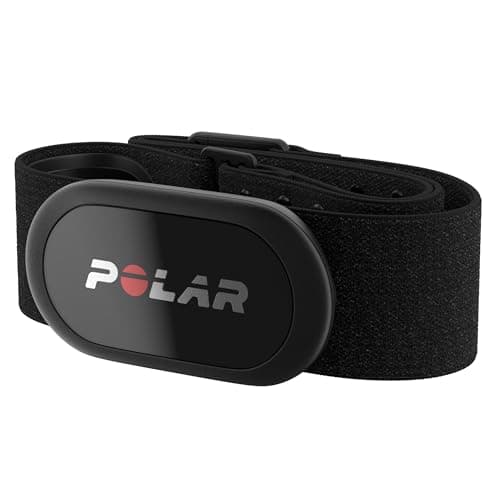
Top pick
Anyone who trains by heart ratePolar H10
The device other people's validation studies use as the reference. That is the strongest recommendation a sensor can have.
Price as of October 22, 2026. Prices move; Amazon's is the one that counts.
#ad · we may earn a commission from this link to Polar H10
The short answer
Swimming heart rate is a transmission problem, not a sensor problem. Bluetooth and ANT+ both run at 2.4 GHz, which water absorbs almost immediately, so a strap cannot reach a watch on your wrist. Buy a device with on-board memory: the Polar H10 stores up to 30 hours, and the Verity Sense records internally too.
Ranked
Quick picks
| # | Device | Best for | Evidence | Score | Price |
|---|---|---|---|---|---|
| 01 | Polar H10 The device other people's validation studies use as the reference. That is the strongest recommendation a sensor can have. | Anyone who trains by heart rate | Peer-reviewed validation | 8.9/10 | $104.45Amazon |
| 02 | 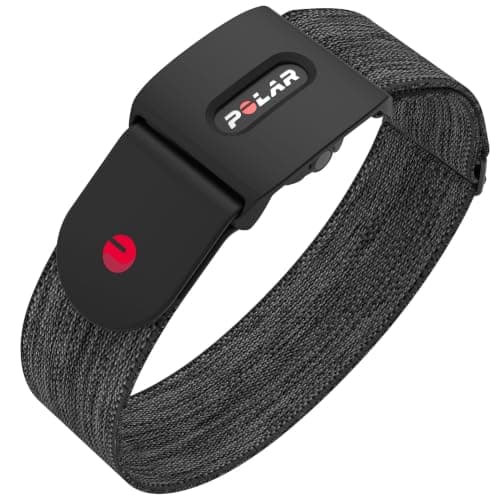 Polar Verity Sense The optical armband that measured a bias under 0.1 bpm against a chest strap on a graded treadmill test. The comfortable answer. | Strap-quality data without the strap | Peer-reviewed validation | 8.4/10 | $104.95Amazon |
| 03 | 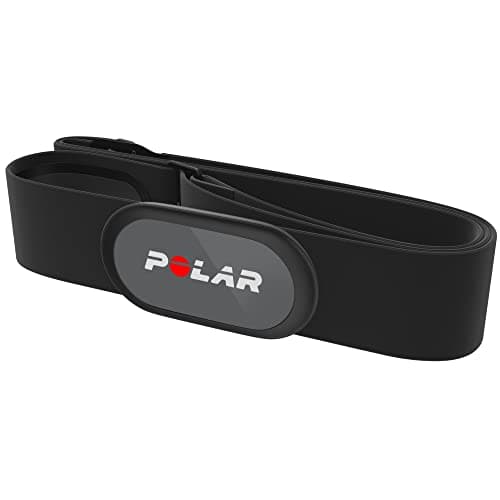 Polar H9 The H10 with the recording memory removed. If you always ride with a head unit, that is a feature you were never going to use. | Riders who always have a head unit running | Manufacturer specification | 7.3/10 | $69.90Amazon |
#ad· Live prices from the Amazon Product API, as of October 22, 2026. Where we have no verified live price we show none. Scores come from the published rubric at How we rank — the Evidence column shows what each ranking actually rests on, including where the answer is nothing.
Why your strap goes silent the moment you push off
Bluetooth Low Energy and ANT+ both transmit in the 2.4 GHz band. Water absorbs radio energy at that frequency extremely strongly — this is the same physical property that makes a microwave oven work at a nearby frequency. A signal that carries ten meters through air struggles to cross a few centimeters of water.
So a chest strap on your sternum cannot reliably reach a watch on your wrist while you are swimming. The link drops on every stroke and recovers only when both devices happen to surface at the same moment. What you get is not a slightly worse heart-rate trace, it is a trace with most of the session missing.
This is worth being precise about because it is routinely misdiagnosed as a water-resistance failure. Your strap is not broken and it is not leaking. It is transmitting perfectly well into a medium that will not carry the signal.
The specification that actually solves it
On-board memory. A device that records internally does not need a live link at all. It logs beat-by-beat data through the whole session and syncs to your phone afterwards, when you are dry and the radio works again.
That is why the ranking on this page is not the same as our site-wide accuracy ranking. Sensor accuracy is necessary but it is not what separates these devices in the pool. Storage is.
The second consideration is water rating, and it is the easier one. Polar states WR30 for both straps here and WR50 for the Verity Sense. All three are comfortably rated for pool swimming. Note that these are pressure ratings rather than depth ratings, and none of these devices is a diving instrument.
The three, and why they rank in this order
1. Polar H10 — memory plus the reference-standard measurement
Polar states internal memory for one session of up to 30 hours, alongside WR30 water resistance and electrical ECG measurement. It is also the device researchers use as their criterion measure — including in the 2025 Sensors placement study — which is the strongest evidentiary position a heart-rate sensor can occupy.
For pool swimming it does the complete job: it measures with the best-established principle, it stores the session while the radio is useless, and it costs less than any watch. The practical annoyance is that a chest strap can migrate during push-offs and turns, so it needs to be tighter than you would wear it on land.
2. Polar Verity Sense — the armband with a swim mode
Polar publishes on-board recording, WR50 and a dedicated swim mode. The recording is the part that matters here for exactly the same reason as on the H10 — it does not need a live link — and the armband form factor tends to stay put through push-offs and turns better than a chest strap does.
Its accuracy record on land is genuinely strong — the same 2025 study measured the lowest resting error of any device tested at roughly 1.6% MAPE, and a bias under 0.1 bpm with concordance of 0.997 on the graded treadmill protocol. It ranks second here rather than first because it is optical, and nobody has published a measurement of any optical sensor underwater. Water on and around a skin-contact optical sensor changes the optical path, and we have no data on what that does. The device is excellent; the swimming claim specifically is unverified.
3. Polar H9 — the one that cannot do this
We rank the H9 highly elsewhere. It has the same electrical measurement principle and the same electrode design as the H10, three radios including the 5 kHz analog that old gym equipment listens for, WR30, and 400 stated hours on a replaceable coin cell — at a meaningfully lower price.
It has no internal memory. It cannot record a session on its own. In the pool that is not a minor limitation, it is total: the strap will happily measure your heart rate and there will be nothing to receive it and nowhere to put it.
It is on this page precisely because it is the trap. It looks like the H10 on a spec sheet, it is cheaper, and it is the wrong purchase for this one use case. Buy it for cycling with a head unit, not for swimming.
What about swim-capable watches?
Most modern sports watches are rated for swimming and will record wrist heart rate in the pool. Two things are worth knowing before you rely on that.
First, wrist optical sensing is the weakest placement in the published evidence even on dry land — the same study found proximal placements beat the wrist at every intensity tested, with wrist limits of agreement of about ±10-19 bpm during a cycling warm-up. Second, nobody has published any measurement of wrist optical heart rate during swimming at all.
So the honest position is that a watch will produce a number and nobody can tell you what it is worth. If you are training by heart rate in the water, the strap-plus-memory approach is the one with a defensible measurement behind at least part of it.
Open water, and a genuine safety note
Everything above applies more strongly in open water, where you are further from any receiver and surface less predictably. The recording approach is the only one that works.
One thing no device on this page does is give you live heart rate you can react to mid-swim. If that is what you need — for a medical reason rather than a training one — none of these is the answer, and that is a conversation to have with a doctor rather than a purchase to make.
What we could not verify
- Any underwater accuracy figure, for any device. Every measurement we cite was taken on land. No published validation of heart-rate accuracy during swimming exists that we could find, optical or electrical.
- Real-world memory behavior.Polar's 30-hour figure is a published specification, not something we have filled.
- The swim mode in use. Polar publishes it; we have not swum with one.
- Long-term water exposure. Chlorine and salt degrade fabric straps and seals, and nobody has published a durability comparison.
In full
Every pick, and why
Polar H10
The device other people's validation studies use as the reference. That is the strongest recommendation a sensor can have.
- Sensor
- Electrical (ECG), chest strap
- Connectivity
- Bluetooth LE + ANT+
- Memory
- One session, up to 30 hours
- Battery (stated)
- Up to 400 h, CR2025 coin cell
- Water rating
- WR30
What's good
- Used as the criterion measure in published research — including the 2025 Sensors placement study on this site
- Simultaneous Bluetooth and ANT+, so it pairs to a watch and a bike computer at once
- 400 stated hours on a coin cell you replace rather than recharge
What isn't
- It is a chest strap, and a chest strap is less comfortable than a watch
- The strap wears out well before the sensor does
Skip this if
Skip this if you know yourself well enough to know you will not wear it. An unworn ECG strap measures nothing, and a wrist sensor you actually wear beats it every time.
What the evidence says
Peer-reviewed validationUsed as the reference standard in Sensors (2025), the anatomical-placement study of 28 participants. Being chosen as the criterion is an implicit validation by the researchers, though it means the study cannot measure the H10's own error.
Show how this 8.9 was calculated
| Factor | Weight | Score |
|---|---|---|
| EvidenceResearchers use it as the criterion measure. Nothing else in this category has a stronger evidentiary position. | 30% | 10.0 |
| HardwareElectrical ECG measurement rather than optical — a different and better physical principle for this job. | 20% | 9.5 |
| Metric coverageHeart rate and R-R intervals only; it does not pretend to do anything else. | 20% | 6.5 |
| Endurance400 stated hours on a replaceable coin cell. | 15% | 9.5 |
| Cost per capabilityInexpensive next to any watch, and it outlasts several of them. | 15% | 8.5 |
Price as of October 22, 2026. Prices move; Amazon's is the one that counts.
#ad · we may earn a commission from this link to Polar H10
Polar Verity Sense
The optical armband that measured a bias under 0.1 bpm against a chest strap on a graded treadmill test. The comfortable answer.
- Sensor
- Optical, forearm or upper-arm band
- Connectivity
- Bluetooth (dual) + ANT+
- Modes
- Live streaming, on-board recording, swim mode
What's good
- Sensors (2025) recorded the smallest bias of any device tested on the graded treadmill protocol — under 0.1 bpm, CCC = 0.997
- Lowest resting error in the same study, at roughly 1.6% MAPE
- Far more comfortable than a chest strap, and it works under a wetsuit
What isn't
- Still an extra device to charge and remember
- Like every optical sensor, it struggled in the same study's burpee protocol — nothing optical handles that well
Skip this if
Skip this if your training is mostly explosive, stop-start work. In the burpee protocol every optical device tested fell below 0.50 concordance, this one included. Buy the H10 for that.
What the evidence says
Peer-reviewed validationDirectly measured in Sensors (2025), n = 28, against a Polar H10 reference: lowest resting MAPE at ~1.6 ± 0.8%, and the smallest bias on the modified Bruce treadmill protocol at under 0.1 bpm (CCC = 0.997).
Show how this 8.4 was calculated
| Factor | Weight | Score |
|---|---|---|
| EvidenceDirectly measured in a peer-reviewed study, with the best result of any optical device tested. | 30% | 9.5 |
| HardwareOptical, but worn on the forearm — the placement the same study found outperforms the wrist. | 20% | 8.5 |
| Metric coverageHeart rate plus on-board recording and a swim mode. | 20% | 7.0 |
| EnduranceRechargeable, with stated endurance comfortably covering long sessions. | 15% | 8.0 |
| Cost per capabilityPriced against a good chest strap, not against a watch. | 15% | 8.5 |
Price as of October 22, 2026. Prices move; Amazon's is the one that counts.
#ad · we may earn a commission from this link to Polar Verity Sense
Polar H9
The H10 with the recording memory removed. If you always ride with a head unit, that is a feature you were never going to use.
- Sensor
- Electrical (ECG), chest strap
- Connectivity
- Bluetooth LE + ANT+ 2.1 + 5 kHz analog
- Memory
- None — it cannot record on its own
- Battery (stated)
- Up to 400 h, replaceable 160 mAh coin cell
- Water rating
- WR30
What's good
- Electrical measurement — the same physical principle as the strap researchers use as their reference
- 5 kHz analog on top of Bluetooth and ANT+, which is what old gym cardio equipment actually listens for
- 400 stated hours on a coin cell you replace rather than recharge
What isn't
- No internal memory, so it cannot record a session without a paired device — this is the specification difference from the H10
- No independent validation of the H9 itself that we could find; the studies use the H10
Skip this if
Skip this if you ever want heart rate from a session you rode without your watch or head unit. The H10 stores 30 hours on its own; this stores nothing, and no firmware adds memory that is not there.
What the evidence says
Manufacturer specificationNo validation study of the H9 specifically that we could find. It shares the electrode and sensing principle of the H10 that researchers use as their criterion measure, which is a good reason to expect it to be accurate and not a measurement of it. We score the principle, not the assumption.
Show how this 7.3 was calculated
| Factor | Weight | Score |
|---|---|---|
| EvidenceCorrect sensing principle from the brand researchers pick as their reference — but no measurement of this device, and we do not let a sibling's record transfer. | 30% | 5.5 |
| HardwareElectrical ECG measurement with three radios, including the 5 kHz analog that gym equipment uses. | 20% | 8.5 |
| Metric coverageHeart rate only, and unlike the H10 it cannot record without a paired device. | 20% | 5.5 |
| Endurance400 stated hours on a replaceable coin cell. | 15% | 9.5 |
| Cost per capabilityMeaningfully cheaper than the H10 for the same measurement principle. | 15% | 9.5 |
Price as of October 22, 2026. Prices move; Amazon's is the one that counts.
#ad · we may earn a commission from this link to Polar H9
How this ranking was built
Every score on this page comes from one published rubric, applied identically to every device on the site, with the weights written down and the inputs shown. We have not worn any of these devices and we never say we have. Read the method and check us.
Questions
Frequently asked
Why does my heart rate monitor not work while swimming?
Because Bluetooth and ANT+ both transmit at 2.4 GHz, and water absorbs that frequency almost immediately. The strap is working; the signal simply cannot reach your watch through the water. The fix is a device with internal memory that records the session and syncs afterwards.
Can the Polar H10 record heart rate while swimming?
Yes — Polar states internal memory for one session of up to 30 hours plus WR30 water resistance, so it logs the swim on its own and transfers it once you are out of the water. That storage capability, not the sensor, is what makes it the pick here.
Is the Polar H9 good for swimming?
No. It shares the H10's electrical measurement and WR30 rating but has no internal memory at all, so it cannot record without a paired device — and a paired device cannot hear it underwater. It is a good strap for cycling with a head unit and the wrong strap for the pool.
How accurate is heart rate data from swimming?
Unknown. Every validation study we could find was conducted on land — rest, cycling, treadmill, burpees. Nobody has published a measurement of any wearable heart-rate device during swimming, optical or electrical, so no figure exists for us to report.
Will my watch track heart rate in the pool?
It will produce a number. Wrist optical sensing is the weakest placement in the published evidence on dry land, with limits of agreement of roughly ±10-19 bpm during a cycling warm-up, and nobody has measured it underwater at all. Treat the pool trace as indicative rather than measured.
Show your working
Sources
Every one of these was read in full before it was cited. Where we could not access a paper, we do not quote its numbers.
- [1]Manufacturer specification2026Polar — H10 heart rate sensor published specifications
Manufacturer-stated: electrical (ECG) measurement, Bluetooth LE + ANT+, internal memory for one session up to 30 hours, up to 400 h on a CR2025 coin cell, WR30.
- [2]Manufacturer specification2026Polar — H9 heart rate sensor published specifications
Manufacturer-stated: electrical (ECG) measurement, Bluetooth LE + ANT+ 2.1 + 5 kHz analog, up to 400 hours on a replaceable 160 mAh coin cell, WR30. No internal memory — the H9 cannot record a session on its own, which is the specification difference from the H10.
- [3]Manufacturer specification2026Polar — Verity Sense published specifications
Manufacturer-stated: optical heart rate worn on the forearm or upper arm, dual Bluetooth plus ANT+, on-board recording, swim mode, WR50.
- [4]Peer-reviewed validation2025“Impact of Anatomical Placement on the Accuracy of Wearable Heart Rate Monitors During Rest and Various Exercise Intensities”, Sensors (Basel)
n = 28 (14 male, 14 female). Polar H10 chest strap as the reference. Compared Polar Verity Sense (forearm), Garmin Forerunner 55 (wrist) and three simultaneous Whoop 4.0 units at wrist, forearm and upper arm, across rest, cycling warm-up, burpees and a modified Bruce treadmill protocol.
Read next
Related
- Polar H10
The full review of the pick, including the 30-hour memory specification.
- Polar Verity Sense
The armband, its swim mode and its measured results on land.
- Chest strap compatibility
Which protocol reaches which platform once you are out of the water.
- Best multisport watches
If the swim is one leg of three.
- Most accurate heart rate monitors
The site-wide ranking, where storage is not the deciding factor.