Head to head
Oura Ring 4 vs Samsung Galaxy Ring
One of these two rings has been measured against a sleep lab. The other states a pairing requirement that rules out every iPhone. Neither fact is about the hardware.
We earn a commission when you buy through our Amazon links, at no extra cost to you. It never decides a ranking — the rubric that does is published in full, so you can check us rather than take our word for it. How this works.
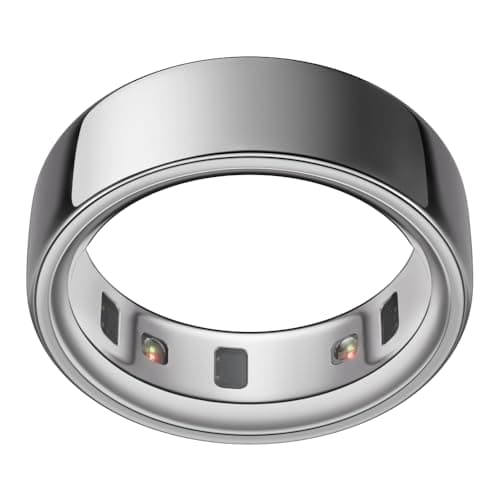
Top pick
Sleep staging you can actually citeOura Ring 4
The only consumer sleep device with a strong independent PSG result behind it — 76.3% four-stage agreement, and the best deep-sleep sensitivity of the three tested.
Price as of October 25, 2026. Prices move; Amazon's is the one that counts.
#ad · we may earn a commission from this link to Oura Ring 4
The short answer
Buy the Oura Ring 4 if you own an iPhone, or if published sleep accuracy is why you are buying — it is the only ring with an independent polysomnography result. Buy the Samsung Galaxy Ring if you carry a Galaxy phone and the recurring membership is the objection: Samsung charges nothing, and over three years that is the larger number.
Ranked
Quick picks
| # | Device | Best for | Evidence | Score | Price |
|---|---|---|---|---|---|
| 01 | Oura Ring 4 The only consumer sleep device with a strong independent PSG result behind it — 76.3% four-stage agreement, and the best deep-sleep sensitivity of the three tested. | Sleep staging you can actually cite | Peer-reviewed validation | 8.0/10 | $349.00Amazon |
| 02 | 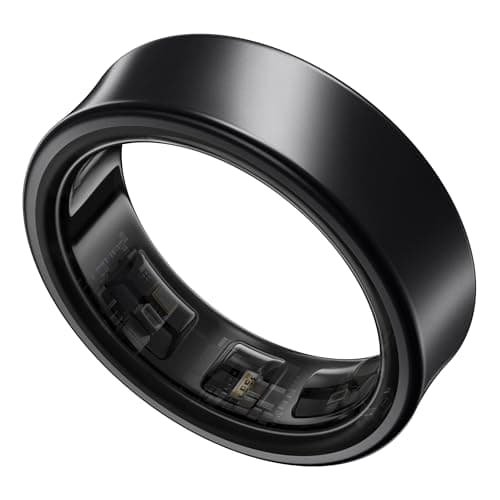 Samsung Galaxy Ring The cheapest no-subscription ring from a major manufacturer — and Samsung's own specification page says it pairs with a Samsung Galaxy phone, which decides the purchase before accuracy ever comes up. | Galaxy phone owners who want sleep and recovery tracking with no recurring fee | No validation study exists | 6.4/10 | $324.99Amazon |
#ad· Live prices from the Amazon Product API, as of October 25, 2026. Where we have no verified live price we show none. Scores come from the published rubric at How we rank — the Evidence column shows what each ranking actually rests on, including where the answer is nothing.
The comparison in one line each
Oura is the only consumer sleep device with a strong published validation against a sleep lab, it works on iOS and Android, and it charges a mandatory membership on top of the hardware.
Samsungcharges nothing recurring, publishes the most complete specification table of any ring we rank, has no published validation of any kind — and states on its own specification page that the ring pairs with a Samsung Galaxy phone.
Start with the phone, because for most readers it ends the comparison
Almost every ring comparison you will read opens with sensors. This one cannot, because one of these two devices carries a pairing requirement that rules it out for a large share of American buyers before accuracy is ever discussed.
Samsung's published specification table states that the Galaxy Ring pairs with a Samsung Galaxy phone running Android 11.0 or later with at least 1.5 GB of RAM, and requires the Samsung Health app version 6.27 or later plus a Samsung account. Samsung's US product page repeats the point feature by feature: Energy Score, Wellness Tips and snore detection are each footnoted as requiring a compatible Samsung Galaxy smartphone. Neither page mentions iPhone or iOS anywhere.
Oura's own product page says “iOS & Android Compatible” and names no handset brand at all.
So: iPhone in your pocket, and there is no comparison left to run. That is not a criticism of Samsung's engineering — it is a platform decision, consistent with the one Samsung made for its watches — but it is the most decisive fact on this page, and it belongs above the sensor talk rather than in a footnote under it. We state only what Samsung publishes: the requirement it prints is a Galaxy phone, and we found no Samsung statement of iOS support to set beside it.
The money, worked out
A ring's sticker price is not its price. Oura requires a membership for the full app and Samsung's pages carry no subscription at all, so the honest comparison is total cost over a realistic ownership period.
Oura's published membership pricing is $5.99 a month or $69.99 a year, with the first month free for new members. We use the monthly rate below because it is the less flattering of the two and the one most people end up on, and we credit the free month.
- Oura Ring 4, three years: $559— the live listing price plus 35 paid months of membership.
- Samsung Galaxy Ring, three years: $325— the live listing price, and that is the whole figure.
Both are computed at page load from live listing prices. If a price is stale beyond 48 hours the arithmetic is withheld rather than shown, because a derived number computed from a remembered price looks more trustworthy than a guess while being exactly as invented. The membership rate is the one figure here we typed in, and it is linked to Oura's own page in the sources below.
One warning about the sticker itself. Ring listings are priced per size andper finish, and when we resolved the Galaxy Ring's live listings on 25 October 2026, four current listings for the same ring came back at four different prices on the same day. The buy link here follows one of them; check the size you actually need before treating any single number as the price of the product.
The shape of the result is stable even when the exact numbers move: the recurring fee is the dominant term and it grows every year you keep the ring. That is the real argument for the Galaxy Ring, and it is a good one.
The evidence, which runs entirely the other way
What Oura has
Robbins et al. (2024) at Brigham and Women's Hospital: 35 healthy adults, single-night inpatient polysomnography, testing the Oura Ring Gen3 against a Fitbit Sense 2 and an Apple Watch Series 8. Oura took the highest four-stage agreement of the three at 76.3% (κ = 0.65) and the best deep-sleep sensitivity at 79.5%, and matched polysomnography on seven of eight nightly summary measures.
And Dial et al. (2025), 536 nights against a single-lead ECG reference: the Oura Gen 4 recorded 0.99 concordance and 5.96% HRV error, the closest any consumer wearable has been measured to a reference, plus the most accurate resting heart rate of the five devices tested.
The caveats travel with those numbers every time we use them: 35 people, one night, healthy adults, and the sleep study tested the Gen3 rather than the Ring 4 you would actually buy.
What Samsung has
Nothing on this ring. No peer-reviewed study, no independent measured test, and no validation published by Samsung itself. The Galaxy Ring sits at no validation study exists on our hierarchy, the bottom tier — which is where a great many of the devices we rank sit.
There is one published Samsung sleep measurement, and it is worth reading precisely because of what it is not. Kim, Joo & Choi (2023) ran a Galaxy Watch 3 against in-laboratory polysomnography in 32 adults at Samsung Medical Center. It found:
- Sleep-versus-wake sensitivity of 0.954— the watch is good at noticing you are asleep
- Wake specificity of 0.524— it correctly identified barely half of the epochs in which you were actually awake
- Overall four-stage accuracy of 0.651, with REM sensitivity 0.598 and a REM-duration ICC of 0.153
- Total sleep time overestimated by 9.5 minutes on average, with limits of agreement from −81.2 to +100.3 minutes
Read that carefully before using it. It tests a wrist watchfrom 2020, not a ring: a different sensor, on a different part of the body, with a different algorithm behind it. We do not transfer it to the Galaxy Ring and nor should you — a new sensor in a new place is exactly what a validation exists to test. It is also not a head-to-head with Oura. Different lab, different protocol, different year; the two four-stage figures on this page come from two separate studies that never ran against each other, and comparing them directly would be the kind of thing this site exists to avoid.
What it does establish is that Samsung knows how to commission a polysomnography study and has done so before — and has not published one for the ring it currently sells.
Why this matters more here than in a watch comparison
A sleep stage graph is unfalsifiable by the person wearing it. If a watch reports your pace, you can check it against a measured route. If a ring reports 51 minutes of deep sleep, you have no way, ever, of knowing whether that is right without going to a sleep lab. That is the precise situation in which third-party validation carries the most weight, and it is the situation in which one of these two devices has none.
The fair case for the Galaxy Ring
We would be overstating things if we left it there, because on everything except evidence this ring argues for itself.
It publishes more than Oura does.Samsung's specification table gives per-size weights from 2.3 g to 3.3 g, per-size battery capacities of 17, 18.5 and 22.5 mAh, 7.0 mm width, 2.6 mm thickness, a 10 ATM and ISO 22810 100 m rating plus an IP68 classification, and a three-item sensor list. Oura publishes 7.90 mm by 2.88 mm, 3.3-5.2 g, 100 m water resistance and four sensor groups — a good table, and a shorter one. Two of the other rings we rank publish no water-resistance figure at all.
It is the thinner and lighter ringon both makers' own numbers: 2.6 mm and 2.3-3.3 g against 2.88 mm and 3.3-5.2 g. The practical argument for a ring over a watch has always been that you will actually wear it to bed, and lighter helps.
No validation is not bad validation. Samsung may well be accurate. The measurement approaches across this category are broadly similar and there is no specific reason to expect this ring to be an outlier.
Unvalidated is the normal state of this market. Among the rings on this site Oura is the exception, not Samsung. Garmin, far larger than either, has no independent polysomnography validation of its sleep staging either.
Hardware, battery and the things you will actually notice
Battery. Samsung states up to six days for sizes 5-11 and up to seven for size 13, with up to 14 days when the charging case in the box is counted. Oura states 5-8 days depending on size and lifestyle, with no case. Both are manufacturer figures and nobody here has run either one down; on the published numbers this is close to a tie, with the case as the tiebreaker.
Water. Both publish 100 m. Samsung adds an IP68 classification for submersion to 1.5 m of fresh water for 30 minutes, and then, on its own US page, describes the ring as water resistant rather than waterproof for swimming or diving. Those two statements sit a page apart, and the second is the one to act on.
Sensors.Samsung lists three: an accelerometer, an optical bio-signal sensor for heart rate and a skin temperature sensor. Oura lists red and infrared LEDs for blood oxygen, alternating green and infrared LEDs for heart rate, HRV and respiration rate, a digital temperature sensor and an accelerometer. That is a longer list, and the blood oxygen hardware in particular has no equivalent in Samsung's published list.
Sizing.Both are sized, both want a sizing kit first, and on both the Amazon listing varies by size — Samsung's also varies by finish. Ordering the wrong one is a return rather than a strap adjustment.
Lifting.Both are rigid rings and both are uncomfortable under a loaded barbell. Oura's own guidance is to take the ring off, and a tracker you remove for training is not tracking your training.
The verdict
Buy the Oura Ring 4 if you use an iPhone, if staging accuracy is the reason you are buying, or if you want the device somebody outside the company has measured. You are paying a recurring fee for the only published sleep result in the category, and that is a defensible trade. Our full Ring 4 review has the rest of it, and the Ring 5 is the newer, costlier, less validated option if you want the current generation.
Buy the Samsung Galaxy Ring if you carry a Galaxy phone and the subscription is the dealbreaker. You get the lowest starting price of any major-brand ring we rank, a charging case, the most complete published specification in the category, and numbers nobody has checked. For reading duration and night-to-night trend rather than hypnograms, that is a reasonable thing to buy.
Buy neither if what you actually want is accurate heart rate while you train. Rings are sleep and recovery instruments. On measured evidence the right answer for exercise heart rate is a chest strap, and it costs a fraction of either ring. If the subscription is the whole objection, the subscription-free ranking has cheaper and longer-lasting options than both of these.
In full
Every pick, and why
Oura Ring 4
The only consumer sleep device with a strong independent PSG result behind it — 76.3% four-stage agreement, and the best deep-sleep sensitivity of the three tested.
- Form
- Ring, worn on the index finger
- Sizing
- Size-specific — the ASIN is per size
- Subscription
- Membership required for full app features
What's good
- Robbins et al. (2024): highest four-stage agreement (76.3%, κ = 0.65) and best deep-sleep sensitivity (79.5%) of the three devices tested against polysomnography
- Matched PSG on seven of eight nightly summary measures, missing only sleep latency by five minutes
- A finger is a better optical site than a wrist for the same reason a forearm is
What isn't
- The membership is mandatory for the full app, so the sticker price is not the price — see our three-year arithmetic
- Rings are sized, so you need the sizing kit first and the ASIN varies by size
Skip this if
Skip this if you lift heavily. A rigid ring on a loaded barbell is uncomfortable at best, and Oura's own guidance is to take it off — a tracker you remove for training is not tracking your training.
What the evidence says
Peer-reviewed validationRobbins et al., Sensors 24(20):6532 (2024), n = 35, single-night inpatient polysomnography, testing the Oura Ring Gen3. Note the study tested Gen3, not the Ring 4. Note also that the manufacturer's press release rounded the four-stage figure to 79%; the paper says 76.3%. We use the paper.
Show how this 8.0 was calculated
| Factor | Weight | Score |
|---|---|---|
| EvidenceThe strongest peer-reviewed sleep result of any consumer device we found — with the honest caveats that it was one night, 35 people, and the previous generation. | 30% | 9.0 |
| HardwareFinger-mounted optical sensing, a better site than the wrist. | 20% | 8.5 |
| Metric coverageSleep, HRV, temperature and readiness; weak on exercise recording. | 20% | 8.0 |
| EnduranceMulti-day battery in normal use. | 15% | 8.0 |
| Cost per capabilityThe mandatory membership makes the true three-year cost materially higher than the sticker. | 15% | 5.5 |
Price as of October 25, 2026. Prices move; Amazon's is the one that counts.
#ad · we may earn a commission from this link to Oura Ring 4
Samsung Galaxy Ring
The cheapest no-subscription ring from a major manufacturer — and Samsung's own specification page says it pairs with a Samsung Galaxy phone, which decides the purchase before accuracy ever comes up.
- Form
- Ring, titanium frame, three finishes
- Size and weight
- 7.0 mm wide, 2.6 mm thick, 2.3-3.3 g by size, manufacturer-stated
- Battery
- Up to 6 days (sizes 5-11) and up to 7 days (size 13), up to 14 with the charging case, manufacturer-stated
- Water resistance
- 10 ATM and ISO 22810 to 100 m, plus IP68, manufacturer-stated
- Sensors
- Accelerometer, optical bio-signal, skin temperature — three, per Samsung's own list
- Sizing
- Sizing kit covers sizes 5-13 — the ASIN is per size and per finish
- Phone requirement
- Pairs with a Samsung Galaxy phone on Android 11.0 or later; Samsung Health v6.27+ and a Samsung account
- Subscription
- None stated anywhere on Samsung's page
What's good
- No subscription of any kind appears on Samsung's page, and the starting price is the lowest of any major-brand ring we rank
- A complete published specification table — per-size weights, per-size battery capacities, a 10 ATM and ISO 22810 rating and an IP68 classification — which two of its rivals do not publish in a form we could read
- 2.6 mm thick and 2.3-3.3 g, which is in the same bracket as the thinnest rings on this site
- A charging case is in the box rather than sold separately, taking stated endurance to up to 14 days
What isn't
- Samsung's own specification page states it pairs with a Samsung Galaxy phone running Android 11.0 or later — there is no iPhone support anywhere on Samsung's pages, and several features need a Galaxy handset specifically
- No independent validation of this ring exists that we could find, and Samsung has published none of its own
- Three sensors is the shortest published sensor list of any ring here, and Samsung's stated six-to-seven-day life is the shortest stated endurance of any ring we rank
- Samsung itself describes the 10 ATM rating as water resistant rather than waterproof for swimming or diving, which is a narrower claim than the number suggests
Skip this if
Skip this if you carry an iPhone. Samsung's own pairing requirement is a Samsung Galaxy phone on Android 11.0 or later, and no amount of ring quality survives a device that will not pair with your phone.
What the evidence says
No validation study existsNo validation study of the Galaxy Ring exists that we could find, by Samsung or by anyone else. The nearest published Samsung measurement is Kim, Joo & Choi (2023) in the Journal of Sleep Medicine, which ran a Galaxy Watch 3 against in-laboratory polysomnography in 32 adults: 0.954 sensitivity for detecting sleep but 0.524 specificity for wake, 0.651 overall four-stage accuracy, and an REM duration ICC of 0.153. That is a wrist watch from 2020, not this ring, and we do not transfer it — a different sensor on a different part of the body is precisely what a validation exists to test.
Show how this 6.4 was calculated
| Factor | Weight | Score |
|---|---|---|
| EvidenceNothing published about this ring by anyone. Half a point above a maker with no measurement record at all, because one peer-reviewed Samsung sleep validation does exist — and it tested a 2020 wrist watch that staged sleep poorly, so it argues for caution rather than confidence. | 30% | 3.0 |
| HardwareTitanium frame at 7.0 mm wide and 2.6 mm thick, 2.3-3.3 g by size, with a published 10 ATM / ISO 22810 / IP68 rating. The sensor list Samsung publishes is three items long, which is shorter than its rivals'. | 20% | 8.0 |
| Metric coverageSleep, heart rate, skin temperature and activity, with no feature paywall — but the readout lives in Samsung Health, and Samsung states that several of its own features need a compatible Galaxy phone. | 20% | 7.0 |
| EnduranceUp to six days for sizes 5-11 and up to seven for size 13, manufacturer-stated, with up to 14 including the charging case. The shortest stated life of any ring on this site. | 15% | 7.5 |
| Cost per capabilityNo subscription and no paid modules, on the lowest starting price of any major-brand ring here. Not a perfect score only because the stated pairing requirement is a Samsung Galaxy phone, so for anyone who does not own one the true cost of entry is a good deal higher than the ring. | 15% | 9.0 |
$399.9919% off
Price as of October 25, 2026. Prices move; Amazon's is the one that counts.
#ad · we may earn a commission from this link to Samsung Galaxy Ring
How this ranking was built
Every score on this page comes from one published rubric, applied identically to every device on the site, with the weights written down and the inputs shown. We have not worn any of these devices and we never say we have. Read the method and check us.
Questions
Frequently asked
Does the Samsung Galaxy Ring work with an iPhone?
Samsung's own specification page states the ring pairs with a Samsung Galaxy phone running Android 11.0 or later, and neither that page nor the US product page mentions iPhone or iOS anywhere. Oura's page says “iOS & Android Compatible”. If you carry an iPhone, that difference settles this comparison on its own.
Is the Galaxy Ring as accurate as Oura?
Nobody knows. Oura has a published polysomnography result — 76.3% four-stage agreement and 79.5% deep-sleep sensitivity on the Gen3 — and no independent validation of the Galaxy Ring exists that we could find. The nearest published Samsung measurement tested a Galaxy Watch 3 in 2023, a different device on a different part of the body, and managed 0.651 four-stage accuracy with 0.524 wake specificity. That is a difference in what has been checked rather than a demonstrated difference between these two rings.
Does the Samsung Galaxy Ring have a subscription?
No subscription fee appears anywhere on Samsung's product page; it asks for the Samsung Health app and a Samsung account, both free. Oura requires a membership at $5.99 a month or $69.99 a year for the full app. Over three years that fee, not the hardware, is the bigger number — the arithmetic is on this page, using live listing prices.
Which ring is cheaper to own over three years?
The Galaxy Ring, by a clear margin, because there is no recurring fee and its starting price is the lower of the two. Both three-year figures are computed on this page from live listing prices and are withheld rather than estimated if a price goes stale.
Which has the better battery life?
They are close on the makers' own figures. Samsung states up to six days for sizes 5-11 and up to seven for size 13, plus up to 14 days counting the charging case it ships with. Oura states 5-8 days depending on size and lifestyle, with no case. Both are manufacturer-stated; nobody here has run either ring down.
Show your working
Sources
Every one of these was read in full before it was cited. Where we could not access a paper, we do not quote its numbers.
- [1]Manufacturer specification2026Samsung — Galaxy Ring US product page
Manufacturer-stated, read 2026-10-25: “starting at $299.99” before trade-in, three scratch-resistant titanium finishes (Titanium Black, Titanium Silver, Titanium Gold), a sizing kit containing nine sample rings in sizes 5 to 13, a seven-day charge with up to 14 days when combined with a full charging-case charge and a footnote stating smaller sizes reach up to six days, a 10ATM and IP68 rating that Samsung itself describes as water resistant rather than waterproof for swimming or diving, and three sensors: an accelerometer, an optical bio-signal sensor for heart rate and a skin temperature sensor used during sleep. Health data syncs to the Samsung Health app and Samsung Cloud through a Samsung account. No subscription fee appears anywhere on the page. Samsung states that features including Energy Score, Wellness Tips and snore detection require a compatible Samsung Galaxy smartphone, and the page makes no mention of iPhone or iOS support.
- [2]Manufacturer specification2026Samsung — Galaxy Ring published specification table
Manufacturer-stated, read 2026-10-25: 7.0 mm wide and 2.6 mm thick, weights by size from 2.3 g (size 5) to 3.3 g (size 15), nominal battery capacity 17 mAh for sizes 5-7, 18.5 mAh for sizes 8-11 and 22.5 mAh for sizes 12-15, rated life up to six days for sizes 5-11 and up to seven days for size 13, a titanium device frame, a charging case and USB cable in the box with the case size varying by ring size, 10 ATM plus ISO 22810 water resistance to 100 m and an IP68 classification for submersion to 1.5 m of fresh water for up to 30 minutes, and three sensors (accelerometer, optical bio-signal, skin temperature). THE PAIRING REQUIREMENT IS PUBLISHED HERE: the ring pairs with a Samsung Galaxy phone running Android 11.0 or later with at least 1.5 GB of RAM, and requires the Samsung Health app v6.27 or later plus a Samsung account. Some features need specific software versions (double-pinch camera control needs One UI 6.1.1 or later; alarm dismissal needs Clock 12.3.30.35 or later).
- [3]Peer-reviewed validation2023Kim, Joo & Choi, “Validation of the Samsung Smartwatch for Sleep-Wake Determination and Sleep Stage Estimation”, Journal of Sleep Medicine 20(1):28-34
DOI 10.13078/jsm.230004. n = 32 healthy adults aged 20-60 (mean 37.8 ± 8.1 years, 28 of 32 male) at Samsung Medical Center, Seoul, wearing a Galaxy Watch 3 against in-laboratory overnight polysomnography (Embla N7000) scored in 30-second epochs under AASM rules. Results: sleep-versus-wake sensitivity 0.954 with specificity 0.524; four-stage sensitivity light 0.695, deep 0.612, REM 0.598; overall four-stage accuracy 0.651; mean per-subject kappa wake 0.47, light 0.34, deep 0.34, REM 0.39; total sleep time overestimated by 9.5 minutes with limits of agreement −81.2 to 100.3 minutes and ICC 0.640; per-stage ICC light 0.518, deep 0.639, REM 0.153. Authors’ stated limits: sleep latency and wake after sleep onset were not collected from the watch and wake-related errors are expected given weak wake discrimination; the sample mixed healthy adults with 16 participants found to have obstructive sleep apnea; single-clinic design with possible inter-rater scoring variability; and no other wearable was tested alongside, so no device can be called superior from it. THIS TESTS A WRIST WATCH FROM 2020, NOT THE GALAXY RING.
- [4]Manufacturer specification2026Oura — Ring 4 product page, published specifications
Manufacturer-stated, read 2026-10-25: 7.90 mm wide and 2.88 mm thick, 3.3-5.2 g depending on ring size, six finishes (Silver, Black, Brushed Silver, Stealth, Gold, Rose Gold), a size-specific charger, “5-8 days of battery life” depending on ring size and lifestyle with a typical charge of 20-80 minutes, “Water resistant up to 100m/328 ft”, and a sensor set listed as red and infrared LEDs for blood oxygen, alternating green and infrared LEDs for 24/7 heart rate, heart rate variability and respiration rate, a digital temperature sensor and an accelerometer. Compatibility is stated on the page as “iOS & Android Compatible” and “Available on iOS and Android”, with no handset brand named and no OS versions given. Oura Membership is listed at $5.99/month or $69.99/year with the first month free. No ring price is published on the page itself.
- [5]Manufacturer specification2026Oura — published membership pricing
Manufacturer-stated, read 2026-08-13: $5.99 USD/month or $69.99 USD/year before tax, with the first month free for new members. Oura states that without a membership “your Oura Ring and Oura App will still function, but the insights, personal health data, and benefits you receive will be much more limited.” Our three-year arithmetic uses the monthly rate — the less flattering of the two — and credits the free first month.
- [6]Peer-reviewed validation2024Robbins et al., “Accuracy of Three Commercial Wearable Devices for Sleep Tracking in Healthy Adults”, Sensors 24(20):6532
Brigham and Women’s Hospital. n = 35 healthy adults, single-night inpatient polysomnography, testing Oura Ring Gen3, Fitbit Sense 2 and Apple Watch Series 8. Authors’ stated limits: one night, lab conditions, healthy adults without insomnia, comparison only during scheduled sleep, and device failures on 6 Apple Watches and 2 Fitbits.
- [7]Peer-reviewed validation2025Dial, Hollander, Vatne, Emerson, Edwards & Hagen, “Validation of nocturnal resting heart rate and heart rate variability in consumer wearables”, Physiological Reports 13(16):e70527
DOI 10.14814/phy2.70527. n = 13 healthy adults (7 male, 6 female, 33.2 ± 8.6 years) across 536 nights, each wearing an Oura Gen 3, Oura Gen 4, Polar Grit X Pro, Garmin fēnix 6 and Whoop 4.0 simultaneously against a Polar H10 single-lead ECG reference sampled at 1000 Hz. Authors’ stated limits: healthy adults only, no atrial-fibrillation population, proprietary and periodically-updated algorithms, and unequal night counts per device. The Garmin was dropped from the resting-heart-rate comparison because the 30-minute window it uses is not timestamped.
- [8]Peer-reviewed validation2024Svensson et al., “Validity and reliability of the Oura Ring Generation 3 with sleep staging algorithm 2.0 compared to multi-night ambulatory polysomnography”, Sleep Medicine
NOT READ — the publisher returned HTTP 403 to our fetch on 2026-07-24. Reported to cover 96 participants and 421,045 epochs. We quote no figure from it. Readers should also note it is the validation of Oura's own staging algorithm, and that a published comment on it exists.
- [9]Peer-reviewed validation2025Khan et al., “The Oura Ring Versus Medical-Grade Sleep Studies: A Systematic Review and Meta-Analysis”, OTO Open
NOT READ — the publisher returned HTTP 403 to our fetch on 2026-07-24. A pooled analysis would be stronger evidence than any single study, so this is a real gap in our record rather than a formality.
Read next
Related
- Oura Ring 4 review
The device with the published polysomnography result, on its own.
- Oura vs RingConn
The other subscription-versus-study ring comparison, with the money worked out.
- Best smart rings
The full ring ranking, evidence column included.
- Best sleep trackers without a subscription
Every option if the recurring fee is the dealbreaker.
- Sleep tracking accuracy by device
Every published figure we could read, and every device with none.
- Smart ring vs watch for sleep
The form-factor question, answered with a polysomnography study.