Rings, bands and recovery
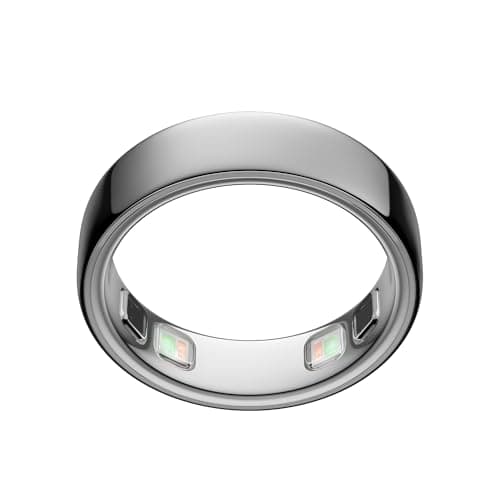
Oura Ring 5
The newest ring from the company with the best evidence in the category, and no evidence of its own. On our rules, that is a demotion.
We earn a commission when you buy through our Amazon links, at no extra cost to you. It never decides a ranking — the rubric that does is published in full, so you can check us rather than take our word for it. How this works.
Top pick
Buyers who want the current generationOura Ring 5
The newer ring, and by our own rules it cannot outrank the Ring 4 on accuracy: nobody has published a validation of it yet.
Price as of October 22, 2026. Prices move; Amazon's is the one that counts.
#ad · we may earn a commission from this link to Oura Ring 5
The short answer
Oura's current ring, smaller than the Ring 4, on the platform that produced the strongest published sleep result in this category. No independent validation of the Ring 5 exists that we could find — so under our evidence hierarchy it ranks below the Ring 4, which is the ring the studies actually looked at.
Ranked
Quick picks
| # | Device | Best for | Evidence | Score | Price |
|---|---|---|---|---|---|
| 01 | Oura Ring 5 The newer ring, and by our own rules it cannot outrank the Ring 4 on accuracy: nobody has published a validation of it yet. | Buyers who want the current generation | No validation study exists | 6.3/10 | $399.00Amazon |
#ad· Live prices from the Amazon Product API, as of October 22, 2026. Where we have no verified live price we show none. Scores come from the published rubric at How we rank — the Evidence column shows what each ranking actually rests on, including where the answer is nothing.
Why the newer ring ranks lower here
This is the clearest example on the site of our rubric doing something a normal review site would never do. The Ring 5 is probably a better device than the Ring 4 — newer sensors, a smaller body, an improved platform. It also has no published validation, and evidence is 30% of the score.
The reasoning is not stubbornness. A validation exists precisely to test a new sensor and a new algorithm; inheriting a predecessor's paper is exactly the move a validation is designed to prevent. Oura's reputation for sleep accuracy was earned by a Gen3 ring in a Brigham and Women's Hospital study, and it belongs to that ring until somebody re-runs the test.
What the Oura evidence actually says
- Sleep staging.In a study of 35 healthy adults with single-night inpatient polysomnography, the Oura Ring Gen3 achieved 76.3% four-stage agreement and 79.5% deep-sleep sensitivity — the best of three devices tested. Oura's own release rounded that four-stage figure to 79%; the paper says 76.3%, and we use the paper.
- HRV. Across 536 nights against a single-lead ECG, Oura Gen 4 recorded 5.96% mean absolute percentage error and Gen 3 recorded 7.15% — the two best results of five devices tested, ahead of Whoop 4.0, a Garmin fēnix 6 and a Polar Grit X Pro.
- The Ring 5. Nothing. Not one published measurement that we could find.
Both of those studies have limits the authors state plainly — one night, lab conditions, healthy adults without insomnia in the sleep study; 13 participants in the HRV study — and we publish those limits alongside the numbers on our sleep accuracy page.
The money
The Ring 5 costs more than the Ring 4 and carries the same mandatory membership. Oura's published pricing is $5.99 per month or $69.99 per year, with the first month free, and the company states that without a membership the ring and app still work but the insights are much more limited.
Over three years that works out to $609 for the Ring 5 against $559 for the Ring 4. You are paying more for the version with less evidence behind it, which is a strange sentence to write and an accurate one.
Who should buy it anyway
People who want the current generation and are comfortable that a newer Oura is very likely at least as good as an older one. That is a reasonable bet — it is simply a bet, and this site's job is to be clear about which of our statements are measurements and which are expectations.
If you want the measured device, buy the Ring 4. If you want to escape the membership entirely, the RingConn Gen 2 has no subscription — and no validation either, which we say just as loudly.
Sizing, and the failure mode nobody warns you about
Rings are sold per size and the listing you buy is size-specific. Fingers swell in heat and shrink in cold, and a ring that is loose reads badly for the same reason a loose watch does: optical sensing needs consistent contact with skin. Use the maker's sizing kit before ordering, and size for your normal evening state rather than a cold morning, because the measurement that matters most to you happens overnight.
The second practical point: a ring cannot record training. No GPS, no display, no pace. If you want one device for both jobs, you want a watch — and you should read what has been measured about watch sleep staging first, because it is very little.
What would change this ranking
One thing: a published validation of the Ring 5 itself. Specifically, a study against clinical polysomnography for sleep staging, or against a timestamped ECG for heart-rate variability, with limits of agreement reported rather than a correlation coefficient.
If that appears, this page will be rewritten and the ranking will move — up or down, depending on what the study says. That is the point of ranking on evidence rather than on release dates: the position is falsifiable, and we have said in advance what would falsify it.
In full
Every pick, and why
Oura Ring 5
The newer ring, and by our own rules it cannot outrank the Ring 4 on accuracy: nobody has published a validation of it yet.
- Form
- Ring, worn on the index finger
- Sizing
- Size-specific — the ASIN is per size
- Subscription
- Membership required for full app features
What's good
- Oura's current generation, smaller than the Ring 4
- Inherits the platform that produced the strongest published sleep result in the category
What isn't
- No independent validation of this generation exists yet — the peer-reviewed result belongs to the Gen3
- Costs more than the Ring 4 while carrying less evidence
Skip this if
Skip this if you are buying on the strength of Oura's accuracy reputation. That reputation was earned by an earlier ring in a published study, and this one has not been measured.
What the evidence says
No validation study existsNo independent validation study of the Ring 5 exists that we could find as of July 2026. This is exactly the case our evidence hierarchy is built for: a newer, probably-better device cannot take a top accuracy rank on the strength of its predecessor's paper.
Show how this 6.3 was calculated
| Factor | Weight | Score |
|---|---|---|
| EvidenceNo validation of this generation. The Gen3 study does not transfer — a new sensor and a new algorithm are precisely what a validation exists to test. | 30% | 3.5 |
| HardwareOura's current sensor generation, per the manufacturer's specification. | 20% | 9.0 |
| Metric coverageSame metric set as the Ring 4, with platform improvements. | 20% | 8.0 |
| EnduranceMulti-day battery in normal use. | 15% | 8.0 |
| Cost per capabilityHigher price than the Ring 4, plus the same mandatory membership. | 15% | 4.5 |
Price as of October 22, 2026. Prices move; Amazon's is the one that counts.
#ad · we may earn a commission from this link to Oura Ring 5
Questions
Frequently asked
Is the Oura Ring 5 more accurate than the Ring 4?
Nobody knows. No independent validation of the Ring 5 has been published that we could find. The measured Oura results belong to the Gen3 (sleep staging against polysomnography) and the Gen 4 (HRV against an ECG). A newer sensor and a newer algorithm are exactly what a validation exists to test.
Do I still need an Oura membership with the Ring 5?
Yes. Oura publishes $5.99 per month or $69.99 per year, first month free, and states that without it the insights and personal health data are much more limited. Three years of ownership comes to $609 including the hardware.
Should I upgrade from the Ring 4?
On the published record there is no accuracy reason to. The Ring 4 is the generation covered by the HRV study; the Ring 5 has no published measurement. Upgrade for size, comfort or battery if those matter to you — not for better data, because nobody has shown the data is better.
Which ring has the best evidence?
Oura, but the earlier generations. The Gen3 was measured against clinical polysomnography and the Gen 4 against an ECG, and both did well. Our smart ring roundup ranks the whole category on that basis.
Show your working
Sources
Every one of these was read in full before it was cited. Where we could not access a paper, we do not quote its numbers.
- [1]Peer-reviewed validation2024Robbins et al., “Accuracy of Three Commercial Wearable Devices for Sleep Tracking in Healthy Adults”, Sensors 24(20):6532
Brigham and Women’s Hospital. n = 35 healthy adults, single-night inpatient polysomnography, testing Oura Ring Gen3, Fitbit Sense 2 and Apple Watch Series 8. Authors’ stated limits: one night, lab conditions, healthy adults without insomnia, comparison only during scheduled sleep, and device failures on 6 Apple Watches and 2 Fitbits.
- [2]Peer-reviewed validation2025Dial, Hollander, Vatne, Emerson, Edwards & Hagen, “Validation of nocturnal resting heart rate and heart rate variability in consumer wearables”, Physiological Reports 13(16):e70527
DOI 10.14814/phy2.70527. n = 13 healthy adults (7 male, 6 female, 33.2 ± 8.6 years) across 536 nights, each wearing an Oura Gen 3, Oura Gen 4, Polar Grit X Pro, Garmin fēnix 6 and Whoop 4.0 simultaneously against a Polar H10 single-lead ECG reference sampled at 1000 Hz. Authors’ stated limits: healthy adults only, no atrial-fibrillation population, proprietary and periodically-updated algorithms, and unequal night counts per device. The Garmin was dropped from the resting-heart-rate comparison because the 30-minute window it uses is not timestamped.
- [3]Manufacturer specification2026Oura — published membership pricing
Manufacturer-stated, read 2026-08-13: $5.99 USD/month or $69.99 USD/year before tax, with the first month free for new members. Oura states that without a membership “your Oura Ring and Oura App will still function, but the insights, personal health data, and benefits you receive will be much more limited.” Our three-year arithmetic uses the monthly rate — the less flattering of the two — and credits the free first month.
- [4]Peer-reviewed validation2024Svensson et al., “Validity and reliability of the Oura Ring Generation 3 with sleep staging algorithm 2.0 compared to multi-night ambulatory polysomnography”, Sleep Medicine
NOT READ — the publisher returned HTTP 403 to our fetch on 2026-07-24. Reported to cover 96 participants and 421,045 epochs. We quote no figure from it. Readers should also note it is the validation of Oura's own staging algorithm, and that a published comment on it exists.
- [5]Peer-reviewed validation2025Khan et al., “The Oura Ring Versus Medical-Grade Sleep Studies: A Systematic Review and Meta-Analysis”, OTO Open
NOT READ — the publisher returned HTTP 403 to our fetch on 2026-07-24. A pooled analysis would be stronger evidence than any single study, so this is a real gap in our record rather than a formality.
Read next
Related
- Oura Ring 4 review
The generation the evidence actually covers.
- Oura Ring 4 vs 5
The upgrade question, with both three-year costs.
- Best smart rings
Every ring we cover, ranked on measured evidence.
- HRV accuracy by device
The 536-night ECG comparison, in one table.