Head to head
Garmin fēnix 8 vs Forerunner 970
Two flagships from one company that record the same numbers. The difference is what happens when you hit the watch on a rock.
We earn a commission when you buy through our Amazon links, at no extra cost to you. It never decides a ranking — the rubric that does is published in full, so you can check us rather than take our word for it. How this works.
Top pick
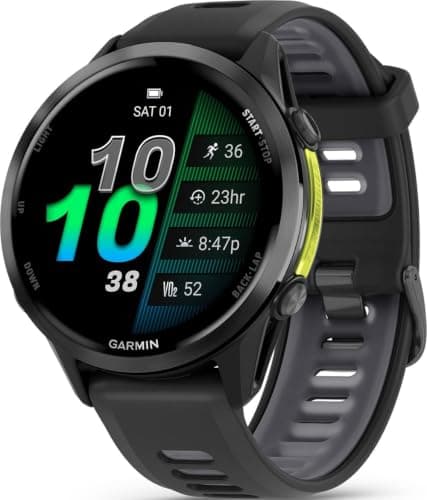
Long-course athletes who want mapsGarmin Forerunner 970
The most complete running watch Garmin sells, and — counter-intuitively — the cheapest of the pair per hour of GPS you get.
Price as of October 22, 2026. Prices move; Amazon's is the one that counts.
#ad · we may earn a commission from this link to Garmin Forerunner 970
The short answer
Buy the Forerunner 970 unless you genuinely need the fēnix's case. The $24 premium buys ruggedization, dive ratings and longer battery — not a better sensor, not a better receiver, and not a single different number in the file at the end of your run. Both are multi-band, both have maps, both use the same optical sensor generation.
Ranked
Quick picks
| # | Device | Best for | Evidence | Score | Price |
|---|---|---|---|---|---|
| 01 | Garmin Forerunner 970 The most complete running watch Garmin sells, and — counter-intuitively — the cheapest of the pair per hour of GPS you get. | Long-course athletes who want maps | Manufacturer specification | 7.7/10 | $749.99Amazon |
| 02 | 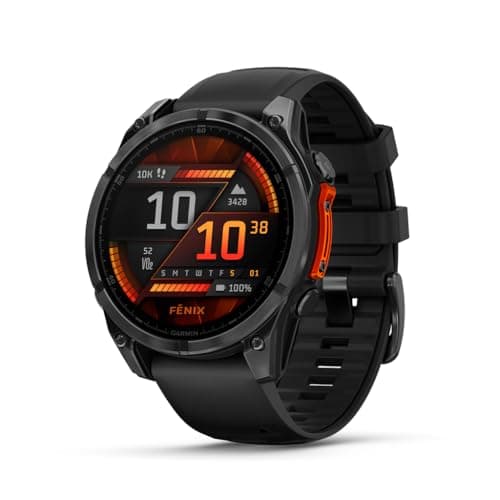 Garmin fēnix 8 (47mm) Everything Garmin makes, in a case built to survive being hit. You pay for the durability, not for better data. | Expedition and rough-terrain use | Manufacturer specification | 7.5/10 | $774.00Amazon |
#ad· Live prices from the Amazon Product API, as of October 22, 2026. Where we have no verified live price we show none. Scores come from the published rubric at How we rank — the Evidence column shows what each ranking actually rests on, including where the answer is nothing.
The full specification table
Every value from Garmin's own published pages. Where the two watches are genuinely identical we say so in a merged row rather than padding the table to look like there are more differences than there are.
| Specification | Forerunner 970 | fēnix 8 (47mm) |
|---|---|---|
| Case | 47 mm, titanium bezel | 47 mm, ruggedized |
| Display | AMOLED on both | |
| Satellite | Multi-band GNSS with SatIQ | Multi-band GNSS |
| Built-in maps | Yes, full color, on both | |
| Dive rating | No | Yes |
| Speaker and microphone | Yes on both | |
| Battery, GPS mode (stated) | Up to 26 hours | Longer — among the longest in Garmin's AMOLED line |
| Optical sensor generation | Same current Garmin sensor family in both | |
| Independent accuracy validation | None published for either, that we could find | |
| Our rubric score | 7.7 | 7.5 |
Where the money goes
The last two rows of that table are the comparison. Same sensor family, no validation for either, and a rubric gap of 0.2 that comes almost entirely from cost per capability — the fēnix scores 4.5 there, the weakest figure on this site, against the 970's 7.5.
The fēnix scores higher on metric coverage (10 against 9.5) because of the dive modes and the breadth of its outdoor feature set, and marginally on hardware. Those are real. They are also, for a runner, a list of things that will not appear in a single workout file.
At today's prices the 970 works out at $28.85 per stated GPS hour, which is the arithmetic that carries it past its more expensive sibling on our weighting.
The case for the fēnix, made properly
There is a real one and it is not about data. It is about consequence.
If your watch is going to take direct impacts on rock, get dunked repeatedly, or be the only navigation device you have four days into a mountain range, then durability stops being a specification and becomes a safety consideration. The fēnix case is built for that and the Forerunner is not.
Dive ratings are the clearest version of the same argument. If you dive, this is not a preference — it is the only one of the two that does the job.
The case for the Forerunner, made properly
For running, including ultras on trails, the 970 gives you the same data, the same maps and the same receiver class in a lighter package for meaningfully less money. Twenty-six stated GPS hours covers an ironman-distance day with a wide margin.
Our full 970 review and fēnix 8 review both go through what we could not verify about each, which on both watches is substantial.
The third option neither of these is
If the appeal of the fēnix is genuinely multi-day battery rather than the case, the Instinct 3 Solar outranks both watches on our rubric at a fraction of the price, publishing 24 stated hours in all-satellite multi-band mode and 36 expedition days. What it gives up is maps, which both watches here have.
What neither of them fixes
Wrist heart rate under rapid intensity change. Both read optically at the wrist, and the published evidence on that is consistently poor across every brand and price point tested. Neither watch is the answer to that problem; a strap is.
In full
Every pick, and why
Garmin Forerunner 970
The most complete running watch Garmin sells, and — counter-intuitively — the cheapest of the pair per hour of GPS you get.
- Case
- 47mm, titanium bezel, AMOLED
- Satellite
- Multi-band GNSS with SatIQ
- Battery (stated)
- 15 days smartwatch / 26 h GPS
- Maps
- Built-in, full color
- Extras
- ECG app, speaker and microphone
What's good
- Multi-band GNSS with SatIQ — the current top tier of consumer positioning hardware
- 26 stated GPS hours is enough for an ironman-distance day with a wide margin
- Built-in maps, which the 570 does not have at any price
What isn't
- The wrist optical sensor is the same class of hardware as the 570's — the premium buys features, not a better heart-rate signal
- 47mm only; there is no smaller case in this model
Skip this if
Skip this if you never race longer than a marathon and never navigate. Maps and titanium are the entire difference, and neither changes a single number the watch records.
What the evidence says
Manufacturer specificationNo independent validation study of the Forerunner 970's optical heart rate has been published that we could find. The specification figures are Garmin's own.
Show how this 7.7 was calculated
| Factor | Weight | Score |
|---|---|---|
| EvidenceSpecs are published and detailed, but no peer-reviewed or independent measured validation of this specific model exists yet. | 30% | 5.5 |
| HardwareMulti-band GNSS with SatIQ and Garmin's current-generation optical sensor — the top hardware tier available. | 20% | 9.5 |
| Metric coverageRunning dynamics, ECG, training load, maps, and a documented export path off the watch. | 20% | 9.5 |
| EnduranceGarmin states 26 hours in GPS mode, 15 days smartwatch. | 15% | 7.5 |
| Cost per capabilityHighest sticker in the range, but the strongest dollars-per-GPS-hour of the two Forerunners — see the arithmetic on the comparison page. | 15% | 7.5 |
Price as of October 22, 2026. Prices move; Amazon's is the one that counts.
#ad · we may earn a commission from this link to Garmin Forerunner 970
Garmin fēnix 8 (47mm)
Everything Garmin makes, in a case built to survive being hit. You pay for the durability, not for better data.
- Case
- 47mm, AMOLED
- Satellite
- Multi-band GNSS
- Extras
- Built-in maps, dive-rated, speaker and microphone
What's good
- The most durable case Garmin puts a multi-band receiver into
- Maps, dive modes and the full metric set in one device
What isn't
- Records essentially the same physiological data as a Forerunner costing a third as much
- Heavy compared with a dedicated running watch
Skip this if
Skip this if you run on roads and pavements. You would be buying a case specification you will never test, and the numbers it records are the ones a Forerunner already gives you.
What the evidence says
Manufacturer specificationPublished specifications only; no independent validation of this model that we could find.
Show how this 7.5 was calculated
| Factor | Weight | Score |
|---|---|---|
| EvidenceDetailed published specs, no independent measured validation. | 30% | 5.5 |
| HardwareMulti-band GNSS in Garmin's most ruggedized current case. | 20% | 9.5 |
| Metric coverageThe widest metric and mode coverage of any device on this site. | 20% | 10.0 |
| EnduranceAmong the longest stated GPS endurance in Garmin's AMOLED line. | 15% | 8.5 |
| Cost per capabilityBy some distance the weakest cost-per-capability figure here — the premium buys the case, not the data. | 15% | 4.5 |
$999.9923% off
Price as of October 22, 2026. Prices move; Amazon's is the one that counts.
#ad · we may earn a commission from this link to Garmin fēnix 8 (47mm)
How this ranking was built
Every score on this page comes from one published rubric, applied identically to every device on the site, with the weights written down and the inputs shown. We have not worn any of these devices and we never say we have. Read the method and check us.
Questions
Frequently asked
Is the fēnix 8 more accurate than the Forerunner 970?
There is no published evidence that it is, and good reason to expect it is not — both use the same generation of Garmin optical sensor and the same class of multi-band receiver. Neither has been independently validated. The premium buys case construction, dive ratings and battery.
Do both have maps?
Yes. Both include built-in full-color maps, which is unusual for a comparison at this price gap — in most Garmin pairings maps are the thing the cheaper watch lacks. Here they are not the differentiator.
Which has better battery life?
The fēnix, which sits among the longest in Garmin's AMOLED line, against 26 stated GPS hours for the 970. Both are manufacturer figures under manufacturer assumptions. If battery is the deciding factor rather than durability, the Instinct 3 Solar states far more than either at a much lower price.
Which should a triathlete buy?
The 970, in almost every case. It handles multisport transitions and open-water swimming, weighs less, and costs meaningfully less. The fēnix earns its money in expedition and dive use rather than in racing.
Show your working
Sources
Every one of these was read in full before it was cited. Where we could not access a paper, we do not quote its numbers.
- [1]Manufacturer specification2026Garmin — Forerunner 970 published specifications
Manufacturer-stated battery: up to 15 days smartwatch mode, up to 26 hours GPS mode.
- [2]Manufacturer specification2026Garmin — Instinct 3 Solar owner’s manual, battery life information
Manufacturer-stated for the 45 mm Solar: 28 days smartwatch (unlimited with solar), 40 hours GPS-only (130 hours with solar), 28 hours all-satellite (50 with solar), 24 hours all-satellite plus multi-band (40 with solar), 36 days expedition GPS (unlimited with solar), 65 days battery-saver. Water rating 10 ATM per the same manual’s specification page. Solar figures assume all-day wear in 50,000 lux conditions, which is Garmin’s assumption and not a measurement of ours.
- [3]Peer-reviewed validation2020Gilgen-Ammann, Schweizer & Wyss, “Accuracy of Distance Recordings in Eight Positioning-Enabled Sport Watches: Instrument Validation Study”, JMIR mHealth and uHealth
DOI 10.2196/17118. Eight watches (Apple Watch Series 4, Coros Apex 46mm, Garmin Fenix 5X Plus, Garmin Forerunner 935, Polar Vantage M, Polar Vantage V, Polar V800, Suunto 9 Baro) measured against a trundle wheel accurate to 1 cm, across urban, forest and 400 m track conditions. IMPORTANT: this predates the dual-frequency receivers now standard, so it describes brand engineering history, not any watch currently sold.
- [4]Peer-reviewed validation2025“Impact of Anatomical Placement on the Accuracy of Wearable Heart Rate Monitors During Rest and Various Exercise Intensities”, Sensors (Basel)
n = 28 (14 male, 14 female). Polar H10 chest strap as the reference. Compared Polar Verity Sense (forearm), Garmin Forerunner 55 (wrist) and three simultaneous Whoop 4.0 units at wrist, forearm and upper arm, across rest, cycling warm-up, burpees and a modified Bruce treadmill protocol.
- [5]Peer-reviewed validation2025Dial, Hollander, Vatne, Emerson, Edwards & Hagen, “Validation of nocturnal resting heart rate and heart rate variability in consumer wearables”, Physiological Reports 13(16):e70527
DOI 10.14814/phy2.70527. n = 13 healthy adults (7 male, 6 female, 33.2 ± 8.6 years) across 536 nights, each wearing an Oura Gen 3, Oura Gen 4, Polar Grit X Pro, Garmin fēnix 6 and Whoop 4.0 simultaneously against a Polar H10 single-lead ECG reference sampled at 1000 Hz. Authors’ stated limits: healthy adults only, no atrial-fibrillation population, proprietary and periodically-updated algorithms, and unequal night counts per device. The Garmin was dropped from the resting-heart-rate comparison because the 30-minute window it uses is not timestamped.
Read next
Related
- Forerunner 570 vs fēnix 8
One tier down, where the price gap gets harder to justify.
- Forerunner 570 vs 970
The other Garmin sibling question, decided by arithmetic.
- fēnix 8 review
Everything we could and could not verify.
- Garmin vs Apple Watch
If you are also weighing the smartwatch side.
- fēnix 8 vs Apple Watch Ultra 3
The other fēnix 8 comparison, where the evidence actually separates them.