Head to head
COROS APEX 4 vs PACE 4
One is the lightest real training watch you can buy. The other is built to be read in direct sun and forgotten on the charger.
We earn a commission when you buy through our Amazon links, at no extra cost to you. It never decides a ranking — the rubric that does is published in full, so you can check us rather than take our word for it. How this works.
Top pick
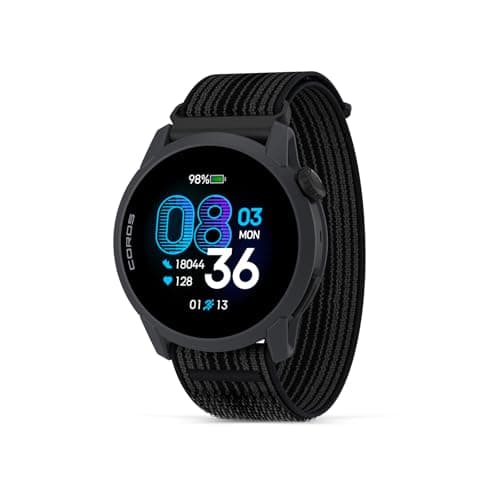
Long days on a budgetCOROS PACE 4
41 stated GPS hours in a 32-gram watch, for a third of the Forerunner 970's money. The endurance-per-dollar winner by a distance.
Price as of October 22, 2026. Prices move; Amazon's is the one that counts.
#ad · we may earn a commission from this link to COROS PACE 4
The short answer
Buy the PACE 4 unless you specifically want a memory-in-pixel screen and a titanium bezel. It is 32 grams against the APEX 4's 51, states 41 hours of All-Systems GPS, and costs substantially less. The APEX 4 buys durability, sun readability and multi-week daily battery — not better data, because both run the same unvalidated COROS optical sensor.
Ranked
Quick picks
| # | Device | Best for | Evidence | Score | Price |
|---|---|---|---|---|---|
| 01 | COROS PACE 4 41 stated GPS hours in a 32-gram watch, for a third of the Forerunner 970's money. The endurance-per-dollar winner by a distance. | Long days on a budget | Independent measured test | 7.5/10 | $249.00Amazon |
| 02 | No image COROS APEX 4 (46mm) 41 days of daily battery and a MIP screen you can read in direct sun. The anti-AMOLED choice. | Multi-day efforts | Manufacturer specification | 7.3/10 | Check price → |
#ad· Live prices from the Amazon Product API, as of October 22, 2026. Where we have no verified live price we show none. Scores come from the published rubric at How we rank — the Evidence column shows what each ranking actually rests on, including where the answer is nothing.
The specification table
| Specification | COROS PACE 4 | COROS APEX 4 (46mm) |
|---|---|---|
| Display | 1.2" AMOLED touchscreen | 3rd-generation memory-in-pixel, sapphire glass |
| Weight (stated) | 32 g with nylon band, 40 g with silicone | 51 g with nylon band |
| Bezel | Polymer | Grade 5 titanium, reinforced lugs |
| Battery, daily use (stated) | 19 days | 41 days |
| Battery, GPS (stated) | 41 h All-Systems satellite mode | 65 h Endurance Satellite Mode |
| Positioning | All-Systems and dual-frequency modes | Dual-frequency tracking |
| Independent validation | None of either model. The one COROS test on record is of the PACE 3. | |
A note on that battery row, because it is the row people misread. COROS publishes 65 hours for the APEX 4 in Endurance Satellite Mode— a reduced-accuracy mode — and does not publish a dual-frequency figure on the product page we read. The PACE 4's 41 hours is an All-Systems figure. They are not the same mode, so we do not put them side by side as if they were, and we do not compute dollars per GPS hour for the APEX 4 at all.
The screen is the actual decision
AMOLED is brighter, sharper and better indoors. Memory-in-pixel gets morereadable as the light gets stronger, uses almost nothing to hold a static image, and looks flat and dull in a room. That single trade explains the entire rest of the table: the APEX 4's 41 stated days of daily use exist because its screen is not lighting itself.
If you run at dawn, at dusk or indoors, take the AMOLED. If you spend hours in open sun and resent charging, take the MIP. Nobody who has strong feelings about this ever changes their mind after buying the other one.
Weight, which matters more than the spec sheet suggests
32 grams against 51 is a 60% difference, and over a long day it is the specification you notice most. The PACE 4 is light enough to disappear on the wrist; the APEX 4 always feels like a watch. That is the price of a titanium bezel and sapphire glass, and if you actually hit rock, it is a price worth paying.
The evidence position is identical, and it is not good
Neither model has been independently validated. The only measured COROS heart-rate test we have found is an independent comparison of the previous-generation PACE 3, which recorded divergence during and after rapid intensity changes — exactly the intervals you would buy a training watch for — and whose author cautioned the dataset was limited. COROS states the current sensor is redesigned. Nobody has tested that claim.
So the sensible move on either watch is the same one: pair a strap for interval work. Both watches accept external sensors over Bluetooth, and doing that removes the one documented weakness in the range.
Who should buy which
- Road, track, treadmill, most runners. The PACE 4 — lighter, cheaper, and the strongest cost-per-GPS-hour figure on this site at $6.07.
- Rocky trails, long sun exposure, weeks between charges. The APEX 4.
- You want validated heart rate. Neither watch, on its own. Add a strap to whichever you buy.
What COROS publishes, and what it does not
COROS states 41 hours in All-Systems satellite mode and 19 days of daily use for the PACE 4, and 41 days of daily use plus 65 hours in Endurance Satellite Mode for the APEX 4. What is missing on the APEX 4 page we read is a dual-frequency GPS figure — the mode you would run if positioning accuracy is the reason you bought a dual-frequency watch.
That absence is why the cost-per-GPS-hour arithmetic on this site is computed for the PACE 4 and not for the APEX 4. We could produce a flattering number from the 65-hour endurance-mode figure in about four seconds; it would describe a mode you would not race in.
Weight, over a real long run
Thirty-two grams against fifty-one sounds trivial written down. It is the specification people report noticing most over four hours or more, and it is one of the few places where a light watch has a second-order benefit: a lighter watch moves less on the wrist, and optical heart-rate sensing depends on the sensor staying put against skin.
That is a mechanism argument rather than a measured one, and we flag it as such — no study we have read isolates watch mass as a variable in optical accuracy. What has been measured is placement, and it says the same thing louder: get the sensor somewhere stable, or get it off the wrist entirely.
In full
Every pick, and why
COROS PACE 4
41 stated GPS hours in a 32-gram watch, for a third of the Forerunner 970's money. The endurance-per-dollar winner by a distance.
- Display
- 1.2" AMOLED touchscreen
- Weight
- 32 g with nylon band, 40 g with silicone
- Satellite
- All-Systems and Dual-Frequency modes
- Battery (stated)
- 19 days daily use / 41 h GPS (All-Systems)
- Thickness
- 11.8 mm
What's good
- 41 manufacturer-stated GPS hours — more than the Forerunner 970 and the 570 combined
- 32 g is light enough that you stop noticing it, which matters more over 100 miles than any feature
- Dual-frequency positioning at an entry-level price
What isn't
- COROS wrist heart rate is the one area where an independent test has published a specific problem — see the evidence note
- Smaller third-party app ecosystem than Garmin's
Skip this if
Skip this if you train by heart rate off the wrist and will not wear a strap. The one independent test we found flagged COROS wrist HR during exactly the intervals you would be buying it for.
What the evidence says
Independent measured testThe5krunner's measured comparison found the previous-generation PACE 3's wrist heart rate diverged during and after rapid intensity changes. That test was of the PACE 3, not the PACE 4, and the author cautions the dataset was limited. COROS states the PACE 4 has a redesigned sensor; no independent test of the new sensor has been published that we could find.
Show how this 7.5 was calculated
| Factor | Weight | Score |
|---|---|---|
| EvidenceThe only independent measured evidence in the range is a limited-dataset test of the PREVIOUS model, and it was unfavorable. The redesigned sensor is unvalidated. | 30% | 4.5 |
| HardwareDual-frequency GNSS and a redesigned optical sensor, per the COROS spec page. | 20% | 8.0 |
| Metric coverageStrong training metrics; a narrower ecosystem than Garmin for third-party integrations. | 20% | 7.5 |
| Endurance41 stated GPS hours in All-Systems mode is the best in this roundup by a wide margin. | 15% | 10.0 |
| Cost per capabilityComfortably the strongest dollars-per-GPS-hour figure on the site. | 15% | 10.0 |
Price as of October 22, 2026. Prices move; Amazon's is the one that counts.
#ad · we may earn a commission from this link to COROS PACE 4
COROS APEX 4 (46mm)
41 days of daily battery and a MIP screen you can read in direct sun. The anti-AMOLED choice.
- Display
- 1.3" MIP (memory-in-pixel)
- Battery (stated)
- 41 days daily use
- Case
- 46mm
What's good
- MIP displays get MORE readable in bright sun, where AMOLED gets worse
- 41 stated days of daily use removes charging from the routine entirely
What isn't
- MIP looks dull indoors next to an AMOLED — this is a genuine aesthetic trade, not just a spec
- Same unvalidated-COROS-optical-sensor caveat as the PACE 4
Skip this if
Skip this if you mostly train indoors or at night. You would be taking the dull screen and giving up nothing for it.
What the evidence says
Manufacturer specificationPublished specifications only. The one independent COROS heart-rate test we found was of the PACE 3 and does not describe this device.
Show how this 7.3 was calculated
| Factor | Weight | Score |
|---|---|---|
| EvidenceNo validation of this model; the only independent COROS test on record is of a different watch and was unfavorable. | 30% | 4.5 |
| HardwareDual-frequency GNSS behind a MIP display. | 20% | 8.0 |
| Metric coverageFull COROS training platform. | 20% | 8.0 |
| Endurance41 stated days of daily use is the longest on this site. | 15% | 10.0 |
| Cost per capabilityStrong battery-per-dollar; mid-range sticker. | 15% | 8.5 |
We don't have a verified live price for this right now, so we aren't showing one.
#ad · we may earn a commission from this link to COROS APEX 4 (46mm)
How this ranking was built
Every score on this page comes from one published rubric, applied identically to every device on the site, with the weights written down and the inputs shown. We have not worn any of these devices and we never say we have. Read the method and check us.
Questions
Frequently asked
Is the COROS APEX 4 worth the extra money over the PACE 4?
Only for durability, sun readability and daily battery. It records the same data with the same sensor family, weighs 51 g against 32, and its headline 65-hour battery figure is an Endurance Satellite Mode number rather than a full-accuracy one. If you are not on rough ground for hours in bright light, the PACE 4 is the better buy.
Which COROS watch has the longer battery life?
The APEX 4, by a wide margin in daily use — 41 stated days against 19 — because its memory-in-pixel screen barely draws power to hold an image. For GPS the comparison is harder: COROS states 41 All-Systems hours for the PACE 4 and 65 Endurance Satellite hours for the APEX 4, and those are different modes.
Has COROS heart-rate accuracy been tested?
Once, independently, on the previous-generation PACE 3 — and it diverged during and after rapid intensity changes, on a dataset its author called limited. Neither the PACE 4 nor the APEX 4 has been tested. COROS says the sensor was redesigned; that is a manufacturer claim, and we label it as one.
Do both watches work with a chest strap?
Yes, over Bluetooth, and doing so is the single biggest accuracy upgrade available to either. The Polar H10 is the reference strap used as ground truth in published studies, which is exactly why we recommend it here.
Show your working
Sources
Every one of these was read in full before it was cited. Where we could not access a paper, we do not quote its numbers.
- [1]Manufacturer specification2026COROS — PACE 4 published specifications
Manufacturer-stated: 1.2" AMOLED, 32 g with nylon band, 11.8 mm thick, All-Systems and Dual-Frequency satellite modes, 41 GPS hours, 19 days of daily training and sleep.
- [2]Independent measured test2023the5krunner, measured heart-rate comparison of the COROS PACE 3
An independent measured test, not a peer-reviewed study, and the author explicitly cautions the dataset was limited. Compared against Garmin HRM-Pro Plus and Polar Verity Sense across easy runs, intervals and cycling. Found divergence during and after rapid intensity change. Tests the PACE 3, not the PACE 4.
- [3]Manufacturer specification2026COROS — PACE 3 published specifications
Manufacturer-stated: 1.2" transflective touchscreen with mineral glass, 42 × 42 × 11.7 mm, 29-30 g with the nylon band, GPS/QZSS/GLONASS/BeiDou with a dual-frequency GPS option, 38 hours of full GPS, 15 days of regular use, 5 ATM.
- [4]Peer-reviewed validation2025“Impact of Anatomical Placement on the Accuracy of Wearable Heart Rate Monitors During Rest and Various Exercise Intensities”, Sensors (Basel)
n = 28 (14 male, 14 female). Polar H10 chest strap as the reference. Compared Polar Verity Sense (forearm), Garmin Forerunner 55 (wrist) and three simultaneous Whoop 4.0 units at wrist, forearm and upper arm, across rest, cycling warm-up, burpees and a modified Bruce treadmill protocol.
Read next
Related
- COROS APEX 4 review
The MIP watch in full, with the battery modes named.
- COROS PACE 4 review
The cost-per-GPS-hour winner on this site.
- COROS PACE 3 vs PACE 4
The generation gap, and where the measured evidence actually sits.
- COROS PACE 4 vs PACE Pro
The third PACE 4 decision: the only one of the pair with global maps.
- COROS vs Garmin
The brand-level version of this decision.