GPS and multisport
Best running watches for women
No manufacturer builds a different sensor for women. What changes is case size, weight and fit — and fit is the thing that quietly decides your heart-rate data.
We earn a commission when you buy through our Amazon links, at no extra cost to you. It never decides a ranking — the rubric that does is published in full, so you can check us rather than take our word for it. How this works.
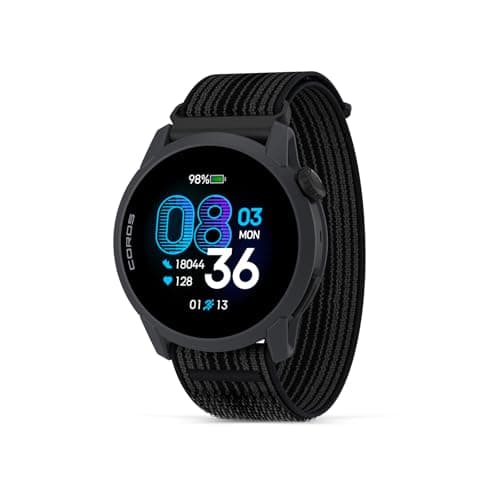
Top pick
Long days on a budgetCOROS PACE 4
41 stated GPS hours in a 32-gram watch, for a third of the Forerunner 970's money. The endurance-per-dollar winner by a distance.
Price as of October 22, 2026. Prices move; Amazon's is the one that counts.
#ad · we may earn a commission from this link to COROS PACE 4
The short answer
Buy the COROS PACE 4 if you want the lightest good training watch — 32 grams with the nylon band, and 41 stated GPS hours. If you want a smaller Garmin with the full feature set, the Forerunner 570 comes in 42mm, and Garmin publishes a separate battery table for it: 18 hours GPS-only, 13 hours All + Multi-Band, 10 smartwatch days.
Ranked
Quick picks
| # | Device | Best for | Evidence | Score | Price |
|---|---|---|---|---|---|
| 01 | COROS PACE 4 41 stated GPS hours in a 32-gram watch, for a third of the Forerunner 970's money. The endurance-per-dollar winner by a distance. | Long days on a budget | Independent measured test | 7.5/10 | $249.00Amazon |
| 02 | 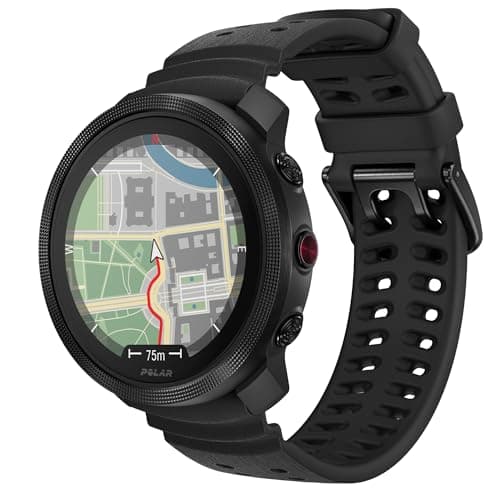 Polar Vantage M3 The pick when positioning accuracy is the thing you actually care about — Polar was the one brand under 5% error in the eight-watch validation study. | Runners who want the best-validated GPS | Peer-reviewed validation | 7.5/10 | $449.18Amazon |
| 03 | 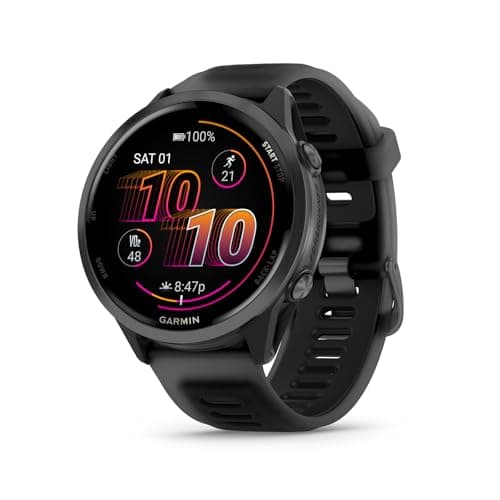 Garmin Forerunner 570 Same sensor family as the 970, $200 less, and no maps. For most runners that is the correct trade. | Most runners, most of the time | Manufacturer specification | 7.3/10 | $546.00Amazon |
| 04 | 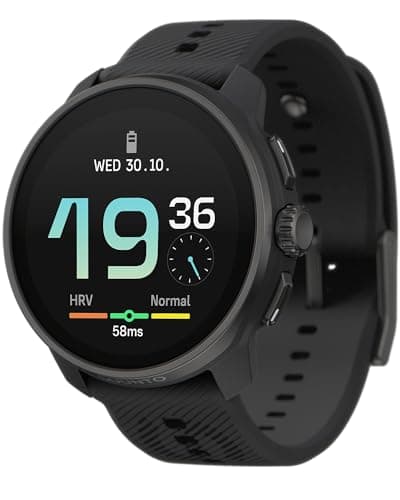 Suunto Race S A big AMOLED and dual-frequency positioning at a price that undercuts the mid-range Garmins. | Value AMOLED multi-sport | No validation study exists | 6.5/10 | $299.00Amazon |
| 05 | 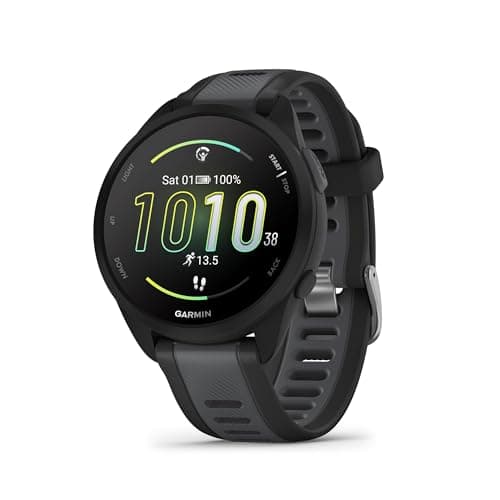 Garmin Forerunner 165 The cheapest way into a genuinely good AMOLED Garmin, provided you accept single-band positioning. | First real running watch | Manufacturer specification | 6.4/10 | $196.29Amazon |
#ad· Live prices from the Amazon Product API, as of October 22, 2026. Where we have no verified live price we show none. Scores come from the published rubric at How we rank — the Evidence column shows what each ranking actually rests on, including where the answer is nothing.
Let us be clear about what this list is
No manufacturer on this site builds a women's sensor. The optical hardware, the receiver, the firmware and the training models are identical across the range; what changes with a "women's" label is usually the band and the color. Any list that implies otherwise is selling you something that does not exist.
What genuinely differs, and what this page ranks on, is case size, weight and fit — and those are not cosmetic. An optical heart-rate sensor reads light bounced off tissue, so it needs consistent skin contact. A watch too heavy or too wide for the wrist it is on slides, rocks and lifts, and every one of those produces bad data before the sensor has done anything wrong.
The specifications that actually matter here
| Watch | Size / weight, as published | Stated battery |
|---|---|---|
| COROS PACE 4 | 32 g with nylon band, 40 g with silicone; 11.8 mm thick | 41 h All-Systems GPS, 19 days daily |
| Garmin Forerunner 570 | 42 mm or 47 mm, same features in both | 42 mm: 18 h GPS-only, 13 h All + Multi-Band, 10 days daily |
| Suunto Race S | Smaller case than the Race 2, per Suunto | 30 h training with GPS, 9 days daily with heart rate on |
| Polar Vantage M3 | Polar's specification pages were offline for maintenance when we checked, so we quote no dimensions | Not quoted for the same reason |
| Garmin Forerunner 165 | Garmin's lightest current AMOLED Forerunner | Solid for the class, per Garmin's stated figures |
Two of those rows are blank on purpose. We do not estimate a case diameter, and a manufacturer page that will not load is a gap in our record rather than an invitation to guess.
The 42mm Forerunner is the most useful fact on this page
Garmin sells the Forerunner 570 in 42mm with exactly the same features as the 47mm, and publishes a separate battery table for it: 18 hours GPS-only, 14 hours Auto Select, 13 hours All + Multi-Band and 10 days in smartwatch mode. The larger case buys one extra hour in multi-band and one extra smartwatch day. That is the entire penalty for choosing the small watch.
The same applies further down the range: Garmin's 42mm Forerunner 265S actually states longer battery than the 46mm 265 in every mode — 15 hours All + Multi-Band against 14. Small does not mean compromised in this category, and it is worth knowing that before being steered toward a 47mm case you do not want.
What the studies say about women specifically
Very little, and that itself is worth publishing. Most consumer-wearable validations report mixed samples without breaking results down by sex. The exception among the papers we cite is the 2025 placement study, which deliberately balanced its sample at 14 women and 14 men and ran three identical sensors at wrist, forearm and upper arm simultaneously.
Its finding applies to everyone: proximal placements beat the wrist at every intensity, and during burpees every optical device fell below 0.50 concordance, with a wrist-worn Garmin showing a bias of roughly 33 bpm. If your heart-rate data looks wrong on intervals, the answer is not a smaller watch — it is moving the sensor off your wrist.
Practical fit advice that costs nothing
- Wear it a finger's width above the wrist bone, tighter for workouts than for daily wear. Manufacturers publish this and almost nobody does it.
- Choose the nylon or fabric band if the silicone one leaves the watch sliding. The COROS PACE 4 is 8 grams lighter on nylon, and lighter watches move less.
- Check the lug width before buying a replacement band — it varies by model, and a band that does not fit is the most common reason a watch ends up in a drawer.
One thing a watch cannot fix, whatever its case size: wrist optical heart rate is the weakest measurement in the whole chain. If accurate heart rate is what you are actually after, the sensor question — including the strap sizes Polar publishes and the bra-band specification Garmin publishes — is at best heart rate monitors for women.
In full
Every pick, and why
COROS PACE 4
41 stated GPS hours in a 32-gram watch, for a third of the Forerunner 970's money. The endurance-per-dollar winner by a distance.
- Display
- 1.2" AMOLED touchscreen
- Weight
- 32 g with nylon band, 40 g with silicone
- Satellite
- All-Systems and Dual-Frequency modes
- Battery (stated)
- 19 days daily use / 41 h GPS (All-Systems)
- Thickness
- 11.8 mm
What's good
- 41 manufacturer-stated GPS hours — more than the Forerunner 970 and the 570 combined
- 32 g is light enough that you stop noticing it, which matters more over 100 miles than any feature
- Dual-frequency positioning at an entry-level price
What isn't
- COROS wrist heart rate is the one area where an independent test has published a specific problem — see the evidence note
- Smaller third-party app ecosystem than Garmin's
Skip this if
Skip this if you train by heart rate off the wrist and will not wear a strap. The one independent test we found flagged COROS wrist HR during exactly the intervals you would be buying it for.
What the evidence says
Independent measured testThe5krunner's measured comparison found the previous-generation PACE 3's wrist heart rate diverged during and after rapid intensity changes. That test was of the PACE 3, not the PACE 4, and the author cautions the dataset was limited. COROS states the PACE 4 has a redesigned sensor; no independent test of the new sensor has been published that we could find.
Show how this 7.5 was calculated
| Factor | Weight | Score |
|---|---|---|
| EvidenceThe only independent measured evidence in the range is a limited-dataset test of the PREVIOUS model, and it was unfavorable. The redesigned sensor is unvalidated. | 30% | 4.5 |
| HardwareDual-frequency GNSS and a redesigned optical sensor, per the COROS spec page. | 20% | 8.0 |
| Metric coverageStrong training metrics; a narrower ecosystem than Garmin for third-party integrations. | 20% | 7.5 |
| Endurance41 stated GPS hours in All-Systems mode is the best in this roundup by a wide margin. | 15% | 10.0 |
| Cost per capabilityComfortably the strongest dollars-per-GPS-hour figure on the site. | 15% | 10.0 |
Price as of October 22, 2026. Prices move; Amazon's is the one that counts.
#ad · we may earn a commission from this link to COROS PACE 4
Polar Vantage M3
The pick when positioning accuracy is the thing you actually care about — Polar was the one brand under 5% error in the eight-watch validation study.
- Display
- AMOLED
- Satellite
- Dual-frequency GNSS
- Extras
- Turn-by-turn navigation, offline maps
What's good
- Polar is the only brand that came in under 5% distance error across all conditions in the JMIR eight-watch study
- Dual-frequency positioning plus offline maps at a mid-range price
What isn't
- The validation that flatters Polar is from 2020 and tested older models — it is evidence about the brand's GNSS engineering, not a measurement of this watch
- Smaller ecosystem than Garmin
Skip this if
Skip this if you are deep in Garmin's ecosystem already. Nothing here is enough better to justify rebuilding your training history somewhere else.
What the evidence says
Peer-reviewed validationThe peer-reviewed evidence is brand-level and dated: Gilgen-Ammann et al. (2020) measured eight watches against a trundle wheel and found only Polar's receivers stayed under 5% error. That study tested the Vantage M, Vantage V and V800 — not the M3.
Show how this 7.5 was calculated
| Factor | Weight | Score |
|---|---|---|
| EvidenceThe only brand in this roundup with a favorable peer-reviewed positioning result — but the study is from 2020 and tested earlier models, so it is dated brand evidence, not a measurement of this watch. | 30% | 7.0 |
| HardwareDual-frequency GNSS with offline maps. | 20% | 8.5 |
| Metric coverageStrong training-load and recovery platform; good sensor support. | 20% | 8.0 |
| EnduranceCompetitive for an AMOLED multi-sport watch, per Polar's stated figures. | 15% | 7.0 |
| Cost per capabilityMid-range pricing for dual-frequency plus maps. | 15% | 7.0 |
$499.9910% off
Price as of October 22, 2026. Prices move; Amazon's is the one that counts.
#ad · we may earn a commission from this link to Polar Vantage M3
Garmin Forerunner 570
Same sensor family as the 970, $200 less, and no maps. For most runners that is the correct trade.
- Case
- 42mm or 47mm, AMOLED
- Satellite
- Multi-band GNSS
- Battery (stated)
- 11 days smartwatch / 18 h GPS (47mm)
- Maps
- None
- Extras
- Speaker and microphone, on-watch music
What's good
- Records the same core metrics as the 970 — the data you get back is not a cut-down version
- Two case sizes, which the 970 does not offer
- Multi-band GNSS at a mid-range price
What isn't
- 18 stated GPS hours is thin for ultra distances
- No maps, so navigation is breadcrumb-only
Skip this if
Skip this if you race beyond about 12 hours or navigate unfamiliar trails. The battery and the missing maps are both real limits, and neither is fixable in software.
What the evidence says
Manufacturer specificationAs with the 970, no independent validation of this model's optical heart rate has been published that we could find.
Show how this 7.3 was calculated
| Factor | Weight | Score |
|---|---|---|
| EvidenceDetailed published specs, no independent measured validation of this model. | 30% | 5.5 |
| HardwareMulti-band GNSS and the same current-generation optical sensor family as the 970. | 20% | 9.0 |
| Metric coverageEverything the 970 records except maps and the ECG app. | 20% | 8.5 |
| EnduranceGarmin states 18 hours GPS, 11 days smartwatch, on the 47mm case. | 15% | 6.0 |
| Cost per capabilityMaterially cheaper than the 970 for the same recorded data. | 15% | 8.0 |
Price as of October 22, 2026. Prices move; Amazon's is the one that counts.
#ad · we may earn a commission from this link to Garmin Forerunner 570
Suunto Race S
A big AMOLED and dual-frequency positioning at a price that undercuts the mid-range Garmins.
- Display
- 1.32" AMOLED
- Sport modes
- 95+
- Satellite
- Dual-frequency GNSS
What's good
- Dual-frequency positioning well below the price the same feature costs at Garmin
- Large, bright AMOLED for the money
What isn't
- No independent validation of its heart rate or positioning that we could find
- Smallest third-party ecosystem of the brands here
Skip this if
Skip this if you want structured workouts pushed from a coaching platform. Suunto's integrations are the thinnest in this group.
What the evidence says
No validation study existsNo independent validation study exists for this device that we could find as of July 2026. It is ranked on published hardware specification and price alone, and that is why it does not place higher.
Show how this 6.5 was calculated
| Factor | Weight | Score |
|---|---|---|
| EvidenceNo validation of any kind that we could find. Under our evidence hierarchy this caps how high it can rank, regardless of its hardware. | 30% | 3.0 |
| HardwareDual-frequency GNSS and a large AMOLED, per Suunto's spec page. | 20% | 8.0 |
| Metric coverage95+ sport modes; a lighter analytics platform than Garmin or Polar. | 20% | 7.5 |
| EnduranceStrong stated battery for an AMOLED watch at this size. | 15% | 7.5 |
| Cost per capabilityThe cheapest dual-frequency AMOLED watch in this roundup. | 15% | 9.0 |
$349.0014% off
Price as of October 22, 2026. Prices move; Amazon's is the one that counts.
#ad · we may earn a commission from this link to Suunto Race S
Garmin Forerunner 165
The cheapest way into a genuinely good AMOLED Garmin, provided you accept single-band positioning.
- Display
- AMOLED
- Satellite
- Single-band GNSS
- Extras
- Training metrics, sleep tracking, music on the Music edition
What's good
- AMOLED and Garmin's training platform at the bottom of the range
- Light, simple, and hard to get wrong as a first watch
What isn't
- Single-band positioning, which is the specification that actually degrades in cities and under tree cover
- No multi-band means it is the wrong upgrade if GPS drift is your complaint
Skip this if
Skip this if you are here because your GPS track wanders between buildings. Single-band is the hardware that causes that, and this watch has it.
What the evidence says
Manufacturer specificationPublished specifications only; no independent validation of this model that we could find.
Show how this 6.4 was calculated
| Factor | Weight | Score |
|---|---|---|
| EvidencePublished specs, no independent measured validation. | 30% | 5.0 |
| HardwareSingle-band GNSS — a genuine step down from the multi-band models above it. | 20% | 6.0 |
| Metric coverageFull Garmin training platform; fewer advanced running-dynamics metrics. | 20% | 7.0 |
| EnduranceSolid for the class, per Garmin's stated figures. | 15% | 7.0 |
| Cost per capabilityLowest entry price to the Garmin ecosystem with an AMOLED screen. | 15% | 8.5 |
$249.9921% off
Price as of October 22, 2026. Prices move; Amazon's is the one that counts.
#ad · we may earn a commission from this link to Garmin Forerunner 165
How this ranking was built
Every score on this page comes from one published rubric, applied identically to every device on the site, with the weights written down and the inputs shown. We have not worn any of these devices and we never say we have. Read the method and check us.
Questions
Frequently asked
Are there running watches designed specifically for women?
Not in any way that changes the data. The sensors, receivers and training models are identical across a manufacturer's range; what differs is case size, band and color. Buy on fit and specification, and treat "for women" labeling as marketing.
What is the best small running watch?
For weight, the COROS PACE 4 at a stated 32 grams with its nylon band. For a small case with the full feature set, the 42mm Garmin Forerunner 570, which gives up only one stated hour of multi-band recording against the 47mm version.
Does watch size affect heart-rate accuracy?
Fit does, and size drives fit. Optical sensors need consistent skin contact; a watch that slides or rocks produces bad readings regardless of its specification. The published evidence goes further — sensors worn on the forearm or upper arm outperformed wrist-worn ones at every intensity in a 2025 study of 28 people.
Do the accuracy studies include women?
Rarely broken out. The clearest exception among the papers we cite is the 2025 placement study, which balanced its sample at 14 women and 14 men. Most validations report mixed samples without sex-specific results, so anyone claiming a device is "more accurate for women" is going beyond the published record.
Show your working
Sources
Every one of these was read in full before it was cited. Where we could not access a paper, we do not quote its numbers.
- [1]Peer-reviewed validation2025“Impact of Anatomical Placement on the Accuracy of Wearable Heart Rate Monitors During Rest and Various Exercise Intensities”, Sensors (Basel)
n = 28 (14 male, 14 female). Polar H10 chest strap as the reference. Compared Polar Verity Sense (forearm), Garmin Forerunner 55 (wrist) and three simultaneous Whoop 4.0 units at wrist, forearm and upper arm, across rest, cycling warm-up, burpees and a modified Bruce treadmill protocol.
- [2]Manufacturer specification2026Garmin — Forerunner 570 Series owner’s manual, specifications
Manufacturer-stated, read 2026-08-18: rechargeable lithium-ion battery, 5 ATM (swim) water rating, and up to 8 GB of media storage — a quarter of what the 970 carries, on a watch that records the same data.
- [3]Manufacturer specification2026Garmin — Forerunner 265 Series owner’s manual, battery life information and specifications
Manufacturer-stated, read 2026-08-18. Forerunner 265 (46 mm): up to 13 days smartwatch mode, 20 h GPS-only, 16 h Auto Select GPS, 14 h All + Multi-Band GPS, and 7 h GPS-only with music playback. Forerunner 265S (42 mm): 15 days, 24 h, 18 h, 15 h and 7.5 h for the same modes. The manual’s specification page states 5 ATM and up to 8 GB of media storage.
- [4]Manufacturer specification2026COROS — PACE 4 published specifications
Manufacturer-stated: 1.2" AMOLED, 32 g with nylon band, 11.8 mm thick, All-Systems and Dual-Frequency satellite modes, 41 GPS hours, 19 days of daily training and sleep.
- [5]Manufacturer specification2026Suunto — Race S published product specifications
Manufacturer-stated, read 2026-08-18: AMOLED touchscreen in a smaller case than the Race, up to 30 hours of training with continuous GPS tracking, up to 9 days of daily use with heart rate on and up to 13 days with it off, plus free offline maps. As with the Race 2 page, the full specification table loads dynamically and we quote only the published text figures.
Read next
Related
- Best heart rate monitors for women
The sensor version of this question, ranked on published fit figures.
- Best running watches
The unfiltered ranking, on the same rubric.
- Best chest strap monitors
The upgrade the placement evidence actually supports.
- COROS PACE 4 review
32 grams, and why that matters more than the spec sheet suggests.
- Wrist vs chest strap accuracy
The placement study in full, with every number.