Head to head
Suunto Race 2 vs Race S
The smaller watch gives up roughly half the battery. Everything else about this decision is wrist size and money.
We earn a commission when you buy through our Amazon links, at no extra cost to you. It never decides a ranking — the rubric that does is published in full, so you can check us rather than take our word for it. How this works.
Top pick
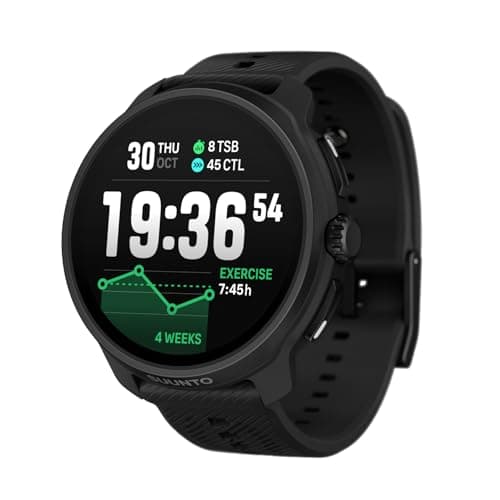
Big-screen multi-sport valueSuunto Race 2
A 1.5" AMOLED and 115+ sport modes, priced under most of the flagships it lines up against.
Price as of October 22, 2026. Prices move; Amazon's is the one that counts.
#ad · we may earn a commission from this link to Suunto Race 2
The short answer
Buy the Race S if the Race 2 is too big for your wrist or too much money; buy the Race 2 if you want the endurance. Suunto states up to 55 hours of training with continuous tracking at best GPS accuracy for the Race 2 against up to 30 for the Race S, and 18 daily days against 9. Neither watch has been independently validated, which caps how high either can rank here.
Ranked
Quick picks
| # | Device | Best for | Evidence | Score | Price |
|---|---|---|---|---|---|
| 01 | Suunto Race 2 A 1.5" AMOLED and 115+ sport modes, priced under most of the flagships it lines up against. | Big-screen multi-sport value | No validation study exists | 6.7/10 | $499.00Amazon |
| 02 | 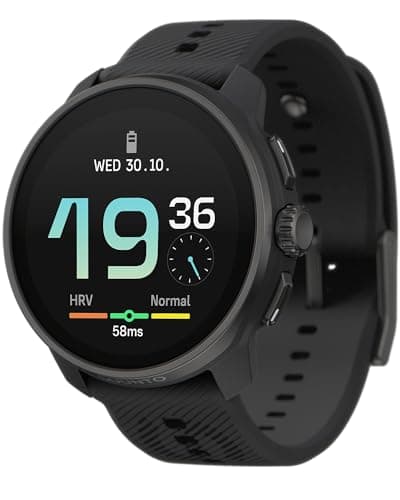 Suunto Race S A big AMOLED and dual-frequency positioning at a price that undercuts the mid-range Garmins. | Value AMOLED multi-sport | No validation study exists | 6.5/10 | $299.00Amazon |
#ad· Live prices from the Amazon Product API, as of October 22, 2026. Where we have no verified live price we show none. Scores come from the published rubric at How we rank — the Evidence column shows what each ranking actually rests on, including where the answer is nothing.
The specification table
The battery figures come from Suunto's own product pages, read on 18 August 2026. Both pages render their full specification tables dynamically, so we quote only the figures that appear as published text — and we name the mode on each, because Suunto's tour-mode numbers are several times larger than its best-accuracy ones and quoting the wrong one is how spec sheets mislead without lying.
| Specification | Suunto Race 2 | Suunto Race S |
|---|---|---|
| Display | 1.5" AMOLED | 1.32" AMOLED |
| Training, continuous tracking at best GPS accuracy (stated) | Up to 55 h | Up to 30 h |
| Tour mode, lower GPS accuracy (stated) | Up to 200 h | Published, lower accuracy — not quoted here |
| Daily use, heart rate on (stated) | Up to 18 days | Up to 9 days |
| Daily use, heart rate off (stated) | Up to 30 days | Up to 13 days |
| Positioning | Dual-frequency GNSS | Dual-frequency GNSS |
| Independent validation | None of either model that we could find | |
The size difference is the battery difference
A smaller case holds a smaller cell and lights a smaller screen. That is the whole story of this comparison: the Race S gives up roughly half the stated endurance in every mode Suunto publishes, and gains nothing but fit and price.
Whether that matters depends entirely on your longest day. Thirty stated hours at best accuracy covers a marathon several times over and covers most 100 km efforts; it does not comfortably cover a 100-mile finish or a multi-day trip. If your longest session is under six hours, the Race S loses you nothing you will ever notice.
The evidence position, which is the same for both
Neither watch has been independently validated for heart rate or positioning that we could find, so on our evidence hierarchy both are capped — they rank on published specification and price, and they sit below devices with measured records even where their hardware reads better on paper.
The one piece of Suunto evidence in the published literature is old and brand-level: the 2020 eight-watch distance validation included a Suunto 9 Baro, measured against a trundle wheel accurate to 1 cm, and found 3.2-6.1% error across the eight watches with only Polar under 5% in all conditions. That study predates dual-frequency receivers entirely. It tells you something about Suunto's engineering history and nothing about either of these watches.
What you give up against Garmin at this price
Analytics and ecosystem, mostly. Suunto's training-load and recovery models are the least documented of the brands we cover, and third-party integration is thinner. What you gain is a large AMOLED and dual-frequency positioning for less money than the equivalent Garmin. Our Suunto versus Garmin comparison works through that trade at brand level.
Who should buy which
- Long days, ultras, multi-day trips. The Race 2 — 55 stated hours at best accuracy is genuinely flagship endurance.
- Smaller wrist, shorter sessions, tighter budget. The Race S, without regret.
- You want a measured device. Neither, on the current record. The Polar Vantage M3 is the watch in this price class with published positioning evidence behind its brand.
Sizing the battery to your longest day
- Marathon or half. Either watch, with days to spare. This decision is about fit and price, not endurance.
- A 12-hour mountain day.Both cover it on Suunto's stated figures — the Race S with 18 hours in hand, the Race 2 with 43.
- A 24-hour or 100-mile effort. Only the Race 2 finishes at best GPS accuracy. The Race S would need tour mode, which Suunto states explicitly reduces GPS accuracy, and reduced accuracy over 100 miles is exactly where distance error accumulates.
Daily wear splits the same way: 18 stated days against 9 with heart rate on, or 30 against 13 with it off. If you want a watch you charge monthly, that is the Race 2.
What Suunto includes that others charge for
Free offline maps, on both watches. Garmin reserves built-in mapping for its upper tiers, and the price step from a non-mapping Forerunner to a mapping one is the single largest in that range. Getting maps on the cheaper Suunto is a genuine value argument, and it is the one specification where these watches beat their price class outright.
How to sanity-check a watch nobody has measured
Since neither model has published validation, here is what you can actually do yourself:
- Run a known distance. Four laps of a standard 400 m track in lane one is 1,600 m. Do it twice, in the same satellite mode, and see how tightly the watch repeats.
- Pair a strap for one interval session and compare the two heart-rate traces. If the wrist trace lags the strap through the hard efforts, you have learned the most useful thing there is to know about your watch.
- Check the same route on separate days. Consistency is what a receiver gives you; agreement with the truth is what a validation would give you, and only one of those is available at home.
In full
Every pick, and why
Suunto Race 2
A 1.5" AMOLED and 115+ sport modes, priced under most of the flagships it lines up against.
- Display
- 1.5" AMOLED
- Sport modes
- 115+
- Satellite
- Dual-frequency GNSS
What's good
- The largest AMOLED in this roundup
- Undercuts the flagship tier substantially
What isn't
- No independent validation we could find
- Ecosystem and third-party support remain the weak point
Skip this if
Skip this if you need a proven training-load model. Suunto's analytics are the least documented of the brands here.
What the evidence says
No validation study existsNo independent validation study exists for this device that we could find as of July 2026.
Show how this 6.7 was calculated
| Factor | Weight | Score |
|---|---|---|
| EvidenceNo validation of any kind that we could find; capped accordingly. | 30% | 3.0 |
| HardwareDual-frequency GNSS with the biggest display here. | 20% | 8.5 |
| Metric coverage115+ modes, lighter analytics. | 20% | 8.0 |
| EnduranceStrong stated figures for the screen size. | 15% | 8.0 |
| Cost per capabilityWell under the flagship tier it competes with on specification. | 15% | 8.5 |
Price as of October 22, 2026. Prices move; Amazon's is the one that counts.
#ad · we may earn a commission from this link to Suunto Race 2
Suunto Race S
A big AMOLED and dual-frequency positioning at a price that undercuts the mid-range Garmins.
- Display
- 1.32" AMOLED
- Sport modes
- 95+
- Satellite
- Dual-frequency GNSS
What's good
- Dual-frequency positioning well below the price the same feature costs at Garmin
- Large, bright AMOLED for the money
What isn't
- No independent validation of its heart rate or positioning that we could find
- Smallest third-party ecosystem of the brands here
Skip this if
Skip this if you want structured workouts pushed from a coaching platform. Suunto's integrations are the thinnest in this group.
What the evidence says
No validation study existsNo independent validation study exists for this device that we could find as of July 2026. It is ranked on published hardware specification and price alone, and that is why it does not place higher.
Show how this 6.5 was calculated
| Factor | Weight | Score |
|---|---|---|
| EvidenceNo validation of any kind that we could find. Under our evidence hierarchy this caps how high it can rank, regardless of its hardware. | 30% | 3.0 |
| HardwareDual-frequency GNSS and a large AMOLED, per Suunto's spec page. | 20% | 8.0 |
| Metric coverage95+ sport modes; a lighter analytics platform than Garmin or Polar. | 20% | 7.5 |
| EnduranceStrong stated battery for an AMOLED watch at this size. | 15% | 7.5 |
| Cost per capabilityThe cheapest dual-frequency AMOLED watch in this roundup. | 15% | 9.0 |
$349.0014% off
Price as of October 22, 2026. Prices move; Amazon's is the one that counts.
#ad · we may earn a commission from this link to Suunto Race S
How this ranking was built
Every score on this page comes from one published rubric, applied identically to every device on the site, with the weights written down and the inputs shown. We have not worn any of these devices and we never say we have. Read the method and check us.
Questions
Frequently asked
How much battery does the Suunto Race S lose against the Race 2?
Roughly half, in every mode Suunto publishes: up to 30 hours of training at best GPS accuracy against 55, up to 9 daily days with heart rate on against 18, and up to 13 days with heart rate off against 30. The smaller case is the reason.
Is the Suunto Race S accurate?
Unknown, honestly. No independent validation of its heart rate or positioning has been published that we could find, so it is ranked here on specification and price alone — which is exactly why it does not place higher. Suunto's only appearance in the peer-reviewed literature is a 2020 study of a Suunto 9 Baro, a different watch from a pre-dual-frequency generation.
Do both Suunto watches have dual-frequency GPS?
Yes — dual-frequency positioning is the headline hardware feature on both, and it is the specification that most reliably improves tracks in cities and under tree cover. It is also the specification that costs the most battery, which is why Suunto publishes a separate, much longer tour-mode figure at reduced accuracy.
Which Suunto is better value?
The Race S, if your longest sessions are short — it is the cheaper watch with the same receiver class and the same screen technology. The Race 2 costs more per unit of capability but is the only one of the two with endurance in the flagship range. The current gap is $200.
Show your working
Sources
Every one of these was read in full before it was cited. Where we could not access a paper, we do not quote its numbers.
- [1]Manufacturer specification2026Suunto — Race 2 published product specifications
Manufacturer-stated, read 2026-08-18: 1.5-inch AMOLED, 115+ sport modes, up to 55 hours of training with continuous tracking at best GPS accuracy, up to 200 hours in tour mode at lower GPS accuracy, up to 18 days of daily use with heart rate on and up to 30 days with it off. Suunto renders part of its specification table dynamically, so we quote only the figures that appear as published text on the page.
- [2]Manufacturer specification2026Suunto — Race S published product specifications
Manufacturer-stated, read 2026-08-18: AMOLED touchscreen in a smaller case than the Race, up to 30 hours of training with continuous GPS tracking, up to 9 days of daily use with heart rate on and up to 13 days with it off, plus free offline maps. As with the Race 2 page, the full specification table loads dynamically and we quote only the published text figures.
- [3]Peer-reviewed validation2020Gilgen-Ammann, Schweizer & Wyss, “Accuracy of Distance Recordings in Eight Positioning-Enabled Sport Watches: Instrument Validation Study”, JMIR mHealth and uHealth
DOI 10.2196/17118. Eight watches (Apple Watch Series 4, Coros Apex 46mm, Garmin Fenix 5X Plus, Garmin Forerunner 935, Polar Vantage M, Polar Vantage V, Polar V800, Suunto 9 Baro) measured against a trundle wheel accurate to 1 cm, across urban, forest and 400 m track conditions. IMPORTANT: this predates the dual-frequency receivers now standard, so it describes brand engineering history, not any watch currently sold.
Read next
Related
- Suunto Race 2 review
The bigger watch, scored on the site rubric.
- Suunto Race S review
The small-wrist AMOLED, and what its evidence gap costs it.
- Suunto vs Garmin
The brand decision underneath this model decision.
- Best running watches
Where both Suuntos sit against the whole field.