GPS and multisport
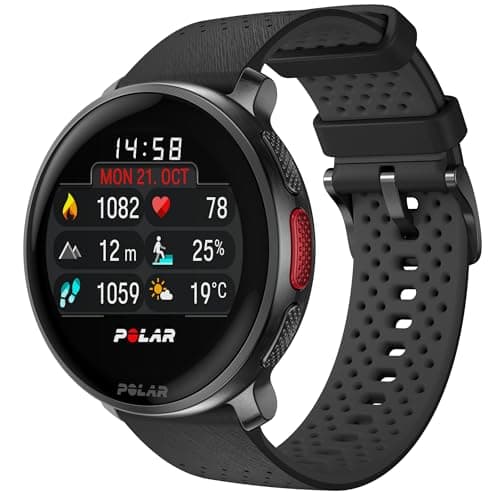
Polar Vantage V3
More sensors than anything else on this site, from the one brand with a favorable positioning study behind it — and the weakest measured HRV agreement in the newest research.
We earn a commission when you buy through our Amazon links, at no extra cost to you. It never decides a ranking — the rubric that does is published in full, so you can check us rather than take our word for it. How this works.
Top pick
Lab-style metrics on the wristPolar Vantage V3
Polar's flagship, and the most sensor-dense watch here — including an on-wrist ECG.
Price as of October 22, 2026. Prices move; Amazon's is the one that counts.
#ad · we may earn a commission from this link to Polar Vantage V3
The short answer
The Vantage V3 carries the widest raw sensor set of any watch we cover — dual-frequency GNSS, on-wrist ECG, skin temperature, offline maps. Polar is also the only brand with a favorable peer-reviewed positioning result, from 2020, on watches two generations old. Set against that: the newest study measured a Polar watch as the weakest of five for nocturnal HRV.
Ranked
Quick picks
| # | Device | Best for | Evidence | Score | Price |
|---|---|---|---|---|---|
| 01 | Polar Vantage V3 Polar's flagship, and the most sensor-dense watch here — including an on-wrist ECG. | Lab-style metrics on the wrist | Peer-reviewed validation | 7.5/10 | $679.90Amazon |
#ad· Live prices from the Amazon Product API, as of October 22, 2026. Where we have no verified live price we show none. Scores come from the published rubric at How we rank — the Evidence column shows what each ranking actually rests on, including where the answer is nothing.
More sensors is not more accuracy
This is the central thing to understand about the Vantage V3, and it applies to the whole "sensor count" arms race. The watch measures more things than anything else here. Whether it measures them well is a separate question, and for most of them nobody has checked.
More measurements from unvalidated sensors is more unverified data. That is not an argument against buying it — it is an argument against treating the sensor list as a proxy for data quality, which is exactly how this category is usually sold.
Polar's evidence, in both directions
Polar is unusual in having any peer-reviewed record at all, and by 2026 it has two, pointing different ways.
Positioning, favorable and dated. Gilgen-Ammann et al. (2020) measured eight watches against a trundle wheel accurate to 1 cm and found only Polar's receivers under 5% distance error across urban, forest and track conditions. It tested the Vantage M, Vantage V and V800 — not the V3, and all single-band. It is evidence about Polar's GNSS engineering culture, which is worth something and is not a measurement of this watch.
Nocturnal HRV, unfavorable and recent. Dial et al. (2025) ran five wearables simultaneously against a single-lead ECG across 536 nights. The Polar watch in that study — a Grit X Pro, sharing Polar's optical platform — recorded the weakest HRV agreement of the five (concordance 0.82, MAPE 16.32 ± 24.39%) and the weakest resting heart rate (0.86, MAPE 2.71%). For comparison, the Oura Ring 4 managed 0.99 and 5.96% on HRV in the same study.
The V3 was not the watch tested. But if you are buying a Polar flagship for its recovery platform, the only published measurement of a Polar watch's HRV came last of five, and you should know that before you spend.
The wrist ECG, and what it is not
The V3 has an on-wrist ECG, which is a genuinely different physical measurement from optical sensing and is the reason chest straps are accurate. It is worth being precise about the difference: the ECG here is a spot measurement you take deliberately, not the sensor that records your run. During training the watch reads optically at the wrist like everything else, with the same limitations the published literature describes.
So the ECG is a real feature and it is not a fix for interval heart rate. For that, the same company's H10 chest strap is the device researchers use as their reference standard — including in both studies cited above.
What we could not verify
- Any measurement of the V3 itself. Both Polar studies tested other models. Nothing has been published about this watch that we could find.
- Optical heart rate during exercise. No Polar watch appears in the 2025 placement study; the Polar device in it is the H10, used as the reference.
- The wrist ECG's clinical performance. Regulatory status is a manufacturer matter; we have not reviewed submission data and make no claim.
- Skin temperature and SpO2 accuracy. No validation of either on this device that we could find.
- Stated battery.Polar's figures under Polar's assumptions.
Who should not buy it
Anyone already inside Garmin's ecosystem. Nothing here is enough better to justify rebuilding a training history somewhere else, and the V3 is priced against the Forerunner 970 without matching its third-party integration depth.
Also anyone buying it for the recovery score specifically. That is the one thing about Polar's platform that has been measured recently, and the measurement was the weakest of the group.
In full
Every pick, and why
Polar Vantage V3
Polar's flagship, and the most sensor-dense watch here — including an on-wrist ECG.
- Display
- AMOLED
- Satellite
- Dual-frequency GNSS
- Extras
- On-wrist ECG, skin temperature, offline maps
What's good
- The widest raw sensor set of any watch in this roundup
- Inherits the brand-level positioning result from the JMIR study
What isn't
- Priced against the Forerunner 970 without matching its ecosystem
- Sensor breadth is not the same thing as validated accuracy, and Polar publishes no per-model validation either
Skip this if
Skip this if you will not actually use the extra sensors. More measurements you ignore is not more value.
What the evidence says
Peer-reviewed validationSame dated, brand-level positioning evidence as the Vantage M3: Gilgen-Ammann et al. (2020) found only Polar's receivers under 5% error, testing the Vantage M, Vantage V and V800 — not the V3.
Show how this 7.5 was calculated
| Factor | Weight | Score |
|---|---|---|
| EvidenceFavorable but dated and brand-level peer-reviewed positioning evidence; no validation of this specific model. | 30% | 6.5 |
| HardwareDual-frequency GNSS plus the densest sensor package here, including wrist ECG. | 20% | 9.0 |
| Metric coverageVery wide metric coverage with a strong recovery platform. | 20% | 9.0 |
| EnduranceGood stated endurance for a sensor-heavy AMOLED watch. | 15% | 7.5 |
| Cost per capabilityFlagship pricing without a flagship ecosystem. | 15% | 5.5 |
Price as of October 22, 2026. Prices move; Amazon's is the one that counts.
#ad · we may earn a commission from this link to Polar Vantage V3
Questions
Frequently asked
Is Polar's GPS more accurate than Garmin's?
The only peer-reviewed evidence says yes, and it is six years old. The 2020 eight-watch study found only Polar's receivers stayed under 5% distance error, testing the Vantage M, Vantage V and V800 against a trundle wheel. Every watch in that study was single-band; the dual-frequency receivers now standard did not exist. It is brand engineering history, not a current comparison.
How accurate is Polar's HRV?
The one published measurement is unflattering. Dial et al. (2025) measured a Polar Grit X Pro across 206 nights against an ECG reference and found the weakest HRV agreement of five devices — concordance 0.82, MAPE 16.32%. That was a different Polar watch from the V3, sharing the platform. Polar's own H10 chest strap was the study's reference standard.
Does the Vantage V3's wrist ECG replace a chest strap?
No. The wrist ECG is a spot measurement you take deliberately; during a workout the watch reads optically at the wrist like every other watch. If you want electrical measurement continuously through a session, that is what a chest strap does, and Polar makes the one researchers use as their reference.
Vantage V3 or Forerunner 970?
They score identically on our rubric within rounding — the V3 has more sensors, the 970 has the deeper ecosystem and better export path. Neither has been independently validated. Choose on which platform your training history and your friends are already in, because the data quality case does not separate them.
Show your working
Sources
Every one of these was read in full before it was cited. Where we could not access a paper, we do not quote its numbers.
- [1]Peer-reviewed validation2020Gilgen-Ammann, Schweizer & Wyss, “Accuracy of Distance Recordings in Eight Positioning-Enabled Sport Watches: Instrument Validation Study”, JMIR mHealth and uHealth
DOI 10.2196/17118. Eight watches (Apple Watch Series 4, Coros Apex 46mm, Garmin Fenix 5X Plus, Garmin Forerunner 935, Polar Vantage M, Polar Vantage V, Polar V800, Suunto 9 Baro) measured against a trundle wheel accurate to 1 cm, across urban, forest and 400 m track conditions. IMPORTANT: this predates the dual-frequency receivers now standard, so it describes brand engineering history, not any watch currently sold.
- [2]Peer-reviewed validation2025Dial, Hollander, Vatne, Emerson, Edwards & Hagen, “Validation of nocturnal resting heart rate and heart rate variability in consumer wearables”, Physiological Reports 13(16):e70527
DOI 10.14814/phy2.70527. n = 13 healthy adults (7 male, 6 female, 33.2 ± 8.6 years) across 536 nights, each wearing an Oura Gen 3, Oura Gen 4, Polar Grit X Pro, Garmin fēnix 6 and Whoop 4.0 simultaneously against a Polar H10 single-lead ECG reference sampled at 1000 Hz. Authors’ stated limits: healthy adults only, no atrial-fibrillation population, proprietary and periodically-updated algorithms, and unequal night counts per device. The Garmin was dropped from the resting-heart-rate comparison because the 30-minute window it uses is not timestamped.
- [3]Peer-reviewed validation2025“Impact of Anatomical Placement on the Accuracy of Wearable Heart Rate Monitors During Rest and Various Exercise Intensities”, Sensors (Basel)
n = 28 (14 male, 14 female). Polar H10 chest strap as the reference. Compared Polar Verity Sense (forearm), Garmin Forerunner 55 (wrist) and three simultaneous Whoop 4.0 units at wrist, forearm and upper arm, across rest, cycling warm-up, burpees and a modified Bruce treadmill protocol.
- [4]Manufacturer specification2026Polar — H10 heart rate sensor published specifications
Manufacturer-stated: electrical (ECG) measurement, Bluetooth LE + ANT+, internal memory for one session up to 30 hours, up to 400 h on a CR2025 coin cell, WR30.
Read next
Related
- Polar Grit X2 Pro review
The bigger Polar, with the longest raw endurance figure we carry.
- Polar vs Garmin
Resolved tier by tier, including the strap tier Polar wins outright.
- Best multisport watches
Where the V3 places against four rivals.
- HRV accuracy by device
The 536-night study, device by device.
- Polar Vantage M3
The value Polar, and whether the flagship sensors are worth the gap.