GPS and multisport
Polar Grit X2 Pro
The one brand with a favorable peer-reviewed GPS result also owns the weakest measured HRV agreement. Both papers are about predecessors.
We earn a commission when you buy through our Amazon links, at no extra cost to you. It never decides a ranking — the rubric that does is published in full, so you can check us rather than take our word for it. How this works.
Top pick
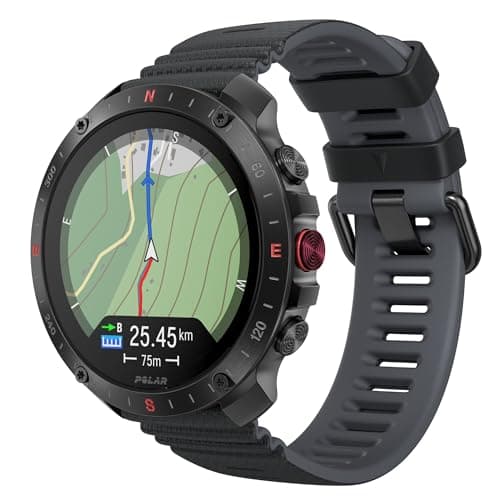
Trail navigation with a full sensor setPolar Grit X2 Pro
Sapphire, steel, offline maps and 43 stated training hours — and the one Polar watch family that has been measured for nocturnal HRV came last of five.
$999.9930% off
Price as of October 22, 2026. Prices move; Amazon's is the one that counts.
#ad · we may earn a commission from this link to Polar Grit X2 Pro
The short answer
A sapphire-and-steel outdoor watch with offline maps preinstalled and 43 stated hours of training with GPS. Two peer-reviewed results touch it and they disagree: Polar was the only brand under 5% distance error in an eight-watch validation, while its predecessor recorded the weakest HRV agreement of five devices against an ECG reference. Neither study tested this watch.
Ranked
Quick picks
| # | Device | Best for | Evidence | Score | Price |
|---|---|---|---|---|---|
| 01 | Polar Grit X2 Pro Sapphire, steel, offline maps and 43 stated training hours — and the one Polar watch family that has been measured for nocturnal HRV came last of five. | Trail navigation with a full sensor set | Peer-reviewed validation | 7.4/10 | $699.93Amazon |
#ad· Live prices from the Amazon Product API, as of October 22, 2026. Where we have no verified live price we show none. Scores come from the published rubric at How we rank — the Evidence column shows what each ranking actually rests on, including where the answer is nothing.
What Polar publishes
From Polar's own specification page: a 1.39-inch AMOLED at 454 × 454 behind sapphire glass, a stainless steel case, dual-frequency GPS plus GLONASS, Galileo, BeiDou and QZSS, 43 hours in training mode with GPS, 10 days in smartwatch mode, WR100, and on-wrist ECG, skin temperature and SpO2 sensors. Offline maps come preinstalled for North America and Europe rather than downloaded per region — a small thing that is genuinely better than the Garmin equivalent.
Forty-three stated training hours behind an AMOLED screen is flagship endurance. It is the specification that makes this watch a real alternative to a fēnix rather than a cheaper imitation of one.
The two papers, and why they point opposite ways
In Polar's favor. The best peer-reviewed distance validation we have read tested eight watches against a trundle wheel accurate to 1 cm across urban, forest and track conditions. Error ran 3.2-6.1%, and Polar was the only brand under 5% in all conditions. That study is from 2020 and predates dual-frequency receivers entirely, so it describes engineering history rather than any watch on sale today.
Against it.In a 2025 study, five wearables were worn simultaneously against a single-lead ECG across 536 nights. The Polar Grit X Pro — this watch's direct predecessor — recorded the weakest HRV agreement of the five, at 16.32% mean absolute percentage error against Oura Gen 4's 5.96%, and the weakest resting heart rate agreement too.
Averaging those two honestly is how this watch lands mid-pack on evidence rather than at the top or the bottom. Both findings are about predecessors, and we say so on the product card rather than choosing the flattering one.
Who it is actually for
People who spend long days outside and want maps, materials and a full sensor set from a brand that is not Garmin. On specification it delivers exactly that. It is also the most durable pairing on this site — sapphire over stainless steel — which matters if your watch meets rock.
The people it is notfor are the ones buying it for the recovery score. Polar's Nightly Recharge and its ecosystem lean heavily on nocturnal HRV, and that is the exact measurement where the only published Polar result came last. If recovery data is the purchase reason, our HRV monitor roundup ranks devices by measured error, and this watch is not at the top of it.
The arithmetic
At $16.28 per stated training hour it is priced against the fēnix tier, and it carries a smaller third-party ecosystem than Garmin does. That is the trade: better materials and preinstalled maps against fewer integrations and a mixed evidence record.
What Polar's platform actually gives you
Polar leans harder on physiology than any other brand here: Nightly Recharge, training load models built around heart-rate variability, and guided testing protocols you run yourself. The sensor set on this watch is the widest Polar sells — on-wrist ECG, skin temperature and SpO2 alongside the optical sensor.
None of those models has been independently validated, and that is not a Polar-specific criticism: no manufacturer's training-load, readiness or recovery model has been validated by anyone, from any brand, in anything we have been able to read. What is Polar-specific is that the one nocturnal HRV measurement in the literature — of this watch's predecessor — came last of five devices.
Who it beats, and who beats it
- Beats the fēnix 8 on materials and map convenience. Sapphire over steel, and maps preinstalled for two continents rather than downloaded per region.
- Loses to the fēnix 8 on ecosystem.Third-party app support and integrations are Garmin's strongest asset and Polar's weakest.
- Loses to the Instinct 3 Solar on cost per capability. The Instinct records the same physiological data for roughly a third of the money, which is why it outranks both on our rubric.
In full
Every pick, and why
Polar Grit X2 Pro
Sapphire, steel, offline maps and 43 stated training hours — and the one Polar watch family that has been measured for nocturnal HRV came last of five.
- Display
- 1.39" AMOLED, 454 × 454, sapphire glass
- Case
- Stainless steel
- Satellite
- Dual-frequency GPS, plus GLONASS, Galileo, BeiDou, QZSS
- Battery (stated)
- 10 days smartwatch / 43 h training with GPS
- Extras
- On-wrist ECG, skin temperature, SpO2, offline maps
What's good
- 43 stated hours in training mode with GPS, which is flagship endurance in an AMOLED watch
- Offline maps preinstalled for North America and Europe, rather than downloaded per region
- Sapphire over stainless steel is the most durable material pairing in this roundup
What isn't
- The nocturnal HRV validation of its predecessor, the Grit X Pro, was the weakest of the five devices tested — MAPE 16.3% against an ECG reference
- Priced against the fēnix tier without Garmin's third-party ecosystem
Skip this if
Skip this if you bought it for the recovery score. The only published nocturnal HRV measurement of a Polar watch is of this watch's predecessor, and it finished last of five devices against an ECG reference. The chest strap from the same company is the reference standard; the watch is not.
What the evidence says
Peer-reviewed validationTwo peer-reviewed results touch this device, and they point opposite ways. Gilgen-Ammann et al. (2020) found only Polar's receivers stayed under 5% distance error across eight watches — dated, brand-level, and about earlier models. Dial et al. (2025) measured the Polar Grit X Pro, this watch's direct predecessor, over 206 nights against an ECG reference and recorded the weakest HRV agreement of five devices (CCC 0.82, MAPE 16.32 ± 24.39%) and the weakest resting heart rate (CCC 0.86). Neither study tested the X2 Pro itself.
Show how this 7.4 was calculated
| Factor | Weight | Score |
|---|---|---|
| EvidencePolar carries the only favorable peer-reviewed positioning result in the category and the weakest measured HRV agreement in the newest study. Both are about predecessors; averaging them honestly lands mid-pack. | 30% | 6.0 |
| HardwareDual-frequency GPS, sapphire over steel, plus ECG, skin temperature and SpO2 sensors. | 20% | 9.0 |
| Metric coverageOffline maps preinstalled, a very wide sensor set and Polar's recovery platform. | 20% | 9.0 |
| Endurance43 stated training hours with GPS and 10 smartwatch days behind an AMOLED screen. | 15% | 8.5 |
| Cost per capabilityFlagship pricing against a smaller ecosystem, and the HRV evidence does not support the premium. | 15% | 5.0 |
$999.9930% off
Price as of October 22, 2026. Prices move; Amazon's is the one that counts.
#ad · we may earn a commission from this link to Polar Grit X2 Pro
Questions
Frequently asked
Is Polar's GPS more accurate than Garmin's?
In the one peer-reviewed eight-watch comparison we have read, Polar was the only brand under 5% distance error across all conditions. That study is from 2020 and tested pre-dual-frequency watches, so it is evidence about brand engineering rather than about the Grit X2 Pro. No current-generation multi-band watch from any brand has been independently validated that we could find.
How accurate is the Grit X2 Pro for HRV?
Unmeasured — but its predecessor was, and it came last. Across 536 nights against a single-lead ECG, the Polar Grit X Pro recorded 16.32% mean absolute percentage error, the weakest of five devices. Polar has changed the platform since; nobody has re-measured it.
Does the Grit X2 Pro come with maps?
Yes, and preinstalled for North America and Europe rather than downloaded region by region. That is a genuine convenience advantage over the equivalent Garmin workflow, and it costs nothing extra.
Grit X2 Pro or Vantage V3?
The Grit X2 Pro for materials and battery — sapphire, steel and 43 stated training hours. The Vantage V3 for a lighter watch with the same sensor platform and the same analytics at a lower price. Neither changes the HRV evidence position, which is shared.
Show your working
Sources
Every one of these was read in full before it was cited. Where we could not access a paper, we do not quote its numbers.
- [1]Manufacturer specification2026Polar — Grit X2 Pro published specifications
Manufacturer-stated: 1.39" AMOLED at 454 × 454 behind sapphire glass, stainless steel case, dual-frequency GPS plus GLONASS, Galileo, BeiDou and QZSS, 43 hours in training mode with GPS, 10 days in smartwatch mode, WR100, on-wrist ECG, skin temperature and SpO2 sensors, offline maps preinstalled for North America and Europe.
- [2]Peer-reviewed validation2020Gilgen-Ammann, Schweizer & Wyss, “Accuracy of Distance Recordings in Eight Positioning-Enabled Sport Watches: Instrument Validation Study”, JMIR mHealth and uHealth
DOI 10.2196/17118. Eight watches (Apple Watch Series 4, Coros Apex 46mm, Garmin Fenix 5X Plus, Garmin Forerunner 935, Polar Vantage M, Polar Vantage V, Polar V800, Suunto 9 Baro) measured against a trundle wheel accurate to 1 cm, across urban, forest and 400 m track conditions. IMPORTANT: this predates the dual-frequency receivers now standard, so it describes brand engineering history, not any watch currently sold.
- [3]Peer-reviewed validation2025Dial, Hollander, Vatne, Emerson, Edwards & Hagen, “Validation of nocturnal resting heart rate and heart rate variability in consumer wearables”, Physiological Reports 13(16):e70527
DOI 10.14814/phy2.70527. n = 13 healthy adults (7 male, 6 female, 33.2 ± 8.6 years) across 536 nights, each wearing an Oura Gen 3, Oura Gen 4, Polar Grit X Pro, Garmin fēnix 6 and Whoop 4.0 simultaneously against a Polar H10 single-lead ECG reference sampled at 1000 Hz. Authors’ stated limits: healthy adults only, no atrial-fibrillation population, proprietary and periodically-updated algorithms, and unequal night counts per device. The Garmin was dropped from the resting-heart-rate comparison because the 30-minute window it uses is not timestamped.
Read next
Related
- Polar vs Garmin vs COROS
Where Polar stands against the two brands it is usually shortlisted with.
- Best trail GPS watches
Where this watch ranks against the fēnix and the Instinct.
- Polar Vantage V3 review
The lighter Polar flagship, same platform, lower price.
- Polar vs Garmin
The brand comparison, with both peer-reviewed results in one place.
- HRV accuracy by device
All five devices from the 536-night study, ranked by measured error.