Head to head
Garmin fēnix 8 vs Instinct 3 Solar
The expensive one has maps and an AMOLED screen. The cheap one has 28 stated days and better arithmetic on every line.
We earn a commission when you buy through our Amazon links, at no extra cost to you. It never decides a ranking — the rubric that does is published in full, so you can check us rather than take our word for it. How this works.
Top pick
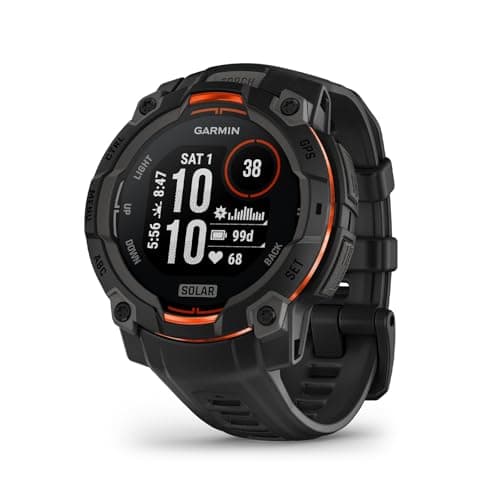
Multi-day trail and backcountry daysGarmin Instinct 3 Solar (45mm)
The watch that wins this site's rubric by publishing an honest battery table and then filling every row of it. No maps, and it still ranks first on trail.
$399.9915% off
Price as of October 22, 2026. Prices move; Amazon's is the one that counts.
#ad · we may earn a commission from this link to Garmin Instinct 3 Solar (45mm)
The short answer
Buy the Instinct 3 Solar unless you need maps. It records the same physiological data, states 28 smartwatch days against the fēnix 8's 16, and costs roughly a third as much — which is why it outscores the fēnix on our rubric despite worse hardware. The fēnix 8 buys cartography, an AMOLED screen, dive modes and a titanium build.
Ranked
Quick picks
| # | Device | Best for | Evidence | Score | Price |
|---|---|---|---|---|---|
| 01 | Garmin Instinct 3 Solar (45mm) The watch that wins this site's rubric by publishing an honest battery table and then filling every row of it. No maps, and it still ranks first on trail. | Multi-day trail and backcountry days | Manufacturer specification | 7.7/10 | $339.99Amazon |
| 02 | 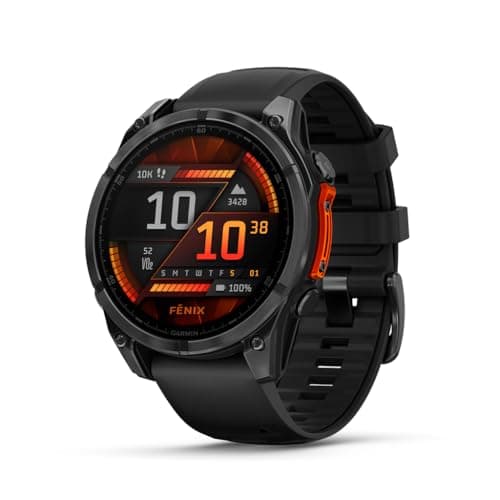 Garmin fēnix 8 (47mm) Everything Garmin makes, in a case built to survive being hit. You pay for the durability, not for better data. | Expedition and rough-terrain use | Manufacturer specification | 7.5/10 | $774.00Amazon |
#ad· Live prices from the Amazon Product API, as of October 22, 2026. Where we have no verified live price we show none. Scores come from the published rubric at How we rank — the Evidence column shows what each ranking actually rests on, including where the answer is nothing.
The specification table
Both battery columns are Garmin's own, with the mode named. The Instinct 3 figures exclude solar assistance, because Garmin's solar numbers assume all-day wear in 50,000 lux and we would rather quote the number you will actually get.
| Specification | Instinct 3 Solar (45mm) | fēnix 8 (47mm) |
|---|---|---|
| Display | Memory-in-pixel, monochrome | AMOLED, full color |
| Maps | None — breadcrumb navigation only | Preloaded TopoActive |
| Smartwatch mode (stated) | 28 days (unlimited with solar) | 16 days |
| GPS-only (stated) | 40 h (130 h with solar) | 47 h |
| All-satellite + multi-band (stated) | 24 h (40 h with solar) | 35 h |
| Water rating | 10 ATM | Dive-rated |
| Cost per stated multi-band hour | $14.17 | $22.11 |
What the fēnix 8 genuinely gives you
Maps, first and most importantly — real cartography with your route drawn on it, which is a different tool from a breadcrumb line when you need to leave the route rather than follow it. Then an AMOLED screen that is far easier to read at night, a dive rating, and 11 more stated hours in the accuracy satellite mode.
None of that is nothing. It is simply not data. Both watches carry the same generation of Garmin optical sensor, both compute the same training metrics from it, and neither has been independently validated.
Why the cheaper watch scores higher here
Our rubric weights cost per capability at 15% and evidence at 30%. The two watches tie on evidence — nothing published for either — so the deciding column is what you pay per unit of capability, and there the Instinct is not close to losing. It also wins the endurance column outright in daily wear: 28 stated days against 16, before any solar assistance.
The monochrome screen is the concession. It is dim indoors, it is not pretty, and it is the reason the watch lasts a month. If that trade sounds wrong to you, you already know which watch you are buying.
The upgrade nobody sells you
If the reason you are considering the fēnix is that your heart-rate data looks wrong on intervals, neither watch fixes it — both put the sensor in the same place, on the same wrist. The 2025 placement study found every wrist-worn optical device dropping below 0.50 concordance during burpees while proximal placements held, and a wrist-worn Garmin showed a bias of roughly 33 bpm at that intensity.
Buy the Instinct and a chest strap for less than the fēnix alone, and you will have better numbers than either watch produces on its own.
Who should buy which
- You navigate unfamiliar ground. The fēnix 8. Maps are the one thing the Instinct genuinely cannot do.
- You want a rugged watch that survives the week without a charger. The Instinct 3 Solar, comfortably.
- You care about the numbers being right. Either watch, plus a strap. That is the only upgrade on this page with published evidence behind it.
Screen technology is the trade underneath the price
The fēnix 8 has an AMOLED panel: bright, sharp, excellent at night, and it lights itself, which costs power continuously. The Instinct 3 has a memory-in-pixel display: it holds an image using almost nothing, and it gets more readable as sunlight gets stronger, while looking flat and dull indoors.
Everything else on the spec sheet follows from that choice. The Instinct's 28 stated smartwatch days exist because its screen is not lighting itself; the fēnix's 16 days exist because its screen is beautiful. Neither is wrong. They are different watches for different eyes.
Solar, and what Garmin's figures assume
Garmin publishes both a plain and a solar-assisted figure for the Instinct 3 Solar — 40 hours GPS-only becomes 130 with solar, 24 hours all-satellite multi-band becomes 40, and smartwatch mode becomes unlimited. Those solar numbers assume all-day wear in 50,000 lux conditions, which is bright open sky, not a winter commute or a forest trail.
We quote the non-solar figures throughout this site for that reason. Treat solar as a bonus that extends a good watch on bright days, not as the number to plan a race around.
In full
Every pick, and why
Garmin Instinct 3 Solar (45mm)
The watch that wins this site's rubric by publishing an honest battery table and then filling every row of it. No maps, and it still ranks first on trail.
- Battery, smartwatch (stated)
- 28 days, unlimited with solar
- Battery, GPS-only (stated)
- 40 h, up to 130 h with solar
- Battery, multi-band (stated)
- 24 h, up to 40 h with solar
- Battery, expedition (stated)
- 36 days, unlimited with solar
- Water rating
- 10 ATM
What's good
- Garmin publishes five separate GPS endurance figures for it, mode by mode — the most honest battery table of any watch on this site
- 24 stated hours in all-satellite multi-band mode, which is the mode you would actually run for accuracy
- Solar charging turns the smartwatch and expedition figures into 'unlimited' under Garmin's stated light conditions
What isn't
- No built-in maps at all, which on unfamiliar trail is the feature people miss first
- No independent validation of its heart rate or positioning that we could find
Skip this if
Skip this if you navigate unfamiliar routes rather than repeat known ones. Breadcrumb navigation on a trail you have never run is a genuinely worse experience than a map, and no amount of battery compensates for it.
What the evidence says
Manufacturer specificationNo independent validation of this device that we could find. What Garmin does publish is unusually complete: a five-row battery table naming each satellite mode separately, with the solar-assisted figures stated separately from the unassisted ones. We rank the unassisted multi-band row, because that is the number you can rely on in a forest.
Show how this 7.7 was calculated
| Factor | Weight | Score |
|---|---|---|
| EvidenceNo measured validation, but the published specification is more granular and more honest about its own assumptions than any other spec sheet here. | 30% | 5.5 |
| HardwareAll-satellite plus multi-band positioning, a solar charging lens and a 10 ATM case. | 20% | 8.5 |
| Metric coverageFull Garmin training and outdoor feature set, minus maps — which on trail is a real omission. | 20% | 7.5 |
| Endurance40 stated GPS-only hours, 24 in multi-band, 28 smartwatch days and 36 expedition days, before solar is counted at all. | 15% | 10.0 |
| Cost per capabilityFlagship endurance at roughly a third of flagship money. | 15% | 9.0 |
$399.9915% off
Price as of October 22, 2026. Prices move; Amazon's is the one that counts.
#ad · we may earn a commission from this link to Garmin Instinct 3 Solar (45mm)
Garmin fēnix 8 (47mm)
Everything Garmin makes, in a case built to survive being hit. You pay for the durability, not for better data.
- Case
- 47mm, AMOLED
- Satellite
- Multi-band GNSS
- Extras
- Built-in maps, dive-rated, speaker and microphone
What's good
- The most durable case Garmin puts a multi-band receiver into
- Maps, dive modes and the full metric set in one device
What isn't
- Records essentially the same physiological data as a Forerunner costing a third as much
- Heavy compared with a dedicated running watch
Skip this if
Skip this if you run on roads and pavements. You would be buying a case specification you will never test, and the numbers it records are the ones a Forerunner already gives you.
What the evidence says
Manufacturer specificationPublished specifications only; no independent validation of this model that we could find.
Show how this 7.5 was calculated
| Factor | Weight | Score |
|---|---|---|
| EvidenceDetailed published specs, no independent measured validation. | 30% | 5.5 |
| HardwareMulti-band GNSS in Garmin's most ruggedized current case. | 20% | 9.5 |
| Metric coverageThe widest metric and mode coverage of any device on this site. | 20% | 10.0 |
| EnduranceAmong the longest stated GPS endurance in Garmin's AMOLED line. | 15% | 8.5 |
| Cost per capabilityBy some distance the weakest cost-per-capability figure here — the premium buys the case, not the data. | 15% | 4.5 |
$999.9923% off
Price as of October 22, 2026. Prices move; Amazon's is the one that counts.
#ad · we may earn a commission from this link to Garmin fēnix 8 (47mm)
How this ranking was built
Every score on this page comes from one published rubric, applied identically to every device on the site, with the weights written down and the inputs shown. We have not worn any of these devices and we never say we have. Read the method and check us.
Questions
Frequently asked
Does the Instinct 3 have maps?
No. It follows a loaded route as a breadcrumb line with off-course alerts, and shows nothing beyond that line — no trails, roads or terrain. That is the single largest functional difference between it and the fēnix 8, and it is worth reading our honest test for whether you need maps before paying for them.
Is the fēnix 8 more accurate than the Instinct 3?
There is no published evidence that it is. Both use the same generation of Garmin optical sensor and both offer all-satellite multi-band positioning; neither has been independently validated that we could find. The fēnix 8 has a better screen and better materials, which are not accuracy.
Which lasts longer on a long day?
The fēnix 8, in the accuracy mode: 35 stated hours against 24. The Instinct wins daily wear by a distance — 28 stated days against 16 — and gains further with solar exposure, though Garmin's solar figures assume 50,000 lux all day, which is a bright-sky assumption rather than a measurement.
Is the Instinct 3 good enough for ultras?
For 24 hours in full multi-band, on Garmin's stated figures, yes. Beyond that you are relying on solar or dropping to GPS-only, where Garmin states 40 hours. Longer than that and the honest answer is a COROS APEX 4 or the 51mm fēnix 8 Pro.
Show your working
Sources
Every one of these was read in full before it was cited. Where we could not access a paper, we do not quote its numbers.
- [1]Manufacturer specification2026Garmin — Instinct 3 Solar owner’s manual, battery life information
Manufacturer-stated for the 45 mm Solar: 28 days smartwatch (unlimited with solar), 40 hours GPS-only (130 hours with solar), 28 hours all-satellite (50 with solar), 24 hours all-satellite plus multi-band (40 with solar), 36 days expedition GPS (unlimited with solar), 65 days battery-saver. Water rating 10 ATM per the same manual’s specification page. Solar figures assume all-day wear in 50,000 lux conditions, which is Garmin’s assumption and not a measurement of ours.
- [2]Manufacturer specification2026Garmin — fēnix 8 Series owner’s manual, battery information
Manufacturer-stated, read 2026-08-18. One table covers the fēnix 8 and the fēnix 8 Pro, which is why the two can be compared here without mixing sources. fēnix 8 AMOLED 47 mm: 16 days smartwatch with Gesture (7 with Always On Display), 47 h GPS-only (37 AOD), 35 h all satellite systems plus multi-band (28 AOD). fēnix 8 Pro 47 mm: 15 days (8 AOD), 44 h GPS-only (33 AOD), 30 h all systems plus multi-band (23 AOD). fēnix 8 Pro 51 mm: 27 days (15 AOD), 78 h GPS-only (56 AOD), 53 h all systems plus multi-band (41 AOD), and 21 h all systems plus multi-band with LTE LiveTrack (19 AOD).
- [3]Peer-reviewed validation2025“Impact of Anatomical Placement on the Accuracy of Wearable Heart Rate Monitors During Rest and Various Exercise Intensities”, Sensors (Basel)
n = 28 (14 male, 14 female). Polar H10 chest strap as the reference. Compared Polar Verity Sense (forearm), Garmin Forerunner 55 (wrist) and three simultaneous Whoop 4.0 units at wrist, forearm and upper arm, across rest, cycling warm-up, burpees and a modified Bruce treadmill protocol.
Read next
Related
- Garmin Instinct 3 Solar review
Why a monochrome watch ranks this high on the rubric.
- Garmin fēnix 8 review
The expensive half, scored the same way.
- fēnix 8 vs fēnix 8 Pro
What the satellite radio costs, in battery and in money.
- Best trail GPS watches
The roundup where both of these watches appear, ranked.