Straps, armbands and sensors
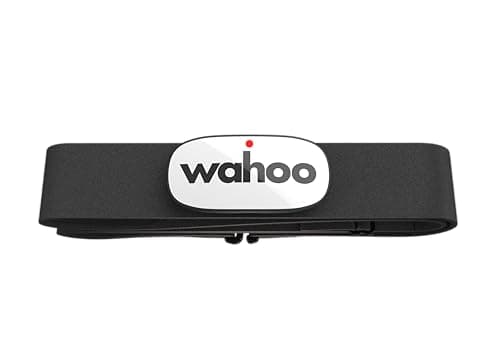
Wahoo TRACKR Heart Rate
The strap for people with too many devices: three Bluetooth connections at once, and a rechargeable cell instead of a coin.
We earn a commission when you buy through our Amazon links, at no extra cost to you. It never decides a ranking — the rubric that does is published in full, so you can check us rather than take our word for it. How this works.
Top pick
Wahoo and Zwift setupsWahoo TRACKR Heart Rate Monitor
A rechargeable electrical strap for people who resent coin cells.
Price as of October 22, 2026. Prices move; Amazon's is the one that counts.
#ad · we may earn a commission from this link to Wahoo TRACKR Heart Rate Monitor
The short answer
A rechargeable electrical chest strap rated by Wahoo at over 100 active hours, with ANT+ and up to three simultaneous Bluetooth connections and an IPX7 rating. The three-connection figure is its real advantage — watch, bike computer and Zwift at once. It has no published validation, and IPX7 is not a swimming rating.
Ranked
Quick picks
| # | Device | Best for | Evidence | Score | Price |
|---|---|---|---|---|---|
| 01 | Wahoo TRACKR Heart Rate Monitor A rechargeable electrical strap for people who resent coin cells. | Wahoo and Zwift setups | Manufacturer specification | 6.6/10 | $98.50Amazon |
#ad· Live prices from the Amazon Product API, as of October 22, 2026. Where we have no verified live price we show none. Scores come from the published rubric at How we rank — the Evidence column shows what each ranking actually rests on, including where the answer is nothing.
What Wahoo publishes
From Wahoo's own product page: a rechargeable lithium-ion battery with over 100 active hours, ANT+ plus up to three simultaneous Bluetooth connections, an IPX7 rating, and in-activity heart-rate capture with an activity summary in the Wahoo app.
Three Bluetooth connections is the feature
Most Bluetooth sensors hold one link at a time, which is why a strap paired to your phone disappears from your watch. If you ride indoors with a head unit and a training platform running simultaneously, or you want the watch and the bike computer to see the same signal without falling back to ANT+, this strap solves a real and irritating problem.
The alternative solution is ANT+, which broadcasts to unlimited receivers by design. The TRACKR supports that too. Our compatibility guide works through which platforms accept which protocol.
IPX7 is not a swim rating, and that matters
IPX7 describes immersion in shallow water for a short period. It is not the same claim as the WR30 rating on a Polar H10, and it is not a claim about swimming laps or ocean water. If you want a strap for the pool, that is a different specification and a different purchase — our swimming heart-rate roundup only lists devices whose makers publish a water rating that covers it.
Rechargeable versus coin cell
Over 100 active hours is around three months of daily hour-long sessions. A Polar H10 states up to 400 hours on a CR2025 that costs a couple of dollars. Rechargeable is tidier and produces no waste cells; coin cells never leave you flat mid-ride with no charger in the hotel room. There is no correct answer here, only a preference — but it is worth choosing deliberately rather than discovering it on a long weekend.
The evidence position
None. No independent validation of this strap exists that we could find. It uses electrical measurement, which is the right principle and the same one the reference-standard Polar H10 uses — but under our rubricthe right principle earns a good hardware score and cannot earn an evidence score. That is why it ranks where it does, priced near the H10 without the H10's record.
What an electrical strap is doing that a watch is not
A chest strap reads the electrical signal your heart generates — the same class of signal an ECG records — through two electrodes held against the skin. A watch infers rate optically, by shining light into tissue and interpreting what comes back through motion, sweat and changing blood flow.
That difference is why every study this site cites uses a chest strap as the reference and measures the optical devices against it, and why the placement study found every optical sensor collapsing below 0.50 concordance during burpees while the strap kept working. The TRACKR uses the right principle; what it lacks is anyone having checked its execution.
The charging discipline a rechargeable strap asks for
Over 100 active hours is roughly three months of hour-a-day training, or about six weeks if you train twice a day. That is a manageable cycle, provided you build the habit — a flat strap on race morning is a different kind of failure from a flat coin cell, because you cannot fix it in a supermarket.
Wahoo charges it over a magnetic USB-C cable, which is one more proprietary cable to lose. Our strap roundup lists the coin-cell alternatives if that is the trade you would rather not make.
Where it sits against the field
- Against the Polar H10: priced similarly, without the published record. The H10 also carries a WR30 rating and on-board recording of a session up to 30 hours.
- Against the Garmin HRM 600: cheaper, and without running dynamics. If you are not on Garmin, those metrics are not visible to you anyway.
- Against a cheap generic strap: three simultaneous Bluetooth connections and a published battery figure are real, checkable advantages.
In full
Every pick, and why
Wahoo TRACKR Heart Rate Monitor
A rechargeable electrical strap for people who resent coin cells.
- Sensor
- Electrical (ECG), chest strap
- Connectivity
- Bluetooth + ANT+
- Power
- Rechargeable
What's good
- Rechargeable rather than coin-cell
- Pairs cleanly with Wahoo head units and indoor platforms
What isn't
- No published validation we could find
- A rechargeable strap is one more thing to remember to charge — the H10's coin cell lasts 400 stated hours
Skip this if
Skip this if you train outdoors on long days. A flat rechargeable strap mid-ride is a problem a coin cell simply does not have.
What the evidence says
Manufacturer specificationPublished specifications only; no independent validation we could find.
Show how this 6.6 was calculated
| Factor | Weight | Score |
|---|---|---|
| EvidenceCorrect sensor principle, no measured validation we could find. | 30% | 5.5 |
| HardwareElectrical ECG chest strap with dual connectivity. | 20% | 8.5 |
| Metric coverageHeart rate; no additional metrics. | 20% | 6.0 |
| EnduranceRechargeable — convenient, but shorter between charges than a coin cell. | 15% | 6.5 |
| Cost per capabilityPriced near the H10 without its evidentiary record. | 15% | 7.0 |
Price as of October 22, 2026. Prices move; Amazon's is the one that counts.
#ad · we may earn a commission from this link to Wahoo TRACKR Heart Rate Monitor
Questions
Frequently asked
How long does the Wahoo TRACKR battery last?
Wahoo states over 100 active hours from a rechargeable lithium-ion battery, charged over a magnetic USB-C cable. That is roughly three months of hour-a-day training between charges.
Can the TRACKR connect to several devices at once?
Yes — Wahoo publishes support for up to three simultaneous Bluetooth connections, plus ANT+, which broadcasts to unlimited receivers. That combination is the strongest practical reason to choose it over a single-connection strap.
Can I swim with the Wahoo TRACKR?
Wahoo rates it IPX7, which covers short shallow immersion rather than swimming. Treat it as rain-and-sweat proof. For pool work, choose a strap whose maker publishes a swim rating.
Is the TRACKR as accurate as a Polar H10?
Unknown. Both are electrical chest straps, which is the measurement principle that works; only the H10 has a published record, and it is the sensor other devices are measured against. Buy the TRACKR for its connectivity, not for a claimed accuracy advantage that nobody has demonstrated.
Show your working
Sources
Every one of these was read in full before it was cited. Where we could not access a paper, we do not quote its numbers.
- [1]Manufacturer specification2026Wahoo — TRACKR Heart Rate published specifications
Manufacturer-stated, read 2026-08-18: rechargeable lithium-ion battery with over 100 active hours, ANT+ plus up to three simultaneous Bluetooth connections, IPX7 rating, and in-activity heart-rate capture with an activity summary in the Wahoo app. IPX7 is a splash-and-immersion rating, not a swim rating — which is the specification difference from a WR30 strap.
- [2]Manufacturer specification2026Polar — H10 heart rate sensor published specifications
Manufacturer-stated: electrical (ECG) measurement, Bluetooth LE + ANT+, internal memory for one session up to 30 hours, up to 400 h on a CR2025 coin cell, WR30.
- [3]Peer-reviewed validation2025“Impact of Anatomical Placement on the Accuracy of Wearable Heart Rate Monitors During Rest and Various Exercise Intensities”, Sensors (Basel)
n = 28 (14 male, 14 female). Polar H10 chest strap as the reference. Compared Polar Verity Sense (forearm), Garmin Forerunner 55 (wrist) and three simultaneous Whoop 4.0 units at wrist, forearm and upper arm, across rest, cycling warm-up, burpees and a modified Bruce treadmill protocol.
Read next
Related
- Best chest strap monitors
The full ranking, evidence weighted at 30%.
- Garmin HRM 600 review
The other rechargeable strap, with running dynamics attached.
- Chest strap compatibility
ANT+ versus Bluetooth, and which platforms take which.
- Best cycling heart rate monitors
Where multi-connection support earns its keep.