Straps, armbands and sensors
Garmin HRM 600
Garmin's most capable strap does things the Polar H10 cannot. None of them is measuring heart rate more accurately.
We earn a commission when you buy through our Amazon links, at no extra cost to you. It never decides a ranking — the rubric that does is published in full, so you can check us rather than take our word for it. How this works.
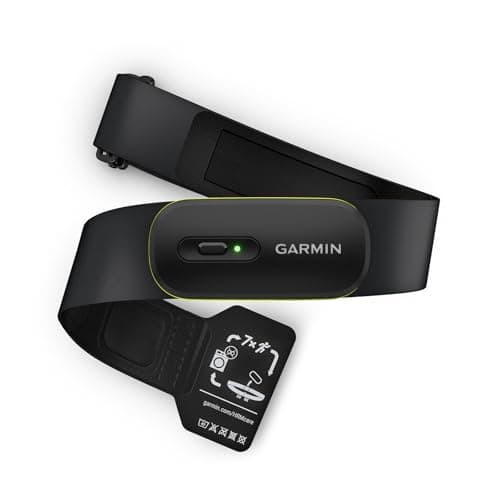
Top pick
Garmin owners wanting running dynamicsGarmin HRM 600
The strap to buy if you are already inside Garmin's ecosystem and want running dynamics with it.
$169.997% off
Price as of October 22, 2026. Prices move; Amazon's is the one that counts.
#ad · we may earn a commission from this link to Garmin HRM 600
The short answer
An electrical chest strap that adds running dynamics and stand-alone recording, rated by Garmin at up to 2 months of battery at 1 hour per day, with a 5 ATM water rating. It is the right buy if you are inside Garmin's ecosystem and want the extra metrics. It is not more accurate than a Polar H10, because nobody has published a measurement of it at all.
Ranked
Quick picks
| # | Device | Best for | Evidence | Score | Price |
|---|---|---|---|---|---|
| 01 | Garmin HRM 600 The strap to buy if you are already inside Garmin's ecosystem and want running dynamics with it. | Garmin owners wanting running dynamics | Manufacturer specification | 7.4/10 | $157.70Amazon |
#ad· Live prices from the Amazon Product API, as of October 22, 2026. Where we have no verified live price we show none. Scores come from the published rubric at How we rank — the Evidence column shows what each ranking actually rests on, including where the answer is nothing.
What Garmin publishes
From the HRM 600 owner's manual: a rechargeable lithium-ion battery rated up to 2 months at 1 hour per day, 5 ATM water rating, an operating range of 0 to 40 °C and a 2.4 GHz radio. Garmin describes the strap as providing real-time heart rate and HRV data, running dynamics, and stand-alone activity recording — that last one meaning it keeps recording when your watch is out of range and syncs afterwards.
What running dynamics actually are
Cadence, ground contact time, ground contact balance, vertical oscillation, vertical ratio and stride length. A watch cannot compute most of them, because it is on your wrist and they describe what your torso is doing. That is the honest reason this strap exists.
Whether you need them is a different question. They are consistent within a device, which makes them useful as trends — is my ground contact time falling as I get fitter? — and they have no published validation from any manufacturer that we could find, which makes absolute comparisons between people meaningless. Most runners look at them twice and never again; the ones who use them well use them as their own baseline.
The comparison that matters
| Garmin HRM 600 | Polar H10 | |
|---|---|---|
| Measurement | Electrical (ECG) | Electrical (ECG) |
| Battery | Rechargeable, up to 2 months at 1 h/day | Up to 400 h on a CR2025 coin cell |
| Water rating | 5 ATM | WR30 |
| On-board recording | Yes | Yes, one session up to 30 hours |
| Running dynamics | Yes | No |
| Independent validation | None we could find | Used as the reference standard in peer-reviewed studies |
That last row is the one that decides our ranking. The H10 is not merely validated; it is the instrument other devices are validated against, including in the 2025 placement study and the 536-night HRV comparison we cite across this site. The HRM 600 uses the same measurement principle, which is a good reason to expect it to be fine — but "right principle" and "measured accuracy" are different claims, and our rubric only credits the second.
Who should buy it
- Garmin owners who want running dynamics.This is the cleanest way to get them, and the metrics surface properly only inside Garmin's platform.
- People who resent coin cells. Rechargeable is genuinely more convenient — as long as you remember to charge it, which a 400-hour coin cell never asks of you.
- Anyone who just wants accurate heart rate. Buy the H10 and spend the difference on anything else.
The battery arithmetic, against a coin cell
Garmin's stated figure is up to 2 months at 1 hour of use per day — roughly 60 hours of recording between charges. A Polar H10 states up to 400 hours on a CR2025 that costs a couple of dollars, which is about a year at the same usage.
For most people that difference is not decisive; it is a monthly charging habit against an annual battery habit. It becomes decisive on a long trip without power, or if you are the sort of person whose devices are discovered flat at the start line. Rechargeable is tidier; coin cells are the ones that never ask anything of you.
The storage feature, and when it earns its place
Garmin describes the HRM 600 as capable of stand-alone activity recording — it keeps recording when the watch is out of range and syncs afterwards. That matters in three specific situations: pool swims, where 2.4 GHz radio does not travel through water; gym sessions where the watch is on a bench rather than your wrist; and any activity where you do not want a watch on at all.
It is a genuinely useful capability, and it is shared with the Polar H10, which also stores a session on board. Neither strap has published validation of the recorded values — the storage is a convenience feature, not an accuracy one.
The honest ranking argument
This strap scores 9 on hardware and 6 on evidence in our rubric. That gap is the whole review: electrical measurement through the chest is the correct physical principle, and nobody has published a measurement of this device doing it. The H10 scores higher because it is the instrument researchers reach for when they need something to measure everything else against — a status no marketing claim can substitute for.
In full
Every pick, and why
Garmin HRM 600
The strap to buy if you are already inside Garmin's ecosystem and want running dynamics with it.
- Sensor
- Electrical (ECG), chest strap
- Extras
- Running dynamics, HRV data, on-board storage
What's good
- Adds running dynamics that a watch alone cannot compute
- Stores data when out of watch range and syncs later
What isn't
- Costs meaningfully more than the Polar H10 without a published validation advantage
- Its extra metrics only fully surface inside Garmin's own platform
Skip this if
Skip this if you just want accurate heart rate. You would be paying a premium over the H10 for running-dynamics metrics most runners look at twice and never again.
What the evidence says
Manufacturer specificationGarmin publishes specifications but no validation study we could find. It is an electrical chest strap, which is the right physical principle — but 'right principle' is not the same as 'measured accuracy'.
Show how this 7.4 was calculated
| Factor | Weight | Score |
|---|---|---|
| EvidenceCorrect sensor principle, detailed published specs, no independent validation we could find. | 30% | 6.0 |
| HardwareElectrical ECG measurement with on-board storage. | 20% | 9.0 |
| Metric coverageHeart rate, HRV and the full running-dynamics set. | 20% | 8.5 |
| EnduranceGood stated endurance; rechargeable. | 15% | 8.0 |
| Cost per capabilityA clear premium over the H10 without a matching evidence advantage. | 15% | 6.0 |
$169.997% off
Price as of October 22, 2026. Prices move; Amazon's is the one that counts.
#ad · we may earn a commission from this link to Garmin HRM 600
Accessories
What keeps any electrical strap honest
Outside the rubric and deliberately so — these are maintenance items with no validation literature, listed because they fix the failures people blame on the sensor.
These are not ranked and they are not scored on the rubric — none of them has a validation study and none ever will. They are here because a manufacturer's own instructions say they change what your sensor records, and each one links the page that says it. How the actual ranking works.
Replacement chest-strap belt
A strap that has stretched, or whose electrodes have washed out.
Polar says it plainly on its own troubleshooting page: the chest strap "doesn't last forever; it wears out like any other garment you regularly wear and wash". The transmitter pod outlives the belt, and the belt is the cheap half. Polar support: unusual heart rate readings.
A third-party belt listed as fitting the Polar H7, H9 and H10 pods. Check the listing against your own sensor first — stud spacing differs between brands.
$12.99Check price on AmazonPrice as of October 22, 2026. Prices move; Amazon's is the one that counts.
#ad · we may earn a commission from this link to Replacement chest-strap belt
Conductive electrode gel
The spiky, nonsense heart rate over the first ten minutes of a run.
Polar's instruction is to "moisten the electrode area of the strap thoroughly under tap water before training". Gel is the same fix that does not evaporate in the first mile — which is precisely when the dropouts happen, because the strap has not warmed up and you have not started sweating yet. Polar support: unusual heart rate readings.
The linked tube is axion's 8.5 oz electrode gel, sold for TENS and EMS pads rather than for chest straps — the listing describes it as hypoallergenic, odorless and suitable for all types of self-adhesive electrodes. Nothing in this category is sold specifically for heart-rate straps, so check the ingredients if your skin reacts to anything.
$9.99Check price on AmazonPrice as of October 22, 2026. Prices move; Amazon's is the one that counts.
#ad · we may earn a commission from this link to Conductive electrode gel
Questions
Frequently asked
Is the Garmin HRM 600 more accurate than the Polar H10?
There is no published evidence that it is. Both use electrical measurement, which is the right principle, but the H10 is the sensor used as ground truth in the studies we cite and the HRM 600 has no independent validation we could find. On our evidence hierarchy that gap is decisive.
How long does the HRM 600 battery last?
Garmin states up to 2 months at 1 hour of use per day, from a rechargeable lithium-ion battery. A coin-cell strap such as the H10 states up to 400 hours, which is roughly a year at the same usage — the trade is convenience against never thinking about it.
Do I need running dynamics?
Only if you will use them as your own baseline over time. No manufacturer's running-dynamics figures have been independently validated that we could find, so comparing your ground contact time to someone else's means nothing. Comparing it to your own, month over month, is useful.
Does it work with non-Garmin devices?
It broadcasts heart rate the way any modern strap does, but the running-dynamics metrics only fully surface inside Garmin's own platform. If you are not on Garmin, you are paying for features you cannot see — see our compatibility guide before buying.
Show your working
Sources
Every one of these was read in full before it was cited. Where we could not access a paper, we do not quote its numbers.
- [1]Manufacturer specification2026Garmin — HRM 600 owner’s manual, specifications
Manufacturer-stated, read 2026-08-18: rechargeable lithium-ion battery rated up to 2 months at 1 hour per day, 5 ATM water rating, operating range 0 to 40 °C, charging range 15 to 42 °C, 2.4 GHz radio at 9.9 dBm maximum. Garmin describes the strap as providing real-time heart rate and HRV data, running dynamics and stand-alone activity recording.
- [2]Manufacturer specification2026Polar — H10 heart rate sensor published specifications
Manufacturer-stated: electrical (ECG) measurement, Bluetooth LE + ANT+, internal memory for one session up to 30 hours, up to 400 h on a CR2025 coin cell, WR30.
- [3]Peer-reviewed validation2025“Impact of Anatomical Placement on the Accuracy of Wearable Heart Rate Monitors During Rest and Various Exercise Intensities”, Sensors (Basel)
n = 28 (14 male, 14 female). Polar H10 chest strap as the reference. Compared Polar Verity Sense (forearm), Garmin Forerunner 55 (wrist) and three simultaneous Whoop 4.0 units at wrist, forearm and upper arm, across rest, cycling warm-up, burpees and a modified Bruce treadmill protocol.
Read next
Related
- Best chest strap monitors
Where this strap ranks against the field.
- Polar H10 review
The reference sensor, and what that status is worth.
- Wahoo TRACKR review
The other rechargeable electrical strap, priced against both.
- Best heart rate monitors for Garmin
Where this strap lands against the field a Garmin owner can actually pair.
- Heart rate accuracy by device
Every published measurement, and every device with none.